Caseflow: Motion to Vacate | Litigation Support | Post-Decisional Motions to Vacate
Current Status: Phase 3 - In Progress
Background
Lit Support encompasses customer service, correspondence, motions, and receiving and routing CAVC remands at the Board. I call them the department of edge cases, because they often handle complex appeals scenarios.
BVA Litigation Support Responsibilities
- Customer service = answering Veteran questions, like status inquiries
- Correspondence = sending correspondence to Veterans and other audiences that require attorneys to write (this is distinct from mail correspondence that other admin teams send, like hearing clarification letters). A key example of this is answering congressional inquiries.
- Motions = there are three major types of post-decisional motions that this team handles: Motion for Reconsideration, Motion to Vacate, and Clear and Unmistakeable Error. There are also pre-decisional motions and AOD motions.
- CAVC remands = when a Veteran appeals to CAVC, and CAVC sends the case back to the Board for development
Note: We first focused on Congressional Inquiries for Lit Support because the Chairman and LRP prioritized it higher than other Lit Support activities.
Goals
- Validate and document existing Litigation Support flows that Caseflow has to support; understanding them specifically for AMA first
- Utilize generic/repeatable queue and task functionality for as many flows as possible, especially post-decisional motions
- Understand appeals edge cases as they come up so we can adapt and change priorities as needed
Assumptions
- Lit support flows can successfully utilize generic/repeatable queue and task functionality
- CAVC remands and post-decisional motions are unlikely to occur for at least months after Feb 14
Designs
Scope
- Lit Support folks can create and view motion for recon and motion to vacate tasks
- They can place them on hold while they wait for the Veteran's response to the 14-day letter
- They can create a parallel task for Pulac-Cerullo if relevant and send
Out of Scope
- If the Motions Attorney who was working the case no longer works at BVA or in Lit Support, the case returns to the team queue for re-assignment. #12523 Out of Scope - Part of Upcoming Echo Work
- If the Judge who was working the case no longer works at BVA or in Lit Support, the case returns to the Judge team queue for re-assignment #12523 Out of Scope - Part of Upcoming Echo Work
Requirements/Stories
Phase 1 | Support Baseline Motion to Vacate Task Creation and Functionality
Note: Items in _italic_ without a linked ticket or ticket placeholder do not require development work i.e. the functionality exists for these users in Caseflow today.
Stories
Litigation Support Team Member/Lead
- _As a Team Lead (Litigation Support), I need to see all of the incoming motions mail (or, motions tasks) in the Lit Support team queue so that I can distribute them to different Motions Attorneys on the team._✅
_As a Team Lead (Litigation Support), I can add any Caseflow user with CSEM access to the Lit Support team queue_ ✅ - _As a Motions Attorney, I need to see motions tasks that my Team Lead assigns to me in my queue so that I can review the cases and work them accordingly._ ✅
- _As a Motions Attorney, I need to view the "original" case and the Veteran's e-folder so that I can determine whether or not the mail task that was assigned to me is the correct motion, a different motion, or not a motion at all. _✅
- As a Litigation Support team member or Lead, I need the ability to create a post-decisional motion task (root task) from a Veteran's Case Details page in the event that a motion comes through channels other than the mail portal. #13351 Workaround being used: Lit support users are also added to Mail team for access to 'Add New Task' function.
- _As a Motions Attorney, I have access to view documents in Reader_ ✅
- _As a Motions Attorney, I need to put a case on hold for 20 days when I draft a "14-day letter" so that the Veteran has time to submit additional documentation (Dependency: https://github.com/department-of-veterans-affairs/caseflow/issues/9207)_ ✅
- _As a Motions Attorney, I need the ability to correct the "task type" that the mail team determined so that the names of my motions tasks are accurate and work is tracked accurately in case timeline. #11721_✅
- _As a Motions Attorney, I need to assign a case to "Pulac-Cerullo" team if the Veteran also filed a CAVC appeal so that they can make a determination about who has jurisdiction on the case. (Dependency: #10323 )_✅
Pulac-Cerullo (OGC/CAVC Liaison) Team
- _AC | A new task type is created - "Notify OGC of Pulac-Cerullo"_ ✅
- _"Notify OGC of Pulac-Cerullo" is an action available to Motions Attorneys in the actions drop-down on the Case Details page_ ✅
- _BVA Leadership can designate the Lead for the "Pulac-Cerullo" team._ ✅
- _As a Team Lead (Pulac-Cerullo), I need to see all of the Pulac-Cerullo tasks tied to "Notify OGC of Pulac-Cerullo" in the team queue_✅
- _As a Team Member (Pulac-Cerullo), I need to see all of the Pulac-Cerullo tasks tied to "Notify OGC of Pulac-Cerullo" in the team queue_✅
- _As a Team Lead (Pulac-Cerullo), I can add any Caseflow user with CSEM access to the Pulac-Cerullo team queue_ ✅
- _As a Liaison between OGC/CAVC, I need to put a case on hold for 14 days if I determine that CAVC has jurisdiction over a case so that BVA employees don't work the case._ ✅
- _AC | User who is working the "Notify OGC of Pulac-Cerullo" task has the "Place hold" action available in the Actions dropdown on the case._ ✅
- _As a liaison between OGC/CAVC, I need to be able to end the hold on a case when BVA gets jurisdiction back so that a Motions Attorney can work the case._
- _AC| User who is working the "Notify OGC of Pulac-Cerullo" task has the "Mark as complete" action available in the Actions dropdown on the case._ ✅
- _AC | When the user selects "Mark as complete", the case is assigned back to the original Motions Attorney who was working the case._ ✅
- _When OGC/CAVC doesn't get back to Lit Support in time, they need to place the task on hold a second time, so everyone knows they cannot work on the case. (This is possible because of the work around individual queue folks being able to place task on hold #9207_ ✅
11683 Motion to Vacate | Designs
11566 Motion to Vacate | Create a Queue task tree for Lit Support Motion to Vacate decisions
12283 Motion to Vacate | Create a motion to vacate task from case details
11252 Motion to Vacate | Allow motions attorneys to assign Motion to Vacate tasks to judges
10325 Motion to Vacate | Allow judges to log motion to vacate decisions
11256 Motion to Vacate | Litigation Support | Pulac-Cerullo reminders
12412 Motion to Vacate | Do not show actions for MTV Judge tasks on_hold
12691 Motion to Vacate | Fix action permissions for MTV tasks
13003 Motions to Vacate | Testing Review | Engineering Corrections Required Post-UAT
Phase 2 | Support Motion to Vacate decisions - denied, dismissed
Scope
- Motions attorneys and judges can work and decide Motions to Vacate
- Caseflow logs Motion to Vacate dispositions
Stories
- As a Lit Support team member, I need to see that a case is in "Post-decision motion" status when I search a case or click the "View all cases" button in Case Details. ✅
- As a Lit Support team member (commonly Motions Attorney, but keeping Lit Support team member to encompass other Lit Support roles we might not know about yet), I need to be able to assign a task to the judge who will decide the Motion to Vacate decision. (https://github.com/department-of-veterans-affairs/caseflow/issues/11252)
- As a Judge, I want Address Motion to Vacate tasks to appear in my Review queue.
- Judges can log their Motion to Vacate decisions/dispositions (grant, deny, or dismiss) in Caseflow so that they have it on record. (#10325) ✅
- As a judge, when I deny or dismiss a motion to vacate, the original task for that motion will be completed and assigned back to the prior motions attorney, so that the Motions attorney can dispatch the denial or dismissal.
- As a motions attorney, I want the ability to close a review motion to vacate (denial or dismissal) task, so that a letter can be dispatched and sent to the veteran.
- As Judge, I want to deny or dismiss a Motion to Vacate, but I don't have the appropriate and/or correct ruling letter to sign, so I want to return my task to the motions attorney to draft the appropriate letter.
Phase 3 | Support Motion to Vacate decisions - granted
Scope
- Motions attorneys, judges, and decision-drafting attorneys can work and decide Motions to Vacate
- Caseflow logs Motion to Vacate dispositions and decisions on new vacated request issues
Stories
- As a Judge who just granted a motion to vacate, I want to create new tasks and assign them to a decision-drafting attorney; this includes Straight Vacate and Readjudication, so that the attorney can add decision to my vacated request issues.(https://github.com/department-of-veterans-affairs/caseflow/issues/11253)
- As a Judge who just granted a motion to vacate, I want to create new tasks and assign them to a decision-drafting attorney; this includes Vacate and De Novo motions to vacate, so that the attorney can add decision to my vacated request issues. (https://github.com/department-of-veterans-affairs/caseflow/issues/XXX)
- After a decision drafting attorney has selected a task on their assigned motion to vacate case, they want to review the vacated issues in question. (Task structure built in: https://github.com/department-of-veterans-affairs/caseflow/issues/13006; UI work to be completed in: https://app.zenhub.com/workspaces/caseflow-5915dd178f67e20b5553ba0c/issues/department-of-veterans-affairs/caseflow/13007)
- When judges grant a motion to vacate and assign tasks - either Straight Vacate and Readjudication or Vacate and De Novo - to a decision drafting attorney, all decision issues from the previous decision become request issues for the decision drafting attorney to decide again.
- This follows the EP 930 pattern.
- Decision-drafting attorneys can remove or add issues, via the Correct issues flow, to reflect which vacated issues are being decided again.
- After decision-drafting attorneys write the
Straight Vacate and Readjudicationdecision, they can go through the typical attorney checkout flow to record their new decision (i.e. new issue dispositions). These new issue dispositions don't overwrite the previous decision, they are in addition to them, and need to be distinguished. (https://github.com/department-of-veterans-affairs/caseflow/issues/11254) - As a decision-drafting attorney receive a
Vacate and De Novotask, I want to assign the appropriate admin action, so that the first (of two) letters can be drafted and sent to the veteran, and the appropriate steps can be taken in the following scenarios:
- FOIA request: put task on hold automatically for 10 business days (minimum; configurable to extend duration, if required)
- Missed hearing: task is sent to hearings team to work accordingly
- Hearing extension: assign task to hearings team immediately so they can schedule hearing, as necessary
- Extension: to allow more time to submit additional evidence (e.g. duration is configurable by whomever owns the task; minimally assumes Lit Support and hearings team attorneys can access this screen)
AC: Attorneys go through the typical attorney checkout flow to record their new decision (i.e. new issue dispositions). These new issue dispositions don't overwrite the previous decision, they are in addition to them, and need to be distinguished.
- When decision drafting attorneys check out either the
Straight Vacate and ReadjudicationorVacate and De Novodecisions to judges, they appear in judgesReview casesqueue. - Judges can check out
Straight Vacate and ReadjudicationorVacate and De Novodecisions. to be dispatched by BVA dispatch. (https://github.com/department-of-veterans-affairs/caseflow/issues/11255) Need to confirm who does this: Judges or the Drafting Decisions Attorney. - BVA dispatch users can use the same dispatch process to outcode and dispatch decisions that result from a granted motion to vacate.
- Caseflow users are reminded to check for "Pulac-Cerullo" if a case is within 120 days from its decision date.
Open Technical Questions re: granted motions to vacate
- Q: When a judge issues a new decision based on a motion, we will need to outcode. Need to understand how this happens in VACOLS today so that we can outcode in Caseflow.
- Q: Do motions documents have document IDs? How is this document ID tracked? Does it need to be?
- Q: Are there any implications to having more than one document ID?
- Q: What is the difference between
Straight Vacate and ReadjudicationandVacate and De Novodecisions? - Q: Do we need to create an EP for new decisions that result from granted motions to vacate?
Motion Types
(LP updated this list 3/17)
In order of priority:
- Motion for Reconsideration (Recons)
- Motion to Vacate / Vacatur
- Clear and Unmistakeable Error
- Corrected Order
- Recusal
- Motion to Withdraw Representation
- Subpoena
- Equitable release
Key contacts and Resources
- Josh Freeman
- Nina DiPadova
- Martina Mills (newer to the org)
- Theo Casey (outgoing)
- Queue discovery materials:
- Usability testing synthesis: Search "Lit Support Usability Testing Synthesis" in Mural.
- Usability testing flow: Motions Attorney Note: See user stories and AC for up-to-date task and action names
- Lit support mural from queue discovery in 2017
- Notes from discussion with Josh Freeman
- Notes from discussion with Nina DiPadova - focusing on CAVC remands
- Notes from discussion with Samuel
- Notes from discussion with Theo Casey
- Notes from Lit Support workshop with Kate and Nina
- Mail mural (head to mural and search for
Epic: Mail) - See section to the right with complex mail and lit support scenarios
Out of scope for this epic
Backlog of additional Lit Support team feature requests
- As a Lit Support team member and BVA employee, I need to see "holds" in a Veteran's case timeline along with notes for that hold so that it's clear, in retrospect, why a case was not being worked. (Dependency: #9382 )
- As a Lit Support Team Lead, I need a permissioned view of the Lit Support team queue so that select people have access. (Dependency: Ticket TBD)
- Acceptance criteria:
- Nina, Kate, and Chris are a team of "team leads" and can only see the team queue.
- Acceptance criteria:
- As a Team Lead, I need the ability to filter by task type and bulk assign tasks to team members so that I can distribute multiple similar tasks to one team member. (Dependency: #9620)
- As a Team Lead, I need to see the BVA received date in my queue table so that I can assign and distribute the oldest tasks first (how Lit Support does their work). (Dependency: #10288)
- As a Motions Attorney working a specific case, I need all motions mail or correspondence for that case to come directly to me (i.e., automatically appear in my queue) so that my Team Lead doesn't need to route it to me.
- Note: More research needed since this might involve a business process change.
- As a Liaison between OGC/CAVC, I need to put a case on hold for 14 days if I determine that CAVC has jurisdiction over a case so that BVA employees don't work the case.
- Acceptance criteria:
- Option to put case on hold for 14 days appears in the hold time drop-down
- Note: This is a "nice to have" since they can currently use the
Customoption in the hold time drop-down.
- Acceptance criteria:
- As a Motions Attorney, I need the ability to send a motion decision draft to my Team Lead for review so that I can understand if I need to make any edits.
- Note: This is a "nice to have" because when testing with Nina, she said she didn't need it.
- As a Motions Attorney, I need the ability to view and receive comments about my motions draft from my Team Lead (in the task instructions) so that I can make the suggested edits.
- Note: This is also a "nice to have" because when testing with Nina, she said she didn't need it.
 laurjpeterson
All 36 comments
See mapping of current state and WIP proposed task flows for Motions for Reconsideration in this Mural. Other Lit Support Motion types in this Mural
Some ideas raised:
- Need change task type - how should this be done? children or renamed
- Need new tasks:
- Motion mail types (Recon, Vacate, CUE)
- Lit Support attorney motion tasks
- New Judge Review tasks and how
- Lit Support dispatch tasks?
- OGC is the conduit btw BVA and CAVC. what if they had a queue.
- Do issues change with motion determinations?
- Lit Support needs a checkout flow - grant, dismiss, deny
Other questions:
- How do Lit Support folks generate letters. Are they all from Shared drive? Is that ok?
- Do Lit Support folks upload their letters to VBMS and mail them? Assuming yes.
laurjpeterson
on 17 Mar 2019

Sketch from a design chat that @sneha-pai and I had. Outlines assumptions, questions, and the beginning of a flow for Motions Attorneys. All of this is reflected in the stories/AC above.
Discussion around creating a new motions record for post-decisional motions is in this ticket: https://github.com/department-of-veterans-affairs/caseflow/issues/9993
 allyceh
on 21 Mar 2019
allyceh
on 21 Mar 2019
I have 2 main questions coming out of this morning's meeting that we will need clarification from lit support on:
- How do appeals that will be reconsidered currently get distributed to judges/attorneys?
A: TBD - Do motions apply to decisions or request issues?
- If motions apply to decisions can a motion apply to a decision for a request issue if a previous motion has resulted in another decision for that same request issue? That is, using the table below, if a new motion is received, can it apply to decision B and not decision D, or D but not B? Or does the motion apply to all decisions for a single request issue?
. | Timeline of an Appeal Issue
--- | ---
A | Initial request
B | Decision on request issue
C | Request for reconsideration
D | Decision on issue after reconsideration
A: Motions only apply to Board Decisions
 lowellrex
on 27 Mar 2019
lowellrex
on 27 Mar 2019
Notes from Allyce & Marvo conversation with Kate (Lit Support) 04/01/2019
What we learned:
- A motion cannot be filed on the ruling from a motion, see answer to question 2. posed above.
- CUEs have a new docket number
- All other post-decisional motions do not have a new docket number
- Reasons for opening new records in VACOLS:
- New motion record can be limited to only adjudicating one issue (or, issue that the motion is filed for). The "original" record is preserved + contains information about other BVA decisions.
- Seeing procedural history for each appeal stream is helpful.
- Motions for Reconsideration cannot be appealed to CAVC.
- When appellants file multiple motions on the same BVA decision, BVA has to respond to all of them (Ex: Case that Nina was explaining where one person files a motion every week). Motion decisions must encompass all motions filed b/f the date the motion decision is issued. Important to know when a decision was issued and what mail items (i.e., motions) it encompasses.
Questions for ENG
- Could we have multiple "appeal streams" with the same docket number?
- CAVC and AOD both show up as different
Types:
- is AOD Type a flag in the background?
- is CAVC Type in fact a different appeal stream?
- do CAVC cases have the same appeal_id (or whatever the number is) as the original appeal?
- How are Motion for Recon and Motion to Vacate cases redistributed to judges? They have the same docket number as the original appeal stream.
 marvokdolor-gov
on 1 Apr 2019
marvokdolor-gov
on 1 Apr 2019
Questions
- A motion cannot be filed on the ruling from a motion, see answer to question 2. posed above.
Does that mean that if a motion for reconsideration (for example) is granted, the decision of that readjudication cannot be appealed?
AH ANSWER: This is correct. They can't appeal the motion decision. But, they could always keep filing a motion on the original BVA decision if the motion was denied and if they wanted to.
- How are Motion for Recon and Motion to Vacate cases redistributed to judges? They have the same docket number as the original appeal stream.
How do judges know they have more work to do for those appeals in VACOLS? Do they just pop back up in some report they run to see what work they have to do?
Answers
- Could we have multiple "appeal streams" with the same docket number?
Yes.
- is AOD Type a flag in the background?
No. We determine whether a case is AOD based on whether the appellant is 75 or if an AOD motion was submitted for the appellant after the appeal was created.
- is CAVC Type in fact a different appeal stream?
No, but it could be. We have not yet implemented any CAVC functionality for AMA appeals yet.
lowellrex
on 2 Apr 2019
@lowellrex Answer to one of your questions in-line above.
allyceh
on 2 Apr 2019
Recapping the options we have, from my understanding:
1) Keep everything in one appeal. When a motion is filed, any work on that motion will be done in the original appeal. When a judge needs to issue a new decision for a motion to vacate or motion for reconsideration, they will do this from the original appeal. Only CUE cases that require review by a judge will be a new appeal stream in VACOLS because they have a separate docket number.
2) Create a new appeal stream whenever BVA is working a motion. The original appeal will be "preserved" and Motions Attorneys will have a "fresh" case where they can work tasks and add motion decisions to the issues on the case. When motions require a new decision by a judge, we distribute the new motions record for review.
Am I missing anything from either of these options @marvokdolor-gov @lowellrex ?
allyceh
on 2 Apr 2019
@allyceh Does 1. involve a bunch of motion tasks? And only CUEs result in a new appeal stream and docket number?
Whereas 2. involves new appeal streams for each motion that all have the same docket number as the original appeal? (Same thing goes for CUEs above - new appeal stream and docket number).
And @lowellrex which one is the more sensible engineering approach?
marvokdolor-gov
on 2 Apr 2019
@marvokdolor-gov That is absolutely correct!
allyceh
on 2 Apr 2019
I think the approach that maps best to the actual process would be to keep everything in the same appeal and only create a new appeal (with a new docket number) for CUEs. I don't know how feasible this is in terms of creating new decisions and EPs though so maybe that doesn't work from an engineering standpoint. I'll defer to @aroltsch on the decision issue/EP creation question.
lowellrex
on 2 Apr 2019
I think creating a new appeal will work fine with decision issues and EP creation. An EP is associated with a veteran file number in VBMS. @pkarman might have a better insight into the EP creation.
 aroltsch
on 2 Apr 2019
aroltsch
on 2 Apr 2019
Do we need to create an EP for issues on the motion when they are intaken?
AFAIK we don't create EPs for Appeal request issues currently. Or are we using the word "appeal" here more generally to refer any of the 3 flavors of decision review?
 pkarman
on 2 Apr 2019
pkarman
on 2 Apr 2019
I think the approach that maps best to the actual process would be to keep everything in the same appeal and only create a new appeal (with a new docket number) for CUEs.
I agree with this!
As for decision issues and EP creation, I think we'd need to determine:
- How do we track the motion decision (i.e. to grant or deny the motion - EXCLUDING the update to the decision issues that were on appeal) ? Is it on the motion tasks?
- If the motion leads to another decision:
- Can decision issues be overwritten? Or, do we need to keep record of the former decision issues (that were vacated, reconsidered, etc.)?
laurjpeterson
on 3 Apr 2019
I am going to move forward assuming we're keeping everything in the same appeal and only creating a new appeal (with a new docket number) for CUEs-- as outlined above. Design will be based on this approach.
allyceh
on 3 Apr 2019
On Lauren's questions:
1.
How do we track the motion decision (i.e. to grant or deny the motion - EXCLUDING the update to the decision issues that were on appeal) ? Is it on the motion tasks?
@lowellrex is this a question for you?
2.
If the motion leads to another decision:
Can decision issues be overwritten? Or, do we need to keep record of the former decision issues (that were vacated, reconsidered, etc.)?
I think the new decision would be on a new appeal (with a new docket number)?
- Either way, I'm thinking we would definitely want to have a record of past decision issues and all actions taken on them.
marvokdolor-gov
on 3 Apr 2019
How do we track the motion decision (i.e. to grant or deny the motion - EXCLUDING the update to the decision issues that were on appeal) ? Is it on the motion tasks?
@marvokdolor-gov @laurjpeterson @lowellrex Since multiple motions can be filed, I feel that it makes the most sense to track them on the task (or, as the user would see it, displayed on case timeline) (from a design perspective). @lowellrex , curious to get your eng input there.
allyceh
on 3 Apr 2019
Since multiple motions can be filed, I feel that it makes the most sense to track them on the task (or, as the user would see it, displayed on case timeline) (from a design perspective).
Agreed. I think we may need to create some data in addition to the task to record information specific to motion workflows. I imagine we could replicate the pattern we use for attorney_case_reviews and judge_case_reviews (among others) where we use the task as a jumping-off point for a more situation-specific workflow.
lowellrex
on 3 Apr 2019
Update for @sneha-pai : Marvo and I went through these stories this afternoon and there were a few adjustments. The plan for next week is to have the kickoff and for me to wrangle the mocks to support what we need for phase 1!
allyceh
on 4 Apr 2019
Agree with your scope for MVP - thank you!
laurjpeterson
on 8 Apr 2019
Open questions:
- how are motions to vacate or motions to reconsider sent to judge/attorneys/senior counsel
- stories for adding new decision issues and such to get feedback from engineers
laurjpeterson
on 15 Apr 2019
I have answers to the questions above from our documentation. This is taken from the Lit Support process flow in our Mural (Mural title is: Lit Support: Motions for Reconsideration).
how are motions to vacate or motions to reconsider sent to judge/attorneys/senior counsel
- Depending on the decision, the motions attorney would dispatch/outcode in different ways
- Grant: they don't outcode in VACOLS. It goes into abeyance for 60 days, and status of the record is changed to "Active". Veteran gets a window of time to respond (and submit evidence and argument). TBD how AMA would affect this.
- Once the 60 day diary expires, route brief face to DVC to set up the judge panel.
An attorney is assigned to draft the case - A 3 new judge panel has to review the case and sign newly drafted decision
- New hearings are not offered at this stage. It can't be entirely new judges if there was a hearing. if AMA, and direct docket, no evidence, express lane. allow arguments to come in but no new evidence.
- Decision letter is mailed and outcoded
- _Note (Marvo)_: In practice, when they realize they're going to grant a motion, they vacate the previous Board decision and have the judge/attorney issue a new decision.
- Deny: they have to outcode it in VACOLS (specific to motions for reconsideration). Coded as either a Dismissal and Denial. VACOLS steps are Processes> recon motion > outcode recon denial.
allyceh
on 16 Apr 2019
Met with a Motions Attorney today to get her reaction to our proposed MVP and ask her some questions about outcoding motions.
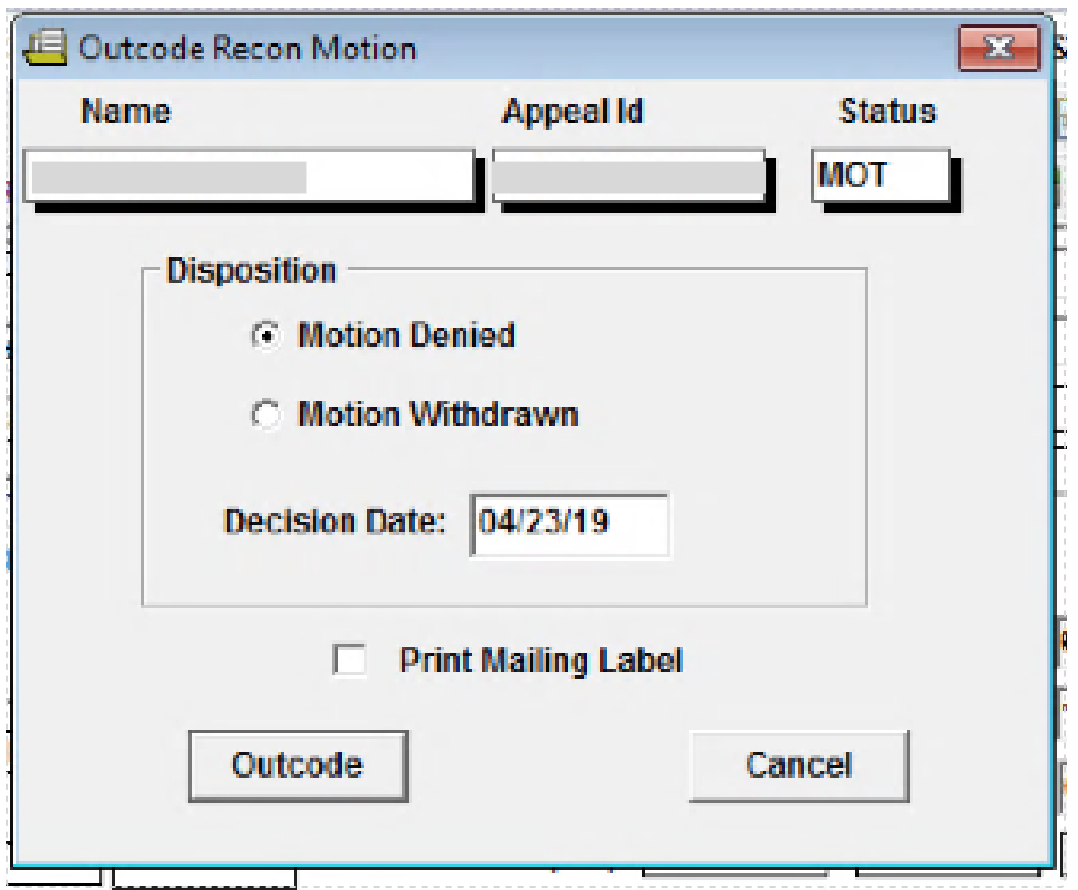
Outcoding notes:
- Motion dismissals and denials are outcoded in VACOLS, but the Motions Attorney didn't know where this data was stored. Or, who it was "outcoded" to or who used this information. She also couldn't say why they outcoded. It seemed like it was just part of their process.
- @monfresh @aroltsch @youngfreezy As part of our discovery and understanding future "outcoding" requirements (and who knows, maybe we don't need to support this...), I feel like we need a better understanding of what outcoding does. Can someone take a look at the code in VACOLS if this would help us?
- The way that motion denials and dismissals are outcoded in VACOLS is: Click Processes menu item in VACOLS> Click Recon Motion > Outcode recon denial.
Main questions:
- Who do motions go to after they are outcoded, if anyone?
- What is this data used for? (Note: Marvo mentioned that it might be used for reporting purposes only)
- What do we need to replace the outcoding process with in Caseflow? If anything at all...
allyceh
on 16 Apr 2019
Answers from Josh to the motions outcoding questions posed above:
Who do motions go to after they are outcoded, if anyone?
The motions work item is completed by outcoding - they are not assigned to anyone else.
What is this data used for?
It's needed for workload monitoring and System of Record purposes.
What do we need to replace the outcoding process with in Caseflow? If anything at all...
He referred us to Lit Support leadership on this one, so TBD.
marvokdolor-gov
on 24 Apr 2019
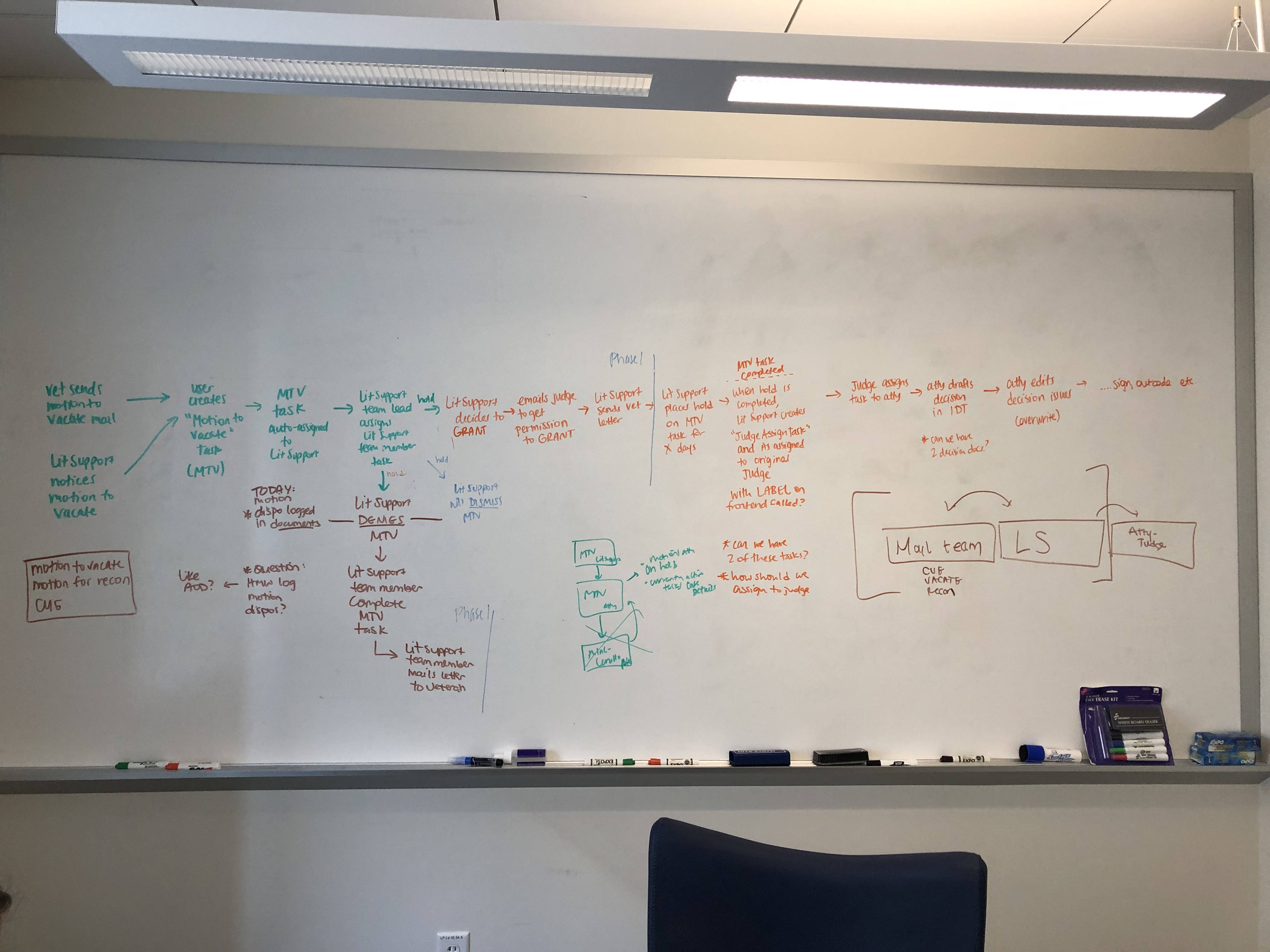
Discussion about judges/attorneys working motion to vacate.
allyceh
on 24 Apr 2019
If we go the "overwrite" route (aka, judges editing or overwriting BVA decision issues when they want to vacate all or part of a decision), here is a prototype I put together yesterday to represent that flow: https://va-gov.invisionapp.com/share/63RPUKL28UP
It leverages existing designs we have for AMA issues.
allyceh
on 25 Apr 2019
Notes about CUE:
As discussed, here is a c number for a CUE decision that may/not assist in determining EPs/notification to the ROs/tracking until final for section five. Notably, I knew of a grant to-be-issued in Hopes, but that hasn’t been completely dispatched just yet. I don’t readily have another that reflects CUE grant readily available.
Kristy, I’m looping you in because Nina and I were a little confused as to the CUE docket. While they are separately docketed, are they being pulled in accordance with the general workable docket for legacy (7/18), or are they being pulled/assigned based on the CUE workable docket?
Example case: https://appeals.cf.ds.va.gov/queue/appeals/3949793
Generally, all AODs and Court remands for Board CUE are pulled first. There really are not that many Board CUE motions that are granted AOD or are returned from the Court.
“Regular” Board CUE Motions (i.e., those that are not AOD or Court remand) are assigned a docket number in accordance to when the Motion was filed. You can see some samples below from my VACOLS programming. While a non-Board CUE case is assigned a docket date based upon the Form 9 date, that is not applicable for Board CUE motions as they are post-decisional motions for which the Board has original jurisdiction. I have being pulling them up in docket date order based on the programming. I am not even sure the Board’s docket date restrictions apply to Board CUE motions given that they are post-decisional motions. Regardless, the Board CUE motions that I am assigning through SCT are still within the Board’s overall docket date.
laurjpeterson
on 24 May 2019
Motion to Vacate flow storming
@sneha-pai
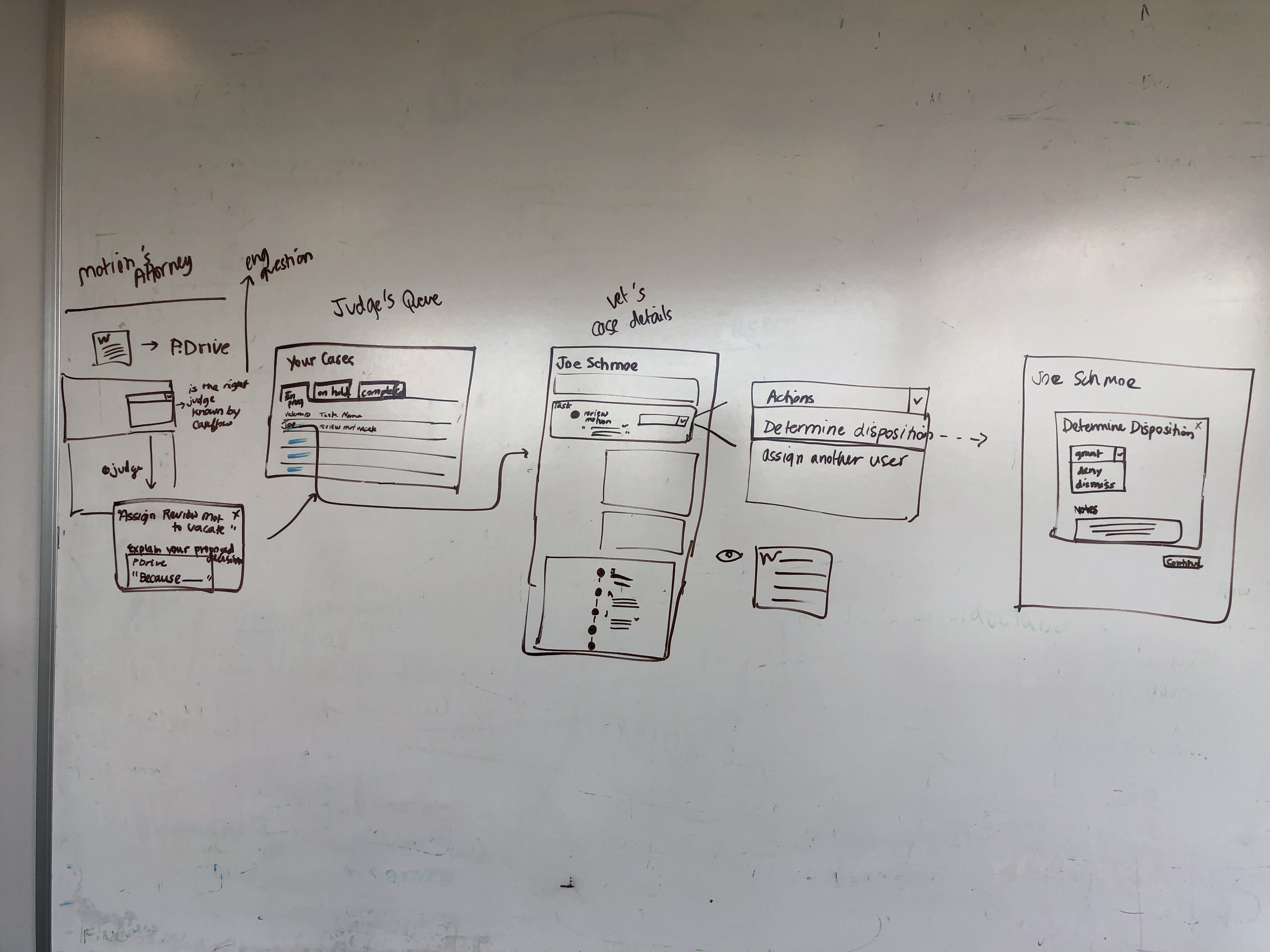
 geronimoramos
on 18 Jun 2019
geronimoramos
on 18 Jun 2019
Motion to Vacate Status
As of 4/1/2020
Completed
Overall Workflow
11683 Motion to Vacate | Designs
13319 Motion to Vacate | Create Progress Bar for MTV Workflows
11566 Motion to Vacate | Create a Queue task tree for Lit Support Motion to Vacate decisions
12283 Motion to Vacate | Create a motion to vacate task from case details
11252 Motion to Vacate | Allow motions attorneys to assign Motion to Vacate tasks to judges
10323 Motion to Vacate | Lit Support Queue: Create "Notify OGC of Pulac-Cerullo" task
10325 Motion to Vacate | Allow judges to log motion to vacate decisions
11256 Motion to Vacate | Litigation Support | Pulac-Cerullo reminders
11721 Motion to Vacate | Motions attorney relabels type of motion | Change Task Type
12412 Motion to Vacate | Do not show actions for MTV Judge tasks on_hold
12691 Motion to Vacate | Fix action permissions for MTV tasks
13003 Motions to Vacate | Testing Review | Engineering Corrections Required Post-UAT
13318 Motion to Vacate | Set Up Container Component for MTV Workflow
13073 Motion to Vacate | Success banner after AddressMotionToVacate task is submitted
13228 Motion to Vacate | Replace URL for draft decision with email instructions
Denied/Dismiss Workflow
12518 Motion to Vacate | Denied Dismiss | Attorney completes Deny or Dismiss motion to vacate
12525 Motion to Vacate | Denied Dismiss | Return to Lit Support when missing draft
12517 Motion to Vacate | Denied Dismiss | Attorney gets assigned Deny or Dismiss MotionToVacateTask
11739 Motion to Vacate | Denied Dismiss | Connect frontend and backend for judges to log motions to vacate decisions
12286 Motion to Vacate | Denied Dismiss | Automatically reassign Motions to Vacate tasks back to motions attorneys when denied or withdrawn/dismissed
12296 Motion to Vacate | Denied Dismiss | Allow attorneys to close denied and dismissed/withdrawn MTV tasks
Granted Workflow
12318 Motion to Vacate | Granted | Add option for partial grant and select issues
12370 Motion to Vacate | Granted | Save partial grant to database with selected issues
12373 Motion to Vacate | Granted | Create request issues for vacated decisions
13071 Motion to Vacate | Granted | Readjudicate | Decision Attorney | Go to Add Decisions screen
12793 Motion to Vacate | Granted | add Straight Vacate option to flow
12954 Motion to Vacate | Granted | Create vacated decision issues
11253 Motion to Vacate | Granted | Allow judges to assign motion to vacate tasks to decision-drafting attorneys
12270 Motion to Vacate | Granted | After a VLJ signs a granted motion to vacate, send to BVA dispatch
13006 Motion to Vacate | Granted | Review vacated decision issues action
13072 Motion to Vacate | Granted | Prepopulated new request issues for straight vacate and readjudicate
13007 Motion to Vacate | Granted | Update attorney review screen
13069 Motion to Vacate | Granted | Add vacated decision issues to new appeal stream
13211 Motion to Vacate | Granted | Support multiple AMA appeal streams | May Require Additional GH PRs/Tickets w/ Complexity
13222 Motion to Vacate | Granted | After AddressMotionToVacate, create appeal stream if granted
 msj0nes
on 5 Feb 2020
msj0nes
on 5 Feb 2020
Training Documentation
- [ ] Motion to Vacate - Denied / Dismissed
- [ ] Motion to Vacate - Granted
msj0nes
on 7 Feb 2020
Current Status:
Internal testing for the all workflows developed has started with an end date 3/13/20.
_Next_: Final fixes associated with internal testing, UAT and stakeholder demo.
msj0nes
on 5 Mar 2020
Post BVA Feedback Session
SME Demo 4/1/20 and 4/6/20
Feedback Received + New Engineering/Design Tickets Related
Overall
- Motion to Vacate | Include draft hyperlink for all vacate types #13861 (HOLD)
- Motion to Vacate | Update Return to Motions Attorney #13862
- Motion to Vacate | Allow partial grant option for Motions Attorneys #13864
- Motion to Vacate | Fix Link to Chairman Memorandum and all assets #13611 BVA Cancelled
- Motion to Vacate | Update CAVC Conflict banner copy with BVA recommendation #13960 (HOLD)
- Motion to Vacate | Change or update name of Pulac Cerullo team #13961
- Motion to Vacate | Admin Actions in De Novo flow #13918
- Motion to Vacate | Add Pulac-Cerullo task action to Judge Task #13920
- Motion to Vacate | Do not create De Novo stream without completed judge and attorney tasks #13623
Granted Flow
- Motion to Vacate | Add admin action to attorney flow
- Review De Novo workflow . Docket type should change to De Novo with dispatch of case (_Sally_)
- Change verbiage for URL for VLJS (deny and dismiss) to "Insert hyperlink to signed denial ruling letter" and "Insert hyperlink to signed dismissal ruling letter" (right now it says draft) - add to existing tickets
- fix "partially_grant" in the instructions section (remove underscore) - add to existing tickets
- When judge receives decision draft from attorney, needs notify of CAVC action in dropdown
- Removing "vacated" from decision options in Add Decisions for Vacate and Readjudicate flows - Create ticket + investigate!
- Ensure the VLJ's context/instructions text box doesn't have a character limit
- Add "Add admin action" screen to Vacate and De Novo flow
Open Questions/Need Prior Development
- Include draft hyperlink for all vacate types - In the demo it was mentioned an unknown number of hyperlinks are needed. One for the shared location of the draft and additional hyperlinks for Reader documents used to assess and address the motion.
> Action Item: Design+Research to address changes needed
> Update: Designs added to #13861 - Engineering can proceed. - Fix Link to Chairman Memorandum and all assets - We received feedback that the verbiage in the banner may spark concerns by VLJs who may raise it to the actual chairman on her memorandum being referred to.
> Action Item: Design+Research to address with A. Highley, approved verbiage on this. - Discharging Granted MTV - From the demo the document goes through QR team then to dispatch team. This isn't the norm in VLJ+attorney flow.
> Action Item: Question for @rutvigupta-design . What this a decision from research @rutvi and was QR team contacted on it to verify this workflow. Otherwise, we run the risk of cases sitting with QR as they aren't aware of it in their business process. - Return to Judge Modal - Litigation Support requested an additional step prior to sending the VLJ a recommendation, we need to iterate the content within the modal.
> Action Item: Design to make changes and validate with A. Highley and Lit Support
msj0nes
on 6 Apr 2020
Remaining Work
As of 4/20/20
Overall
- Motion to Vacate | Update CAVC Conflict banner copy with BVA recommendation #13960
- Motion to Vacate | Change or update name of Pulac Cerullo team | CANCELLED by Board #13961
- Motion to Vacate | Admin Actions in De Novo flow #13918
- Motion to Vacate | Add Pulac-Cerullo task action to Judge Task #13920
- Motion to Vacate | Do not create De Novo stream without completed judge and attorney tasks [Enhancement - Not required for pilot] #13623
Newly Added
- Motion to Vacate | Update Actions Menu reference from 'Pulac Cerullo' team to 'Litigation Support' team #14038
- Motion to Vacate | Update 'Notify Pulac Cerullo team' Modal with BVA proposed copy #14039
- Motion to Vacate | Address Motion to Vacate | Update Copy Instructions #14066
msj0nes
on 20 Apr 2020
Remaining Work
As of 5/4/20
Overall
- Motion to Vacate | Address Motion to Vacate | Update Copy Instructions #14066
msj0nes
on 4 May 2020
Update
Remaining work #14066 placed on hold to solicit feedback via pilot activity. Foxtrot team designer @rutvigupta-design will take next steps pending pilot feedback.
msj0nes
on 8 May 2020
Status
Motion to Vacate has been released on 6/1/10.
Completed
- Deployment plan [supplied to stakeholder POC]
- Pilot Bug Assessment [supplied to stakeholder POC]
- Headway Release Note [available to all users in Caseflow]
msj0nes
on 5 Jun 2020
I'm going to re-open this for now. There are a couple of open ends and since this is newly being used, we're learning there are a few more requirements to handle.
 leikkisa
on 26 Jun 2020
leikkisa
on 26 Jun 2020
Related issues
 araposo-tistatech
·
5Comments
laurjpeterson
·
4Comments
araposo-tistatech
·
5Comments
laurjpeterson
·
4Comments
 hschallhorn
·
5Comments
laurjpeterson
·
5Comments
pkarman
·
5Comments
hschallhorn
·
5Comments
laurjpeterson
·
5Comments
pkarman
·
5Comments
Most helpful comment
I am going to move forward assuming we're keeping everything in the same appeal and only creating a new appeal (with a new docket number) for CUEs-- as outlined above. Design will be based on this approach.