Web-bugs: www.fcc.gov - ECFS search results not paginated
URL: https://www.fcc.gov/ecfs/search/filings?date_received=%5Bgte%5D2017-5-7%5Blte%5D2017-5-10&express_comment=0&sort=date_disseminated,DESC
Browser / Version: Firefox 55.0
Operating System: Mac OS X 10.11
Problem type: Something else - I'll add details below
Steps to Reproduce
- Navigate to: https://www.fcc.gov/ecfs/search/filings?date_received=%5Bgte%5D2017-5-7%5Blte%5D2017-5-10&express_comment=0&sort=date_disseminated,DESC
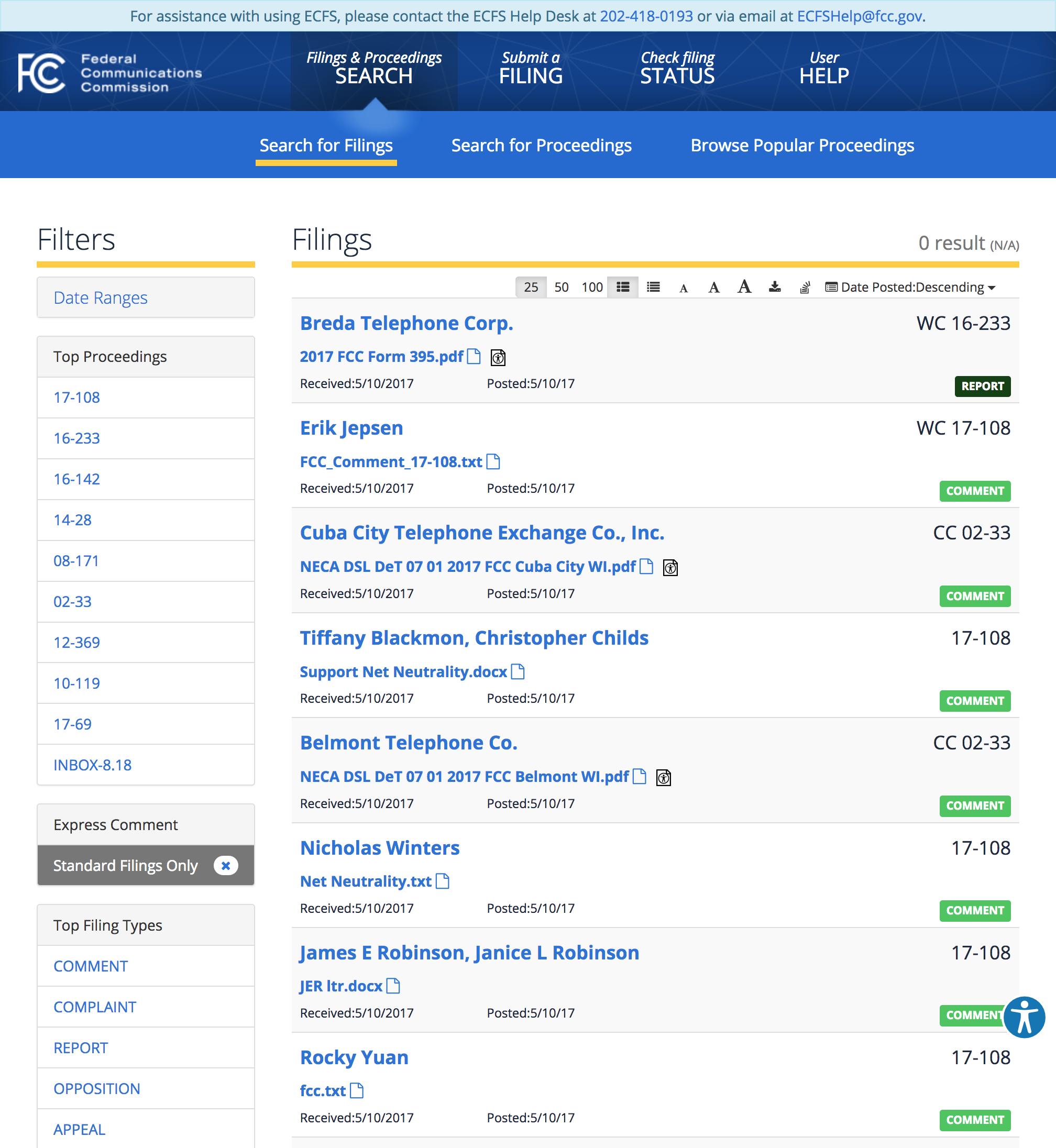
Expected Behavior: There should be 3,453 results, with pagination
Actual Behavior: It says 0 results (but is showing more than 0), and no pagination is available.
_From webcompat.com with ❤️_
 miketaylr
All 19 comments
AngularJS. Pagination is defined in https://www.fcc.gov/ecfs/scripts/scripts.min.js, searchable via searchPagination. HTML markup is there in Firefox, but hidden and the list of pages only contains one element.
 denschub
on 12 May 2017
denschub
on 12 May 2017
The template filings.html gets this for its headers value in Chrome (I just had it dump the json value):
{
  "params": "[object Object]",
  "total": "3453",
  "offset": "0",
  "content-type": "application/json; charset=utf-8",
  "access-control-allow-origin": "https://www.fcc.gov",
  "x-response-time": "368.923ms",
  "cache-control": "no-cache",
  "limit": "25"
}
In Firefox, this is what it dumps:
{
  "content-type": "application/json; charset=utf-8",
  "cache-control": "no-cache"
}
 wisniewskit
on 12 May 2017
wisniewskit
on 12 May 2017
That's the module, basically:
}), angular.module("fcc.ecfs").directive("searchPagination", [
  "$stateParams",
  "$state",
  function(a, b) {
    return {
      template: '<pagination direction-links="false" max-size="8" total-items="meta.total" items-per-page="meta.limit" ng-model="page" ng-change="changePage()" class="pagination-sm pagination" boundary-links="false" rotate="false" num-pages="numPages" ng-show="{{pageTotal > pageLimit}}"></pagination>',
      restrict: "EA",
      scope: { meta: "=" },
      link: function(c, d, e) {
        c.changePage = function() {
          var d = _.clone(a);
          d.limit = parseInt(d.limit || 25, 10), d.offset = (c.page - 1) *
            d.limit, window.scrollTo(0, 0), b.go(".", d);
        };
        var f = c.meta || {};
        c.page = Number(f.offset) / Number(f.limit) + 1, c.pageLimit = Number(
          f.limit
        ) ||
          25, c.pageTotal = Number(f.total) || 0;
      }
    };
  }
]), angular.module("fcc.ecfs").directive("facetSearchFilter", function() {
Interesting is the line:
c.page = Number(f.offset) / Number(f.limit) + 1
f seems to be the header object, as @wisniewskit found. But yeah, that's different in Chrome and Firefox.
denschub
on 12 May 2017
Both browsers receive the same response from the server, so nothing fishy here.
(For the XHR to https://ecfsapi.fcc.gov/filings?date_received=%5Bgte%5D2017-5-7%5Blte%5D2017-5-10&express_comment=0&limit=25&sort=date_disseminated,DESC, that is.)
denschub
on 12 May 2017
Both browsers receive the same response from the server, so nothing fishy here.
I'm seeing the same thing, for both the https://ecfsapi.fcc.gov/filings?date_received=%5Bgte%5D2017-5-7%5Blte%5D2017-5-10&express_comment=0&limit=25&sort=date_disseminated,DESC and https://ecfsapi.fcc.gov/documents?id_submission=105100914620866,10510204081248,10510251716417,1051009230015,105102457227022,10510666509421,1051027075503,105102927106512,10510215301771,1051086390924,10510273721859,10510724612672,1051090890327,1051098446493,105102127108767,1051033958850,10510295366600,10510473006830,10510659520640,105102239124169,10510145239750,10510246821461,10510883015246,1051021019305,105102432410051 xhr requests.
miketaylr
on 12 May 2017
FWW, they're using AngularJS 1.3.20
{
  "full": "1.3.20",
  "major": 1,
  "minor": 3,
  "dot": 20,
  "codeName": "shallow-translucence"
}
In angular.min.js, there is a call to C.getAllResponseHeaders() in the XHRs onload. Interestingly, there are some differences in their return values.
In Chrome:
"params: [object Object]
total: 3453
offset: 0
Content-Type: application/json; charset=utf-8
Access-Control-Allow-Origin: https://www.fcc.gov
X-Response-Time: 370.409ms
limit: 25"
In Firefox:
"Content-Type: application/json; charset=utf-8

"
Just double checked if this is the same request.
Chrome:

Firefox:

One idea is that the squared brackets are throwing our parser off. @wisniewskit is having a look, I'll do so as well.
denschub
on 12 May 2017
Isolated test-case with that URL: http://jsbin.com/wejehuqaxo/1/edit?js,console
Seems like there are indeed issues with the header parsing.
denschub
on 12 May 2017
This seems to be both header format abuse (technically, [ and ] are used as field separators as per RFC2616) and we're not recovering as nice as Chrome does.
@wisniewskit is filing a Necko/Gecko issue as well as an issue to track a possible change to the XHR spec to add a note that headers have to be parsed differently. Edge, Safari, and Chrome seem to recover just fine, so I guess it's fine to make that a default behavior for everyone.
As for a fix the site could deploy, they probably should wrap their header into double quotes, which would make this issue disappear. What do you think, @miketaylr?
denschub
on 12 May 2017
@denschub yeah, that sounds cool -- let's move this to needscontact to explain the double quote workaround while @wisniewskit works to get the right bug filed.
miketaylr
on 12 May 2017
I see the @FCC is on GitHub. I wonder if @bizui @brianfunk @antoinegreen could help us find the right contact to fix this issue?
To summarize, ECFS search results aren't paginated properly in Firefox, due to an invalid HTTP response header format (which other browsers are able to recover from). To fix this, the params response should be double quoted (possibly returning "[object Object]" isn't actually useful anyways?).
miketaylr
on 12 May 2017
Reaching out via Linkedin as well.
 adamopenweb
on 12 May 2017
adamopenweb
on 12 May 2017
Update: actually the problem is not the brackets, it's that their CORS "expose headers" line has a stray space in the list of allowed headers:
Access-Control-Expose-Headers:server,limit,offset,params,response-time,total,authorization,access-control-allow-origin,x-response- time
Chrome is fine with that. Firefox just ignores the entire header, which is why none of the headers end up being accessible.
wisniewskit
on 12 May 2017
Ah, nice find!
miketaylr
on 13 May 2017
Alright, I've filed bug 1364598. Turns out that Firefox, Chrome/Safari, and Edge all treat this case differently, so it's a subtle webcompat issue.
Regardless, it's something the FCC should fix on their end as well, as it's an error in their CORS header even if some browsers try to work around it for them.
wisniewskit
on 13 May 2017
Thanks for investigating and thanks for tag @miketaylr . On it.
 brianfunk
on 13 May 2017
brianfunk
on 13 May 2017
Just a quick update: it was decided that Firefox's behavior is correct, given that it is what the spec says and there is no evidence of that this is a widespread webcompat issue. As such the web platform tests have been updated and Chrome, Edge, and Safari have been contacted to adhere to the spec, with signs that Chrome and Edge are already working on patches.
wisniewskit
on 24 May 2017
Update: the issue has been resolved on FCC.gov with the extra space in header removed.
brianfunk
on 24 May 2017
Thanks for the help @brianfunk! I can confirm the issue is resolved. Getting 3508 results from the original query, tested in Firefox 55 for OSX.
Let's close this report.
adamopenweb
on 24 May 2017
Related issues
 Ezio916
·
4Comments
Ezio916
·
4Comments
 christantoan
·
4Comments
christantoan
·
4Comments
 karlcow
·
5Comments
karlcow
·
5Comments
 webcompat-bot
·
5Comments
webcompat-bot
·
5Comments
 bvanrijn
·
4Comments
bvanrijn
·
4Comments
Most helpful comment
Update: actually the problem is not the brackets, it's that their CORS "expose headers" line has a stray space in the list of allowed headers:
Access-Control-Expose-Headers:server,limit,offset,params,response-time,total,authorization,access-control-allow-origin,x-response- timeChrome is fine with that. Firefox just ignores the entire header, which is why none of the headers end up being accessible.