Vamiga: new Universal App doesn't start emulation on m1
v0.9.15 doesn't start the emulation on m1 Mac mini. I can open the app, configure everything, but as soon as I start the Emulation it will stay at a blank screen. If I start the app by checking "open with Rosetta" it will work, although the emulation is way to fast (discussed on other issue with virtualC64)
 Optic00
All 35 comments
Xcode output just before it stops:
2020-11-25 09:50:48.739121+0100 vAmiga[1948:75168] setup
DiskMountDialog.120::awakeFromNib()
DialogController.68::awakeFromNib()
DiskMountDialog.239::windowDidResize(_:)
DiskMountDialog.239::windowDidResize(_:)
DiskMountDialog.199::insertDiskAction(_:): insertDiskAction df0
MyDocument.439::loadScreenshots(): Seeking screenshots for disk with id 13183632172158702109
MyDocument.448::loadScreenshots(): 0 screenshots loaded
Animation.197::zoomIn(steps:): Zooming in...
v0.9.15.2 emulation does not start on Apple Silicon.
 mibosshard
on 12 Dec 2020
mibosshard
on 12 Dec 2020
There are some loads of misaligned addresses that probably should be fixed.
Quick fix:
(vAmiga) > Edit Scheme... > Diagnostics > Enable "Thread Sanitizer" and "Undefined Behavior Sanitizer"
 roger-wetzel
on 23 Dec 2020
roger-wetzel
on 23 Dec 2020
Replacing read16 and read32 in Serialization.h with this quick and dirty hack gets rid of the misaligned address accesses.
inline u16 read16(u8 *& buffer)
{
    u8 b1 = *buffer;
    buffer += 1;
    u8 b2 = *buffer;
    buffer += 1;
    u16 result = (b1 << 8) | b2;
    return result;
}

inline u32 read32(u8 *& buffer)
{
    u8 b1 = *buffer;
    buffer += 1;
    u8 b2 = *buffer;
    buffer += 1;
    u8 b3 = *buffer;
    buffer += 1;
    u8 b4 = *buffer;
    buffer += 1;

    u32 result = (b1 << 24) + (b2 << 16) + (b3 << 8) | b4;
    return result;
}
But several data race conditions make the emulator go stop on Apple silicon. That also occurs on x86 machines. But this does not cause any problems there.
roger-wetzel
on 24 Dec 2020
data race conditions make the emulator go stop on Apple silicon. That also occurs on x64 machines.
Thanks a lot for digging into that!
How did you detect the race conditions on x64 machines? Using the Sanitizer setting mentioned above?
Being able to debug these conditions on x64 Macs would be brilliant news. It would mean that I can rule out (hopefully all) Mac Silicon bugs without having such a machine in my possession.
 dirkwhoffmann
on 24 Dec 2020
dirkwhoffmann
on 24 Dec 2020
Yes, use the settings above. And thanks for your brilliant work!
roger-wetzel
on 24 Dec 2020
To tackle the memory alignment issue, let's do some benchmarking first. Here is my example code:
#include <arpa/inet.h>

unsigned char a[1024];

unsigned short read16(int i) {
    return a[i] << 8 | a[i+1];
}

unsigned long read32(int i) {
    return a[i] << 24 | a[i+1] << 16 | a[i+2] << 8 | a[i+3];
}

unsigned short read16_2(int i) {
    return htons(((unsigned short *)a)[i]);
}

unsigned long read32_2(int i) {
    return htonl(((unsigned long *)a)[i]);
}
Code produced by x86-64 gcc (-O3):
read16(int):
        movsx   rax, edi
        add     edi, 1
        movzx   edx, BYTE PTR a[rax]
        movsx   rdi, edi
        movzx   eax, BYTE PTR a[rdi]
        sal     edx, 8
        or      eax, edx
        ret
read32(int):
        movsx   rax, edi
        lea     edx, [rdi+3]
        movzx   eax, BYTE PTR a[rax]
        movsx   rdx, edx
        movzx   edx, BYTE PTR a[rdx]
        sal     eax, 24
        or      eax, edx
        lea     edx, [rdi+1]
        add     edi, 2
        movsx   rdx, edx
        movsx   rdi, edi
        movzx   edx, BYTE PTR a[rdx]
        sal     edx, 16
        or      eax, edx
        movzx   edx, BYTE PTR a[rdi]
        sal     edx, 8
        or      eax, edx
        cdqe
        ret
read16_2(int):
        movsx   rdi, edi
        movzx   eax, WORD PTR a[rdi+rdi]
        rol     ax, 8
        ret
read32_2(int):
        movsx   rdi, edi
        mov     rax, QWORD PTR a[0+rdi*8]
        bswap   eax
        mov     eax, eax
        ret
a:
        .zero   1024
Code produced by x86-64 clang (-O3):
read16(int):                             # @read16(int)
        movsxd  rax, edi
        movzx   eax, word ptr [rax + a]
        rol     ax, 8
        ret
read32(int):                             # @read32(int)
        movsxd  rax, edi
        movzx   ecx, byte ptr [rax + a]
        shl     ecx, 24
        movzx   edx, byte ptr [rax + a+1]
        shl     rdx, 16
        movsxd  rcx, ecx
        or      rcx, rdx
        movzx   edx, byte ptr [rax + a+2]
        shl     rdx, 8
        or      rdx, rcx
        movzx   eax, byte ptr [rax + a+3]
        or      rax, rdx
        ret
read16_2(int):                           # @read16_2(int)
        movsxd  rax, edi
        movzx   eax, word ptr [rax + rax + a]
        rol     ax, 8
        ret
read32_2(int):                           # @read32_2(int)
        movsxd  rax, edi
        mov     eax, dword ptr [8*rax + a]
        bswap   eax
        ret
a:
        .zero   1024
Bottom line:
- gcc: The original code produces more compact (and most likely faster) code for both word and long word accesses
- clang: The original code produces more compact (and most likely faster) code for long word accesses. Word accesses are pretty much the same.
dirkwhoffmann
on 25 Dec 2020
In v0.9.16.1, I've introduced new macros for big endian memory access:
//
// Accessing memory
//

// Reads a value in big-endian format
#define R8BE(a)  (*(u8 *)(a))
#define R16BE(a) HI_LO(*(u8 *)(a), *(u8 *)((a)+1))
#define R32BE(a) HI_HI_LO_LO(*(u8 *)(a), *(u8 *)((a)+1), *(u8 *)((a)+2), *(u8 *)((a)+3))

#define R8BE_ALIGNED(a)  (*(u8 *)(a))
#define R16BE_ALIGNED(a) (htons(*(u16 *)(a)))
#define R32BE_ALIGNED(a) (htonl(*(u32 *)(a)))

// Writes a value in big-endian format
#define W8BE(a,v)  { *(u8 *)(a) = (v); }
#define W16BE(a,v) { *(u8 *)(a) = HI_BYTE(v); *(u8 *)((a)+1) = LO_BYTE(v); }
#define W32BE(a,v) { W16BE(a,HI_WORD(v)); W16BE((a)+2,LO_WORD(v)); }

#define W8BE_ALIGNED(a,v)  { *(u8 *)(a) = (u8)(v); }
#define W16BE_ALIGNED(a,v) { *(u16 *)(a) = ntohs((u16)v); }
#define W32BE_ALIGNED(a,v) { *(u32 *)(a) = ntohl((u32)v); }
The faster _ALIGNED variants are used for accessing the Amiga memory. They will work on ARM as well, because all accesses will happen at aligned memory locations. The other variants are utilized by the Serializer since the values inside a snapshot are not aligned in general.
dirkwhoffmann
on 27 Dec 2020
v0.9.16.1 still no joy on Apple silicon. a few days ago I had it running with roger's fixes though...
mibosshard
on 27 Dec 2020
I do have a spare Macmini9,1. if you want me to, I can setup a VPN / Screen Sharing account for you. that's how roger was able to do some debugging on M1.
mibosshard
on 27 Dec 2020
Hmm I am uncertain whether the cause of the failure on m1 is found .... It is not clear to me whether it did run ok with rogers fixes on m1 or not ....
When it did run ok with the above fixes then zip the project and put it into here ... dirk can then run a file compare and patch it into the version at github ....
 mithrendal
on 27 Dec 2020
mithrendal
on 27 Dec 2020
unfortunately, I already have wiped the Mac mini on which roger did the debugging. I only kept the working .app which runs slow like molasses if startet without the "Thread Sanitizer" of Xcode.
mibosshard
on 28 Dec 2020
Oh I see ... and also there seems to be no ARM emulator on Intel Macs to test the ArmBuild of vAmiga or vC64 directly ... apple wants us to buy the real hardware 😬
Another way to test the ARM build of the emulator code would be to make a blank iOS Project and copy over the Emulator source-code-folder only into that empty iOS project ... Then to instantiate the C64 or Amiga Object and to depoy and run the emulator on an iPhone/iPad with an AXX processor ... which shares the same ABI as the M1 processor ... so in theory the same problems should arise in an iPad/iPhone build of the vAmiga/C64 emulator .. no?
mithrendal
on 28 Dec 2020
I have a mac mini with M1. I also get the same issue that emulation doesn't seem to start.
 emoon
on 28 Dec 2020
emoon
on 28 Dec 2020
I have an iPhone with an AppleSilicon A9 processor. And emulation seems to start on that machine... I see the DF0 drive head clicking ...
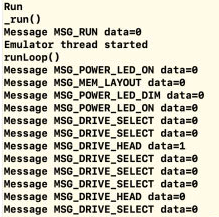
question the M1 owners ... do you at least see the hand disk image ?
next I will try to boot defender of the crown on the A9 processor ...
mithrendal
on 29 Dec 2020
I only see a black screen when I try to boot with both 1.3 kick or the built-in AROS
emoon
on 29 Dec 2020
the emulator itself taken from master branch without its GUI loads defender of the crown on an iPhone AppleSilicon A9 processor
(the first seconds of the video nothing happens ...because XCode loads the code package onto the AppleSilicon powered iPhone... wait a bit)
mithrendal
on 29 Dec 2020
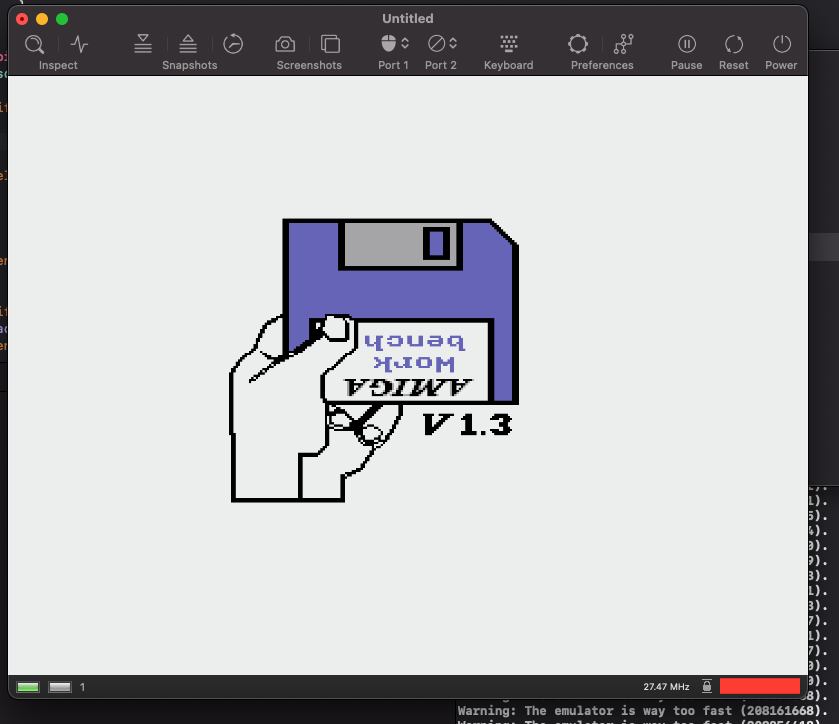
Good news. I got it to boot :)
emoon
on 29 Dec 2020
There seems to be a problem with this code
void
Oscillator::waitUntil(u64 deadline)
{
#ifdef __MACH__

   // mach_wait_until(deadline);

#else

    assert(false);
    // TODO: MISSING IMPLEMENTATION

#endif
}
If I comment out the wait code above thing seems to start running (of course too fast) but the sleep value that comes in here is wayyy too big so the code just sits sleeping in there it looks like.
deadline u64 515659668836899
but the sleep value that comes in here is wayyy too big
Wow, that's great news! So it's due to the Mach conversion unit thing that was mentioned in another thread (where I replied the code would already take care of it 🙄).
dirkwhoffmann
on 29 Dec 2020
Yeah. I think the code needs some extra checks :) I can run more tests if you find something.
emoon
on 29 Dec 2020
@emoon good news that m1 is back in game 🤩!!
The timing bug on applesilicon and its background was mentioned in this thread see second post https://github.com/dirkwhoffmann/virtualc64/issues/592
mithrendal
on 29 Dec 2020
That perfectly explains now why the isolated emulator on A9 AppleSilicon needed the warp mode set to true !!!
I first spent no attention the importance or meaning that I had to set it to true ... to make the isolated emulator code to work on the iPhone... 🙄
if I now uncomment the setWarp(true) like this
    //armAmiga->setWarp(true);
    DiskFile *df0file = DiskFile::makeWithFile(df0_path);
    if (df0file) {
        fprintf(stderr, "disk found, insert the disk %s", df0_path);
        Disk *disk = Disk::makeWithFile(df0file);
        armAmiga->df0.ejectDisk();
        armAmiga->df0.insertDisk(disk);
        armAmiga->df0.setWriteProtection(false);
    }
    armAmiga->run();
and run it again on the A9 chip then it does not load defender of the crown anymore ... the A9 gets stuck as on the m1 chip very early in boot process ... no drive actions
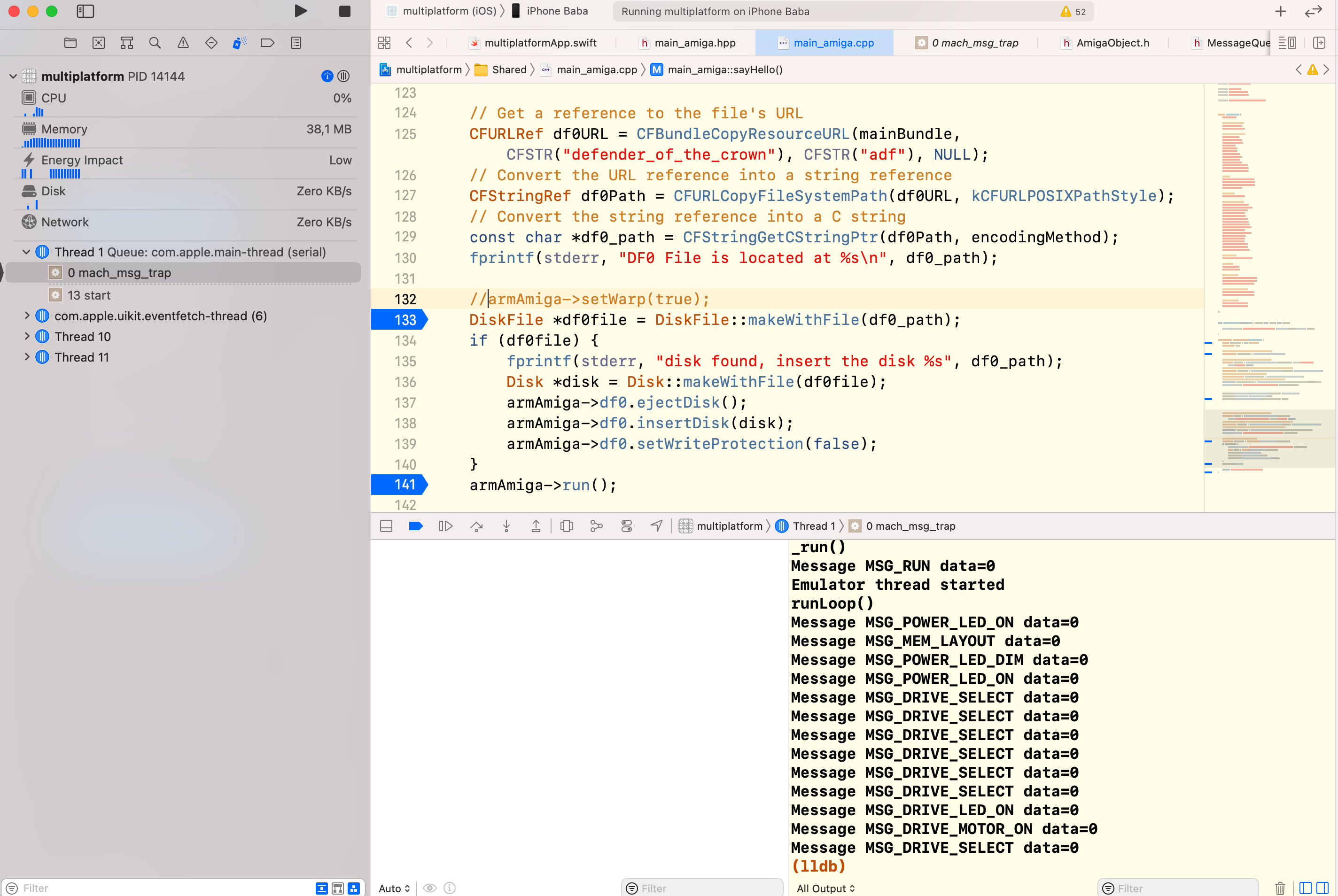
I guess setWarp(true) skips the defect time waiting code ...
@dirkwhoffmann should I send you the xcode project with the isolated emulator code for testing on iPhone ARM chip ?
mithrendal
on 29 Dec 2020
should I send you the xcode project with the isolated emulator code for testing on iPhone ARM chip ?
Yes, that's the way to go
dirkwhoffmann
on 29 Dec 2020
pm with zipped project sent ...😎
So bad for apple... they wanted to sell us tons of M1 Macs and now we just use our iPhones for ARM development instead 😂
mithrendal
on 29 Dec 2020
I think I got it:
This
Oscillator::waitUntil(u64 deadline)
{
#ifdef __MACH__
    mach_wait_until(deadline);
#else
...
has to be replaced by that:
Oscillator::waitUntil(u64 deadline)
{
#ifdef __MACH__
    mach_wait_until(nanos_to_abs(deadline));
#else
...
My nanos_to_absfunction was alright, but not called at all necessary places.
dirkwhoffmann
on 29 Dec 2020
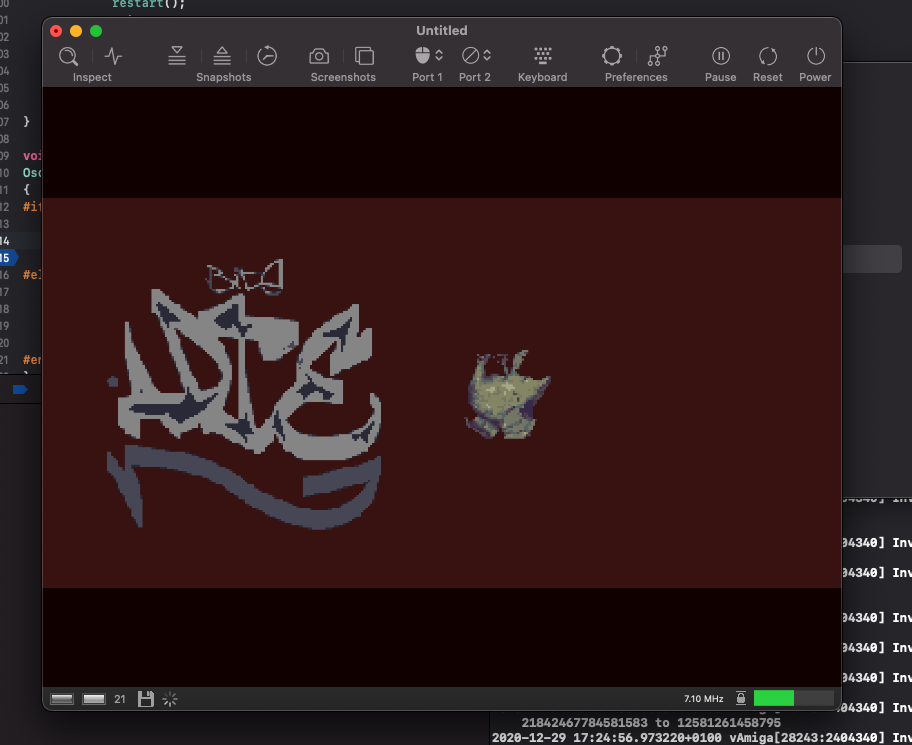
Yes, works fine now :)
emoon
on 29 Dec 2020
yup, confirmed! works fine now ;-)
mibosshard
on 29 Dec 2020
Great news and great teamwork!
I'll upload version v0.16.2 tomorrow.
dirkwhoffmann
on 29 Dec 2020
I'll upload version v0.16.2 tomorrow.
0.9.16.2 ;-)
roger-wetzel
on 29 Dec 2020
dieser thread kann zu, v0.9.16.2 laeuft auf Apple silicon.
issue resolved, v0.9.16.2 works on Apple silicon.
thanks everybody, happy new year to all!
mibosshard
on 30 Dec 2020
issue resolved, v0.9.16.2 works on Apple silicon.
Could you do one thing before I close the thread? Could you check if snapshot saving (and loading) works? 😬
dirkwhoffmann
on 30 Dec 2020
yup: taking and reverting to a snapshot works for me.
mibosshard
on 30 Dec 2020
yup: taking and reverting to a snapshot works for me.
Great 😎. I'll close it then. Please reopen if other issues arise.
dirkwhoffmann
on 30 Dec 2020
what would also be interesting (only theoretically) is whether M1 saved snapshots could be loaded on Intel machine ... but in practise its maybe not as important ...
mithrendal
on 30 Dec 2020
Related issues
dirkwhoffmann
·
4Comments
dirkwhoffmann
·
3Comments
 Alessandro1970
·
4Comments
dirkwhoffmann
·
3Comments
dirkwhoffmann
·
4Comments
Alessandro1970
·
4Comments
dirkwhoffmann
·
3Comments
dirkwhoffmann
·
4Comments
Most helpful comment
Great news and great teamwork!
I'll upload version v0.16.2 tomorrow.