Scout: Allow for multiple loqusdb
Is it possible to support different loqusdb entities for different institutes?
For example, we currently have:
A institute with hg19 wgs-samples
Another with hg38 wgs-samples
A third with hg38 panel-data for oncogenetics
We'd like to present different data from different loqusdb-versions in the Local Observations in the variant view for the different institutes.
 ViktorHy
All 29 comments
Hi @ViktorHy sounds like a good idea, we are getting closer to a similar situation. One alternative which I find attractive, would be to have separate instances of Scout for different types of data. But anyway, I will have a look if there is a nice way to implement this.
 moonso
on 15 May 2020
moonso
on 15 May 2020
Hi @ViktorHy , we will start working on this now. Do you have any input on how it should work or be implemented?
moonso
on 11 Jun 2020
My 2 cents:
Since loqusdb already has support for loading data into separate databases using the -db flag (which defaults to loqusdb), I think a simple and backwards compatible solution would be to leave the default database in scout as loqusdb and not change anything in how loqusdb is configured in config.py.
Then allow this default to be overridden by setting an optional field named something like loqusdb_db in an institute document, or in a case document (which overrides any institute value). The case value should be set in the yaml file.
This allows both setting an institute specific database and to set it on a case-to-case basis.
 bjhall
on 11 Jun 2020
bjhall
on 11 Jun 2020
Hi,
This is my proposed solution:
- LOQUSDB_SETTINGS is a dict or a list of dicts.
- Add an extra field in LOQUSDB_SETTINGS named "institute". If your session's institute matches, configured binary and config will be used. Otherwise default setting will be used.
- Omitting the institute field will be interpreted as 'default' (making the solution backwards compatible)
[{'binary_path':"loqusdb", 'config_path':"", 'institute':"default"},
{'binary_path':"/bin/anotherloqusb", 'config_path':"--config1", 'institute':"KI"},
 {'binary_path':"/bin/yetanother/loqusdb", 'config_path':"--config2", 'institute':"Mayo"}]
What do you think?
 mikaell
on 17 Jun 2020
mikaell
on 17 Jun 2020
I think that is a really nice solution, it will be easy to control it on institute level just by adding another line there. Let's try to have it on institute level for a while and if there is a need to have it on case level we could come up with another solution in the future.
moonso
on 17 Jun 2020
I think it is an bit confusing to have institute-specific settings in config.py, when all other such settings are in the institute collection. But if you need to have multiple installations of loqusdb, maybe it makes sense.
What's the rationale behind having multiple installations of loqusdb rather than multiple databases in the same instance?
It would be nice if this solution would support both strategies. As I understand it, it won't be possible to set a database name?
Also I think the suggested solution makes it almost impossible to support case-specific configuration in a clean way. But maybe that is a contrived use case anyway...
bjhall
on 17 Jun 2020
Hi, thanks for feedback. I agree that there is no particular reason to point to multiple installations of loqusdb, however we want to be able to use different mongod processes for different loqus databases (not required, it is possible to have multiple dbs in one process as well).
Another suggestion could be to have:
LOQUSDB_SETTING = [
    {"binary_path": "loqusdb", "config_path": "rare_disease_37.yml", "name": "default"},
    {"binary_path": "loqusdb", "config_path": "rare_disease_38.yml", "name": "rd38"},
    {"binary_path": "loqusdb", "config_path": "melanoma_37.yml", "name": "melanoma37"},
]
rare_disease_37.yml
db_name: "rd37"
host: localhost
port: 27017
rare_disease_38.yml
db_name: "rd38"
host: localhost
port: 27017
rare_disease_37.yml
db_name: "melanoma_37"
host: otherhost
port: 27030
Then we can refer to these from institutes and cases and fall back on "default" if nothing specified.
moonso
on 17 Jun 2020
Also it would be nice (perhaps in the future) If one institute can choose to show frequencies from multiple loqusdb instances
moonso
on 17 Jun 2020
Created a pull request!
mikaell
on 10 Jul 2020
Like @mikaell said he created a PR that adds this feature in https://github.com/Clinical-Genomics/scout/pull/1984 . This is now ready so please have a look @bjhall and @ViktorHy and see if this will solve your situation.
moonso
on 25 Aug 2020
Thanks! Will have a look this week.
ViktorHy
on 31 Aug 2020
So I have just updated to the latest version of scout. I've been trying to get multiple loqusdb instances to work. Am I correct in this assessment?
To get it work I need 2 separate installations of loqusdb with different paths to the binary?
I was hoping I could use the same installation only with different -db of the same installation/binary
ViktorHy
on 1 Sep 2020
Did you update the version or latest master? There was some misunderstanding during the merge of this, could you give @ViktorHy a hand @northwestwitch @mikaell @dnil ?
moonso
on 1 Sep 2020
More @mikaell, I don't have a clear idea of how the multi-loqus works yet.
 northwestwitch
on 1 Sep 2020
northwestwitch
on 1 Sep 2020
And version is as is in the repo - there was never anything wrong with it, just some confusion during stage branch testing!
 dnil
on 1 Sep 2020
dnil
on 1 Sep 2020
The multiloqus code is in current master, but not yet in any released version that I know of.
dnil
on 1 Sep 2020
@mikaell @northwestwitch we can also have a look in the afternoon - it's going to block testing for the next release if we don't understand how to integrate it on stage.
dnil
on 1 Sep 2020
I think the config files of stage and prod should be changed according to this PR. @mikaell is working on this
northwestwitch
on 1 Sep 2020
Bug patch pushed and with @northwestwitch for review
Documentation is updated (https://github.com/Clinical-Genomics/scout/pull/2043/files)
mikaell
on 1 Sep 2020
OK so I've tried the latest bugfixes in the latest merge of master.
What I still don't understand is in:
scout/server/blueprints/variant/templates/variant/variant_details.html
The data presented on line 125, ie Cases, takes the loqusdb_id from institute settings
However, the data on the above lines does not take into consideration what loqusdb_id it should present. And as such it always presents the default loqusdb whether or not I set it. That is "Nr Obs" "Nr Hom" and "Total nr"
I hope that you understand what I mean.
ViktorHy
on 2 Sep 2020
Good catch @ViktorHy , could you check that @mikaell @northwestwitch ?
moonso
on 3 Sep 2020
Calling LoqusDB is done in controllers.py on this line:
obs_data = loqusdb.get_variant(variant_query, loqusdb_id=institute_obj.get("loqusdb_id")) or {}
institute_obj.loqusdb_id is read from the MongoDB and is configurable.
However, there might be a misunderstanding. You refer to a line in a html file and setting of the variable loqusdb_id not present in that file. Can you clarify?
The data presented on line 125, ie Cases, takes the loqusdb_id from institute settings
```
{{ data.case.display_name }}
mikaell
on 3 Sep 2020
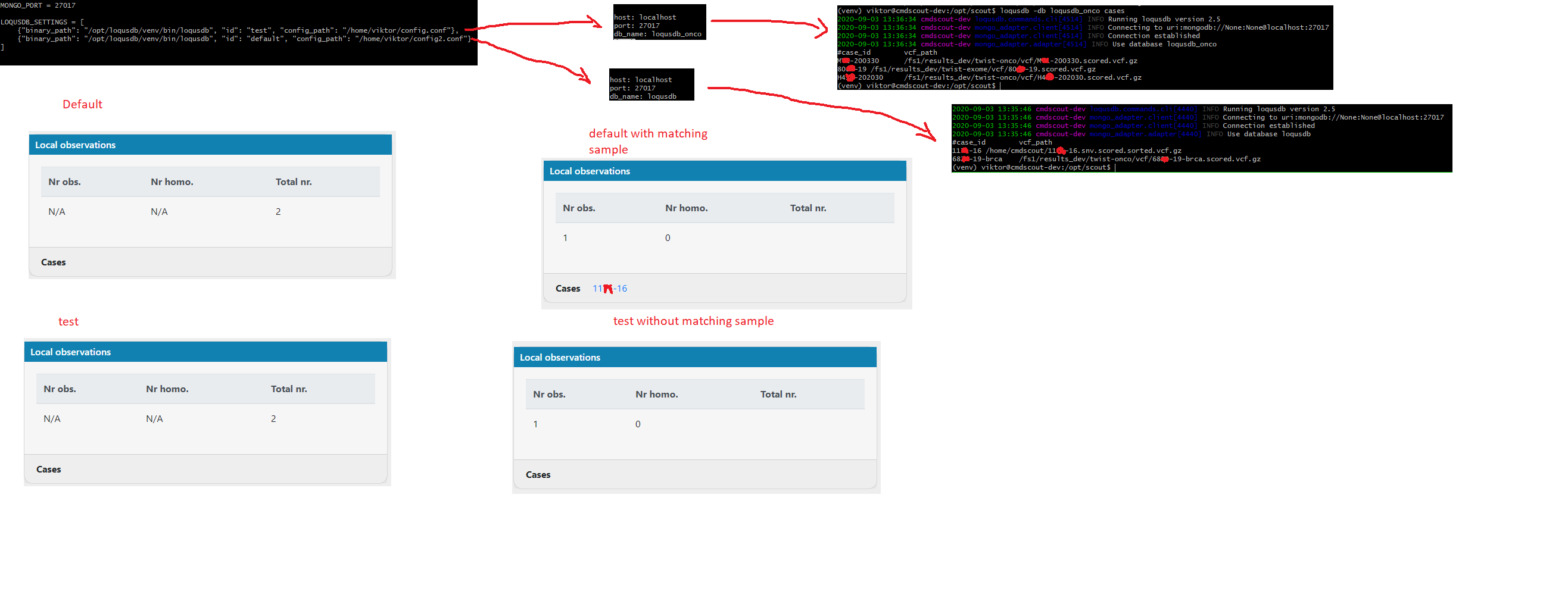
So, I have two loqusdb databases. One has 2 samples the other has 3. The one with 2 samples is my default. I set the loqusdb_id in my institute to the one containing 3. In variant view it shows observations for the default, that is 2. I can get it to match cases from the different loqusdb databases however, but it still only shows observations for the default no matter what loqusdb_id is set for the institute.
ViktorHy
on 3 Sep 2020
ViktorHy
on 3 Sep 2020
The argument "--case-count" was missing in the call to LoqusDB. A patch is on its way.
mikaell
on 3 Sep 2020
@ViktorHy You can try this patch: https://github.com/Clinical-Genomics/scout/tree/bugfix-loqusdb_case-count-200903
mikaell
on 3 Sep 2020
Seems to be working now. Will try some more when I find the time. Thanks!
ViktorHy
on 4 Sep 2020
Seems to be working now. Will try some more when I find the time. Thanks!
That's great, thanks @ViktorHy!
northwestwitch
on 4 Sep 2020
The solution has been deployed, closing this!
northwestwitch
on 28 Sep 2020
Related issues
northwestwitch
·
5Comments
 hassanfa
·
3Comments
dnil
·
3Comments
hassanfa
·
3Comments
dnil
·
3Comments
 andreaswallberg
·
4Comments
andreaswallberg
·
4Comments
 1ctw
·
5Comments
1ctw
·
5Comments
Most helpful comment
Seems to be working now. Will try some more when I find the time. Thanks!