Prettier: Formatting of generators changed without sufficient consensus
I noted in #3903 that the formatting of generators was recently changed based on an issue (#7028) that had a total of just 2 up-votes (excluding the OP's).
I was under the impression that such changes would require far more consensus and motivation. There are issues with many more votes that have not yet even been considered.
I'm opening this issue to suggest that the relevant changes be reverted until a proper process has been followed.
FWIW, the original arguments didn't seem that compelling to me, but ultimately this is a very subjective matter and there isn't really a right or wrong answer. However, the change should only be made if there are either objective reasons to do so, or a really high percentage of votes in favour of the change.
I'd like to avoid discussing the pros and cons in this issue, as that can be done elsewhere.
 glen-84
All 69 comments
Is this a major change for you? There were no heated discussions on this issue because it is just space. What are the disadvantages of the current formatting? I don’t think that every change should create a holy war. In addition, all contributors have chosen that formatting. You can find details and explanation why we made this choice.
I was under the impression that such changes would require far more consensus and motivation. There are issues with many more votes that have not yet even been considered.
We don’t have any regulations when we decide what we do or not, the main reason for the change is the improvement in readability, in this problem we decided to choose a consistent output.
If after each merge the developers open up new issues without explanations of problems (and there are already a lot of them) or bugs with the idea of discussion, we will never go far.
 alexander-akait
on 1 Feb 2020
alexander-akait
on 1 Feb 2020
Is this a major change for you?
Honestly, it's _not_ a big change for me personally. I just feel that the wider community should be given the opportunity to provide their input before such changes are made.
because it is just space
3847 was also just a space, but it was open since 31 January 2018 and received 487 up-votes (!).
What are the disadvantages of the current formatting?
What were the disadvantages of the previous formatting? The items mentioned by Brian were:
Consistency.
No one likes consistency more than I do, but it seems unlikely that someone would be mixing shorthand syntax with longhand syntax within the same object. If you do, I'd be interested in seeing the code.
Catching bugs.
I didn't quite understand how this catches bugs. I don't think that I'd miss the
*after the function keyword when reading code, but I can't speak for others.
I don’t think that every change should create a holy war.
I'm not asking for a holy war. If the majority of users prefer the new formatting, then we'll just live with it.
In addition, all contributors have chosen that formatting. You can find details and explanation why we made this choice.
Where can I find this? I just saw about 3 contributors giving a thumbs up. Are there only 3 contributors? The reason for accepting the proposal seems to simply be "I guess we just need to make sure there is no good reason for rejecting this proposal", a couple of days before making the change.
the main reason for the change is the improvement in readability
Which is subjective. I personally find 4-space indentation and double quotes to be much more readable, but that's not enough to change the defaults.
If after each merge the developers open up new issues without explanations of problems
I explained the problem, the problem is that the change was made on relatively short notice with no community input. However, if that's just the way that things are done here, then let it be.
FWIW:
- Out of the top 9 Google results (1st page) for "js generators", 6 use left-aligned, 2 use centre-aligned, and 1 is mixed. None of the articles use right-aligned.
- In addition to MDN (the most popular resource for web development), the most popular JavaScript style guide (Airbnb) also recommends the left alignment.
- Quotes:
- "Why? function and * are part of the same conceptual keyword - * is not a modifier for function, function* is a unique construct, different from function." (ref)
- "... usually the first syntax is preferred, as the star * denotes that it’s a generator function, it describes the kind, not the name, so it should stick with the function keyword." (ref)
glen-84
on 1 Feb 2020
Out of the top 9 Google results (1st page) for "js generators", 6 use left-aligned, 2 use centre-aligned, and 1 is mixed. None of the articles use right-aligned.
I think because many developers use them extremely rarely and do not pay attention to the style
In addition to MDN (the most popular resource for web development), the most popular JavaScript style guide (Airbnb) also recommends the left alignment.
I would recommend MDN to use prettier. Also they used single quotes https://developer.mozilla.org/en-US/docs/Learn/JavaScript/First_steps/Arrays and other strange things, sometimes I saw very poorly readable code there
Airbnb - contains a lot of strange things, it's just one of many style guides
"Why? function and * are part of the same conceptual keyword - * is not a modifier for function, function* is a unique construct, different from function."
"... usually the first syntax is preferred, as the star * denotes that it’s a generator function, it describes the kind, not the name, so it should stick with the function keyword."
Eslint has other opinion https://eslint.org/docs/rules/generator-star-spacing
The default is {"before": true, "after": false}.
We can read other people's guides for a long time, but it's useless
alexander-akait
on 1 Feb 2020
I think we can leave this problem issue for discussion (but I do not think that we will change our decision in the near future, perhaps never), but I will ask other developers not to write “give an option”, “please change the behavior”, “I hate prettier”, etc.
alexander-akait
on 1 Feb 2020
I am also very surprised by this. It was previously discussed and everyone seemed to be in agreement that it would be function* gen() {} and function* () {}.
 bakkot
on 1 Feb 2020
bakkot
on 1 Feb 2020
No one likes consistency more than I do, but it seems unlikely that someone would be mixing shorthand syntax with longhand syntax within the same object. If you do, I'd be interested in seeing the code.
I don’t think consistency for a code formatter is based on whether the code appears within the same expression or statement. You don’t think it’s inconsistent that you put no space before the star when using the function keyword and no space after the star when using methods/shorthand? There’s no before for generator stars in the case of methods, and you literally can’t use a yield star without an operand, so it should be formatted like literally every other prefix operator in JavaScript.
I didn't quite understand how this catches bugs. I don't think that I'd miss the * after the function keyword when reading code, but I can't speak for others.
Accidentally exploding a string iterable using yield* is a rite of passage for anyone who uses generator functions. You don’t think you’d miss it, but most syntax highlighters color function and yield the same as the generator star, see github’s highlighting for instance:
yield* this.isABusyCallExpression(a + b);
yield *this.isABusyCallExpression(a + b);


md5-9e345e0b4447baee7180906fa7ad6ae0


```js
function *myLongFunctionName(withLots, ofArguments = {}) {
}
 brainkim
on 1 Feb 2020
brainkim
on 1 Feb 2020
Does this output really look okay to somebody here?
Prettier 1.19.1
Playground link
--parser typescript
Input:
function *foo<T>() {}
class Bar {
  static *foo<T>() {
    yield *foo<T>();
  }
}
baz = {
  async *foo<T>() {}
};
f = function *<T>() {};
Output:
function* foo<T>() {}
class Bar {
  static *foo<T>() {
    yield* foo<T>();
  }
}
baz = {
  async *foo<T>() {}
};
f = function*<T>() {};
 thorn0
on 1 Feb 2020
thorn0
on 1 Feb 2020
@thorn0 That could probably be an example used in the changelog entry that’s a great way to show how it’s more consistent.
brainkim
on 1 Feb 2020
The situation with yield * is more complicated though. Its precedence is tricky:
c = yield *a + b;
actually means
c = yield *(a + b);
and not
c = (yield *a) + b;
but the star placed closer to the expression seems to make the misinterpretation more probable.
Apparently Prettier should always add parens in such cases, when a binary or ternary expression gets trapped in a yield, regardless of whether the yield has a star. This should prevent bugs caused by this precedence, which seems very counter-intuitive now that everyone is used to await, whose precedence is completely different.
thorn0
on 2 Feb 2020
I didn’t think about the way operator precedence would work if we treated yield stars like prefix operators, insofar as yield star precedence is so low, but I also don’t think it’s a big deal, insofar as using yield star implies that the operand is an iterable, and I have never seen a binary expression used as the operand for a yield star.
I am perplexed by the different precedences of await and yield. Feels like a mistake to me. But I also dislike whenever prettier adds or removes parens from my code so there’s that.
brainkim
on 2 Feb 2020
I have never seen a binary expression used as the operand for a yield star
For this reason, adding the parens seems to be the right thing to do. If Prettier adds the parens and transforms yield *a + b → yield *(a + b), the mistake won't go unnoticed. Also we might want to skip adding the parens in cases where yield is used as a statement and feels more like return than await.
I am perplexed by the different precedences of await and yield. Feels like a mistake to me.
Totally agree. Also I wish we had yield ... instead of yield *.
thorn0
on 2 Feb 2020
You don’t think it’s inconsistent that you put no space before the star when using the function keyword and no space after the star when using methods/shorthand?
You can put a space after the asterisk for methods ...
function* example {
    // ...
}

class Example {
    foo() {
        // ...
    }

    * example() {
        // ...
    }

    * [Symbol.iterator]() {
        // ...
    }
}
It would take the place of the function keyword. But it doesn't bother me too much either way.
... it should be formatted like literally every other prefix operator in JavaScript
Except it's not a prefix operator? It works together with function (which might be implied in the case of methods or shorthand syntax), or yield.
*this.isABusyCallExpression(a + b); is not going to do anything by itself.
It's commonly referred to as one thing:
- The
yield*expression function*declaration- The
function*keyword
Do we refer to it the same way after this change, or as something like "function *{funcName} declarations"?
Accidentally exploding a string iterable using yield* is a rite of passage for anyone who uses generator functions.
Doesn't seem like a big issue to me.
most syntax highlighters color function and yield the same as the generator star
Reference? VSCode (multiple themes): no, PhpStorm (default theme): no. GitLab: no.
And I think most developers can notice the asterisk even when it's the same colour. If we are truly concerned about the accessibility, then we should also switch to 4-space indentation and double-quotes (I actually use both).
I haven’t seen a single argument in favor of the former styling.
And I haven't seen a strong argument for changing the current formatting.
The consistent refrain from the top-page of google results is that function* and yield* are keywords
They are keywords followed by an asterisk ...
"The function* declaration (function keyword followed by an asterisk) defines a _generator function_"
I don’t understand how the fact that the star describes the “kind“ of function motivates that it should stick to the function keyword and not the name of the function.
Because it's a "generator function", and has nothing to do with the name.
Does this output really look okay to somebody here?
It could just as easily be left-aligned ...
function* foo<T>() {}
class Bar {
  static* foo<T>() {
    yield* foo<T>();
  }
}
baz = {
  async* foo<T>() {}
};
f = function*<T> () {};
(although GH and VSC seem to choke on async*)
For what little it's worth, I only noticed one code example in the spec (EnumerateObjectProperties), and it is left-aligned. 🤷♂
Anyway, I think that we've dumped enough information here for others to make up their own minds, although I guess that that decision has already been made for them.
glen-84
on 2 Feb 2020
Created https://github.com/prettier/prettier/pull/7516 to revert.
This is just a style preference, but it looks to me like there was pretty broad agreement (per previous discussions here and here) prettier's previous style was correct. When there is such broad agreement I don't think it makes sense to do something different - in fact, as far as I am aware, this would be the _only_ case where there is broad agreement on a style and prettier chose to do something different.
bakkot
on 2 Feb 2020
How about making the star left-aligned in yield, but right-aligned in function declarations? It would be still much more consistent than the current behavior.
 phaux
on 2 Feb 2020
phaux
on 2 Feb 2020
@bakkot IMHO people in that issue didn't care about generators at all and would have +1'd anything just to get that whitespace after function as quickly as possible. Calling those reactions 'broad agreement' is a stretch.
Generators are still a relatively little-used feature of the language, so I don't think we can really speak of any 'broad agreement' or 'widespread formatting' with regard to them. This gives Prettier freedom to consider other factors: consistency, expressiveness, readability, etc. #7028 had been open since November and nobody had any substantial objections against its reasoning.
But you linked twice to the same comment in that issue. Did you want to link to something else?
@glen-84
Do we refer to it the same way after this change, or as something like
What's wrong with "generator declaration"? "The function* keyword" makes as much sense as "the async function keyword". Anyway, people can call things whatever they like. Prettier and formatting in general have nothing to do with that.
It works together with function (which might be implied
Implied? I don't think so. Just because function is an older syntax, that doesn't mean all function-like constructions imply the function keyword. Isn't it more logical to say that * works together with the signature? The signature is always there, no need to imply anything.
Except it's not a prefix operator?
* after yield does a thing very similar to ..., which is not an operator too, strictly speaking, but is often called 'spread operator' and is formatted as such, without whitespace between it and the subsequent expression:
yield *[firstValue, ...getOtherValues(...args)];
Can you see what I mean? Isn't it expressive when similar things are formatted in a similar way? The formatting helps communicate the fact that the same idea of spreading is in play here.
You can put a space after the asterisk for methods
One-character modifiers like * don't look good on their own. What idea would the space between it and the name communicate? "_There is an implied function keyword in front of me (but it can't actually be here)_"? Also that space would seem especially strange in private class methods:
class Foo {
  * #bar() { ... }
}
yield ... would have made so much more sense. I’m mourning that realization today because all these language decisions are so irreversible.
brainkim
on 2 Feb 2020
@brainkim I think it still can be added as an alternative syntax. Grammarwise, nothing seems to block this possibility. Who wants to write a proposal to TC39? :)
thorn0
on 3 Feb 2020
IMHO people in that issue didn't care about generators at all and would have +1'd anything just to get that whitespace after function as quickly as possible. Calling those reactions 'broad agreement' is a stretch.
I really don't think that's true; if people didn't agree it would be weird to vote. (And a dozen people also upvoted the next comment, which gives an explicit reason to prefer function*.)
But if you like we can look elsewhere: function* is the style used by
the spec itself, MDN, rauschma's tutorial, Eloquent JS, pretty much every other tutorial I could find (etc, etc, etc, etc), babel, wu.js, gatsby, co, node, deno, v8, spidermonkey, angular, bluebird, typescript, GraphQL, msgpack-javascript, etc.
I did find a couple of exceptions: flow-typed and YDKJS both use the function * style. But not many others do.
But you linked twice to the same comment in that issue. Did you want to link to something else?
Oops. I meant to link to this earlier discussion. Fixed.
bakkot
on 3 Feb 2020
I really don't think that's true; if people didn't agree it would be weird to vote.
We can't know for sure, but that's how it often goes in those popular issues. People go through comments upvoting everything that appears to be in support of the issue's proposal (space vs no space in this case).
FWIW that comment also says 'Since this is all about consistency with named functions, the spaces should be exactly like for a named generator function'. What if the upvotes were addressed to this statement, with which the behavior in next is in line? What if people simply voted for consistency?
thorn0
on 3 Feb 2020
BTW, another argument against
functionand*are part of the same conceptual keyword -*is not a modifier forfunction,function*is a unique construct, different fromfunction
If they're different constructs, why make them look similar by not putting a space in front of *? Instead, we should emphasize their difference to avoid confusion. Everything is more noticeable when it's separated, that's what separators are for.
thorn0
on 3 Feb 2020
People go through comments upvoting everything that appears to be in support of the issue's proposal (space vs no space in this case).
But that comment wasn't in support of the issue's proposal. It was in support of a particular answer to an unrelated question.
In any case, again, a dozen people _also_ upvoted the next comment (and zero people downvoted it), which specifically gave a reason to prefer function* over function * (a reason other maintainers have also spontaneously generated in the past), and that is still three times as many people as upvoted https://github.com/prettier/prettier/issues/7028.
Anyway, this sort of exegesis is not really that helpful. I think that 40 people upvoting a comment saying the format should be function*, and a dozen people upvoting the immediately following comment which agrees gives an explicit reason to do so, is pretty clear support of function*. You, apparently, don't. I don't think we're going to convince each other; going back and forth here isn't all that useful.
Which is why I also went through pretty much every major project or tutorial I could find which makes use of generators. That _also_ showed what looks to me like very broad agreement. Does this list not look like broad agreement to you?
bakkot
on 3 Feb 2020
But that comment wasn't in support of the issue's proposal.
It was a pro-space comment. It included that much desired space in the code snippet.
The point I’m trying to make is that if a feature is relatively little-used, if the absolute number of its users is much smaller compared to other language features, then _any_ agreement about it automatically isn't broad and a change in its formatting isn't a massive change.
thorn0
on 3 Feb 2020
The utter lack of interest towards #7028, compared to #3847 for example, clearly shows that people don't feel strongly about how to format decorators. As I wrote earlier, this gives Prettier some freedom. What's wrong with using this freedom if it exists?
thorn0
on 3 Feb 2020
@bakkot I mean, thanks for doing a survey of the literature on generators, but my response when I wrote #7028 and now is the same, I use generators all the time, and I noticed two concrete reasons why the former formatting is less optimal. I bet you if you went back and asked each author if they agree with my issue they’d either 1. not care or 2. agree with me.
Most of these articles repeat the dubious claim that function* or yield* are keywords, implying that the authors did not know you could add a space between the keyword and the star in the first place. Again, I feel like I’m repeating myself, they’re not keywords, no keyword permits spaces between its members or has members to begin with. The closest analogue for what generator stars are in JS is spread/rest syntax, which can only appear in specific places like function parameter lists or object/literal arrays, but is treated like a prefix operator for formatting.
@bakkot Besides your comprehensive review of the literature can you respond to #7028 based on the arguments it does make? I just don’t understand how you and @glen-84 can both argue that this is an unimportant formatting decision, and also that the consistency/bug-catching reasons are also unimportant. In programming, when faced with arbitrary decisions, small concerns like the two which I brought up are god-sends because they help us choose. I’m glad that @glen-84 has eagle eyes that can spot a misplaced asterisk anywhere in their code, but if you can’t concede that the new formatting could help us mere mortals catch bugs then I don’t know how to respond. Also, if you somehow end up arguing that true consistency in code would be to write classes like this:
class Foo {
  * bar() {
  }

  async* baz() {
  }

  * #quux() {
  }
}
despite the fact that this would also be a “breaking” change to prettier, I dunno. Again I’m not sure how this conversation moves forward.
@thorn0
The utter lack of interest towards #7028
Wow I thought my prose was compelling but guess not 😂.
brainkim
on 3 Feb 2020
Wow I thought my prose was compelling but guess not 😂.
I meant the number of reactions. :) But I guess we need more prose. Something like a "Generator formatting mini-FAQ" for the 2.0 blog post.
thorn0
on 3 Feb 2020
this would also be a “breaking” change to prettier
I'd like to remind that Prettier doesn't consider formatting changes 'breaking'. Some of them are considered 'massive' though. I believe none of the changes we discuss in this issue can be qualified as 'massive'.
thorn0
on 3 Feb 2020
@thorn0
The utter lack of interest towards #7028 clearly shows that people don't feel strongly about how to format decorators.
Very few people hang out on prettier's issue tracker. What happens is that people show up when prettier is doing something they _don't_ like, and look for (or file) an issue asking for it to be changed. #3847 had a lot of activity because a lot of people disliked prettier's then-current behavior on that topic. All we can conclude from the lack of activity on #7028 is that there are not a lot of people who dislike prettier's then-current behavior on this one.
We can't say whether that's because they don't care or because they agree with it. We could, of course, ship the change to master and then wait for people to show up asking for it to be changed, but that seems... bad. Usually we try to figure out if there's consensus on one style or the other by looking at the ecosystem, instead of just shipping it and waiting for people to get mad. And it seems to me that there is rough consensus in the ecosystem.
That said, the comment in #3847 gives us something of an opportunity to distinguish between "people don't care" and "people agreed with what was already happening": people were already in that issue because they had a _different_ thing they disliked, so the comment asking about function* reached a larger than usual subset of users not preselected for disliking prettier's generator formatting. And it turned out that a lot of those users took the time to upvote a comment - sometimes two comments - which were in favor of the function* style. (And _zero_ people downvoted or disagreed!)
As I wrote earlier, this gives Prettier some freedom. What's wrong with using this freedom if it exists?
In cases like this, I don't think prettier ought to use the fact that a feature is relatively rarely used to do something which is different from what most people who _are_ using it are doing.
@brainkim:
I bet you if you went back and asked each author if they agree with my issue they’d either 1. not care or 2. agree with me.
Since they all apparently independently thought that function* was the way to go, I think the burden of this claim ought to be on you.
Also, though, I can't speak for all of those projects, but at least for the JavaScript specification itself: I help maintain the specification - I recently rewrote the section in which the generator in question appears, in fact - and I care, and I don't agree with you.
Most of these articles repeat the dubious claim that
function*oryield*are keywords, implying that the authors did not know you could add a space between the keyword and the star in the first place. Again, I feel like I’m repeating myself, they’re not keywords, no keyword permits spaces between its members or has members to begin with.
I am familiar with the rules for parsing JavaScript. I suspect rauschma and marijnh and vjeux are as well. The claim is not that function* is _literally_ a keyword; it's that it is _conceptually_ a keyword. It changes the kind of function you are declaring (or in the case of yield*, it changes behavior from yield-once to yield-each). It's not changing how the function is invoked: function *f() {} is still called as f(), not *f(). So it should be treated as a keyword.
I just don’t understand how you and @glen-84 can both argue that this is an unimportant formatting decision
I didn't say it was an unimportant formatting decision.
Besides your comprehensive review of the literature can you respond to #7028 based on the arguments it does make?
Sure:
* does not behave like a prefix operator. yield* is a different kind of thing that yield; it's not the the value being provided to yield is transformed (if it were, it would only yield once). Also, * _is_ a prefix operator in some other languages, like C++ and Rust, where it has nothing to do with the behavior here. So I don't think it should be treated like a prefix operator.
And I find yield* x to be much more obviously different from yield x than yield *x would be (especially having written a decent amount of C++). So I don't think it will catch more bugs - just the opposite, in fact.
I agree with the consistency argument. I just don't find it compelling in light of all of the above. A foolish consistency, and all that. As far as I can tell, pretty much everyone who uses generators decides to write function* f() {} and also to write ({ *f(){} }). These are inconsistent, but people do it anyway, so whatever.
bakkot
on 3 Feb 2020
All we can conclude from the lack of activity on #7028 is that there are not a lot of people who dislike prettier's then-current behavior on this one.
I personally don't like Standard JS for its misleading naming and don't know how much popular it is, but it turns out it prescribes to format generators this way:
function * lonelyGenerator () {
  yield * increment()
}
One of the big complaints in #3847 was that Prettier's behavior was incompatible with Standard. How come all this time nobody from the Standard users complained about formatting of generators?
thorn0
on 3 Feb 2020
@bakkot
The claim is not that function* is literally a keyword; it's that it is conceptually a keyword. It changes the kind of function you are declaring...
Your conception of what a “keyword” is, is incoherent. Just because the async keyword makes functions return a promise doesn’t make async function a keyword, the keywords are still async and function, and the function keyword can be used independently. So too with generator stars, except that because it is punctuation, the whitespace rules with respect to parsing are relaxed.
It's not changing how the function is invoked
Isn’t the fact that function and function * both create invokables an argument that the generator star is a modifier, not a keyword?
The whole concept of “keywords” exists because JavaScript treats certain English words as special, so that you can’t use them as identifiers. To muddy that distinction by saying function* or yield* is a keyword is unhelpful, no more helpful than saying for( or import( is a keyword. The pedagogical value of the concept of keywords is to draw attention to the fact that not every word can be a variable identifier.
*does not behave like a prefix operator.
The * in yield * behaves EXACTLY like a prefix operator. Check out the following code:
function *foo() {
  yield; // not a syntax error
  yield *; // a syntax error
}
The fact that you can yield without an operand but cannot yield * without an operand is the clearest evidence that we should treat the * as though it were a prefix operator. In addition, I imagine that if the syntax was yield ... you would find your position that it is not prefix-like untenable.
I find
yield* xto be much more obviously different fromyield xthanyield *x
Your code examples are trivial enough where it does not matter, but when the yielded expression is complicated it’s very easy to miss the delegation star when it is flush against yield. I guess this borders on subjective, but let me point out two facts which point to yield * being more obvious than yield*:
- Almost every JavaScript syntax highlighter colors
yieldand*the same color. - No experienced programmer is spending their time reading keywords when scanning code.
Putting the star against the operand makes the delegation much more obvious. Just look at the examples I posted.
yield* this.isABusyCallExpression(a + b);
yield *this.isABusyCallExpression(a + b);
Are you really going to hold the position that the former is more obviously a delegated yield than the latter?
brainkim
on 3 Feb 2020
Isn’t the fact that both
functionandfunction *create invokables an argument that the generator star is a modifier, not a keyword?
... No? Lots of things create functions. => creates functions. function* is just another way of declaring a function.
Again, I'm not claiming that function* is _literally_ a keyword. I'm just saying that it makes sense to treat it as one. This is a position that multiple other contributors - at least josephfrazier and vjeux - have expressed as well. (And at least a couple of other contributors :+1:'d that first comment too.)
The
*inyield *behaves EXACTLY like a prefix operator. Check out the following code:
Again, I am intimately familiar with how JavaScript is parsed. But the way I would think of this is that some operations, like await and yield*, require an argument, whereas others, like yield, do not. This makes perfect sense if you think of yield* as being a different operation than yield. Which it is: yield yields exactly once, whereas yield* yields arbitrarily many times.
On the other hand, unlike actual prefix operators like ! or ~, you cannot use the * from yield * anywhere except immediately following yield. This is because yield* is one unit: the * is a _part_ of yield*. It is not a part of the subsequent expression.
Are you really going to hold the position that the former is more obviously a delegated yield than the latter?
Yes, that is my position. Much more obviously, to my eye, especially (but not only) if I've been reading C++ or Rust recently.
bakkot
on 3 Feb 2020
Again, I'm not claiming that function* is literally a keyword. I'm just saying that it makes sense to treat it as one.
I don’t think this line of argumentation is sound. There are plenty of syntax combinations which change the behavior of code: async function makes functions async, for loops vary based on whether its expression contains an in or of. And I hate to be “mansplaining” JavaScript syntax to a spec contributor, but your position that we treat syntax combinations which do different things as atomic “keywords” has so many counter-examples. Just because different syntaxes do different things doesn’t mean the tokens should be treated as keywords, and the fact that you probably think async function should not be “treated like” a keyword but function* should, despite the fact that these syntax combinations are more or less analogous, makes me think your reasoning is inconsistent and circular. You want to call function* a keyword because you want there not to be a space between the two tokens, and you want there to be no spaces between function and * because you think they’re a keyword.
On the other hand, unlike actual prefix operators like ! or ~, you cannot use the * from yield * anywhere except immediately following yield.
Yeah I conceded this, and mentioned ... syntax as the closest analogue. If the ... token could possibly appear after a word, I would similarly argue that it should be word ...expression.
brainkim
on 3 Feb 2020
your position that we treat syntax combinations which do different things as atomic “keywords” has so many counter-examples
I'm not saying we should treat all such combinations as keywords. I'm saying it makes sense to treat function* and yield*, specifically, as keywords, for the purposes of formatting code. This is not something for which there is an objectively correct answer, but mine is an intuition that many other people share - I linked to two other maintainers above independently expressing the same point of view, one of those comments has a upvotes from multiple other maintainers, the AirBnB style guide linked in the OP says the same thing, etc.
bakkot
on 3 Feb 2020
But if you like we can look elsewhere: function* is the style used by
the spec itself, MDN, rauschma's tutorial, Eloquent JS, pretty much every other tutorial I could find (etc, etc, etc, etc), babel, wu.js, gatsby, co, node, deno, v8, spidermonkey, angular, bluebird, typescript, GraphQL, msgpack-javascript, etc.
FWIW Babel, Deno and GraphQL use Prettier. Co's readme isn't consistent in how generators are formatted. And as I mentioned, a popular style guide Standard JS is against this style.
That said, the comment in #3847 gives us something of an opportunity to distinguish between "people don't care" and "people agreed with what was already happening":
Still think I may very well be right about that comment. Did you read other comments there? Did you see how much people care about that space? Everything that was at least remotely in support of it got upvoted. The closer to the OP the more attention and votes.
so the comment asking about function* reached a larger than usual subset of users not preselected for disliking prettier's generator formatting.
They totally were preselected. Prettier's formatting was function*(). Those users came there because they disliked function(). Obviously, they disliked function*() too.
This makes perfect sense if you think of
yield*as being a different operation thanyield.
But is it really easier to distinguish visually these two different operations when yield* is written as one word than when there is a space that presumably makes * more visible?
All that said, I don't have much to add to this discussion. If other collaborators are strongly against this change, obviously it has to be reverted.
thorn0
on 4 Feb 2020
@thorn0,
Can you see what I mean? Isn't it expressive when similar things are formatted in a similar way? The formatting helps communicate the fact that the same idea of spreading is in play here.
So what does the star spread in function *gen()?
I see the star as meaning "generator", so:
function* = generator function
yield* = yield from a generator
You don't spread a generator, you yield a value from it.
Also that space would seem especially strange in private class methods
I would argue that two sigils next to each other might be difficult to read, but remember that this issue is not supposed to be about the ideal formatting, but instead about how a change was made with very little consensus. You think that "no one seems to care", but you've not considered "no one cares because they're happy with the way that it is currently" – this is why there should be a couple of hundred votes + contributer consensus before such changes are made (IMO).
And don't get me started on the # sigil prefix. That one still hurts. 😆
And as I mentioned, a popular style guide Standard JS is against this style.
They're also against using *gen, and the issue that you linked to literally provides another example of someone expecting function*.
@brainkim,
Almost every JavaScript syntax highlighter colors yield and * the same color.
You still haven't provided references.
No experienced programmer is spending their time reading keywords when scanning code.
References?
glen-84
on 4 Feb 2020
So what does the star spread in function
*gen()?
I was talking only specifically about * after yield in this case.
yield*= yield from a generator
This false impression (I wonder how widespread it is) is one of the reasons why yield ... would be a better syntax.
yield* = iterate through an iterable yielding values from it one by one. In other words, it's a shortcut for for (const value of iterable) yield value;.
You don't spread a generator, you yield a value from it.
yield* accepts any iterables: arrays, generators, strings... Just like spread syntax in array literals and function calls.
there should be a couple of hundred votes + contributer consensus before such changes are made
What do you mean, "such"? Prettier makes lots of formatting changes in every release. Only some of them lead to massive code reformatting and those should be considered really carefully. But this specific change isn't a change of that scale.
[Standard JS is] also against using
*gen, and the issue that you linked to literally provides another example of someone expectingfunction*.
Still it's a precedent in the ecosystem. A precedent against function*. And their justification is similar to brainkim's: make the star stand out. Apparently, they thought it needs to stand out even more.
thorn0
on 4 Feb 2020
Almost every JavaScript syntax highlighter colors yield and * the same color.
I was wrong about yield and * coloring the same on most editors. It seems like the big exception is VSCode/Atom which color them differently. I use vim exclusively and the syntax highlighting is not great.
RE: “experienced programmers don’t look at keywords.” I don’t have an eye tracking study, but are you gonna argue that you’re scrutinizing every await, yield, or return when you look at JS?
I still think it’s pretty objective that adding a space between the keywords and the star is more obvious, and I can’t for the life of me figure out how anyone can think differently.
RE: yield * is a single unit because it does different things:
return !expression does a different thing from return expression and yet it would be wild to suggest return! expression right? Why is yield * any different? It can often make sense to either yield or yield * the same expression, and from the perspective of the generator the result is the same, you suspend execution until something outside the generator’s control resumes it.
We’ve established that function * and yield * are neither keywords nor the * a prefix operator, but if we count up all the analogies and disanalogies, the count is overwhelmingly in the favor of it being closer to a prefix operator. It can be added and removed independently of the function or yield, adding a star without an expression is a syntax error in yield, and no one here is arguing that if the syntax was yield ..., which makes infinitely more sense, we’d format it like yield... expression.
RE: “you didn’t work off consensus.” If TC39 dies it’s gonna be because they perpetually tried to do the impossible of building consensus with people who never concede when they’re clearly wrong, and moreover seem to be bad-take-factories about literally everything in JavaScript (I’m not referring to anyone in present company). It’s impossible to build consensus with people who don’t seem to be arguing in good faith.
brainkim
on 5 Feb 2020
return
!expressiondoes a different thing fromreturn expression
No, it doesn't. The first evaluates !expression and returns it, and the second evaluates expression and returns it. In both cases you are evaluating the thing after return, and then returning it.
It can often make sense to either
yieldoryield *the same expression, and from the perspective of the generator the result is the same, you suspend execution until something outside the generator’s control resumes it.
First, that's not actually true: yield* might not suspend at all (if the iterable is empty). And second, they are very different from the perspective of the whole program, which is the thing you care about; "from the perspective of the generator" is not really that interesting.
if we count up all the analogies and disanalogies, the count is overwhelmingly in the favor of it being closer to a prefix operator
I disagree with this very strongly. But I also don't think it's the only relevant question; "what is the usual formatting in the rest of the ecosystem" is at least as important.
bakkot
on 5 Feb 2020
The first evaluates !expression and returns it, and the second evaluates expression and returns it. In both cases you are evaluating the thing after return, and then returning it.
I don’t fully understand the distinction between return ! and yield * doing completely different things. The end result is the return value of the function is changed. In the first case, it’s coerced to a boolean and negated, in the second case, the yielded expression is flattened into the returned iterator. What is the principled distinction that you’re making which makes yield* special while return! not special such that you format the former “like a keyword”? This distinction can’t be that yield* somehow changes the execution of the program outside of the function, because return! could also theoretically change how the caller executes. I don’t think there is a principled distinction you could make which distinguishes return ! and yield *, and even if you care about the total effects of your programs, saying you need to care about all of it when writing local functions breaks the idea that functions are about abstracting and encapsulating logic.
brainkim
on 5 Feb 2020
And even if we say yield * is special, thorn0’s point still stands. If you think it should be treated differently shouldn’t we format it in the most obvious way? I think reasonable people would say that yield * is more obvious than yield*, and I don’t really know what from C++/Rust makes you think otherwise.
brainkim
on 5 Feb 2020
What is the principled distinction that you’re making which makes
yield*special
yield* does something which yield x _cannot do_ for any expression x. That is the distinction.
return expression returns a value and return !expression returns a (different) value. Those are the same operation. You could just as well do expression = !expression; return expression and you would get the same effect. That's how expressions work.
But yield* is not like this. It is performing a _different operation_ than yield is. There is no value for expression2 which will make yield expression2 behave like yield* expression1; you have to actually use yield* (or a loop).
Honestly this argument is getting a little surreal, so I'm going to step away.
If you think it should be treated differently shouldn’t we format it in the most obvious way?
I do think we should format it the most obvious way! The easiest way to figure out what the most obvious way is is to look at what everyone defaults to. Everyone defaults to function* and yield*. We should do that.
I think reasonable people would say that
yield *is more obvious thanyield*
I don't. A lot of people, evidently, don't. Reasonable people can disagree.
bakkot
on 5 Feb 2020
The airbnb config has always required the * be next to function, not the name, because it's part of what kind of thing it is - it's not part of the (optional) name.
function *() {} is weird, so function *foo() {} is weird too.
 ljharb
on 5 Feb 2020
ljharb
on 5 Feb 2020
I want to stop but I can’t 😂.
yield* xdoes something whichyield xcannot do for any expressionx.
Okay I understand that you can’t do with yield what you would do with a yield* on the same line. That’s mildly compelling. But isn’t the following statement also true?
return! xdoes something whichreturn xcannot do for any expressionx.
There is nothing the expression x could resolve to that would make return! and return perform “the same operation”: that’s just the law of the excluded middle. Maybe we’re delving into some philosophical notions of what an “expression” is, but there is no value which also cancels out its own negation, right?
brainkim
on 5 Feb 2020
@ljharb So what about methods then?
thorn0
on 5 Feb 2020
@thorn0 altho i'd say that could be decided differently, the airbnb config mandates * foo() {} just like you do async foo() {}. The syntax that denotes the kind of method is separate from the name.
ljharb
on 5 Feb 2020
@ljharb What about async and static methods?
thorn0
on 5 Feb 2020
@thorn0,
I was talking only specifically about * after yield in this case.
So this "prefix operator" behaves differently in different positions? Is that common in JS?
What do you mean, "such"?
Any changes that aren't considered bug fixes.
Prettier makes lots of formatting changes in every release.
Where can I find a list of non-bug-fix formatting changes in each release?
@brainkim,
but are you gonna argue that you’re scrutinizing every await, yield, or return when you look at JS?
Not scrutinizing, but I'd like to think that I'd notice an asterisk after a function/yield keyword. How many developers have complained about not being able to notice the asterisk with the current formatting?
It can be added and removed independently of the function or yield, adding a star without an expression is a syntax error in yield
No it can't. If you remove the yield asterisk, you're no longer yielding to a generator/iterable, and if you remove the function asterisk, you no longer have a generator. They work together.
and no one here is arguing that if the syntax was yield ..., which makes infinitely more sense, we’d format it like yield... expression.
But spreads happen within brackets, (...x), [...y], {...z}. If you just used yield ...x, that would expand to yield a, b, c? They don't seem like similar concepts to me.
It’s impossible to build consensus with people who don’t seem to be arguing in good faith
I am arguing in good faith, and not just for myself. However, I'm done now. If Prettier's process is "if it suits 2 or 3 contributers, while potentially affecting 1.3m other projects*, that's good enough for us", then I'm not sure what else I can say.
[*] We can't know how many of these projects use generators, but that's for you to prove before making changes.
PS. There's an asterisk after projects, in case you didn't notice it. (I'm just kidding :heart:)
glen-84
on 5 Feb 2020
So this "prefix operator" behaves differently in different positions? Is that common in JS?
Many tokens are used for multiple purposes. As for operators, + can be binary and unary. As for "quasi-operators", spreads in arrays and objects have different mechanics. Etc, etc.
Anyway, the analogy with operators and spreads makes sense only for * after yield because there is an expression after it, and operators are applied to expressions. We're discussing the formatting of two different language constructs. Quite expectedly, not all the points made in this discussion are applicable to both.
Where can I find a list of non-bug-fix formatting changes in each release?
In the blog. Please also have a look at this explanation.
If you just used yield ...x, that would expand to yield a, b, c?
To yield a; yield b; yield c;. Expanding to a comma-operator expression would be useless. (Although it would make sense if yield actually supported this syntax and yield *[a, b, c], yield ...[a, b, c] and yield a, b, c all did the same thing, but it's too late to add this one.)
They don't seem like similar concepts to me.
Honestly?
There's an asterisk after projects, in case you didn't notice it. (I'm just kidding
BTW, what would really be useful is to ask visually impaired developers what position of the star would be better for them.
thorn0
on 5 Feb 2020
@thorn0
the "function" keyword is omitted in concise methods, but all spacing remains otherwise unchanged - it's all quite consistent. The same logic is applied to the function's name - either it's there or not, but the spacing is unaffected.
function* () {}
function* foo() {}

async function () {}
async function foo() {}

async function* () {}
async function* foo() {}

class C {
  * foo() {}
  async foo() {}
  async * foo() {}

  static * foo() {}
  static async foo() {}
  static async * foo() {}
}
So, this change turned out a bit more controversial than it initially seemed to be. I'm not comfortable with including it in the release. At least in the next release.
We can keep this issue open or better open a new one with a brief summary of the discussion above (key arguments for and against).
Meanwhile, I'd like to proceed with reverting.
thorn0
on 14 Feb 2020
We can keep this issue open or better open a new one with a brief summary of the discussion above (key arguments for and against).
Yes, a new issue will be great, we can close it after reverting
alexander-akait
on 14 Feb 2020
Do you want to revert to the inconsistent spacing we have now with the latest version? It seems that the controversy was around making the star right-aligned instead of left, not that the change was not needed.
phaux
on 14 Feb 2020
Almost. Anonymous generators will have a space after the star (because #3903). The issue can be discussed further and that discussion might lead to some changes, but not as part of the upcoming 2.0 release.
thorn0
on 14 Feb 2020
Anonymous generators will have a space after the star (because #3903)
@thorn0 does that mean:
const anon = function *() {
and
function* named() {
That feels worse than prettier’s previous formatting. And does it also mean that generator star spacing won’t be decided until a 3.0 release?
I am mildly swayed by the argument that stars might get confused as part of the name, but it’s also a confusion that is dispelled almost immediately once you start using generators, and again, prefix operators are a great counter-example to the idea that anyone would make this mistake. But if the direction of the language is that @ or # are part of names (a trend which I deeply despise), this opinion might change as well.
@phaux
It seems that the controversy was around making the star right-aligned instead of left
Honestly I chose right-aligned because that’s what prettier was doing with methods anyways. I am also okay with spaces around the star (function * name, yield * expression) but didn’t propose that because it would also change generator methods as well. Maybe spaces around would be the great compromise? To be honest, if there’s anything that this discussion has revealed to me, it’s that generator syntax is deeply flawed (still mourning the lack of yield ...).
brainkim
on 15 Feb 2020
The star will never be part of the name regardless of what private fields have done, or decorators do - you can verify this by checking the function’s name property.
ljharb
on 15 Feb 2020
@ljharb
The star will never be part of the name regardless of what private fields have done, or decorators do - you can verify this by checking the function’s name property.
I wasn’t saying that private members (#) or the decorators v2 proposal (@) changes generator names, I’m saying that my opinion about function stars would change if it came to be that there were a bunch of declaration constructs like those two which used punctuation sigils in their identifiers. I’m opposed to both proposals for other reasons, but the star not being part of the name is a good argument for having separation between star and name, especially if those proposals move forward.
brainkim
on 15 Feb 2020
@brainkim,
does that mean:
No, that's before the star, it's after the star:
const anon = function* () {
(see the PR)
Besides the proposal to make the star right-aligned, the only other discussion point would be whether or not to include a space after the star in method declarations:
class C {
  *foo() {}
  async foo() {}
  async *foo() {}

  static *foo() {}
  static async foo() {}
  static async *foo() {}
}
vs
class C {
  * foo() {}
  async foo() {}
  async * foo() {}

  static * foo() {}
  static async foo() {}
  static async * foo() {}
}
I think the latter (suggested by @ljharb) seems more consistent.
Should I create an issue to discuss this?
glen-84
on 15 Feb 2020
No, that's before the star, it's after the star:
I dunno how I misread that.
@glen-84
Besides the proposal to make the star right-aligned, the only other discussion point would be whether or not to include a space after the star in method declarations:
If you’re okay with changing the spacing after the star for methods, why can‘t we also add a space before the star? I sincerely think I’ve shown all “function*/yield* are keyword-like” arguments are circular, and even if you hold the mostly untenable position that somehow spaces-before is less obvious than spaces-after, spaces-around is clearly, undisputedly the most obvious way to space generator stars, which is something everyone in this issue seems to think is important.
brainkim
on 15 Feb 2020
@brainkim
And does it also mean that generator star spacing won’t be decided until a 3.0 release?
thorn0
on 15 Feb 2020
@brainkim there should not be a space between the function keyword and the star; please don’t claim things like “undisputably” and “obvious” when people are disputing it in this very thread.
ljharb
on 15 Feb 2020
@ljharb
When I say “obvious” I’m talking about the conspicuousness of the generator star. I’m not saying that my point is “obvious.” Everyone seems to agree that function* and yield* should be made maximally conspicuous. When the choice was between “spaces-before” and “spaces-after”, it was argued that “spaces-after” was somehow more conspicuous. I don’t believe this claim, don’t think it’s subjective, and have literally run into bugs where I failed to notice the star when it was flush against the keyword, but whatever, I guess you could make that argument. What I am saying is undisputable is that “spaces-around” is the most conspicuous way to format generator stars. In terms of conspicuousness, I think the ordering of generator star spacing goes: “spaces-around,” “spaces-before,” “spaces-after.” See for yourself:
“spaces-around”
function * aBusyFunctionName() {
}
“spaces-before”
function *aBusyFunctionName() {
}
“spaces-after”
function* aBusyFunctionName() {
}
Again, even if someone can argue that “spaces-after” is more conspicuous than “spaces-before,” I think absolutely no one would dare argue that “spaces-after” is more conspicuous than “spaces-around.” Are you arguing that? Is anyone in this issue arguing that?
brainkim
on 15 Feb 2020
@brainkim,
why can‘t we also add a space before the star
I (along with at least 2 members of TC39, the spec, MDN, etc.) see the star as being closely linked to the function and yield keywords, which it really is, since it's marking a regular function as a generator function, and a regular yield as a generator yield.
I personally don't see the need for adding a space before the star, but again, this is somewhat subjective and you're welcome to reopen your original issue to see how many others are in agreement.
glen-84
on 15 Feb 2020
I opened #7590, FWIW.
It probably won't get a ton of attention, even if it is pinned, for the reasons that @bakkot mentioned previously (developers mostly visit issue trackers when they're experiencing real bugs, or they want to request new features, not just randomly looking to provide input/feedback).
glen-84
on 15 Feb 2020
I (along with at least 2 members of TC39, the spec, MDN, etc.)
Appeals to authority don’t sway me here, and I don’t think they should factor highly in an engineer or designer’s decision-making process. Do you see how my view has evolved to say that maybe there could be a space after the generator star, in light of yield *’s precedence relative to other operators and other (terrible) proposed syntax changes which allow identifiers to start with punctuation? On the other hand, your position has remained static, and any time a fact was established in favor of a different spacing of the star, you’ve retreated to your appeal to authority.
I don’t see this as a strength of your argument, and to consistently downplay the bug-catching ability of a little separation doesn’t make you a better programmer in my eyes either. I also don’t see how appeals to authority work when one of the tc39 contributors you mentioned described the spacing of function* but static * and async * as “quite consistent.” It’s not consistent, and it’s divorced from the reality of what language consumers face. We don’t see the language as a grammar, but in terms of characters classes ([a-zA-Z], [!@#$%^&*]), and it does not make sense that the star should be flush against the keyword function but not against the keywords static or async. The existence of generator methods is an explicit counter-example to your claim that the * is “closely linked” to the function keyword. Generator stars can appear without the function keyword, and function keywords can appear without the generator star.
Why am I writing so many words about a whitespace character on a Saturday morning
brainkim
on 15 Feb 2020
@brainkim you're focusing on the consistency of where spaces appear; I'm focusing on the consistency of the semantics of what the things mean. I don't see the language as a grammar either, but I do not agree that users see the language like a regular expression - humans parse tokens, in contest, to convey meaning, and the exact choice of glyphs isn't the entirety of that.
In terms of methods: they elide function, and all other spacing should be the same. Note:
function f() {}
async function g() {}
function* h() {}
async function* i() {}
converted to methods:
f() {}
async g() {}
* h() {}
async * i() {}
The same consistent spacing should apply imo when you elide the function's name - just like trailing commas avoid diff churn (both in terms of git and in terms of humans) when adding or removing a line in a multiline construct, adding or removing a function's name, or the function keyword, shouldn't cause churn in the surrounding whitespace.
ljharb
on 15 Feb 2020
On the other hand, your position has remained static
Because my position is _unimportant_ on its own. Look at the title of this issue, and at the last sentence of the initial comment. This issue was meant for discussing how a change affecting thousands of developers (however small it is) was made with almost no prior discussion or consensus.
The subjectivity of the formatting means that arguing about it is not very useful. Some people will think that it's easier to read, and some people will not. Some people will think that it will prevent bugs, and others will not. Some people will think that it makes sense to group the keyword and star, and others will not. This is not black or white, for the most part.
The only option is to create issues like #7028 and #7590, and see if a non-trivial number of developers agree. If after 1 or 2 years there are fewer than X (100?) votes total, or the difference between up- and down-votes is negligable, then perhaps it's not even worth changing.
doesn’t make you a better programmer in my eyes either
I never claimed to be a better programmer, and I don't think that it's necessary for you to get personal.
It’s not consistent
It is consistent, in a specific way, and in fact a similar reasoning is used to justify the space after the function keyword in anonymous functions. Instead of the function name being elided, the function keyword is elided, and a space is left in its place.
I don't have anything more to say about this.
glen-84
on 15 Feb 2020
@glen-84
I never claimed to be a better programmer, and I don't think that it's necessary for you to get personal.
I didn’t mean that as a personal attack and I’m realizing it could have come across as such so I apologize. What I was saying is that claiming that the lack of a space is not a big deal personally goes against the ethos of engineering, which is to understand that we are fallible, and look for habits and practices which help us make fewer errors. Again, claiming “I don’t see this as a big deal” in regards to the bug-catching abilities of a single space is the wrong way to approach this decision.
brainkim
on 15 Feb 2020
RE the elision stuff: It’s tempting until you realize you could just as well argue that it’s function (function + space) that gets elided and not function. Which means we haven’t gotten to the actual issue at hand which is why there shouldn’t be a space between function and star. In other words:
In terms of methods: they elide function + space, and all other spacing should be the same. Note:
function f() {}
async function g() {}
function * h() {}
async function * i() {}
converted to methods:
f() {}
async g() {}
* h() {}
async * i() {}
Again, my challenge stands. Is there anyone who would argue that “spaces-around” the generator star is less conspicuous than “space-after”?
brainkim
on 15 Feb 2020
@brainkim well done :-) that's a totally reasonable counterpoint, that makes our "methods" cases agree, and our arguments identically consistent, with different (but each self-consistent) "functions" cases.
Personally, I don't think conspicuousness is important, since syntax highlighting achieves that with any option. I don't have a strong argument against "spaces around", beyond that the airbnb config, for a great many developers for a great many years, has mandated the "space-after" style, and we've gotten zero complaints about it or requests for a change. (if you consider that an appeal to authority, feel free to ignore it; but either way it's anecdotal at best)
ljharb
on 16 Feb 2020
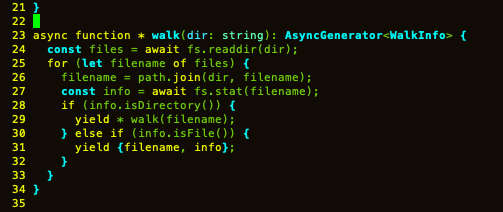
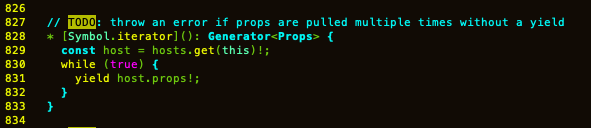
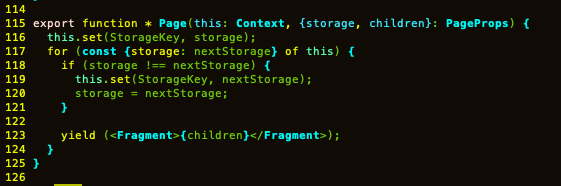
Update: I’ve been trying out spaces-around for generator stars and I am disturbed by how much I dislike it. Subjectively, I feel like it’s distracting, and constructs like * [Symbol.iterator] just feel unnatural. I’ll keep trying it to see if I get used to it, but I think I’m going to say I prefer spaces-before over spaces-around. Notice how my syntax highlighting sucks though, maybe that has something to do with it. I dunno.
The people in this issue also use generators regularly right? This isn’t just some idle intellectual posturing, right? 😈
brainkim
on 21 Feb 2020
Related issues
 599316527
·
89Comments
599316527
·
89Comments
 bengry
·
273Comments
bengry
·
273Comments
 ikatyang
·
91Comments
ikatyang
·
91Comments
 Brian-Gaffney
·
107Comments
Brian-Gaffney
·
107Comments
 Swizec
·
81Comments
Swizec
·
81Comments
Most helpful comment
yield*does something whichyield x_cannot do_ for any expressionx. That is the distinction.return expressionreturns a value andreturn !expressionreturns a (different) value. Those are the same operation. You could just as well doexpression = !expression; return expressionand you would get the same effect. That's how expressions work.But
yield*is not like this. It is performing a _different operation_ thanyieldis. There is no value forexpression2which will makeyield expression2behave likeyield* expression1; you have to actually useyield*(or a loop).Honestly this argument is getting a little surreal, so I'm going to step away.
I do think we should format it the most obvious way! The easiest way to figure out what the most obvious way is is to look at what everyone defaults to. Everyone defaults to
function*andyield*. We should do that.I don't. A lot of people, evidently, don't. Reasonable people can disagree.