Online-go.com: Plurals not handled correctly for some languages
Describe the bug
Not all languages follow the 1 => singular, !1 => plural paradigm. One example is Russian where you use different plural forms depending on if the number ends in a 2/3/4 or not. However, looking at translate.ts, we do not take this into account, even though there is evidence that there were plans to do this (pluralidx(), storing the plural forms in an array).
To Reproduce
Steps to reproduce the behavior:
- Switch to Russian.
- Find a game with more than 4 captures:
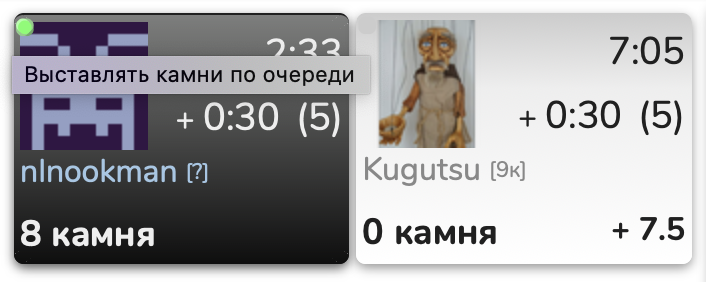
- Note that it says "камня" instead of "камней"
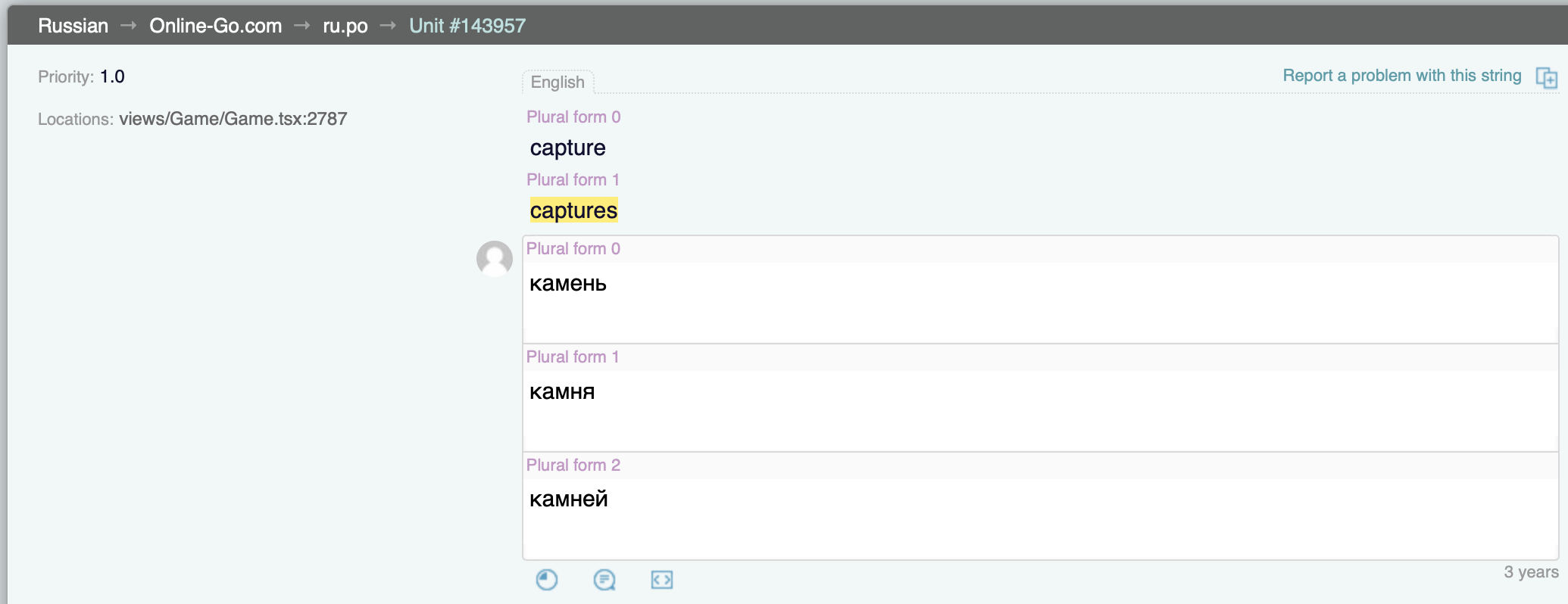
I don't actually speak Russian, but I think it should say the latter. In addition, note that the translators are putting in 2 plural forms, so nothing needs to change on the translation side:
 benjaminpjones
All 2 comments
Welcome to the rabbit hole ❤
 BHydden
on 2 Nov 2020
BHydden
on 2 Nov 2020
Okay, I took a look at the CLDR's Language Plural Rules and it looks like we support 7 languages that have more than 1 plural form. Here is a brief summary:
el : Greek : [one, other]
eo : Esperanto : [one, other]
en : English : [one, other]
vi : Vietnamese : [all]
ca : Catalan : [one, other]
it : Italian : [one, other]
cs : Czech : [one, few, many, other]
eu : Basque : [one, other]
et : Estonian : [one, other]
es : Spanish : [one, other]
ru : Russian : [one, few, many, other]
nl : Dutch : [one, other]
pt : Portuguese : [one, other]
zh-tw : Chinese (Traditional) : [all]
tr : Turkish : [one, other]
zh-cn : Chinese (Simplified) : [all]
ro : Romanian : [one, few, other]
pl : Polish : [one, few, many, other]
fr : French : [one or zero, other]
hr : Croatian : [one, few, other]
de : German : [one, other]
da : Danish : [one*, other]
fi : Finnish : [one, other]
hu : Hungarian : [one, other]
ja : Japanese : [all]
he : Hebrew : [one, two, many, other]
sr : Serbian : [one, few, other]
ko : Korean : [all]
sv : Swedish : [one, other]
uk : Ukrainian : [one, few, many, other]
Since there are only 9 different pluralidx functions that need to be written, I can do this by hand. However, if a more robust solution (i.e. third-party library) is preferred, let me know!
benjaminpjones
on 8 Nov 2020
Related issues
BHydden
·
4Comments
 alexmitrani
·
4Comments
alexmitrani
·
4Comments
 chaverly1
·
3Comments
chaverly1
·
3Comments
 LaurieLinz
·
5Comments
benjaminpjones
·
3Comments
LaurieLinz
·
5Comments
benjaminpjones
·
3Comments
Most helpful comment
Welcome to the rabbit hole ❤
https://youtu.be/0j74jcxSunY