Napari: Performance regression for many layers
🐛 Bug
As noted in https://forum.image.sc/t/viewer-add-points-significantly-slower-after-upgrade-to-v-0-4/45670/12?u=sofroniewn there was a significant regression in performance with many layers in #1360. I can confirm that it is due to the dynamic calculation of _extent_world https://github.com/napari/napari/blob/v0.4.0/napari/components/layerlist.py#L198 and _step_size https://github.com/napari/napari/blob/v0.4.0/napari/components/layerlist.py#L240 (and the computations they in turn trigger).
The dynamic calculation is very appealing in many ways, but also very time consuming. I'm not quite sure how to fix yet, but making this issue to discuss in more detail.
A minimal example to reproduce the problem is the following
import numpy as np
import napari
from time import time

data = []
for i in range(50):
    data.append(np.random.random((1000, 2)))

viewer = napari.components.ViewerModel()
for i, points in enumerate(data):
    # add the points
    start = time()
    viewer.add_points(points)
    end = time()
    print(f'run {i} in time {end - start}')
which note only runs with the ViewerModel and doesn't need the full Viewer
 sofroniewn
All 3 comments
This issue has been mentioned on Image.sc Forum. There might be relevant details there:
https://forum.image.sc/t/viewer-add-points-significantly-slower-after-upgrade-to-v-0-4/45670/13
 imagesc-bot
on 23 Nov 2020
imagesc-bot
on 23 Nov 2020
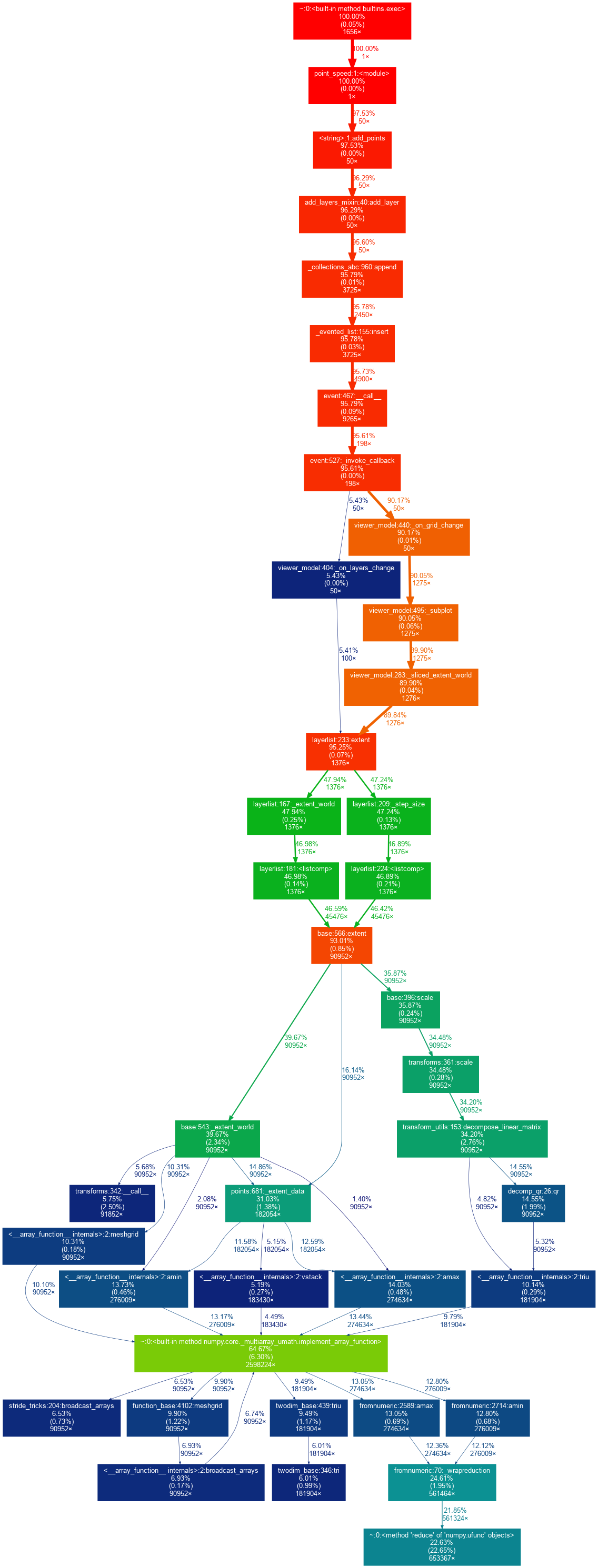
It looks like the same issue as #1885. Here pstat file and graph from the profiling script.
 Czaki
on 23 Nov 2020
Czaki
on 23 Nov 2020
I'm going to close this as the most significant regression is fixed, though we still have #1949 and #1950 in progress that could bring further speed enhancements
sofroniewn
on 28 Nov 2020
Related issues
 VolkerH
·
3Comments
VolkerH
·
3Comments
 jni
·
3Comments
Czaki
·
3Comments
jni
·
3Comments
Czaki
·
3Comments
 tlambert03
·
3Comments
sofroniewn
·
3Comments
tlambert03
·
3Comments
sofroniewn
·
3Comments
Most helpful comment
It looks like the same issue as #1885. Here pstat file and graph from the profiling script.
point_speed.zip