Machinelearning: Poor accuracy with non-US regional settings
System information
- OS Windows 10:
- .NET Core 2.2:
Issue
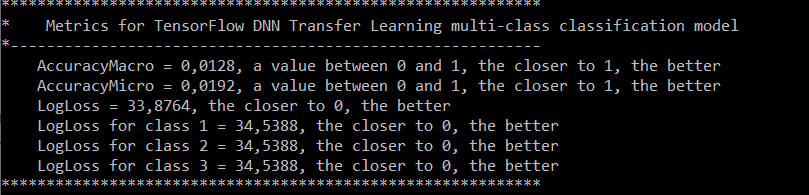
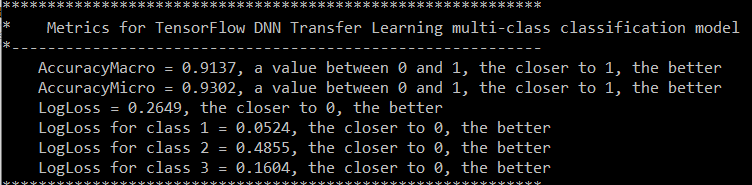
Getting poor accuracy running the training code on a system with non-US regional settings. The issue is number format. After replacing ',' as decimal symbol to '.' all works fine.
Accuracy with ',' decimal symbol:
Accuracy with '.' decimal symbol:
Is there some way to take a control of localization in .NET ML?
Thanks
Damir
 ddobric
All 6 comments
Hi Damir,
You bring up a very good edge case we shouldn't forget, which is that decimal points are represented with commas in a lot of regions outside the US, (For example, 3.5 * 10^1 is represented as 3.5 in the US and 3,5 in Europe, and 3.5 * 10^5 is represented as 350,000 in the US and 350.000 in Europe). We will look into this, thank you!
Edit: Another good edge case is the negative (-) sign. In some cultures (e.g. Faroese in Denmark), -1 is denoted as: −1. Here, the negative sign has ASCII value of 8722 (which is not on the normal ASCII table), and the default negative sign has ASCII value of 45. In addition, some cultures have text written from right to left (e.g. Arabic, Hebrew), so with these the negative sign will be to the right of the value (e.g. 3-, 4.05-).
 mstfbl
on 3 Mar 2020
mstfbl
on 3 Mar 2020
We may want to setup a CI leg which tests another culture. Perhaps "de-DE" or "ru-RU".
 justinormont
on 3 Mar 2020
justinormont
on 3 Mar 2020
How about this or similar?
MLContext ctx = new MLContext(.., culture: CultureInfo.InvariantCulure)
ddobric
on 5 Mar 2020
Here is a .NET Fiddle that demonstrates some of these cultural differences in .NET Core 3.1 (major thanks to @justinormont for the idea and the initial implementation): https://dotnetfiddle.net/LtAtoi
mstfbl
on 6 Mar 2020
Hey @ddobric , can you provide sample code and data for which you've used to obtain the difference in your results above? It'll be helpful in testing the validity of a PR to fix this issue. Thanks!
mstfbl
on 13 Apr 2020
Hi @ddobric, I'm reaching out again to ask if you can provide sample code and data with which you've encountered this issue. Thanks.
mstfbl
on 4 May 2020
Related issues
 aslotte
·
3Comments
aslotte
·
3Comments
 darren-zdc
·
3Comments
darren-zdc
·
3Comments
 pgovind
·
3Comments
pgovind
·
3Comments
 bs6523
·
4Comments
bs6523
·
4Comments
 daholste
·
3Comments
daholste
·
3Comments
Most helpful comment
We may want to setup a CI leg which tests another culture. Perhaps "de-DE" or "ru-RU".