Kibana: KQL: When using terms with dashes, I am warned about using Lucene syntax.
Kibana version: 7.2.0
Elasticsearch version: 7.2.0
Server OS version: Google Container OS / GKE 1.12.8-gke.10
Browser version: Firefox 68.0.1
Browser OS version: WIndows 10
Original install method (e.g. download page, yum, from source, etc.): Docker
Describe the bug:
Kibana mistakenly warns me that I am using Lucene syntax when I'm trying to use KQL.
Steps to reproduce:
- Use KQL
- Type
test-123helloin the query bar - Click "update"
Expected behavior:
Don't warn? I'm trying to use KQL! ;P
Is it possible that Kibana doesn't treat - (dash) as part of a term?
This also happens when I'm searching for a specific field with hostname values that have dashes, such as: beat.hostname:auditbeat-1234
Screenshots (if relevant):

 jordansissel
All 16 comments
Pinging @elastic/kibana-app
 elasticmachine
on 1 Aug 2019
elasticmachine
on 1 Aug 2019
cc @Bargs @TinaHeiligers
 timroes
on 1 Aug 2019
timroes
on 1 Aug 2019
@jordansissel If you're using KQL without using the drop down menu and want to omit the query field, please add your query term as a string (in quotation marks). Please try "test-123hello" rather than test-123hello and beat.hostname : "auditbeat-1234" rather than beat.hostname:auditbeat-1234.
If the query term is not provided as a string, we will get a syntax error:
_Incorrect syntax (unquoted):_

As a string, the query will be issued:
_Correct syntax (quoted):_

Please also note that when a field is not added, the input term will be matched against the default field in your index settings. If there isn't a default field, terms are matched against all fields. With KQL, the term needs to be provided as a string. For more information, please see https://www.elastic.co/guide/en/kibana/current/kuery-query.html.
KQL with autocomplete is there to help you with selecting valid fields and values in your index pattern. I highly encourage you to take advantage of selecting items from these drop downs:
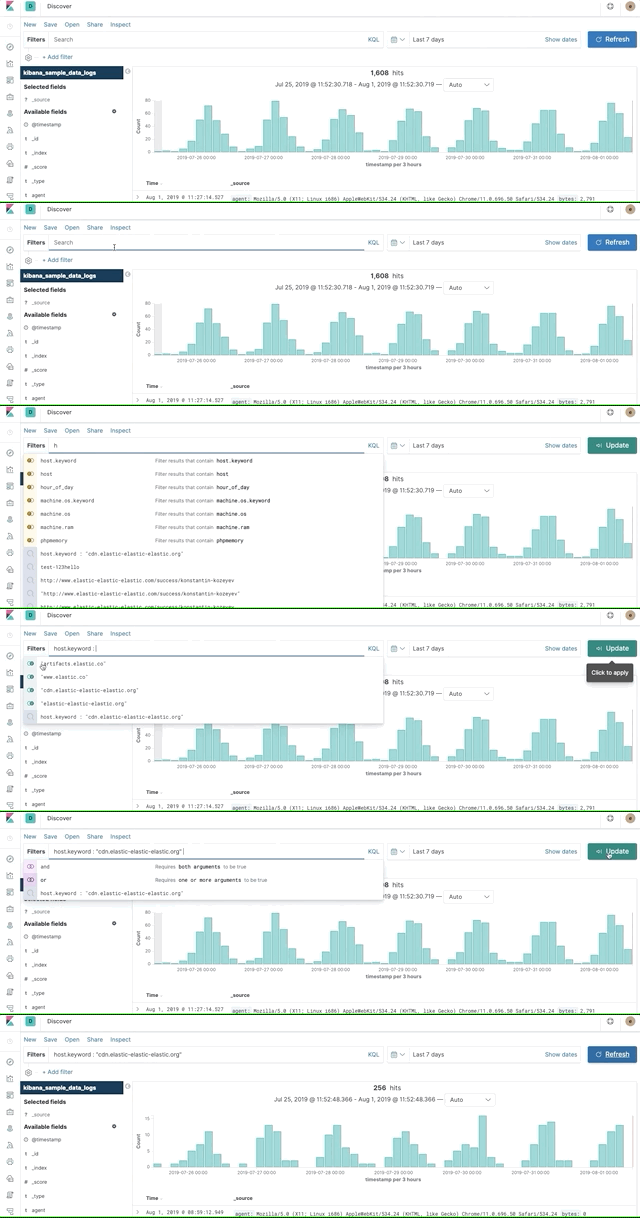
Please let us know if there are any issues otherwise I'm going to close this issue.
 TinaHeiligers
on 1 Aug 2019
TinaHeiligers
on 1 Aug 2019
There are definitely some edge cases where valid KQL queries will trigger our lucene detection. We could look into the possibility of fixing this particular edge case, but in general when a user runs into false positives like this we assume they know they're using KQL at that point and will hit the "Don't show again" button. This warning is really just to prevent the total beginner from using lucene on accident in the KQL query bar.
 Bargs
on 1 Aug 2019
Bargs
on 1 Aug 2019
@TinaHeiligers @Bargs thank you both for your excellent answers <3
jordansissel
on 2 Aug 2019
I am wondering, if we should fix those specific edge cases, or maybe consider, since we made KQL the default in 7.0, that we could remove the warning completely in 8.0, assuming KQL is our default and we don't treat Lucene queries with a high enough priority anymore to trigger false positive errors for KQL users.
timroes
on 2 Aug 2019
I was wondering why it kept saying this!
Query: user-id:10
It looks like you may be trying to use Lucene query syntax, although you have Kibana Query Language (KQL) selected. Please review the KQL docs here.
 montanaflynn
on 23 Jan 2020
montanaflynn
on 23 Jan 2020
Pinging @elastic/kibana-app-arch (Team:AppArch)
elasticmachine
on 20 Feb 2020
Recently came across this bug in Kibana 7.8.1
 iankoetter
on 2 Sep 2020
iankoetter
on 2 Sep 2020
Even worse, you can't mix hyphens and wildcards it seems, e.g. none of these work:
hostname:*-stuff-*
hostname:"*-stuff-*"
hostname:*"-stuff-"*
 nyetwurk
on 5 Sep 2020
nyetwurk
on 5 Sep 2020
@nyetwurk if you put * inside your quotes, it is interpreted as a literal asterisk * and not a wildcard
 rw-access
on 19 Sep 2020
rw-access
on 19 Sep 2020
@nyetwurk if you put
*inside your quotes, it is interpreted as a literal asterisk*and not a wildcard
hostname:*"-stuff-"* and hostname:*"-"stuff"-"* should work then. They do not.
nyetwurk
on 19 Sep 2020
Those are surrounded by quotes, so * is not interpreted as a wildcard.
rw-access
on 19 Sep 2020
Those are surrounded by quotes, so
*is not interpreted as a wildcard.
No, they are not. The *'s are not inside of the quotes.
nyetwurk
on 19 Sep 2020
Sorry I think I chose words poorly. By "surrounded by quotes," I meant to say "in a quoted string.". Like "this*example", not like this*example. I'm sorry for the confusion.
And for this example: hostname:*"-stuff-"* looks like invalid syntax, but it does look like a clever idea.
rw-access
on 19 Sep 2020
Considering things like foo-bar-baz are a common pattern (e.g in index patterns), having a way to do *-bar-* seems like a pretty obvious requirement.
nyetwurk
on 19 Sep 2020
Related issues
 cafuego
·
3Comments
cafuego
·
3Comments
 LukeMathWalker
·
3Comments
LukeMathWalker
·
3Comments
 tbragin
·
3Comments
tbragin
·
3Comments
 treussart
·
3Comments
treussart
·
3Comments
 MaartenUreel
·
3Comments
MaartenUreel
·
3Comments
Most helpful comment
Considering things like
foo-bar-bazare a common pattern (e.g in index patterns), having a way to do*-bar-*seems like a pretty obvious requirement.