Ingress-nginx: traffic imbalance issue with lua balancer / default ingress-nginx load balancing
Is this a request for help? (If yes, you should use our troubleshooting guide and community support channels, see https://kubernetes.io/docs/tasks/debug-application-cluster/troubleshooting/.):
What keywords did you search in NGINX Ingress controller issues before filing this one? (If you have found any duplicates, you should instead reply there.):
Is this a BUG REPORT or FEATURE REQUEST? (choose one):
Bug
NGINX Ingress controller version:
0.23.0
Kubernetes version (use kubectl version):
1.11.6
Environment:
- Cloud provider or hardware configuration:
- OS (e.g. from /etc/os-release): Debian GNU/Linux 9 (stretch) (kops image)
- Kernel (e.g.
uname -a): Linux ip-172-18-76-224 4.9.0-7-amd64 #1 SMP Debian 4.9.110-3+deb9u2 (2018-08-13) x86_64 GNU/Linux - Install tools: Kops
- Others:
What happened:
On our production cluster, we found there is a severe traffic imbalance with lua balancer when there are many pods. For example when we have 50pods, I found only top 20% of pods are getting traffics and thus suffering from probe failures and crash loop back offs.
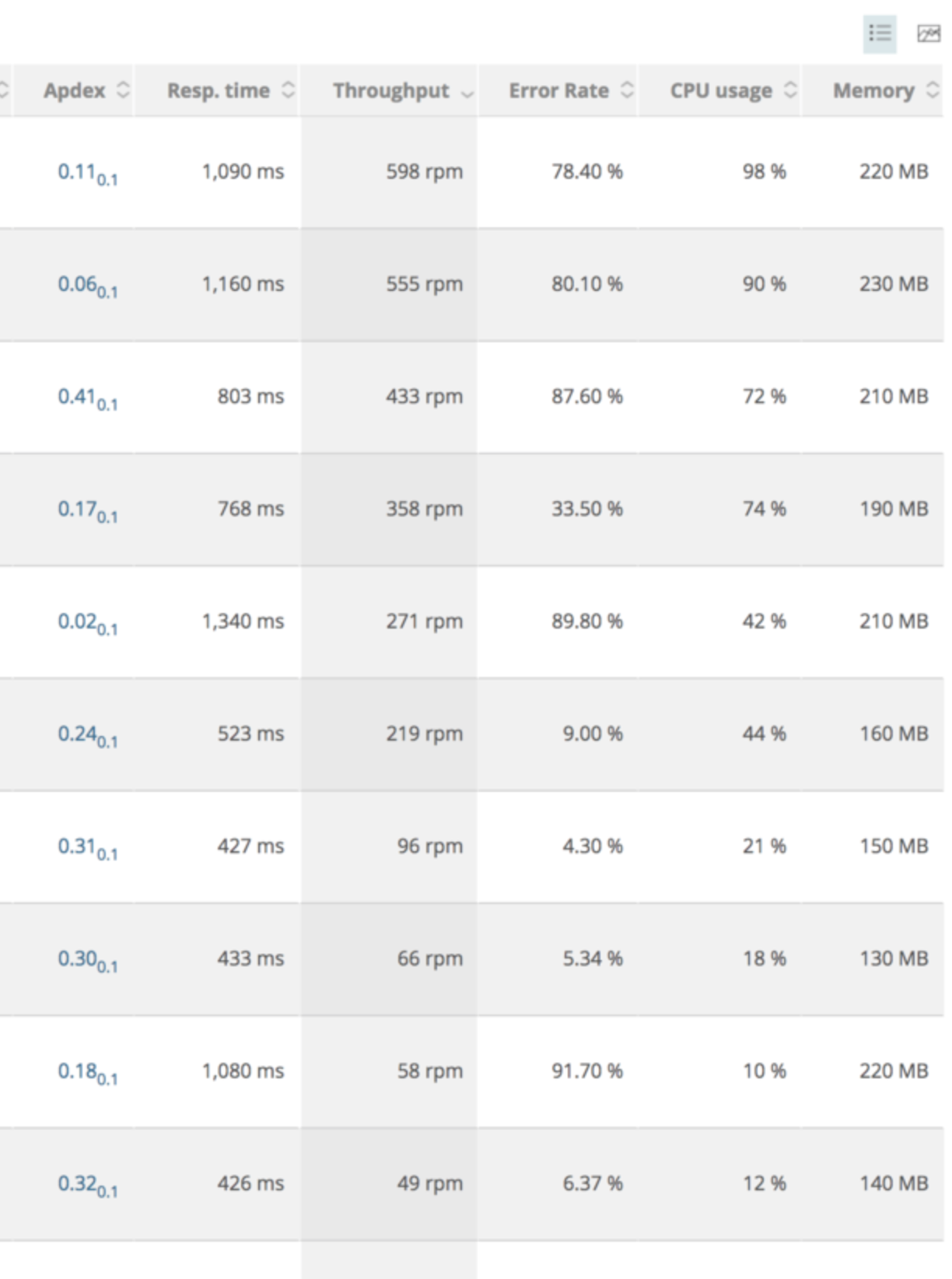
The following two metrics show the severe traffic imbalance across the pods.
Throughput across the pods (sorted by rpm)
Not shown in this pic but the half of the pods at the bottom were actually getting almost no traffic.
Piechart of a incoming traffic(# of access logs). top 5pods were getting over 50% of whole traffic whereas 36 "other" pods were getting almost no traffic
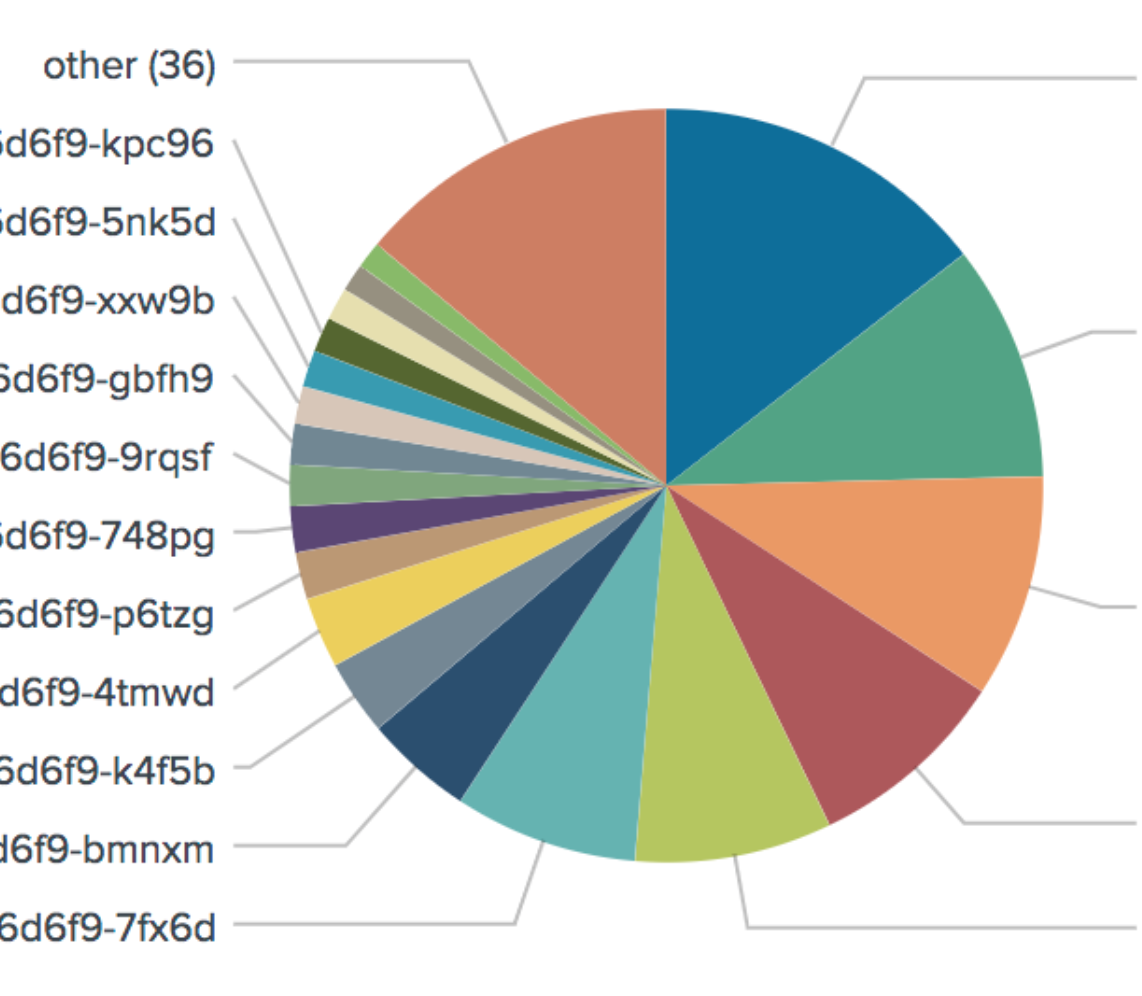
One interesting aspect was that, the traffic was always concentrated onto those specific pods even after the probe failures and restart events as if there is some stickiness, and the traffic had never been balanced no matter how long I waited.
We found all the internal services (i.e., services with http://<service_name>.<namespace> inside the kubernetes cluster) were working great, and then later I realized after speaking with @aledbf on slack and reading through the doc that ingress nginx does not use kube-proxy for load balancing.
So we decided to enable service-upstream annotation for all the ingress entries so we can force ingress-nginx to use iptables for load balancing.
This is the piechart after we applied the annotation.
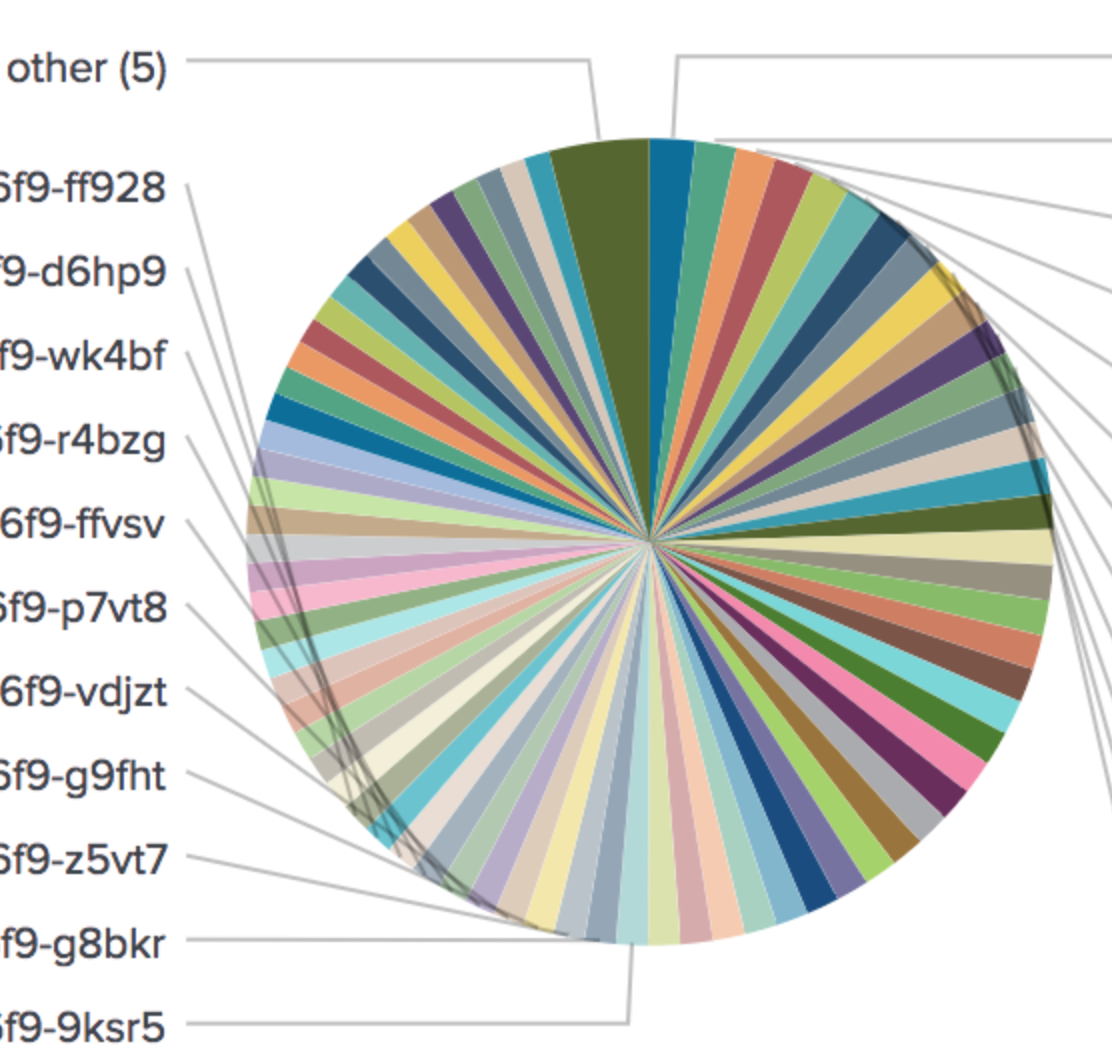
We verified the behavior using new debugging tool dbg by printing out the endpoints
/dbg backends get <service-upstream>
when the upstream is a set of Pod IPs we see the traffic imbalance, and the balancing normalizes when it is pointing at one service endpoint after applying service-upstream
Is this a known issue or do you have any clue why this is possibly happening?
What you expected to happen:
Lua balancer should perform similar traffic balance as kube-proxy load balancing.
How to reproduce it (as minimally and precisely as possible):
Remove service-upstream annotation
Anything else we need to know:
One thing may worth mentioning is that the traffic I mentioned above is not a public user traffic directly hitting our k8s cluster, but it is curl requests from our datacenter.
Public        Datacenter               AWS K8S
------        ----------               -------

               Host 1
users  ->  LB  Host 2(curl) -> app.foo.com(Ingress-Nginx)
               Host n
Not sure if lua loadbalancer would have yielded different result if that was organic public traffic.
 dmxlsj
All 24 comments
@dmxlsj please the ingress definition you are using for this test
 aledbf
on 18 Apr 2019
aledbf
on 18 Apr 2019
Hi @aledbf, sure this is the ingress.
apiVersion: extensions/v1beta1
kind: Ingress
metadata:
  annotations:
    kubernetes.io/ingress.class: nginx
    nginx.ingress.kubernetes.io/configuration-snippet: |
      if ($http_x_is_testing_pool = "1") {
        set $proxy_upstream_name "$namespace-$service_name-testing-$service_port";
      }
    nginx.ingress.kubernetes.io/proxy-buffer-size: 16k
    nginx.ingress.kubernetes.io/proxy-buffering: "on"
  name: www-private-ingress
  namespace: app
spec:
  rules:
  - host: foo.privatesvc.net
    http:
      paths:
      - backend:
          serviceName: app-private
          servicePort: 80
        path: /svc
      - backend:
          serviceName: app-private-testing
          servicePort: 80
        path: /-testing-/svc
The logic is when the requests hit the datacenter (please see the diagram above), it first determines if this is a part of testing pool and if so, we append X-Is-Testing-Pool: 1 header.
When the request hits Kubernetes Ingress-nginx, it checks if it has the header and override the $proxy_upstream_name to point at app-private-testing svc.
So Inside the nginx.conf, it would look like the following.
        set $proxy_upstream_name    "app-app-private-80";
        set $proxy_host             $proxy_upstream_name;
        ...
        proxy_buffering                         on;
        proxy_buffer_size                       16k;
        proxy_buffers                           4 16k;
        proxy_request_buffering                 on;
        ...
        if ($http_x_is_testing_pool = "1") {
            set $proxy_upstream_name "$namespace-$service_name-testing-$service_port";
        }

        proxy_pass http://upstream_balancer;
        proxy_redirect                          off;
Other than this, I believe the ingress config seems pretty straightforward.
dmxlsj
on 18 Apr 2019
Other than this, I believe the ingress config seems pretty straightforward.
Well, not really, basically, you are changing the normal behavior of the lua balancing.
aledbf
on 18 Apr 2019
@ElvinEfendi can you take a look, please?
aledbf
on 18 Apr 2019
Can you try without that configuration snippet to see if the distribution is better?
Also you can use canary feature of ingress-nginx to achieve that in a tested and cleaner way: https://kubernetes.github.io/ingress-nginx/user-guide/nginx-configuration/annotations/#canary
 ElvinEfendi
on 18 Apr 2019
ElvinEfendi
on 18 Apr 2019
Thanks @aledbf and @ElvinEfendi ,
I think we tried it without configuration snippet before but for sure I will try it again today.
Yeah. we are aware of the new canary annotation, but actually that x-is-testing-pool header for us is to shape the traffic between users and bots so it has been a long-term logic although there is a consolidation effort now.
dmxlsj
on 18 Apr 2019
Have you verified these stats using something else than NewRelic?
The instance overview can't to be trusted, it includes pods that have long been terminated. The tool isn't made for hostnames to be changing.
 joekohlsdorf
on 19 Apr 2019
joekohlsdorf
on 19 Apr 2019
Hi @joekohlsdorf
Yes we've verified this across multiple apm/toolings/manual testings. for example the piechart above is the splunk access log not the APM. Above all, the performance difference is very visible when you watch k8s pod events.
dmxlsj
on 19 Apr 2019
I ran a small load testing today against the endpoints after removing the configuration snippet.
The ingress is now as simple as the following.
apiVersion: extensions/v1beta1
kind: Ingress
metadata:
  annotations:
    kubernetes.io/ingress.class: nginx
  name: app-load-test
  namespace: app
spec:
  rules:
  - host: app-load-test.foo.com
    http:
      paths:
      - backend:
          serviceName: app-load-test
          servicePort: 80
        path: /target
I set 100 replicas with minimum of 1vCPU/512Mi per pod.
- Using
service-upstreamannotation. (kube-proxy)
In average, 520rps and 145ms response time
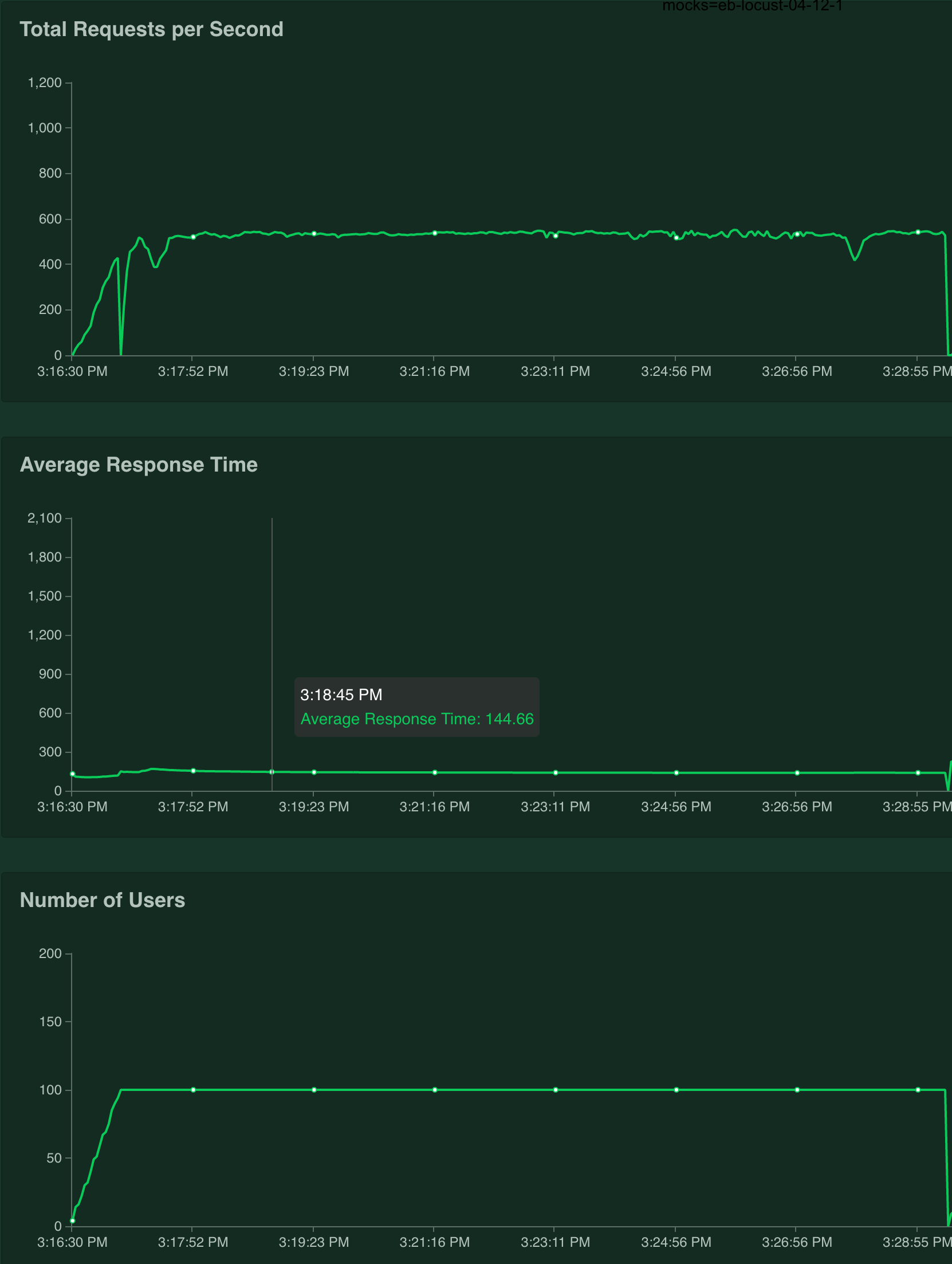
Piechart of accesses for initial 15mins.
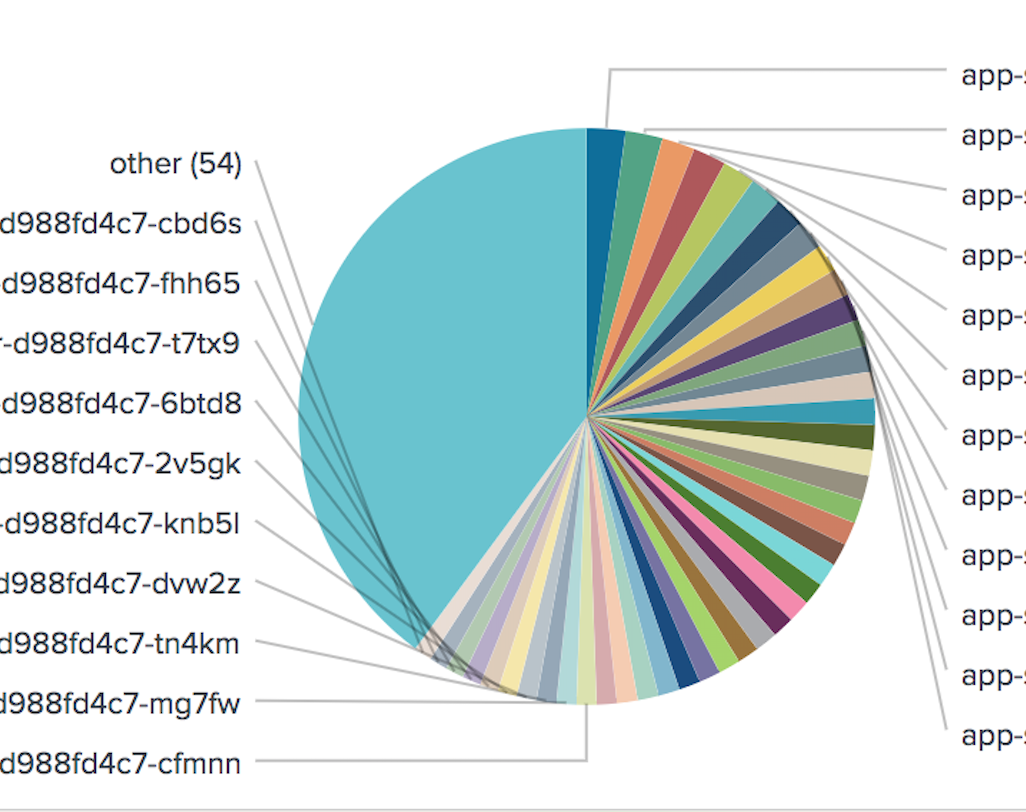
balance based on access log.
app-load-test-d988fd4c7-mp2nc | 1314
app-load-test-d988fd4c7-cp7rp | 1270
app-load-test-d988fd4c7-gvw92 | 834
app-load-test-d988fd4c7-hzz7k | 813
app-load-test-d988fd4c7-mrmm5 | 773
app-load-test-d988fd4c7-qhfbm | 753
app-load-test-d988fd4c7-nz2vc | 707
app-load-test-d988fd4c7-f9vsm | 667
app-load-test-d988fd4c7-zvdr5 | 647
app-load-test-d988fd4c7-fdknz | 627
app-load-test-d988fd4c7-w2d9v | 622
app-load-test-d988fd4c7-kzk8m | 618
app-load-test-d988fd4c7-mk488 | 616
app-load-test-d988fd4c7-jddwh | 614
app-load-test-d988fd4c7-kxqmv | 613
app-load-test-d988fd4c7-jq6x4 | 612
app-load-test-d988fd4c7-k2x79 | 610
app-load-test-d988fd4c7-7k84n | 606
app-load-test-d988fd4c7-m4pzd | 600
app-load-test-d988fd4c7-fbpcp | 592
app-load-test-d988fd4c7-75bxb | 585
app-load-test-d988fd4c7-9xk7s | 579
app-load-test-d988fd4c7-r7dzw | 557
app-load-test-d988fd4c7-8zh4v | 549
app-load-test-d988fd4c7-wcgfw | 534
app-load-test-d988fd4c7-mg7fw | 532
app-load-test-d988fd4c7-95xhn | 531
app-load-test-d988fd4c7-q49tb | 530
app-load-test-d988fd4c7-vpq8x | 522
app-load-test-d988fd4c7-s97ck | 517
app-load-test-d988fd4c7-4dd68 | 512
app-load-test-d988fd4c7-tklbt | 507
app-load-test-d988fd4c7-9xj6w | 506
app-load-test-d988fd4c7-vfflp | 504
app-load-test-d988fd4c7-cbd6s | 495
app-load-test-d988fd4c7-thmsh | 488
app-load-test-d988fd4c7-knb5l | 481
app-load-test-d988fd4c7-726nw | 478
app-load-test-d988fd4c7-zptmv | 473
app-load-test-d988fd4c7-krrch | 470
app-load-test-d988fd4c7-fhh65 | 459
app-load-test-d988fd4c7-dvw2z | 443
app-load-test-d988fd4c7-cfmnn | 440
app-load-test-d988fd4c7-xm2v5 | 438
app-load-test-d988fd4c7-vv68z | 436
app-load-test-d988fd4c7-t7tx9 | 435
app-load-test-d988fd4c7-4fxz5 | 429
app-load-test-d988fd4c7-dxw49 | 426
app-load-test-d988fd4c7-zcn67 | 425
app-load-test-d988fd4c7-c97jj | 423
app-load-test-d988fd4c7-r8wxx | 419
app-load-test-d988fd4c7-ww8vb | 418
app-load-test-d988fd4c7-n8w6j | 415
app-load-test-d988fd4c7-njr8t | 409
app-load-test-d988fd4c7-k2bh9 | 408
app-load-test-d988fd4c7-5xc2n | 403
app-load-test-d988fd4c7-qdvsp | 398
app-load-test-d988fd4c7-z49fm | 391
app-load-test-d988fd4c7-m4j8t | 390
app-load-test-d988fd4c7-hvckj | 386
app-load-test-d988fd4c7-qwcbd | 383
app-load-test-d988fd4c7-8vfxl | 367
app-load-test-d988fd4c7-bfs67 | 361
app-load-test-d988fd4c7-p76cx | 352
app-load-test-d988fd4c7-8nbhm | 348
app-load-test-d988fd4c7-cb4kq | 348
app-load-test-d988fd4c7-n5hdr | 347
app-load-test-d988fd4c7-6btd8 | 344
app-load-test-d988fd4c7-wzj74 | 335
app-load-test-d988fd4c7-tn4km | 334
app-load-test-d988fd4c7-kbmsv | 333
app-load-test-d988fd4c7-v7jh5 | 332
app-load-test-d988fd4c7-6wtg7 | 328
app-load-test-d988fd4c7-d9w9z | 328
app-load-test-d988fd4c7-wqhqv | 315
app-load-test-d988fd4c7-2v5gk | 312
app-load-test-d988fd4c7-rkm4d | 311
app-load-test-d988fd4c7-sm9zk | 305
app-load-test-d988fd4c7-qb7sl | 301
app-load-test-d988fd4c7-qtr8j | 299
app-load-test-d988fd4c7-ffgj6 | 294
app-load-test-d988fd4c7-t47z2 | 294
app-load-test-d988fd4c7-ckkb9 | 274
app-load-test-d988fd4c7-j7mkr | 273
app-load-test-d988fd4c7-4srx8 | 268
app-load-test-d988fd4c7-9cl9h | 264
app-load-test-d988fd4c7-jhhnl | 264
app-load-test-d988fd4c7-zw9vh | 260
app-load-test-d988fd4c7-cdhnk | 239
app-load-test-d988fd4c7-bs5rg | 235
app-load-test-d988fd4c7-9d8ml | 223
app-load-test-d988fd4c7-rc5kv | 223
app-load-test-d988fd4c7-xzwsx | 212
app-load-test-d988fd4c7-8x85s | 209
app-load-test-d988fd4c7-cl862 | 177
app-load-test-d988fd4c7-d4mvx | 171
app-load-test-d988fd4c7-x9qcn | 158
app-load-test-d988fd4c7-76zht | 152
- Without
service-upstreamannotation (lua balancer)
In average, 110rps and 960ms response time.
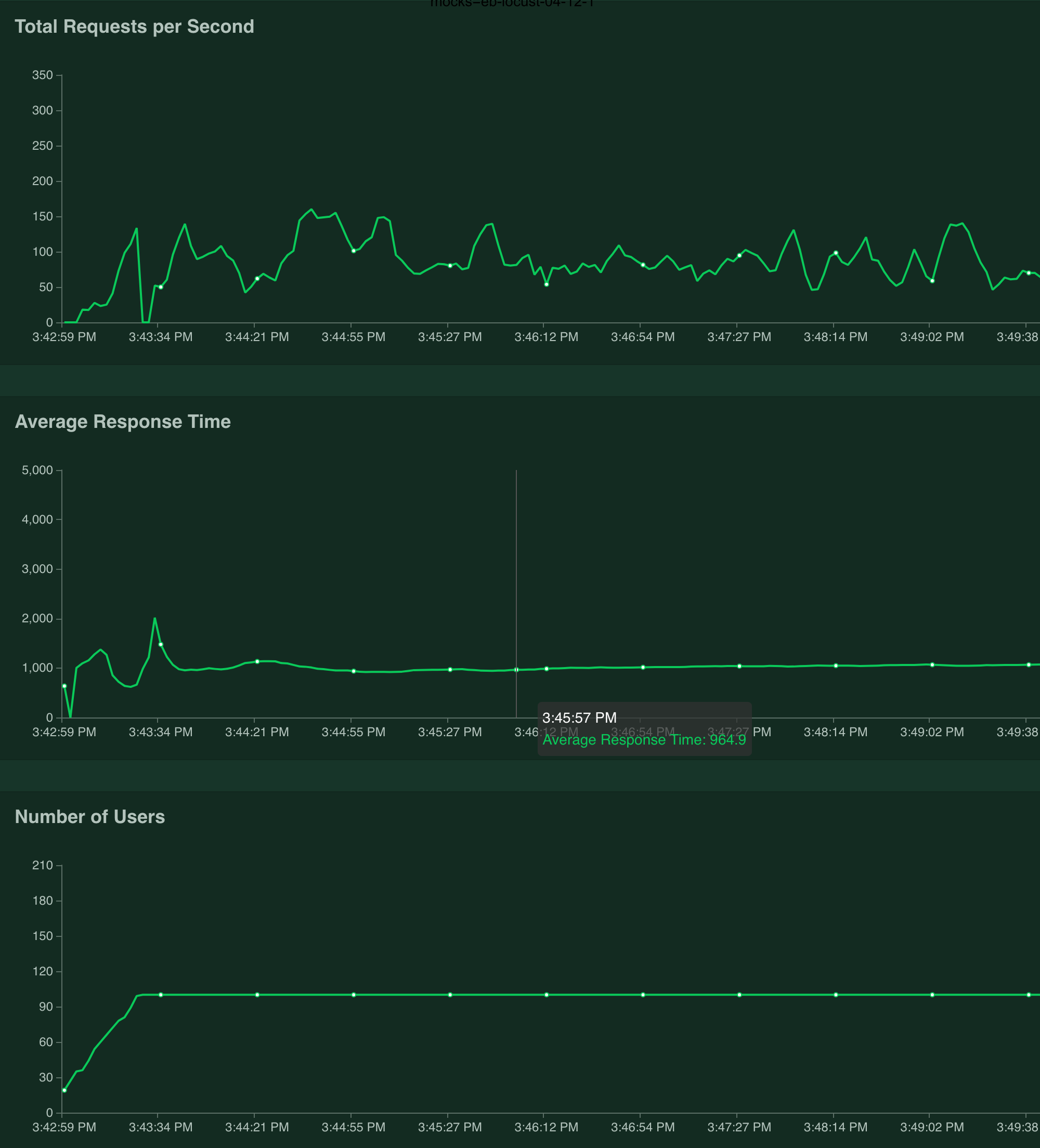
Piechart of accesses logs for initial 15mins.
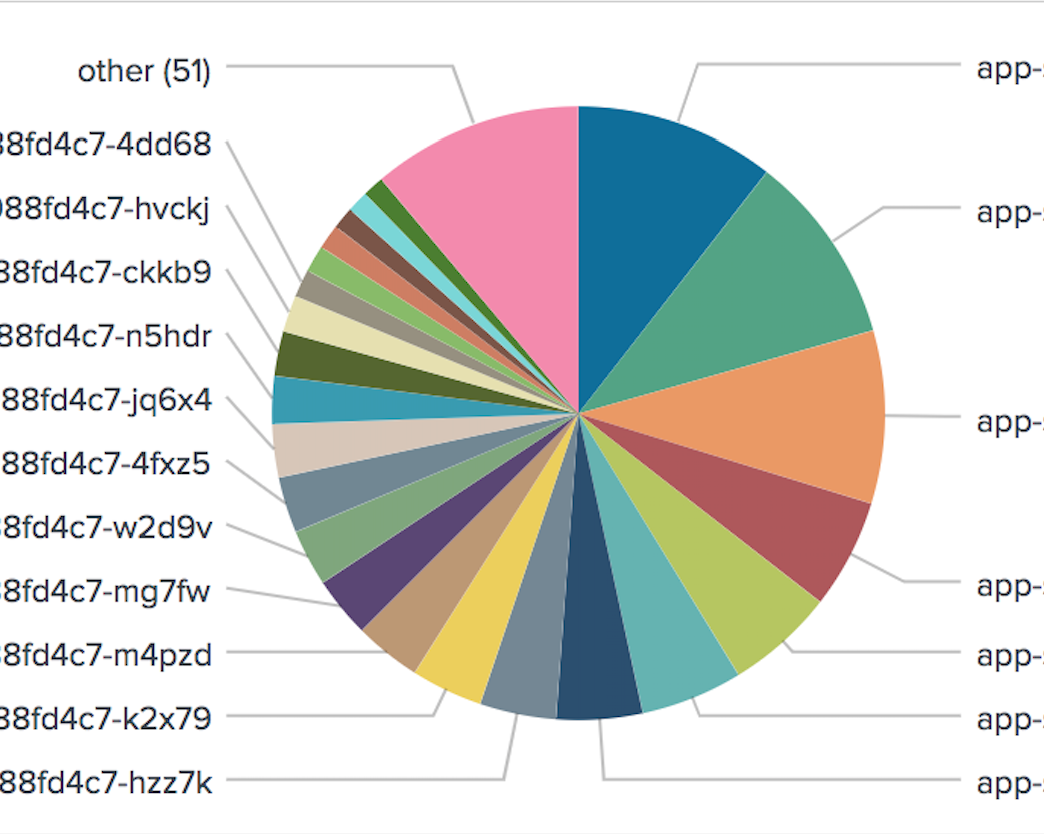
and balance based on access log.
app-load-test-d988fd4c7-gvw92 | 880
app-load-test-d988fd4c7-dxw49 | 842
app-load-test-d988fd4c7-mk488 | 761
app-load-test-d988fd4c7-j7mkr | 483
app-load-test-d988fd4c7-qwcbd | 478
app-load-test-d988fd4c7-f9vsm | 449
app-load-test-d988fd4c7-bfs67 | 379
app-load-test-d988fd4c7-hzz7k | 337
app-load-test-d988fd4c7-k2x79 | 315
app-load-test-d988fd4c7-m4pzd | 293
app-load-test-d988fd4c7-mg7fw | 268
app-load-test-d988fd4c7-w2d9v | 250
app-load-test-d988fd4c7-4fxz5 | 247
app-load-test-d988fd4c7-jq6x4 | 235
app-load-test-d988fd4c7-n5hdr | 209
app-load-test-d988fd4c7-ckkb9 | 198
app-load-test-d988fd4c7-hvckj | 161
app-load-test-d988fd4c7-4dd68 | 122
app-load-test-d988fd4c7-ww8vb | 118
app-load-test-d988fd4c7-kxqmv | 109
app-load-test-d988fd4c7-z49fm | 98
app-load-test-d988fd4c7-kzk8m | 94
app-load-test-d988fd4c7-thmsh | 94
app-load-test-d988fd4c7-bs5rg | 79
app-load-test-d988fd4c7-rc5kv | 63
app-load-test-d988fd4c7-9xk7s | 56
app-load-test-d988fd4c7-6btd8 | 54
app-load-test-d988fd4c7-wcgfw | 44
app-load-test-d988fd4c7-9d8ml | 42
app-load-test-d988fd4c7-nz2vc | 39
app-load-test-d988fd4c7-wzj74 | 38
app-load-test-d988fd4c7-7k84n | 24
app-load-test-d988fd4c7-cfmnn | 24
app-load-test-d988fd4c7-cdhnk | 22
app-load-test-d988fd4c7-fhh65 | 21
app-load-test-d988fd4c7-kbmsv | 20
app-load-test-d988fd4c7-m4j8t | 20
app-load-test-d988fd4c7-vv68z | 20
app-load-test-d988fd4c7-zvdr5 | 20
app-load-test-d988fd4c7-8vfxl | 19
app-load-test-d988fd4c7-2v5gk | 18
app-load-test-d988fd4c7-cbd6s | 18
app-load-test-d988fd4c7-8x85s | 17
app-load-test-d988fd4c7-jhhnl | 17
app-load-test-d988fd4c7-xm2v5 | 16
app-load-test-d988fd4c7-zptmv | 16
app-load-test-d988fd4c7-dvw2z | 15
app-load-test-d988fd4c7-krrch | 15
app-load-test-d988fd4c7-t7tx9 | 15
app-load-test-d988fd4c7-vpq8x | 15
app-load-test-d988fd4c7-5xc2n | 14
app-load-test-d988fd4c7-6wtg7 | 12
app-load-test-d988fd4c7-qdvsp | 12
app-load-test-d988fd4c7-qpj56 | 11
app-load-test-d988fd4c7-tklbt | 10
app-load-test-d988fd4c7-75bxb | 9
app-load-test-d988fd4c7-95xhn | 9
app-load-test-d988fd4c7-mrmm5 | 9
app-load-test-d988fd4c7-vfflp | 9
app-load-test-d988fd4c7-c97jj | 8
app-load-test-d988fd4c7-d4mvx | 8
app-load-test-d988fd4c7-d9w9z | 7
app-load-test-d988fd4c7-p76cx | 7
app-load-test-d988fd4c7-r7dzw | 7
app-load-test-d988fd4c7-v7jh5 | 7
app-load-test-d988fd4c7-tn4km | 5
app-load-test-d988fd4c7-726nw | 3
app-load-test-d988fd4c7-8zh4v | 3
app-load-test-d988fd4c7-k2bh9 | 3
app-load-test-d988fd4c7-r8wxx | 3
app-load-test-d988fd4c7-q49tb | 2
app-load-test-d988fd4c7-9xj6w | 1
app-load-test-d988fd4c7-s97ck | 1
app-load-test-d988fd4c7-sslb5 | 1
Besides the severe traffic imbalance, there are 74 pods which means there are 26 pods which didn't get any traffic when using lua balancer
dmxlsj
on 19 Apr 2019
Hi @dmxlsj you are in good company 😄 we are experiencing the same behaviour in our cluster for services with a number of pods bigger than 50...
We are trying to replicate and debug this issue and so far found the same behaviour you described: as soon as a deployment is scaled out or in, the number of requests is not balanced between all pods, but the whole traffic is sent to a subset of pods.
May I ask what balancing algorithm are you using?
We specified the algo in the configMap so we expect the NGINX to be configured with round_robin balancing (https://kubernetes.github.io/ingress-nginx/user-guide/nginx-configuration/configmap/#load-balance).
 inge4pres
on 24 May 2019
inge4pres
on 24 May 2019
@dmxlsj @inge4pres please disable reuse-port and try again. This setting is enabled by default, helping in cases with high load, avoiding ports exhaustion and waits
aledbf
on 24 May 2019
Hi @aledbf thanks for your hint, I don't see any correlation between the effect of traffic imbalance and the parameter you posted, can you please elaborate on that?
inge4pres
on 24 May 2019
@dmxlsj after some debugging of the LUA code and some tests we switched to the ewma load-balancing algorithm by configuring it in the annotation
apiVersion: extensions/v1beta1
kind: Ingress
metadata:
  name: my-ingress
  namespace: my-ns
  annotations:
    ingress.kubernetes.io/load-balance: "ewma"
...
and this solved our issue with traffic imbalance while keeping the stickiness feature that would be otherwise lost using service-upstream. Hope this helps...
We also found a possible bug in the LUA round-robin balancer code that is a _reprise_ of a previous issue: we will write some tests and try to come up with a fix for it.
inge4pres
on 24 May 2019
Hello there, I'd like to give more context around my statement in previous comment.
We believe the current round robin implementation is not suitable for a production environment: because the list of IPs returned by the k8s endpoint API is always ordered in the same way, the round_robin algorithm generates a table that is exactly the same for all instances of ingress pods.
This results in the first IPs in the list to receive more requests that the last because the requests that are balanced on multiple ingress pods all gets routed at the first, then second, then third item and so on...
This results in overloading some pods while leaving others with less requests to handle, hence generating the graphs shown by @dmxlsj.
We already found this behaviour in the NGINX C implementation of the round robin algorithm; since the code to perform the balancing is now in Lua, I tried so hard to replicate the same logic here
https://github.com/inge4pres/ingress-nginx/blob/issues/4023/rootfs/etc/nginx/lua/util.lua#L90
but as you will see if you checkout that branch, tests fail because the resulting shuffled table is nil.
I was reading the Lua manual for the past day and could not really do more than this, so before opening a PR I'd love to hear your opinion on the code and on the overall approach to this issue.
Thank you
inge4pres
on 25 May 2019
@inge4pres correct me if I'm wrong but that can happen only if Nginx workers constantly reload and the list of endpoints change. Because when that happens we reinit roundrobin balancer instance which means setting last_id to nil (https://github.com/openresty/lua-resty-balancer/blob/0fb8a792ca69a3769b358fb489e2fb36c183bb6e/lib/resty/roundrobin.lua#L71) which in its turn means start from the first element in the list. Only and only in this case we can see what you describe.
If that's not the case, maybe we have a bug in https://github.com/kubernetes/ingress-nginx/blob/dfa7f10fc9691a3be90fd30cb458b64b617ef440/rootfs/etc/nginx/lua/balancer/resty.lua#L17 that always returns true for some reason (a.k.a thinks the list of endpoints changed) and therefore reinits roundrobin instance.
I'll add some info logging in there to give some visibility.
ElvinEfendi
on 26 May 2019
Also we have e2e test covering round robing load balancing functionality in test/e2e/loadbalance/round_robin.go, feel free to try to regenerate this issue with that.
ElvinEfendi
on 26 May 2019
Hi @ElvinEfendi thanks for the follow up on this and the additional info.
We are seeing this issue only during rollout of a Deployment, when the list of backend.endpoints is updated continuously by the deployment controller and hence the NGINX backends list refreshed.
I looked into the e2e tests for round robin and yes it is correctly distributing evenly the requests, I'm not arguing the algorithm _per se_ in the single ingress instance, only that it can be a problem if the list is exactly the same for multiple ingress instances, which seems to be the case.
Imagine the scenario where you have an ingress deployment of 50 pods sending requests to a backend with 5 pod: during a deployment rollout, as soon as the config changes, all first 50 requests coming in each ingress pod are routed to the first pod in the backend list; at first glance this might seem innocuous although if the service is tuned for 10 concurrent requests and suddenly gets 50 requests it might overload. This gets repeated for all the times the rollout updates its state so the overload goes even worse.
Personally I have not enough Lua skills (yet! 😄) to help debugging/improving this, so we can only report the same data provided by @dmxlsj (showing that during a deployment some pods are routed with more requests, some with less)
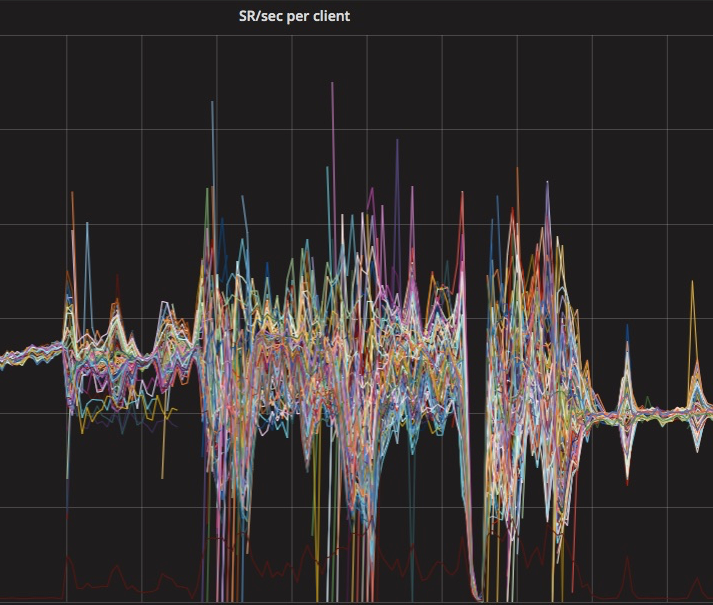
and suggest to reimplement in the round_robin module a shuffle of the pods list before using it as list of IPs to balance.
inge4pres
on 26 May 2019
Thanks for more context @inge4pres. We are still not sure whether this is the reason why the original OP in this thread is seeing the issue but I agree that we should fix the scenario you described above.
I created https://github.com/openresty/lua-resty-balancer/pull/26 to tackle it.
ElvinEfendi
on 26 May 2019
Agree with you both in putting this behind a flag and thanks for the new issue!
I'll follow up in there and see if I can help 😄
inge4pres
on 26 May 2019
@dmxlsj @inge4pres please test quay.io/kubernetes-ingress-controller/nginx-ingress-controller:dev
That image contains #4225 (with the fix @ElvinEfendi mentioned)
aledbf
on 25 Jun 2019
Hello @aledbf and all,
I apologize for my late response, but is the dev tag still valid? I am considering to upgrade nginx container to 0.25.0 this week, so I wonder if that dev tag fix is included in 0.25.0
dmxlsj
on 16 Jul 2019
@dmxlsj yes, please use 0.25.0.
aledbf
on 16 Jul 2019
Thanks, I will test lua balancer and let you know.
dmxlsj
on 16 Jul 2019
Closing. Please update to 0.26.0 and reopen the issue if the problem persists.
aledbf
on 28 Sep 2019
Related issues
 jwfang
·
3Comments
jwfang
·
3Comments
 c-mccutcheon
·
3Comments
c-mccutcheon
·
3Comments
 sophaskins
·
3Comments
sophaskins
·
3Comments
 yuyang0
·
3Comments
yuyang0
·
3Comments
 cehoffman
·
3Comments
cehoffman
·
3Comments
Most helpful comment
Thanks for more context @inge4pres. We are still not sure whether this is the reason why the original OP in this thread is seeing the issue but I agree that we should fix the scenario you described above.
I created https://github.com/openresty/lua-resty-balancer/pull/26 to tackle it.