Gliden64: Having copy auxiliary buffers to RDRAM enabled causes some graphical issues in games
With the option "Copy auxiliary buffers to RDRAM" enabled, Conker's shadow in CBFD is broken. What is this option useful for again?
 fzurita
All 7 comments
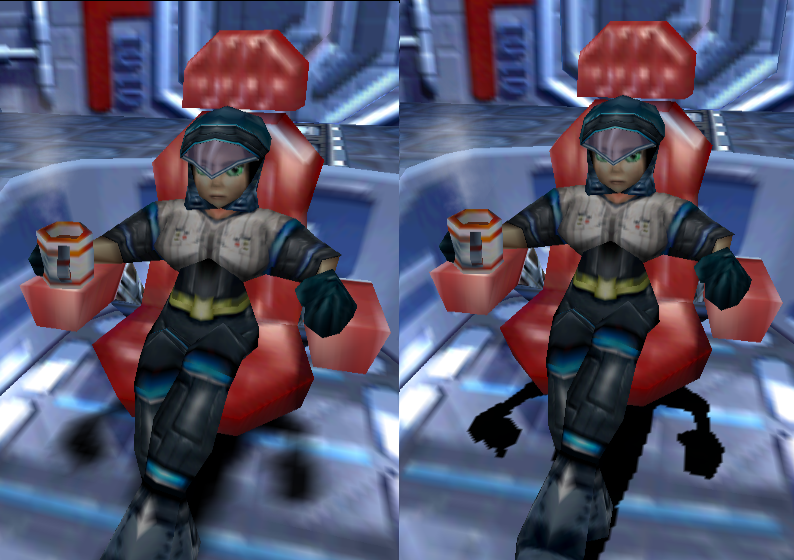
Some fb effects look/work more correct with it. For example shadows in JFG intro:
 gonetz
on 28 Jan 2019
gonetz
on 28 Jan 2019
Gotcha, why does it break some effects?
fzurita
on 28 Jan 2019
It may require several hours to answer this question.
gonetz
on 29 Jan 2019
@fzurita Some games use the CPU basically for post processing. Like for instance JFG's softshadows. (a feature normally seen in modern PC games using pixel shaders on shadow buffer textures)
 ghost
on 22 Feb 2019
ghost
on 22 Feb 2019
Oh, gotcha, very informative.
fzurita
on 22 Feb 2019
Yeah, some N64 devs were extremely smart. On N64, because access to memory and pixels by CPU is so easy, they can do this and many other effects.
On PC its tons more complicated since there is no unified memory area (you got normal GPU memory, abstracted by OpenGL in this case) and normal PC emulated RDRAM. GLideN64 allocates texture buffers for framebuffers (done on N64 by a certain RDP color/depth image command I think) to a framebuffer object in OpenGL. All these framebuffer objects are rendered independantly from main emulator RDRAM and are managed entirely by OpenGL and stored on the GPU.
Modern PC games don't have this problem as everything is done on GPU anyway for graphics, and post processing and other blending operations are now done by pixel/compute shaders in them.
This option just copies these back to main RDRAM using OpenGL specific commands, but that can come with performance penalties on PC due to AGP/PCI-E bus speeds, that and other quirks in OGL and drivers themselves. And plus there can be bugs when it does because HWFBE itself is a hack,
Software rendering avoids all these problems since everything is done on CPU/main RAM and framebuffer access is much easier.
I could be wrong.
ghost
on 23 Feb 2019
@mudlord you are totally correct here, thanks!
gonetz
on 24 Feb 2019
Related issues
 olivieryuyu
·
12Comments
olivieryuyu
·
12Comments
 Dorzalty
·
20Comments
Dorzalty
·
20Comments
 purplemarshmallow
·
18Comments
purplemarshmallow
·
18Comments
 IceLancerSR
·
15Comments
IceLancerSR
·
15Comments
 IronYoshi64
·
18Comments
IronYoshi64
·
18Comments
Most helpful comment
Yeah, some N64 devs were extremely smart. On N64, because access to memory and pixels by CPU is so easy, they can do this and many other effects.
On PC its tons more complicated since there is no unified memory area (you got normal GPU memory, abstracted by OpenGL in this case) and normal PC emulated RDRAM. GLideN64 allocates texture buffers for framebuffers (done on N64 by a certain RDP color/depth image command I think) to a framebuffer object in OpenGL. All these framebuffer objects are rendered independantly from main emulator RDRAM and are managed entirely by OpenGL and stored on the GPU.
Modern PC games don't have this problem as everything is done on GPU anyway for graphics, and post processing and other blending operations are now done by pixel/compute shaders in them.
This option just copies these back to main RDRAM using OpenGL specific commands, but that can come with performance penalties on PC due to AGP/PCI-E bus speeds, that and other quirks in OGL and drivers themselves. And plus there can be bugs when it does because HWFBE itself is a hack,
Software rendering avoids all these problems since everything is done on CPU/main RAM and framebuffer access is much easier.
I could be wrong.