I'm not sure if this has been considered, but should we do builds for Red Hat based OSs like Fedora? Would this require much effort?
 TMiguelT
All 34 comments
That would be difficult because the CI we use for the builds is on ubuntu. Possible, but probably not worth the effort. Anyone on an rpm-based distro should be comfortable with compiling.
 Daenyth
on 6 Jan 2016
Daenyth
on 6 Jan 2016
But the CI we use also produces Windows and Mac builds, no? So surely it's possible?
Just to clarify I'm willing to put in the actual work to have RPM builds, I'd just need some pointers on how to do so. I'm on an RPM-based distro and I did build cockatrice but it would certainly be easier to have an automated update process!
TMiguelT
on 6 Jan 2016
I've tried this in the past, but not being an user of an rpm-distro, i left the job half-cooked: https://build.opensuse.org/project/show/home:ctrlaltca:Cockatrice
 ctrlaltca
on 6 Jan 2016
ctrlaltca
on 6 Jan 2016
But the CI we use also produces Windows and Mac builds, no
Travis has Ubuntu 14.04 and 12.04 build platforms, as well as OSX.
Appveyor has windows.
If you're aware of a CI that can do this I'm open to it. I suppose a last resort might be to compile it inside docker on travis, but the travis builds already take long enough...
Daenyth
on 6 Jan 2016
Can you make a specfile that just pulls in the git repo?
Daenyth
on 6 Jan 2016
So is this BuildOpenSuse site a CI for rpm-using OSs ? I'll look into it if
that could work
On 14:46, Wed, 06/01/2016 Gavin Bisesi [email protected] wrote:
Can you make a specfile that just pulls in the git repo?
—
Reply to this email directly or view it on GitHub
https://github.com/Cockatrice/Cockatrice/issues/1746#issuecomment-169326429
.
TMiguelT
on 6 Jan 2016
@ctrlaltca it seems like this was almost finished? It just failed on xUbuntu and CentOS because they were missing some dependencies (which I suspect you can find anyway)
TMiguelT
on 7 Jan 2016
Yep, it was mostly working, but totally untested.
ctrlaltca
on 7 Jan 2016
Okay I should be able to test the fedora ones at least. Where are the .rpm downloads?
TMiguelT
on 7 Jan 2016
Here, but they're surely outdated: http://download.opensuse.org/repositories/home:/ctrlaltca:/Cockatrice/Fedora_21/
ctrlaltca
on 7 Jan 2016
Incidentally I suspect the package name is being set to the description (the title at the top should probably say 'Cockatrice'). Also could we package the Cockatrice logo as well? The Software program sees it like this at the moment:

TMiguelT
on 7 Jan 2016
It installs and runs perfectly though
TMiguelT
on 7 Jan 2016
It doesn't show the version in About->About Cockatrice but that's probably due to it being an old version
TMiguelT
on 7 Jan 2016
I'm maintaining a cockatrice package in copr for Fedora.
http://copr.fedoraproject.org/coprs/linkdupont/fedora-link-extras/
 subpop
on 10 Jan 2016
subpop
on 10 Jan 2016
@subpop That's helpful, but I'd like to focus on automated builds to make sure we continue to support as many platforms as possible. I added a note about your repo to the wiki page though.
Daenyth
on 10 Jan 2016
@Daenyth In terms of supporting as many platforms as posslible it would be nice to have .deb builds for Debian (opposed to Ubuntu) aswell.
 Sir-Binks
on 1 Feb 2016
Sir-Binks
on 1 Feb 2016
Yes, that would be nice.
Daenyth
on 2 Feb 2016
@subpop do you still maintain that Fedora package on copr?
 tooomm
on 6 Nov 2016
tooomm
on 6 Nov 2016
I do, yes.
subpop
on 6 Nov 2016
Along these lines, I just successfully experimented with and built Cockatrice in a flatpak. I've uploaded the relevant files into a standalone repo.
I'm not familiar enough with CMake to figure out how to integrate this into CPack yet; I need to do some more investigation there. But the Makefile contains all the necessary commands to build a flatpak repo that can be hosted for consumption by flatpak users.
subpop
on 1 May 2017
@subpop nice! Does that flatpak only work on fedora?
Cmake didn't pick up the job of supporting package creators like snap/flatpak yet, so there are two ways to make it work:
- quick and dirty: create a cmake target that just runs the needed command in a shell, so the user would run
cmake && make && make flatpak; - long but "correct": write a cmake module that implements a cpack generator for flatpak.
ctrlaltca
on 1 May 2017
No, flatpak is distribution-agnostic. Most of the distros are picking it up in some capacity (via PPAs or AURs, etc). I'd guess that over time it'll work its way into the distro proper.
Currently I'm hosting the cockatrice repo on S3. The idea with flatpak repositories is that the vendor hosts the repository themselves. That way they can directly distribute binaries to their users. (Imagine if Valve hosted a flatpak repository of Steam and shipped a flatpak instead of a .deb). If we do get this all properly integrated, it would be ideal if we could figure out a way for Cockatrice (the project) to somehow host the flatpak repository.
I'll try to learn how to write a CMake module & CPack generator. That sounds like the better way in the long run.
subpop
on 1 May 2017
Little update here. CPack's generators are a fixed set. Adding a new one requires adding a new CPackGenerator C++ class to the core CPack source and get it submitted in upstream CMake. While that's still a noble goal, that's a whole lot more work and something that should be done under some generic effort of bringing Flatpak generator to CMake in general.
I'll try to build a custom module that emulates some CPack behavior.
subpop
on 2 May 2017
A few hints:
- you may want to create a module that finds
flatpack-builderand the other needed binaries, here's an example that does the same forgit: https://github.com/Kitware/CMake/blob/master/Modules/FindGit.cmake - Once you have variables holding paths to the needed binaries, use add_custom_target or add_custom_command to execute them.
ctrlaltca
on 2 May 2017
Fedora now has cockatrice in its official repositories (maintained by me). Taking the Fedora spec file and porting it to openSUSE is probably fairly straightforward.
subpop
on 3 Jun 2017
@subpop Awesome!
 ZeldaZach
on 3 Jun 2017
ZeldaZach
on 3 Jun 2017
@subpop I just noticed your flatpak build hosting is 404'ing. Have we made any progress in making easy flatpak builds for cockatrice?
TMiguelT
on 19 Jun 2017
@TMiguelT Sorry about how long this took, but yes, my URLs are now 404'ing, because I have submitted and finally achieved a flatpak hosting in flathub. I'll change the relevant wiki pages to use the flathub repos instead. This means hosting and building and everything is done using the Flathub infrastructure, instead of my laptop and my personal S3 bucket. :)
subpop
on 18 Oct 2017
@subpop I'm confused now :) Which link 404'ed? You just added the flapak part:
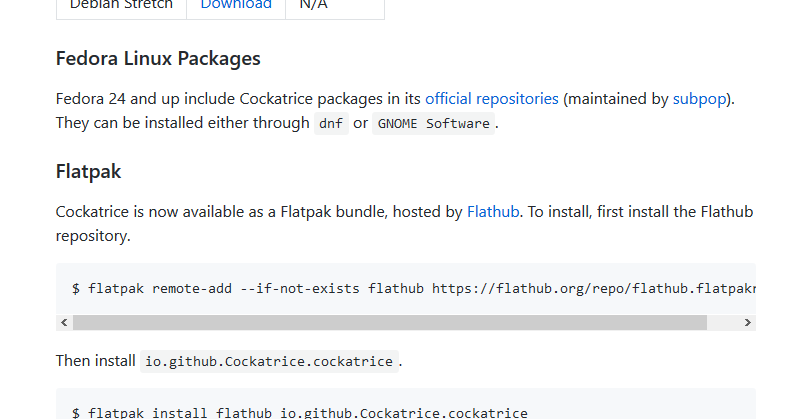
Is flatpak an additional possibility to install, next to the official fedora repos? They do still work?
my URLs are now 404'ing, because I have submitted and finally achieved a flatpak hosting in flathub. I'll change the relevant wiki pages to use the flathub repos instead.
But you're saying it's replacing it?
tooomm
on 18 Oct 2017
@tooomm Sorry, the link that no longer works is one mentioned in an earlier comment on this issue (a standalone Flatpak repository hosted in an S3 bucket). Since I moved the Flatpak build into Flathub, I deleted the S3 bucket.
Along these lines, I just successfully experimented with and built Cockatrice in a flatpak. I've uploaded the relevant files into a standalone repo.
At this point, I am maintaining two separate packaging mechanisms:
- Flatpak (hosted by Flathub)
- RPM (hosted by Fedora)
Both can be installed in parallel. Maybe that wiki page could be reworked to more clearly identify the differences between Flatpak and the Fedora RPMs.
subpop
on 18 Oct 2017
Ok, I get a better understanding now. 👍
I added the maintainer note for flathub/flatpak in the wiki, too.
Who can use the flatpak version? Is it only compatible with a special type of distros? Any requirements?
tooomm
on 18 Oct 2017
Any distribution that has Flatpak available in its repositories can use the Flatpak. The Flatpak website lists how to install Flatpak for many of the major distributions. As of this writing:
- Alpine
- Archlinux
- Debian
- Endless OS
- Fedora
- Gentoo
- Mageia
- openSUSE
- Solus
- Ubuntu
Edit, they now also list:
- elementary OS
- Linux Mint
- Pop! OS
- Red Hat Enterprise Linux
subpop
on 18 Oct 2017
I saw that you initiated a project at the flathub repo: https://github.com/flathub/io.github.Cockatrice.cockatrice @subpop (request: https://github.com/flathub/flathub/pull/98)
Can you explain how this works exactly, what is needed and how is a new version deployed to flathub?
Maybe we could include a flatpak deploy to flathub in travis, too. It targets a huge spectrum of linux users.
There is also the possibility to use https://appimage.org/.
tooomm
on 29 Nov 2017
Right now, I update the Flatpak manifest by hand when new versions come out. It would be neat to get Travis to submit a PR against that Flathub repo with an updated JSON manifest.
subpop
on 2 Dec 2017
Related issues
 skwerlman
·
6Comments
skwerlman
·
6Comments
 jonschoning
·
3Comments
tooomm
·
6Comments
jonschoning
·
3Comments
tooomm
·
6Comments
 Thunderbeliever
·
6Comments
tooomm
·
5Comments
Thunderbeliever
·
6Comments
tooomm
·
5Comments
Most helpful comment
Fedora now has cockatrice in its official repositories (maintained by me). Taking the Fedora spec file and porting it to openSUSE is probably fairly straightforward.