Same as [== ligature] #46
The distinction between "=" and "~=" is quite subtle too.
 seanmars
All 10 comments
Cascadia Code:

Fira Code:

seanmars
on 20 Sep 2019
They look distinct enough to me.
 ExE-Boss
on 20 Sep 2019
ExE-Boss
on 20 Sep 2019
hmm, what language does cascadia target? because some languages do ~= as a variant of == but other languages do ~= as a variant of != (not equals)
Making it look like an equality test makes those languages harder to read, they should be clearly distinguishable from equality tests.
 weltkante
on 20 Sep 2019
weltkante
on 20 Sep 2019
Mm
 laperraputs513
on 22 Sep 2019
laperraputs513
on 22 Sep 2019
Mmm
laperraputs513
on 22 Sep 2019
@seanmars @weltkante Interesting. For Lua (and related languages), would swapping for a not equals ligature be workable? Like this:
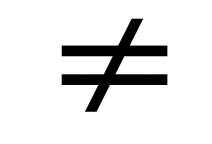
I can certainly include a stylistic set variant that forces the not equals form. It'll require Terminal to build in intelligence to turn on the set when in Lua (and using Cascadia Code). @DHowett-MSFT, what do you think?
 aaronbell
on 24 Sep 2019
aaronbell
on 24 Sep 2019
We can't exactly guess when Lua's in use in the terminal, so this would be another user-driven choice. :smile:
 DHowett-MSFT
on 24 Sep 2019
DHowett-MSFT
on 24 Sep 2019
I think that consistent behavior is less confusing to the user. 😄
seanmars
on 24 Sep 2019
Well, VS Code could support something like:
"[lua]": {
    "editor.fontStylisticSets": "luaNotEquals"
}
I think the defaults should be easily distinguishable from other operators and any language specific cases should be opt-in. When you are in a terminal you don't know which language you are showing (for example piping source code file sections to stdout via command line tooling is a common operation for me) and you want to make sure that the user can easily read everything regardless of which language he uses in his files.
weltkante
on 24 Sep 2019
Related issues
 pmartin-brierley
·
5Comments
pmartin-brierley
·
5Comments
 Taomyn
·
3Comments
Taomyn
·
3Comments
 hansswolfs
·
3Comments
hansswolfs
·
3Comments
 rivy
·
5Comments
rivy
·
5Comments
 xmha97
·
3Comments
xmha97
·
3Comments
Most helpful comment
hmm, what language does cascadia target? because some languages do ~= as a variant of == but other languages do ~= as a variant of != (not equals)
Making it look like an equality test makes those languages harder to read, they should be clearly distinguishable from equality tests.