Botbuilder-samples: Issue with Proactively Send Files
Github issues for C# /JS / Java/ Python should be used for bugs and feature requests. Use Stack Overflow for general "how-to" questions.
Sample information
- Sample type: botbuilder-sample
- Sample language: Python
- Sample name: 56.teams-file-upload
Describe the bug
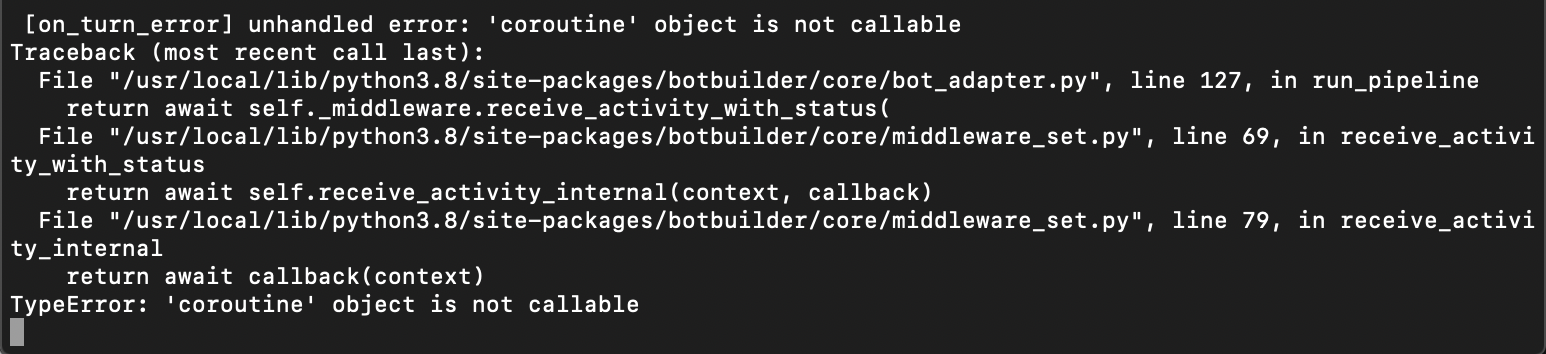
return await callback(context)
TypeError: 'coroutine' object is not callable
To Reproduce
async def sendProactiveMessage(convoRef, filename, fileSize):
    await ADAPTER.continue_conversation(convoRef,
            # lambda TurnContext: TurnContext._send_file_card('Hello'),
            BOT._send_file_card(TurnContext, filename, fileSize),
            "----------------------------",
        )
The following command works:
lambda TurnContext: TurnContext._send_file_card('Hello')
Expected behaviour:
Send File Card To User
Screenshots
Additional context
Add any other context about the problem here.
 JoshBello
All 6 comments
Hi @JoshBello,
Based on what you've written you've merged 3 samples (proactive messaging, files, and MS Teams) together. Can you help me understand what you're trying to do? I want to make sure you're using the best starting sample.
 Virtual-Josh
on 12 Nov 2020
Virtual-Josh
on 12 Nov 2020
@Virtual-Josh Thanks for getting back to me. I am trying to send a html file to a user proactively. What is the best starting point?
JoshBello
on 12 Nov 2020
@JoshBello The best one is probably the proactive sample. From there it should be fairly straight forward to add a file to the message.
Virtual-Josh
on 12 Nov 2020
So I've now used the provocative sample as my base. This is from my This is from app.py. This runs but every time I send a post to /notify I get a async def notify(req: Request) -> Response: # pylint: disable=unused-argument
filename = 'test.png'
fileSize = 10
await _send_proactive_message(filename, fileSize)
return Response(status=201, text="Proactive messages have been sent")
# Send a message to all conversation members.
# This uses the shared Dictionary that the Bot adds conversation references to.
async def _send_proactive_message():
for conversation_reference in CONVERSATION_REFERENCES.values():
return await ADAPTER.continue_conversation(
conversation_reference,
# lambda turn_context: turn_context.send_activity("proactive hello"),
BOT._send_file_card(TurnContext, filename, fileSize),
APP_ID,
)
APP = web.Application(middlewares=[aiohttp_error_middleware])
APP.router.add_post("/api/messages", messages)
APP.router.add_get("/api/notify", notify)
if __name__ == "__main__":
try:
web.run_app(APP, host="localhost", port=CONFIG.PORT)
except Exception as error:
raise error
proactive_bot.py
from datetime import datetime
import os

import requests
from botbuilder.core import TurnContext
from botbuilder.core.teams import TeamsActivityHandler
from botbuilder.schema import (
    Activity,
    ChannelAccount,
    ActivityTypes,
    ConversationAccount,
    Attachment,
)
from botbuilder.schema.teams import (
    FileDownloadInfo,
    FileConsentCard,
    FileConsentCardResponse,
    FileInfoCard,
)
from botbuilder.schema.teams.additional_properties import ContentType


class TeamsFileUploadBot(TeamsActivityHandler):
    async def on_message_activity(self, turn_context: TurnContext):
        message_with_file_download = (
            False
            if not turn_context.activity.attachments
            else turn_context.activity.attachments[0].content_type == ContentType.FILE_DOWNLOAD_INFO
        )

        if message_with_file_download:
            # Save an uploaded file locally
            file = turn_context.activity.attachments[0]
            file_download = FileDownloadInfo.deserialize(file.content)
            file_path = "files/" + file.name

            response = requests.get(file_download.download_url, allow_redirects=True)
            open(file_path, "wb").write(response.content)

            reply = self._create_reply(
                turn_context.activity, f"Complete downloading <b>{file.name}</b>", "xml"
            )
            await turn_context.send_activity(reply)
        else:
            # Attempt to upload a file to Teams.  This will display a confirmation to
            # the user (Accept/Decline card).  If they accept, on_teams_file_consent_accept
            # will be called, otherwise on_teams_file_consent_decline.
            filename = "teams-logo.png"
            file_path = "files/" + filename
            file_size = os.path.getsize(file_path)
            await self._send_file_card(turn_context, filename, file_size)

    async def _send_file_card(
            self, turn_context: TurnContext, filename: str, file_size: int
    ):
        """
        Send a FileConsentCard to get permission from the user to upload a file.
        """

        consent_context = {"filename": filename}

        file_card = FileConsentCard(
            description="This is the file I want to send you",
            size_in_bytes=file_size,
            accept_context=consent_context,
            decline_context=consent_context
        )

        as_attachment = Attachment(
            content=file_card.serialize(), content_type=ContentType.FILE_CONSENT_CARD, name=filename
        )

        reply_activity = self._create_reply(turn_context.activity)
        reply_activity.attachments = [as_attachment]
        await turn_context.send_activity(reply_activity)

    async def on_teams_file_consent_accept(
            self,
            turn_context: TurnContext,
            file_consent_card_response: FileConsentCardResponse
    ):
        """
        The user accepted the file upload request.  Do the actual upload now.
        """

        file_path = "files/" + file_consent_card_response.context["filename"]
        file_size = os.path.getsize(file_path)

        headers = {
            "Content-Length": f"\"{file_size}\"",
            "Content-Range": f"bytes 0-{file_size-1}/{file_size}"
        }
        response = requests.put(
            file_consent_card_response.upload_info.upload_url, open(file_path, "rb"), headers=headers
        )

        if response.status_code != 200:
            print(f"Failed to upload, status {response.status_code}, file_path={file_path}")
            await self._file_upload_failed(turn_context, "Unable to upload file.")
        else:
            await self._file_upload_complete(turn_context, file_consent_card_response)

    async def on_teams_file_consent_decline(
            self,
            turn_context: TurnContext,
            file_consent_card_response: FileConsentCardResponse
    ):
        """
        The user declined the file upload.
        """

        context = file_consent_card_response.context

        reply = self._create_reply(
            turn_context.activity,
            f"Declined. We won't upload file <b>{context['filename']}</b>.",
            "xml"
        )
        await turn_context.send_activity(reply)

    async def _file_upload_complete(
            self,
            turn_context: TurnContext,
            file_consent_card_response: FileConsentCardResponse
    ):
        """
        The file was uploaded, so display a FileInfoCard so the user can view the
        file in Teams.
        """

        name = file_consent_card_response.upload_info.name

        download_card = FileInfoCard(
            unique_id=file_consent_card_response.upload_info.unique_id,
            file_type=file_consent_card_response.upload_info.file_type
        )

        as_attachment = Attachment(
            content=download_card.serialize(),
            content_type=ContentType.FILE_INFO_CARD,
            name=name,
            content_url=file_consent_card_response.upload_info.content_url
        )

        reply = self._create_reply(
            turn_context.activity,
            f"<b>File uploaded.</b> Your file <b>{name}</b> is ready to download",
            "xml"
        )
        reply.attachments = [as_attachment]

        await turn_context.send_activity(reply)

    async def _file_upload_failed(self, turn_context: TurnContext, error: str):
        reply = self._create_reply(
            turn_context.activity,
            f"<b>File upload failed.</b> Error: <pre>{error}</pre>",
            "xml"
        )
        await turn_context.send_activity(reply)

    def _create_reply(self, activity, text=None, text_format=None):
        return Activity(
            type=ActivityTypes.message,
            timestamp=datetime.utcnow(),
            from_property=ChannelAccount(
                id=activity.recipient.id, name=activity.recipient.name
            ),
            recipient=ChannelAccount(
                id=activity.from_property.id, name=activity.from_property.name
            ),
            reply_to_id=activity.id,
            service_url=activity.service_url,
            channel_id=activity.channel_id,
            conversation=ConversationAccount(
                is_group=activity.conversation.is_group,
                id=activity.conversation.id,
                name=activity.conversation.name,
            ),
            text=text or "",
            text_format=text_format or None,
            locale=activity.locale,
        )
JoshBello
on 13 Nov 2020
The reason you're getting the 500 is because continue_conversation only takes 3 parameters, and you're passing in 4. The BOT._send_file_card(TurnContext, filename, fileSize) is the problem.
For the code below I added a hello.txt to the project just so I had an easy file to work with.
If this is your bot file:
# Copyright (c) Microsoft Corporation. All rights reserved.
# Licensed under the MIT License.

import os
from datetime import datetime


from typing import Dict

from botbuilder.core import ActivityHandler, TurnContext
from botbuilder.schema import ChannelAccount, ConversationAccount, ConversationReference, Activity, Attachment, ActivityTypes

from botbuilder.schema.teams import (
    FileDownloadInfo,
    FileConsentCard,
    FileConsentCardResponse,
    FileInfoCard,
)

from botbuilder.schema.teams.additional_properties import ContentType

class ProactiveBot(ActivityHandler):
    def __init__(self, conversation_references: Dict[str, ConversationReference]):
        self.conversation_references = conversation_references

    async def on_conversation_update_activity(self, turn_context: TurnContext):
        self._add_conversation_reference(turn_context.activity)
        return await super().on_conversation_update_activity(turn_context)

    async def on_members_added_activity(
        self, members_added: [ChannelAccount], turn_context: TurnContext
    ):
        for member in members_added:
            if member.id != turn_context.activity.recipient.id:
                await turn_context.send_activity(
                    "Welcome to the Proactive Bot sample.  Navigate to "
                    "http://localhost:3978/api/notify to proactively message everyone "
                    "who has previously messaged this bot."
                )

    async def on_message_activity(self, turn_context: TurnContext):
        self._add_conversation_reference(turn_context.activity)
        return await turn_context.send_activity(
            f"You sent: {turn_context.activity.text}"
        )

    def _add_conversation_reference(self, activity: Activity):
        """
        This populates the shared Dictionary that holds conversation references. In this sample,
        this dictionary is used to send a message to members when /api/notify is hit.
        :param activity:
        :return:
        """
        conversation_reference = TurnContext.get_conversation_reference(activity)
        self.conversation_references[
            conversation_reference.user.id
        ] = conversation_reference

    async def _send_file_card(
            self, turn_context: TurnContext, filename: str, file_size: int
    ):
        """
        Send a FileConsentCard to get permission from the user to upload a file.
        """

        consent_context = {"filename": filename}

        file_card = FileConsentCard(
            description="This is the file I want to send you",
            size_in_bytes=file_size,
            accept_context=consent_context,
            decline_context=consent_context
        )

        as_attachment = Attachment(
            content=file_card.serialize(), content_type=ContentType.FILE_CONSENT_CARD, name=filename
        )

        reply_activity = self._create_reply(turn_context.activity)
        reply_activity.attachments = [as_attachment]
        await turn_context.send_activity(reply_activity)

    def _create_reply(self, activity, text=None, text_format=None):
        return Activity(
            type=ActivityTypes.message,
            timestamp=datetime.utcnow(),
            from_property=ChannelAccount(
                id=activity.recipient.id, name=activity.recipient.name
            ),
            recipient=ChannelAccount(
                id=activity.from_property.id, name=activity.from_property.name
            ),
            reply_to_id=activity.id,
            service_url=activity.service_url,
            channel_id=activity.channel_id,
            conversation=ConversationAccount(
                is_group=activity.conversation.is_group,
                id=activity.conversation.id,
                name=activity.conversation.name,
            ),
            text=text or "",
            text_format=text_format or None,
            locale=activity.locale,
        )
and your app.py is this:
# Copyright (c) Microsoft Corporation. All rights reserved.
# Licensed under the MIT License.
import os
import sys
import traceback
import uuid
from datetime import datetime
from http import HTTPStatus
from typing import Dict

from aiohttp import web
from aiohttp.web import Request, Response, json_response
from botbuilder.core import (
    BotFrameworkAdapterSettings,
    TurnContext,
    BotFrameworkAdapter,
    MessageFactory,
)
from botbuilder.core.integration import aiohttp_error_middleware
from botbuilder.schema import Activity, ActivityTypes, ConversationReference

from bots import ProactiveBot
from config import DefaultConfig

CONFIG = DefaultConfig()

# Create adapter.
# See https://aka.ms/about-bot-adapter to learn more about how bots work.
SETTINGS = BotFrameworkAdapterSettings(CONFIG.APP_ID, CONFIG.APP_PASSWORD)
ADAPTER = BotFrameworkAdapter(SETTINGS)


# Catch-all for errors.
async def on_error(context: TurnContext, error: Exception):
    # This check writes out errors to console log .vs. app insights.
    # NOTE: In production environment, you should consider logging this to Azure
    #       application insights.
    print(f"\n [on_turn_error] unhandled error: {error}", file=sys.stderr)
    traceback.print_exc()

    # Send a message to the user
    await context.send_activity("The bot encountered an error or bug.")
    await context.send_activity(
        "To continue to run this bot, please fix the bot source code."
    )
    # Send a trace activity if we're talking to the Bot Framework Emulator
    if context.activity.channel_id == "emulator":
        # Create a trace activity that contains the error object
        trace_activity = Activity(
            label="TurnError",
            name="on_turn_error Trace",
            timestamp=datetime.utcnow(),
            type=ActivityTypes.trace,
            value=f"{error}",
            value_type="https://www.botframework.com/schemas/error",
        )
        # Send a trace activity, which will be displayed in Bot Framework Emulator
        await context.send_activity(trace_activity)


ADAPTER.on_turn_error = on_error

# Create a shared dictionary.  The Bot will add conversation references when users
# join the conversation and send messages.
CONVERSATION_REFERENCES: Dict[str, ConversationReference] = dict()

# If the channel is the Emulator, and authentication is not in use, the AppId will be null.
# We generate a random AppId for this case only. This is not required for production, since
# the AppId will have a value.
APP_ID = SETTINGS.app_id if SETTINGS.app_id else uuid.uuid4()

# Create the Bot
BOT = ProactiveBot(CONVERSATION_REFERENCES)


# Listen for incoming requests on /api/messages.
async def messages(req: Request) -> Response:
    # Main bot message handler.
    if "application/json" in req.headers["Content-Type"]:
        body = await req.json()
    else:
        return Response(status=HTTPStatus.UNSUPPORTED_MEDIA_TYPE)

    activity = Activity().deserialize(body)
    auth_header = req.headers["Authorization"] if "Authorization" in req.headers else ""

    response = await ADAPTER.process_activity(activity, auth_header, BOT.on_turn)
    if response:
        return json_response(data=response.body, status=response.status)
    return Response(status=HTTPStatus.OK)


# Listen for requests on /api/notify, and send a messages to all conversation members.
async def notify(req: Request) -> Response:  # pylint: disable=unused-argument
    await _send_proactive_message()
    return Response(status=HTTPStatus.OK, text="Proactive messages have been sent")


# Send a message to all conversation members.
# This uses the shared Dictionary that the Bot adds conversation references to.
async def _send_proactive_message():
    filename = "hello.txt"
    file_path = filename
    file_size = os.path.getsize(file_path)

    for conversation_reference in CONVERSATION_REFERENCES.values():
        await ADAPTER.continue_conversation(
            conversation_reference,
            lambda turn_context: BOT._send_file_card(turn_context, filename, file_size),
            APP_ID,
        )


APP = web.Application(middlewares=[aiohttp_error_middleware])
APP.router.add_post("/api/messages", messages)
APP.router.add_get("/api/notify", notify)

if __name__ == "__main__":
    try:
        web.run_app(APP, host="localhost", port=CONFIG.PORT)
    except Exception as error:
        raise error
then it works assuming you're starting from the base proactive_bot sample.
Virtual-Josh
on 13 Nov 2020
Thanks, @Virtual-Josh you're a hero!
JoshBello
on 15 Nov 2020
Related issues
 pesarkhobeee
·
9Comments
pesarkhobeee
·
9Comments
 montacerdk
·
10Comments
montacerdk
·
10Comments
 EricDahlvang
·
9Comments
EricDahlvang
·
9Comments
 v-kydela
·
4Comments
v-kydela
·
4Comments
 MariaMendietaSpur
·
7Comments
MariaMendietaSpur
·
7Comments