Bipedal-locomotion-framework: The ContinousContactModelUnitTests lasts weirdly long when compiled in debug
It took 10.5 minutes (!) on my PC on Ubuntu 20.04. Even without memcheck.
cc @GiulioRomualdi
 S-Dafarra
All 8 comments
Yes I noticed this. I think it's due to the Montecarlo integration used to test the code
 GiulioRomualdi
on 7 Jul 2020
GiulioRomualdi
on 7 Jul 2020
Yes I noticed this. I think it's due to the Montecarlo integration used to test the code
Is there a way to speed it up?
S-Dafarra
on 7 Jul 2020
I'm running callgrind to find the bottleneck
valgrind --tool=callgrind --dump-instr=yes --simulate-cache=yes --collect-jumps=yes ./bin/ContinousContactModelUnitTests
but it's taking ages. I'll update this issue as soon as it finishes
GiulioRomualdi
on 8 Jul 2020
I'm running
callgrindto find the bottleneckvalgrind --tool=callgrind --dump-instr=yes --simulate-cache=yes --collect-jumps=yes ./bin/ContinousContactModelUnitTestsbut it's taking ages. I'll update this issue as soon as it finishes
For faster collection of profilation data, you could also try perf/hotspot (see https://github.com/KDAB/hotspot#using), I heard good things about it (but I never used it).
 traversaro
on 8 Jul 2020
traversaro
on 8 Jul 2020
I run callgrind only on one portion of the code. Please check here to understand how.
This is the result.
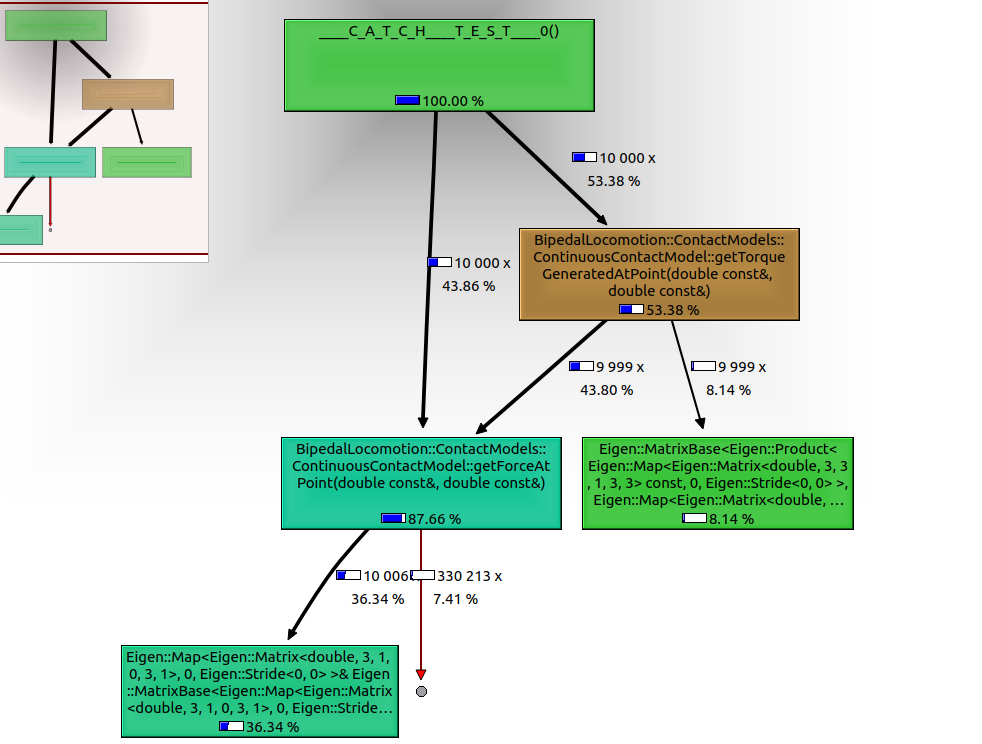
I reduced the number of samples used in Monte-Carlo from 1e7 to 1e4. Consequentially the tolerance is now increased from 1e-4 to 1e-2. Thanks to this solution now the test is much faster. Indeed when it's compiled in debug the following command:
time ./bin/ContinousContactModelUnitTests
returns
real    0m0,776s
user    0m0,736s
sys 0m0,040s
Since getTorqueAtPoint() calls getForceAtPoint(), another way to improve the performances is fuse the getForceAtPoint() and getTorqueAtPoint() into getWrenchAtPoint().
GiulioRomualdi
on 8 Jul 2020
Cool @GiulioRomualdi, thanks a lot.
Since getTorqueAtPoint() calls getForceAtPoint(), another way to improve the performances is fuse the getForceAtPoint() and getTorqueAtPoint() into getWrenchAtPoint().
I may have misunderstood, but then probably getWrenchAtPoint() would take a time equal to the sum of getTorqueAtPoint() plus getForceAtPoint(), unless they both require to compute the whole wrench. In any case, getWrenchAtPoint() seems cleaner if you need both parts at the same time.
S-Dafarra
on 8 Jul 2020
getTorqueAtPoint() actually cals getForceAtPoint(). So the getWrenchAtPoint() is not simply
getWrenchAtPoint(....)
{
    getForceAtPoint(...);
    getTorqueAtPoint(....);
   ....
}
The idea is in fact to copy the content of the two functions inside getWrenchAtPoint().
By the way, I think that for the time being, we can simply reduce the number of samples used in the Monte-Carlo integration since it solves the issue
GiulioRomualdi
on 8 Jul 2020
getTorqueAtPoint()actually calsgetForceAtPoint(). So thegetWrenchAtPoint()is not simplygetWrenchAtPoint(....) { getForceAtPoint(...); getTorqueAtPoint(....); .... }The idea is in fact to copy the content of the two functions inside
getWrenchAtPoint().By the way, I think that for the time being, we can simply reduce the number of samples used in the Monte-Carlo integration since it solves the issue
Yes, I think it is enough to reduce the samples, but the other improvement is also interesting. It may be worth bearing in mind if we are going to have other performance issues in the future.
S-Dafarra
on 8 Jul 2020
Related issues
GiulioRomualdi
·
3Comments
GiulioRomualdi
·
5Comments
S-Dafarra
·
4Comments
GiulioRomualdi
·
10Comments
GiulioRomualdi
·
8Comments