[Table("Tracker", Schema = "HR")]
public class Tracker
{
   [System.ComponentModel.DataAnnotations.Key]
    public int Id { get; set; }
    [Required, MinLength(6), MaxLength(48), Column(TypeName = "varchar(48)")]
    public string EmployeeSid { get; set; }
    public virtual ICollection<TrackerInfo> TrackerInfos { get; set; }
}
[Table("TrackerInfo", Schema = "HR")]
public class TrackerInfo
{
    [System.ComponentModel.DataAnnotations.Key]
    public int Id { get; set; }
    public virtual Tracker Tracker { get; set; }
    [Required]
    public int TrackerId { get; set; }
}
When expanding multiple queries are executed
Trackers?$expand=TrackerInfos
Assemblies affected
7.0 Beta 4, .net 2.1 ef core 2.1
Reproduce steps
Create two classes with one having a collection of the other. Try to do a Get with expand on the collection and the SQL generated will not be good. The query's that are generated are as below, https://github.com/aspnet/EntityFrameworkCore/issues/8531
Expected result
The query should be a join on the collection and finish but it executes a where for each child row eventhough the data has already been retrieved.
Actual result
SELECT [a.TrackerInfos].[Id], [a.TrackerInfos].[CompletedBy], [a.TrackerInfos].[CompletedDate], [a.TrackerInfos].[CreatedDate], [a.TrackerInfos].[Key_Id], [a.TrackerInfos].[SupportType], [a.TrackerInfos].[TrackerId]
FROM [HR].[TrackerInfo] AS [a.TrackerInfos]
INNER JOIN (
SELECT [a0].[Id]
FROM [HR].[Tracker] AS [a0]
) AS [t0] ON [a.TrackerInfos].[TrackerId] = [t0].[Id]
ORDER BY [t0].[Id]
[07:11:07 INF] Executed DbCommand (3ms) [Parameters=[@_outer_Id='1'], CommandType='"Text"', CommandTimeout='30']
SELECT [t].[Id], [t].[CompletedBy], [t].[CompletedDate], [t].[CreatedDate], [t].[Key_Id], [t].[SupportType], [t].[TrackerId]
FROM [HR].[TrackerInfo] AS [t]
WHERE @_outer_Id = [t].[TrackerId]
[07:11:07 INF] Executed DbCommand (2ms) [Parameters=[@_outer_Id='2'], CommandType='"Text"', CommandTimeout='30']
SELECT [t].[Id], [t].[CompletedBy], [t].[CompletedDate], [t].[CreatedDate], [t].[Key_Id], [t].[SupportType], [t].[TrackerId]
FROM [HR].[TrackerInfo] AS [t]
WHERE @_outer_Id = [t].[TrackerId]
[07:11:07 INF] Executed DbCommand (1ms) [Parameters=[@_outer_Id='3'], CommandType='"Text"', CommandTimeout='30']
SELECT [t].[Id], [t].[CompletedBy], [t].[CompletedDate], [t].[CreatedDate], [t].[Key_Id], [t].[SupportType], [t].[TrackerId]
FROM [HR].[TrackerInfo] AS [t]
WHERE @_outer_Id = [t].[TrackerId]
[07:11:07 INF] Executed DbCommand (1ms) [Parameters=[@_outer_Id='4'], CommandType='"Text"', CommandTimeout='30']
SELECT [t].[Id], [t].[CompletedBy], [t].[CompletedDate], [t].[CreatedDate], [t].[Key_Id], [t].[SupportType], [t].[TrackerId]
FROM [HR].[TrackerInfo] AS [t]
WHERE @_outer_Id = [t].[TrackerId]
[07:11:07 INF] Executed DbCommand (2ms) [Parameters=[@_outer_Id='5'], CommandType='"Text"', CommandTimeout='30']
SELECT [t].[Id], [t].[CompletedBy], [t].[CompletedDate], [t].[CreatedDate], [t].[Key_Id], [t].[SupportType], [t].[TrackerId]
FROM [HR].[TrackerInfo] AS [t]
WHERE @_outer_Id = [t].[TrackerId]
... on and on for each row
Additional detail
 smasherprog
All 31 comments
@smasherprog I am trying to understand your problem. In my testing, I have the following debug information:
When I issue a request: http://localhost:5000/odata/Trackers?$expand=TrackerInfos
I can get the following debug information:
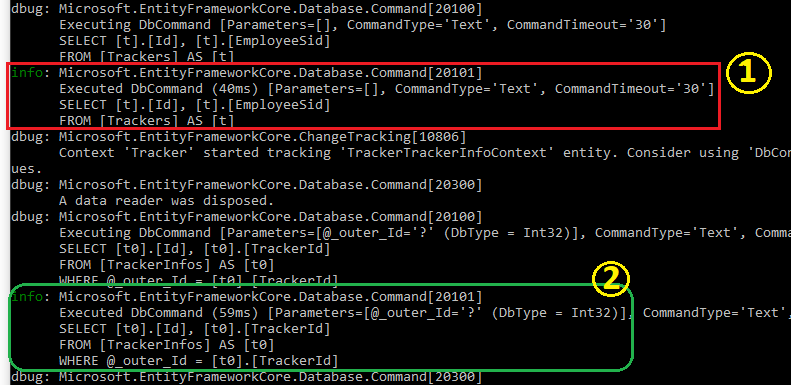
So, two DB executions is your concern? It should be one execution with inner join? Please correct me if I am wrong. Any way, if that's the case, do you think that's EFCore problem or OData side problem.
 xuzhg
on 19 Jun 2018
xuzhg
on 19 Jun 2018
Ill try to get you more information on this
smasherprog
on 21 Jun 2018
I am seeing a similar behavior, when adding a $expand={ChildEntity}. A query is issued that retrieves the parent record(s). Then for each parent record a query is issued for the child records. So if I use /parent?$top=10&$expand=Children, 11 queries would be issued assuming 10 parents came back. 1 query for all the parent records, and a query for the children by parent id.
Ideally this would be one inner joined query. Using EF this would be accomplished with an Include(context.Parents.Include(p => p.Children).Take(10)), but this is not behavior I've seen with Beta4.
@xuzhg your screenshot seems to support this finding. Your screenshot shows a query for Trackers and then a query for TrackerInfos by TrackerId. Assuming the Tracker table had more than 1 record I would expect you'll see a query against TrackerInfo for each Tracker, however without a sample I can only guess by what I am seeing in the screenshot.
 Meyce
on 27 Jun 2018
Meyce
on 27 Jun 2018
I faced with same issue in 7.0 Release
 KyryloLehonkov
on 9 Jul 2018
KyryloLehonkov
on 9 Jul 2018
Could this useful in this situation? Optimization of correlated sub-queries
 techniq
on 24 Jul 2018
techniq
on 24 Jul 2018
Hardly. Actually OData right now is willfully ignoring dotnetcore entity framework functionality it seems.
I execute the same query
THe Lambda runs down to:
.Call System.Linq.Queryable.Select( .Lambda #Lambda1 .Lambda #Lambda2 I execute once: var data = q2.ToList() Api.Odata.Web> info: Microsoft.EntityFrameworkCore.Database.Command[20101] return Ok(q2); I am not sure what OData does to EFCore, but it actually REMOVES the includes. The following SQL Sequences are executed: Api.Odata.Web> info: Microsoft.AspNetCore.Mvc.Internal.ControllerActionInvoker[2] OData is ACTIVELY FIGHTING EF. As you can see, EF is actually doing the same SQL a in the first query, with joiningi n the expand (and yes, that is because I manually parse the ODataOptions and extract the includes needed). THEN it goes on and does subquery by subquery. I would be totally happy if OData would stop fighting - if the relationship has a collection FROM EF then use it and do not issue another SQL.
.Call Microsoft.EntityFrameworkCore.EntityFrameworkQueryableExtensions.Include(
.Constant
"Account"),
'(.Lambda #Lambda1
Comment = $dtoIDTLogin.SComment,
Created = $dtoIDTLogin.DCreateDate,
Email = $dtoIDTLogin.SEMail,
FirstName = $dtoIDTLogin.SFirstName,
Id = $dtoIDTLogin.PkLoginID,
Identity = .Call ($dtoIDTLogin.GIdentity).ToString(),
LastName = $dtoIDTLogin.SLastName,
LoginSource = $dtoIDTLogin.ILoginSource,
MailingAddress = $dtoIDTLogin.SMailingAddress,
PhoneBusiness = $dtoIDTLogin.SPhoneBusiness,
PhoneMobile = $dtoIDTLogin.SPhoneMobile,
Position = $dtoIDTLogin.SPosition,
Title = $dtoIDTLogin.STitle,
TuevEmployee = $dtoIDTLogin.BIsTuevEmployee
}
}
Created = $dtoGTMandator.DCreateDate,
Id = $dtoGTMandator.PkMandatorID,
Identity = $dtoGTMandator.GIdentity,
Name = $dtoGTMandator.SName
}
}
-> Executes ONE sql query, with the (one) expand nicely in as join and EF doing the proper deconstruction.
Api.Odata.Web> Executed DbCommand (67ms) [Parameters=[], CommandType='Text', CommandTimeout='30']
Api.Odata.Web> SELECT [t].[pkLoginID], [f.GTMandators].[dCreateDate] AS [Created], [f.GTMandators].[pkMandatorID] AS [Id], [f.GTMandators].[gIdentity] AS [Identity], [f.GTMandators].[sName] AS [Name], [f.GTMandators].[fkLoginID]
Api.Odata.Web> FROM [dbo].[G_TMandator] AS [f.GTMandators]
Api.Odata.Web> INNER JOIN (
Api.Odata.Web> SELECT [f0].[pkLoginID]
Api.Odata.Web> FROM [dbo].[ID_TLogin] AS [f0]
Api.Odata.Web> WHERE CHARINDEX(N'{deleted}', [f0].[sEMail]) <= 0
Api.Odata.Web> ) AS [t] ON [f.GTMandators].[fkLoginID] = [t].[pkLoginID]
Api.Odata.Web> ORDER BY [t].[pkLoginID]
-> N+1 nightmare with every single relationship manually requeried.
Api.Odata.Web> Executed action method Api.Odata.Web.Controllers.UserController.Get (Api.Odata.Web), returned result Microsoft.AspNetCore.Mvc.OkObjectResult in 5468.481ms.
Api.Odata.Web> info: Microsoft.EntityFrameworkCore.Database.Command[20101]
Api.Odata.Web> Executed DbCommand (56ms) [Parameters=[@__p_1='?' (DbType = Int32)], CommandType='Text', CommandTimeout='30']
Api.Odata.Web> SELECT TOP(@__p_1) [f].[sComment] AS [Comment], [f].[dCreateDate] AS [Created], [f].[sEMail] AS [Email], [f].[sFirstName] AS [FirstName], [f].[pkLoginID] AS [Id], CONVERT(VARCHAR(36), [f].[gIdentity]) AS [Identity], [f].[sLastName] AS [LastName], [f].[iLoginSource] AS [LoginSource], [f].[sMailingAddress] AS [MailingAddress], [f].[sPhoneBusiness] AS [PhoneBusiness], [f].[sPhoneMobile] AS [PhoneMobile], [f].[sPosition] AS [Position], [f].[sTitle] AS [Title], [f].[bIsTuevEmployee] AS [TuevEmployee]
Api.Odata.Web> FROM [dbo].[ID_TLogin] AS [f]
Api.Odata.Web> WHERE CHARINDEX(N'{deleted}', [f].[sEMail]) <= 0
Api.Odata.Web> ORDER BY [Identity], [f].[pkLoginID]
Api.Odata.Web> info: Microsoft.EntityFrameworkCore.Database.Command[20101]
Api.Odata.Web> Executed DbCommand (66ms) [Parameters=[@__p_1='?' (DbType = Int32)], CommandType='Text', CommandTimeout='30']
Api.Odata.Web> SELECT [t].[c], [t].[pkLoginID], [f.GTMandators].[dCreateDate] AS [Created], [f.GTMandators].[pkMandatorID] AS [Id], [f.GTMandators].[gIdentity] AS [Identity], [f.GTMandators].[sName] AS [Name], [f.GTMandators].[fkLoginID]
Api.Odata.Web> FROM [dbo].[G_TMandator] AS [f.GTMandators]
Api.Odata.Web> INNER JOIN (
Api.Odata.Web> SELECT TOP(@__p_1) CONVERT(VARCHAR(36), [f0].[gIdentity]) AS [c], [f0].[pkLoginID]
Api.Odata.Web> FROM [dbo].[ID_TLogin] AS [f0]
Api.Odata.Web> WHERE CHARINDEX(N'{deleted}', [f0].[sEMail]) <= 0
Api.Odata.Web> ORDER BY [c], [f0].[pkLoginID]
Api.Odata.Web> ) AS [t] ON [f.GTMandators].[fkLoginID] = [t].[pkLoginID]
Api.Odata.Web> ORDER BY [t].[c], [t].[pkLoginID]
Api.Odata.Web> info: Microsoft.EntityFrameworkCore.Database.Command[20101]
Api.Odata.Web> Executed DbCommand (42ms) [Parameters=[@_outer_PkLoginID='?' (DbType = Int32)], CommandType='Text', CommandTimeout='30']
Api.Odata.Web> SELECT [dtoGTMandator].[dCreateDate] AS [Created], [dtoGTMandator].[pkMandatorID] AS [Id], [dtoGTMandator].[gIdentity] AS [Identity], [dtoGTMandator].[sName] AS [Name]
Api.Odata.Web> FROM [dbo].[G_TMandator] AS [dtoGTMandator]
Api.Odata.Web> WHERE @_outer_PkLoginID = [dtoGTMandator].[fkLoginID]
Api.Odata.Web> info: Microsoft.EntityFrameworkCore.Database.Command[20101]
Api.Odata.Web> Executed DbCommand (43ms) [Parameters=[@_outer_PkLoginID='?' (DbType = Int32)], CommandType='Text', CommandTimeout='30']
Api.Odata.Web> SELECT [dtoGTMandator].[dCreateDate] AS [Created], [dtoGTMandator].[pkMandatorID] AS [Id], [dtoGTMandator].[gIdentity] AS [Identity], [dtoGTMandator].[sName] AS [Name]
Api.Odata.Web> FROM [dbo].[G_TMandator] AS [dtoGTMandator]
Api.Odata.Web> WHERE @_outer_PkLoginID = [dtoGTMandator].[fkLoginID]
Api.Odata.Web> info: Microsoft.EntityFrameworkCore.Database.Command[20101]
Api.Odata.Web> Executed DbCommand (43ms) [Parameters=[@_outer_PkLoginID='?' (DbType = Int32)], CommandType='Text', CommandTimeout='30']
Api.Odata.Web> SELECT [dtoGTMandator].[dCreateDate] AS [Created], [dtoGTMandator].[pkMandatorID] AS [Id], [dtoGTMandator].[gIdentity] AS [Identity], [dtoGTMandator].[sName] AS [Name]
Api.Odata.Web> FROM [dbo].[G_TMandator] AS [dtoGTMandator]
Api.Odata.Web> WHERE @_outer_PkLoginID = [dtoGTMandator].[fkLoginID]
 NetTecture
on 26 Jul 2018
NetTecture
on 26 Jul 2018
I concur. I'm almost completely sure the problem is related to one to many relationships. OData generates a single query per relation. This is a real performance killer at the moment.
This generates 3 queries with EF Core:
    _dbSet<Product>
                .Include(i => i.ProductProductInformationGroups)
                .ThenInclude(ti => ti.ProductInformationGroup)
                .ThenInclude(ti => ti.ProductInformationGroupProductAttributeValues)
                .ThenInclude(ti => ti.ProductAttributeValue)
                .ThenInclude(ti => ti.ProductAttribute)
                .ThenInclude(ti => ti.ProductAttributeGroup)
                .ToList();
The same written as OData query generates multiple singular queries per relationship:
odata/Products?$expand=ProductProductInformationGroups($expand=ProductInformationGroup($expand=ProductInformationGroupProductAttributeValues($expand=ProductAttributeValue($expand=ProductAttribute($expand=ProductAttributeGroup)))))
 bdebaere
on 26 Sep 2018
bdebaere
on 26 Sep 2018
@bdebaere If you're calling ToList and then returning the materialized result to oData, then those 3 queries are being performed by ef core, no matter you use OData or not. Test that in a simple console app first.
There are some problems with Associations+OData+EntityFrameworkCore too, but as long as you call ToList, your issue is Associations+EntityFrameworkCore only.
 ysmoradi
on 30 Sep 2018
ysmoradi
on 30 Sep 2018
This is an issue with OData, please see my PR to fix this:
 joshcomley
on 21 Oct 2018
joshcomley
on 21 Oct 2018
Hello,
Just wondering if the PR submitted by joshcomley will be merged? If you could please let us know it would be great as there seem to be a few of us whom are suffering a bit from the issues this PR fixes.
Thanks!!
 Mhirji
on 28 Jan 2019
Mhirji
on 28 Jan 2019
@joshcomley thanks for the PR. Do you have any insights on why it is still waiting for review?
Mhirji
on 31 Jan 2019
Does anyone have any more news on this?
Mhirji
on 7 Feb 2019
I havent heard anything.. I wish this would get merged already
smasherprog
on 7 Feb 2019
For your information, the problem is not resolved when upgrading to EF Core 3.0.0-preview4.19216.3.
bdebaere
on 20 Apr 2019
this is a serious issue. please approve the PR or provide your own fix, but do something.
 yadavvineet
on 20 May 2019
yadavvineet
on 20 May 2019
How long will it take to resolve this problem?
 vazavi
on 7 Jun 2019
vazavi
on 7 Jun 2019
@vazavi This is on our list for the next WebAPI release unless something unexpected pops up.
 KanishManuja-MS
on 7 Jun 2019
KanishManuja-MS
on 7 Jun 2019
Do you guys know when you're planning on releasing the next release? When might it be available in Preview?
Cheers,
Mike
 mikeoconnor1980
on 24 Jun 2019
mikeoconnor1980
on 24 Jun 2019
@vazavi This is on our list for the next WebAPI release unless something unexpected pops up.
Do we know when this release is, any information available?
 RMHR
on 16 Jul 2019
RMHR
on 16 Jul 2019
We are waiting on this fix also. It has critically slowed down expands for us since switching from full framework to .Net core, and making OData almost unusable for us.
 PaulGilchrist
on 16 Jul 2019
PaulGilchrist
on 16 Jul 2019
I'm shocked this isn't receiving a higher priority. This bug can result in thousands of round trips to the database and kill performance. Until this gets fixed, $expand and in turn OData is effectively unusable in many situations.
 erjicles
on 23 Jul 2019
erjicles
on 23 Jul 2019
This is actually a non issue. Took me 2 days to extract all possible includes from the query graph. Now I get nice efficiency because I can INCLUDE what I need on the query ;)
I use AutoMapper ProjectTo, so I can take the business level expands and directly hand them in as array of includes from the business side. Voila. As I said - about 2 days of work.
MUCH worse are the significant bugs on the EFCore side which force me to ignore all filters and conditions and pull all data in memory. Global filters basically result often excpetions as they do some bad optimizations for some foreign key scenarios. I possibly could handle that too, but it is a little more complex.
NetTecture
on 23 Jul 2019
This is actually a non issue. Took me 2 days to extract all possible includes from the query graph. Now I get nice efficiency because I can INCLUDE what I need on the query ;)
I use AutoMapper ProjectTo, so I can take the business level expands and directly hand them in as array of includes from the business side. Voila. As I said - about 2 days of work.
MUCH worse are the significant bugs on the EFCore side which force me to ignore all filters and conditions and pull all data in memory. Global filters basically result often excpetions as they do some bad optimizations for some foreign key scenarios. I possibly could handle that too, but it is a little more complex.
If I'm understanding this correctly, you're manually parsing the expands in your controller and adding Includes to the LINQ query before it even hits the OData pipeline so they're already built into the query?
erjicles
on 23 Jul 2019
Actually no. I am intercepting the generated LINQ decision tree and parsing it for all necessary expansions ;)
NetTecture
on 23 Jul 2019
Actually no. I am intercepting the generated LINQ decision tree and parsing it for all necessary expansions ;)
this could help greatly until the issue is addressed. could you please share excerpts of your code here
 erraineon
on 23 Jul 2019
erraineon
on 23 Jul 2019
Why was this closed? Has it been resolved somehow?
 jtrout
on 29 Jul 2019
jtrout
on 29 Jul 2019
Even with the suggested fix, I could not make it work. The proposed fix really worked for someone?
 rodrigocmoreira
on 22 Oct 2019
rodrigocmoreira
on 22 Oct 2019
We managed to fix it by upgrading to Microsoft.AspNetCore.OData version 7.2.2 and adding EnableQuery to the Get method in the controller:
[EnableQuery(EnableCorrelatedSubqueryBuffering = true)]
public IQueryable<T> Get()
The global fix as described in the pull request didn't work for us.
 vvopenka
on 22 Oct 2019
vvopenka
on 22 Oct 2019
We managed to fix it by upgrading to Microsoft.AspNetCore.OData version 7.2.2 and adding EnableQuery to the Get method in the controller:
[EnableQuery(EnableCorrelatedSubqueryBuffering = true)]
public IQueryable<T> Get()
The global fix as described in the pull request didn't work for us.
Works great 👍
rodrigocmoreira
on 22 Oct 2019
I have tried same updated version and able to run with given parameter EnableCorrelatedSubqueryBuffering = true but still generating N+1 queries.
Please guide me if I missed something.
 ankitpatel5989
on 7 May 2020
ankitpatel5989
on 7 May 2020
I do not think you will be lucky. We had it working but with EXTREME problems with Ef Core (and basically had an inspector that decided whether to have EfCore do the filtering or loading all data and filter in memory).
Roight now moving back to Ef Classic - yeah, older, slower blablabla but IT WORKS. And it works in .NET core since Ef Classic 6.4 is netstandard.
I use odata -> Automapper (ProjectTo) -> Ef (classic) and have a module that gets me all the includes that I need from the filter condition.
NetTecture
on 7 May 2020
Related issues
 davidmorissette
·
3Comments
davidmorissette
·
3Comments
 VikingsFan
·
5Comments
VikingsFan
·
5Comments
 LianwMS
·
5Comments
LianwMS
·
5Comments
 rleos
·
5Comments
rleos
·
5Comments
 rafeeqg
·
4Comments
rafeeqg
·
4Comments
Most helpful comment
Why was this closed? Has it been resolved somehow?