Three.js: r101 randomly overrides camera.y to 1.6
this is a change I am getting while trying to upgrade from r92.
there is this code in render():
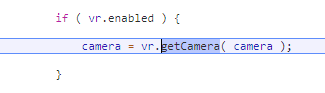
which, when you step inside, does this:
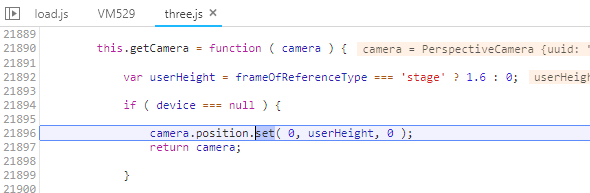
why is this?
 makc
makc
All 9 comments
For now I am using work-around (changed
        renderer.vr.enabled = true;
        WEBVR.getVRDisplay( function ( display ) {
            renderer.vr.setDevice( display );
            document.body.appendChild( WEBVR.getButton( display, renderer.domElement ) );
        } );
to
        WEBVR.getVRDisplay( function ( display ) {
            renderer.vr.enabled = true;
            renderer.vr.setDevice( display );
            document.body.appendChild( WEBVR.getButton( display, renderer.domElement ) );
        } );
)
makc
on 11 Feb 2019
why is this?
Maybe it is the height of user's eyes from ground, when one is standing and wearing VR goggles (1 m 60 cm)?
The code is in src/renderers/webvr/WebVRManager.js. The original commit that introduced the value of "1.6" was cfd22c2c4f4621d770f3a5af68b0533e69af5959. Also see #11619.
 kkolinko
on 25 Feb 2019
kkolinko
on 25 Feb 2019
why is this?
When you enable VR mode, the renderer assumes a default position of the camera (at the origin with a specific height). It simulates in some sense the standing pose of a user wearing a VR headset. Note that this behavior is specific to WebVRManager and does not happen with WebXRManager.
I don't understand what you mean with "randomly overrides". The behavior should be consistent when using WebVRManager.
 Mugen87
on 28 Feb 2019
Mugen87
on 28 Feb 2019
Does this still happen with r102?
 mrdoob
on 2 Mar 2019
mrdoob
on 2 Mar 2019
Closing since the OP does not respond.
Mugen87
on 17 Mar 2019
I never upgraded to 102, so would not know, sorry :/
makc
on 19 Mar 2019
Same issue happens in r103. The camera position should probably not be modified when no XR/VR device is available.
 speigg
on 29 Mar 2019
speigg
on 29 Mar 2019
Let me clarify. Instead of this:
The code should do this in your view, correct?
if ( isPresenting() === false ) return camera;
Correct. It should match the behavior in the WebXRManager.
speigg
on 29 Mar 2019
Related issues
 zsitro
·
3Comments
zsitro
·
3Comments
 fuzihaofzh
·
3Comments
fuzihaofzh
·
3Comments
 ghost
·
3Comments
ghost
·
3Comments
 akshaysrin
·
3Comments
akshaysrin
·
3Comments
 konijn
·
3Comments
konijn
·
3Comments