Tf-pose-estimation: the Train of MobileNet is too slow
Hi @ildoonet sorry to intrupt you for another time. when I try to train the MobileNet from scratch.
[0109 11:50:12 @prefetch.py:170] [PrefetchData] Will fork a dataflow more than one times. This assumes the datapoints are i.i.d
when run this ,it take too much time, Have I made something wrong ?
I would appreciate if you can reply.
 andyqian2015
All 17 comments
To me that part works quite fast (Intel i7, Nvidia 1070). You can evince it from time-stamps.
[2018-01-12 10:34:05,236] [train] [INFO] define model+
[2018-01-12 10:34:05,239] [pose_dataset] [INFO] dataflow img_path=/home/alessio/Sandbox/COCO/
loading annotations into memory...
Done (t=7.11s)
creating index...
index created!
[2018-01-12 10:34:12,581] [pose_dataset] [INFO] /home/alessio/Sandbox/COCO/annotations dataset 118287
[0112 10:34:12 @prefetch.py:169] [PrefetchData] Will fork a dataflow more than one times. This assumes the datapoints are i.i.d.
[0112 10:34:13 @prefetch.py:169] [PrefetchData] Will fork a dataflow more than one times. This assumes the datapoints are i.i.d.
[2018-01-12 10:34:13,964] [pose_dataset] [INFO] dataflow img_path=/home/alessio/Sandbox/COCO/
loading annotations into memory...
Done (t=1.41s)
creating index...
index created!
[2018-01-12 10:34:15,432] [pose_dataset] [INFO] /home/alessio/Sandbox/COCO/annotations dataset 5000
[0112 10:34:15 @prefetch.py:169] [PrefetchData] Will fork a dataflow more than one times. This assumes the datapoints are i.i.d.
[0112 10:34:15 @prefetch.py:169] [PrefetchData] Will fork a dataflow more than one times. This assumes the datapoints are i.i.d.
[2018-01-12 10:34:23,542] [train] [INFO] tensorboard val image: 12
[2018-01-12 10:34:23,547] [train] [INFO] Tensor("fifo_queue_Dequeue:0", shape=(8, 288, 368, 3), dtype=float32, device=/device:GPU:0)
[2018-01-12 10:34:23,547] [train] [INFO] Tensor("fifo_queue_Dequeue:1", shape=(8, 72, 92, 19), dtype=float32, device=/device:GPU:0)
[2018-01-12 10:34:23,547] [train] [INFO] Tensor("fifo_queue_Dequeue:2", shape=(8, 72, 92, 38), dtype=float32, device=/device:GPU:0)
[2018-01-12 10:34:50,229] [train] [INFO] define model-
2018-01-12 10:34:57.854218: I tensorflow/stream_executor/cuda/cuda_gpu_executor.cc:892] successful...
However, I noticed it uses a lot of RAM. So it may be that it swap to disk, which is really slow.
 elmuz
on 12 Jan 2018
elmuz
on 12 Jan 2018
I also find the training is slow. It seems dataflow is the bottleneck. "queue_size" is quite small, it is close to 0. Would you share your training log? @ildoonet
 tranorrepository
on 16 Jan 2018
tranorrepository
on 16 Jan 2018
@elmu thx for your reply, I check the code and find that the load data is too slow and I decrease the queue_size,and the speed is much better. During training, I find another question, the loss doesn't converage and still to 1000 more or less. Have you encounter this problem? thx if you can reply.
andyqian2015
on 18 Jan 2018
the loss doesn't converage
Yes, many users found the same issue, included me. Maybe a problem of learning rate (or batch size). Let's see if @ildoonet shares some info more.
elmuz
on 18 Jan 2018
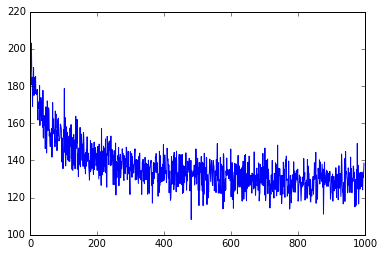
basically, his change of architecture is dramatic, and it is hard to train. I managed to train a mobilenet based 1 stage network with loss like this, the axis is the average of 200 iterations.
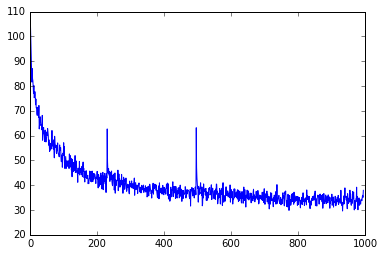
The l2 loss converges at around 35 in constrast to cmu-pose 20, l1 loss is around 130 vs 100 (cmu-pose), but I did use the original mobilenet architecture without any change and sgd as optimizer instead
 ouceduxzk
on 18 Jan 2018
ouceduxzk
on 18 Jan 2018
Hi @ouceduxzk , I am very appreciated of your reply. what do you mean of "based 1 stage network "(one stage of openpose?),what lr ,batchsize and other parameter do you choose ? the same as the auther? thx ouceduxzk
andyqian2015
on 19 Jan 2018
@ouceduxzk , another question is you mean you use the original mobilenet architecture,is it the net in tf_pose_estimation or mobilenet paper(if the architecture, the output should be revised ? ) thx if you can reply.
andyqian2015
on 19 Jan 2018
@andyqian2015 for the first question, yes, only one stage of openpose, lr batchsize is same to the training of openpose, but I am using caffe instead of tensorflow in this case. The mobilenet arch is from the original paper and using first 12 layers as input
ouceduxzk
on 19 Jan 2018
@ouceduxzk thx, I am trying !
andyqian2015
on 19 Jan 2018
with batchsize 96, my loss now looks similar to what the author has
ouceduxzk
on 22 Jan 2018
So which are the general rules to train on our own a mobilenet (I wanted to try mobilenet_accurate)? I am suffering like many others of high loss values (1.0k~1.5k) and it would be nice if we could understand why.
- Considering the architecture: @ouceduxzk said "his change of architecture is dramatic". In what sense? Can you provide a pull request to add models in 'networks.py'?
Training options
- Both @ouceduxzk and @ildoonet used a 96 batch size. Is it vital to get convergence with little loss? If we have just a single 8GB GPU is there any chance to get good results?
- Which optimizer (adam? rmsprop?) you used in the end? Is there particular learning step program to set (if you used exp decay, which paramters you applied?)
elmuz
on 22 Jan 2018
@elmuz in the sense of concat different layers in the feat_concat , which are different type of information, then rmsprop is crucial in my experience to make the training stable. I am not sure how vital is the batchsize is, but now I am training on a 4-gpu or 8-gpu machine while before I usually use 1 or 2 gpu for experiments. I will try to reproduce the problem and figure out the most sensitive variable. lr decay is same as @ildoonet in the code
ouceduxzk
on 22 Jan 2018
@elmuz the feat_concat in this mobilenet_thin is called Hyperfeature which works well for small object discovery, which is explained in this paper https://arxiv.org/pdf/1604.00600.pdf for object detection. Thanks @ildoonet for his work to show that hyper feature are great also for pose estimation
ouceduxzk
on 24 Jan 2018
@elmuz I found big batch size, like 96 with 8 gpu is indeed better (not from the loss point of view) from the visualization point of view (more acc prediction and less false positives). I still did not get a great model that does not have obvious false positive though.
ouceduxzk
on 22 Feb 2018
Ok, thank you for the updates!
elmuz
on 22 Feb 2018
The weight initialization method,I choose normal distribution instead of Xavier and have a good result.
 FoolishMao
on 4 May 2018
FoolishMao
on 4 May 2018
@andyqian2015 for the first question, yes, only one stage of openpose, lr batchsize is same to the training of openpose, but I am using caffe instead of tensorflow in this case. The mobilenet arch is from the original paper and using first 12 layers as input
Can you show your prototxt file? thanks
 chuck0518
on 16 Oct 2018
chuck0518
on 16 Oct 2018
Related issues
 guofuzheng
·
6Comments
guofuzheng
·
6Comments
 GreatGBL
·
4Comments
GreatGBL
·
4Comments
 ildoonet
·
4Comments
ildoonet
·
4Comments
 arnabdeypolimi
·
5Comments
arnabdeypolimi
·
5Comments
 vladbelo
·
4Comments
vladbelo
·
4Comments
Most helpful comment
@elmuz the feat_concat in this mobilenet_thin is called Hyperfeature which works well for small object discovery, which is explained in this paper https://arxiv.org/pdf/1604.00600.pdf for object detection. Thanks @ildoonet for his work to show that hyper feature are great also for pose estimation