Tensorboard: First Batch Normalization layer in a Keras-generated model appears to be connected to everything.
- TensorBoard version 1.10.0
- TensorFlow version 1.10.0
- OS Platform and version Windows 10 64bit and CentOS 6.9
- Python version 2.7 and 3.6
- For browser-related issues: n/a
When using tensorflow.keras to create a model, the first batchnormalization layer appears to be connected to all other batch normalization layers in the graph. I think this is rendered incorrectly rather than built incorrectly but have not been able to prove that.
Code follows that builds the same model with pure tensorflow, and with tensorflow.keras, as well as the graph rendered by tensorboard in each case.
This issue is probably related to this unanswered StackOverflow post:
https://stackoverflow.com/questions/52586853/batchnormalization-nodes-wrongfully-linked-with-each-other
and possibly related to this tensorflow issue:
https://github.com/tensorflow/tensorflow/issues/17985
Graph produced by pure tensorflow

Graph produced with keras model

Tensorflow code
import tensorflow as tf
import numpy as np

logdir="usingtf"
num_classes=10

x = tf.placeholder(tf.float32, shape=[None, 28,28,1], name="data_in")
y = tf.placeholder(tf.int32, shape=[None, num_classes], name="target_labels")

conv_1    =tf.layers.conv2d(inputs=x,filters=32,kernel_size=(3,3),name="Conv1")
bn_1      =tf.layers.batch_normalization(inputs=conv_1)
rl_1      =tf.nn.relu(bn_1)
conv_2    =tf.layers.conv2d(inputs=rl_1,filters=64,kernel_size=(3,3),name="Conv2")
bn_2      =tf.layers.batch_normalization(inputs=conv_2)
rl_2      =tf.nn.relu(bn_2)
maxpool_1 =tf.layers.max_pooling2d(inputs=rl_2,pool_size=2,strides=2,name="Pool1")
dropout_1 =tf.layers.dropout(inputs=maxpool_1,rate=0.25,name="Drop1")
flatten_1 =tf.layers.flatten(dropout_1)
dense_1   =tf.layers.dense(inputs=flatten_1,units=128,activation=tf.nn.relu,name="Dense1")
bn_3      =tf.layers.batch_normalization(inputs=dense_1)
rl_3      =tf.nn.relu(bn_3)
dropout_2 =tf.layers.dropout(rl_3,rate=0.5,name="Drop2")
dense_2   =tf.layers.dense(dropout_2,units=num_classes,name="Final")

with tf.Session() as sess:
  tbwriter=tf.summary.FileWriter(logdir)
  tbwriter.add_graph(sess.graph)
Keras equivalent
import tensorflow as tf
import tensorflow.keras as keras
import numpy as np
import tensorflow.keras.backend as K
sess=tf.Session()
K.set_session(sess)

logdir="usingkeras"
num_classes=10

model=keras.models.Sequential()

model.add(keras.layers.Conv2D(input_shape=(28,28,1),filters=32,kernel_size=(3,3),name="Conv1"))
#conv_1    =tf.layers.conv2d(inputs=x,filters=32,kernel_size=(3,3),name="Conv1")
model.add(keras.layers.BatchNormalization(name="FirstBatchnorm"))
#bn_1      =tf.layers.batch_normalization(inputs=conv_1)
model.add(keras.layers.Activation("relu"))
#rl_1      =tf.nn.relu(bn_1)
model.add(keras.layers.Conv2D(filters=64,kernel_size=(3,3),name="Conv2"))
#conv_2    =tf.layers.conv2d(inputs=rl_1,filters=64,kernel_size=(3,3),name="Conv2")
model.add(keras.layers.BatchNormalization())
#bn_2      =tf.layers.batch_normalization(inputs=conv_2)
model.add(keras.layers.Activation("relu"))
#rl_2      =tf.nn.relu(bn_2)
model.add(keras.layers.MaxPooling2D(pool_size=2,strides=2,name="Pool1"))
#maxpool_1 =tf.layers.max_pooling2d(inputs=rl_2,pool_size=2,strides=2,name="Pool1")
model.add(keras.layers.Dropout(0.25))
#dropout_1 =tf.layers.dropout(inputs=maxpool_1,rate=0.25,name="Drop1")
#flatten_1 =tf.layers.flatten(dropout_1)
model.add(keras.layers.Dense(units=128,activation="relu",name="Dense1"))
#dense_1   =tf.layers.dense(inputs=flatten_1,units=128,activation=tf.nn.relu,name="Dense1")
model.add(keras.layers.BatchNormalization())
#bn_3      =tf.layers.batch_normalization(inputs=dense_1)
model.add(keras.layers.Activation("relu"))
#rl_3      =tf.nn.relu(bn_3)
model.add(keras.layers.Dropout(0.25))
#dropout_2 =tf.layers.dropout(rl_3,rate=0.5,name="Drop2")
model.add(keras.layers.Dense(units=num_classes,name="Dense2"))
#dense_2   =tf.layers.dense(dropout_2,units=num_classes,name="Final")
model.compile("adam","categorical_crossentropy")

tbwriter=tf.summary.FileWriter(logdir)
tbwriter.add_graph(sess.graph)
model.summary()
pinging @nuance-research
 str4w
str4w
All 5 comments
Same here. It must be a rendering issue because I see the same thing (first batch norm layer connected to all other batch norm layers) on totally different networks built long time ago. Also, in models trained without batch normalization, instead, the first dropout layer appears to be connected to all other dropout layers.
 alexhernandezgarcia
on 15 Oct 2018
alexhernandezgarcia
on 15 Oct 2018
Just encountered the same problem today, and after some juggling I think I have found the true root of this behaviour.
As far as I understand it, it's not per se _wrongfully linked_; it looks like it's about intrinsic optimizations or such.
Keras uses Batch Normalization (and perhaps Dropout) layer realizations that depend on flag learning_phase (a boolean value)—because they should work differently while fitting and while evaluating. And it looks like this flag is stored as input in the first layer that uses it; and even if we set it to false manually (e.g., calling keras.backend.set_learning_phase(0)), it is still used for some primary flag calculations, that are propagated from there to all of other layers of similar internal structure.
You could see that, I guess, just by observing the structure of batch norm layer.
True question is, how do we disable that flag propagation? Is it even possible to at least make it reducable by optimization (i.e., for manual setting learning_phase to zero—in that case the input to that keras_learning_phase node is static—and the flags that are propagated could be static as well)?
Or, to formulate the question to be more related to this repo—is it possible for TensorBoard to automatically hide these Keras-specific autogenerated links that are unrelated to the actual logic of the graph?
 cyberillithid
on 19 Oct 2018
cyberillithid
on 19 Oct 2018
I think I have the same issue here

 aeweiwi
on 28 May 2019
aeweiwi
on 28 May 2019
I think I had the same problem when converting a tensorflow.model to a keras model.
 rafikg
on 30 Jul 2019
rafikg
on 30 Jul 2019
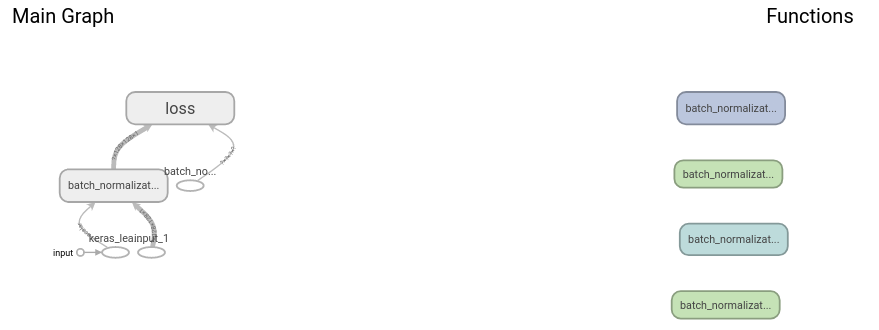
I also have the problem, that using keras BatchNormalization produces 4 nodes in the Functions graph in tensorboard for each BatchNormalization.
Having a keras model with just a few BatchNormalization layers results in Tensorboard Graphs being extremely slow and buggy - I suspect because of all the Functions nodes the rendering takes too long.
It would be nice if the Functions graph is hidden per default.
For example this:
input_shape = (128, 128, 1)

inp = tf.keras.layers.Input(input_shape)
bn = tf.keras.layers.BatchNormalization()
out = bn(inp)
model = tf.keras.models.Model(inputs=inp, outputs=out)
model.compile(optimizer="Adam", loss="mse")

output_shape = out.shape
feature_batch = np.zeros([1] + list(input_shape))
label_batch = np.zeros([1] + list(output_shape)[1:])
log_dir = "/tmp/tensorboard_model/"
tensorboard_callback = tf.keras.callbacks.TensorBoard(log_dir)
model.fit(feature_batch, label_batch, callbacks=[tensorboard_callback])
results in
 kpe
on 16 Apr 2020
kpe
on 16 Apr 2020
Related issues
 OverLordGoldDragon
·
3Comments
OverLordGoldDragon
·
3Comments
 ismael-elatifi
·
3Comments
ismael-elatifi
·
3Comments
 Daniel451
·
3Comments
Daniel451
·
3Comments
 neouyghur
·
3Comments
neouyghur
·
3Comments
 datlife
·
4Comments
datlife
·
4Comments
Most helpful comment
Just encountered the same problem today, and after some juggling I think I have found the true root of this behaviour.
As far as I understand it, it's not per se _wrongfully linked_; it looks like it's about intrinsic optimizations or such.
Keras uses Batch Normalization (and perhaps Dropout) layer realizations that depend on flag
learning_phase(a boolean value)—because they should work differently while fitting and while evaluating. And it looks like this flag is stored as input in the first layer that uses it; and even if we set it to false manually (e.g., callingkeras.backend.set_learning_phase(0)), it is still used for some primary flag calculations, that are propagated from there to all of other layers of similar internal structure.You could see that, I guess, just by observing the structure of batch norm layer.
True question is, how do we disable that flag propagation? Is it even possible to at least make it reducable by optimization (i.e., for manual setting
learning_phaseto zero—in that case the input to thatkeras_learning_phasenode is static—and the flags that are propagated could be static as well)?Or, to formulate the question to be more related to this repo—is it possible for TensorBoard to automatically hide these Keras-specific autogenerated links that are unrelated to the actual logic of the graph?