Spring-security: Provide support for symmetric key verification via JwtDecoder
JWT signature verification for id_token fails in OidcAuthorizationCodeAuthenticationProvider for OIDC providers like Ping Federate that have alternate signature verification rules.
From Ping Identity Developers Guide:
Note: Signature validation is only required for tokens not received directly from the token endpoint (i.e. for the Implicit Client Profile). In other cases where the id_token is received directly by the client from the token endpoint over HTTPS, transport layer security should be sufficient to vouch for the integrity of the token.
And

These rules are valid according to the OpenID Connect specification:
If the ID Token is received via direct communication between the Client and the Token Endpoint (which it is in this flow), the TLS server validation MAY be used to validate the issuer in place of checking the token signature. The Client MUST validate the signature of all other ID Tokens according to JWS [JWS] using the algorithm specified in the JWT alg Header Parameter. The Client MUST use the keys provided by the Issuer.
There is a method within OidcAuthorizationCodeAuthenticationProvider to dynamically lookup a JwtDecoder for a given ClientRegistration:
private JwtDecoder getJwtDecoder(ClientRegistration clientRegistration) {
A few challenges here:
- That method is
private - There is no way to plug in sublcasses or alternate mappings in the
.oauth2Login()configuration DSL
As such, there need to be changes to the core classes to enable such pluggability.
 sirianni
All 18 comments
Thanks for the report @sirianni! I think being able to customize the implementation is important, but I think the first step is to fix the default implementation so it works with Ping.
 rwinch
on 26 Jun 2018
rwinch
on 26 Jun 2018
OK. What approach would you suggest for that? I may be able to work on a PR.
sirianni
on 27 Jun 2018
If you don't view the Ping approach of reusing the client secret as a symmetric JWT signing key as a special case, a configuration-only approach might suffice. You could be to add another field to ProviderDetails. Something like idTokenSigningKeySource with the values:
jwks- resolve the public key using JWKS URL (current behavior)clientSecret- use the client secret as a symmetric keynone- trust the id_token without signature verification since it was served directly over TLS
sirianni
on 27 Jun 2018
Looks like Auth0 allows a symmetric key to be used also:
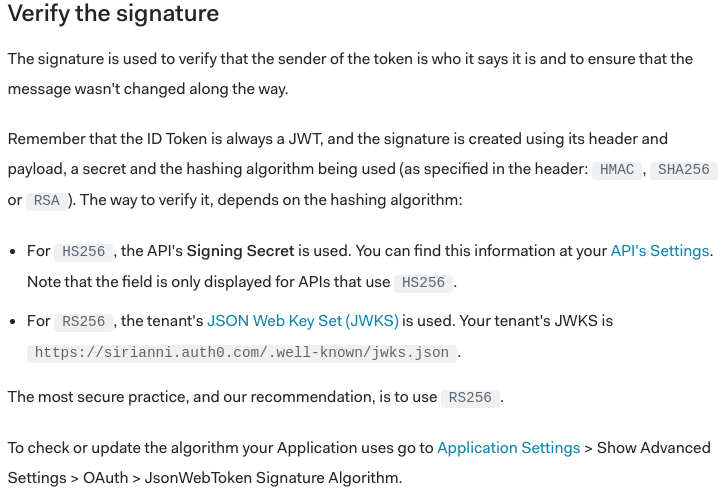
However, they don't reuse the client_secret. It's a separately configured value (if I'm reading the docs correctly).
So you could make the config parameter an object with a type and a value. Something like
provider.auth0.idTokenSignature.strategy=sharedSecret
provider.auth0.idTokenSignature.secret=mySecretKey
provider.microsoft.idTokenSignature.strategy=jwks
provider.ping.idTokenSignature.straegy=trust
@sirianni Can you please provide more details around the issue you are having.
JWT signature verification for id_token fails in OidcAuthorizationCodeAuthenticationProvider for OIDC providers like Ping Federate that have alternate signature verification rules.
Specifically, what is the alg in the JWS header that Ping is signing with? Can you also provide a stacktrace of the exception?
I agree with @rwinch, let's ensure we have things working out-of-the-box for Ping before we expose configuration points that allow for customization.
 jgrandja
on 27 Jun 2018
jgrandja
on 27 Jun 2018
As an aside, I will say that it seems the Spring OAuth2 coding style has deviated from the standard Spring practice of coding for extensibility that has made Spring so popular. The code uses some fairly paranoid practices like marking classes as final and using private constructors and methods vs. protected ones.
let's ensure we have things working out-of-the-box for Ping
Right, I get it. I hope you can see from the comments above that I'm trying to help you assess the ability to have a generic "out of the box" solution that works for Ping.
Specifically, what is the alg in the JWS header that Ping is signing with
As I mentioned in my comment above (with screenshot of Ping docs), Ping is signing with HS256.
Right off the bat you can see that NimbusJwtDecoderJwkSupport has hardcoded the RS256 JwsAlgorithm.
public NimbusJwtDecoderJwkSupport(String jwkSetUrl) {
this(jwkSetUrl, JwsAlgorithms.RS256);
}
Stacktrace:
org.springframework.security.oauth2.jwt.JwtException: An error occurred while attempting to decode the Jwt: Signed JWT rejected: Another algorithm expected, or no matching key(s) found
at org.springframework.security.oauth2.jwt.NimbusJwtDecoderJwkSupport.decode(NimbusJwtDecoderJwkSupport.java:123) ~[spring-security-oauth2-jose-5.0.6.RELEASE.jar:5.0.6.RELEASE]
at org.springframework.security.oauth2.client.oidc.authentication.OidcAuthorizationCodeAuthenticationProvider.authenticate(OidcAuthorizationCodeAuthenticationProvider.java:153) ~[spring-security-oauth2-client-5.0.7.BUILD-SNAPSHOT.jar:5.0.7.BUILD-SNAPSHOT]
at org.springframework.security.authentication.ProviderManager.authenticate(ProviderManager.java:174) ~[spring-security-core-5.0.6.RELEASE.jar:5.0.6.RELEASE]
at org.springframework.security.oauth2.client.web.OAuth2LoginAuthenticationFilter.attemptAuthentication(OAuth2LoginAuthenticationFilter.java:164) ~[spring-security-oauth2-client-5.0.7.BUILD-SNAPSHOT.jar:5.0.7.BUILD-SNAPSHOT]
at org.springframework.security.web.authentication.AbstractAuthenticationProcessingFilter.doFilter(AbstractAuthenticationProcessingFilter.java:212) ~[spring-security-web-5.0.6.RELEASE.jar:5.0.6.RELEASE]
at org.springframework.security.web.FilterChainProxy$VirtualFilterChain.doFilter(FilterChainProxy.java:334) ~[spring-security-web-5.0.6.RELEASE.jar:5.0.6.RELEASE]
at org.springframework.security.oauth2.client.web.OAuth2AuthorizationRequestRedirectFilter.doFilterInternal(OAuth2AuthorizationRequestRedirectFilter.java:128) ~[spring-security-oauth2-client-5.0.7.BUILD-SNAPSHOT.jar:5.0.7.BUILD-SNAPSHOT]
Note that Nimbus' native IDTokenValidator handles this case properly:
/**
* Validator of ID tokens issued by an OpenID Provider (OP).
*
* <p>Supports processing of ID tokens with the following protection:
*
* <ul>
* <li>ID tokens signed (JWS) with the OP's RSA or EC key, require the
* OP public JWK set (provided by value or URL) to verify them.
* <li>ID tokens authenticated with a JWS HMAC, require the client's secret
* to verify them.
* <li>Unsecured (plain) ID tokens received at the token endpoint.
* </ul>
*
* <p>Convenience static methods for creating an ID token validator from OpenID
* Provider metadata or issuer URL, and the registered Relying Party
* information:
*
* <ul>
* <li>{@link #create(OIDCProviderMetadata, OIDCClientInformation)}
* <li>{@link #create(Issuer, OIDCClientInformation)}
* </ul>
*
* <p>Related specifications:
*
* <ul>
* <li>OpenID Connect Core 1.0, sections 3.1.3.7, 3.2.2.11 and 3.3.2.12.
* </ul>
*/
@ThreadSafe
public class IDTokenValidator extends AbstractJWTValidator implements ClockSkewAware {
@sirianni Thank you for all your feedback!
As an aside, I will say that it seems the Spring OAuth2 coding style has deviated from the standard Spring practice of coding for extensibility that has made Spring so popular.
This is very true and _quite intentional in the short term_. We are adding lots of new functionality at a fast pace and so we are starting out quite cautious. As we get reasonable enhancement requests, we will be able to spend time to improve the flexibility that users are use to. If you find places you need to customize that are not easy to do so, please let us know and we will work with you to update the code.
I want to emphasize that we agree that customization of the signature verification is desirable. However, we want to prioritize fixing this to work out of the box first. It may seem very easy to expose a new API, but as a framework every API we create and expose limits our ability to refactor the code later. I hope this helps alleviate any concerns you might have.
Thanks again for working with us to make Spring Security better!
rwinch
on 27 Jun 2018
@sirianni
Right off the bat you can see that NimbusJwtDecoderJwkSupport has hardcoded the RS256 JwsAlgorithm
This was intentional to support RS256 only in the initial release of 5.0, as it was quite easy to integrate with the JWK Set endpoint.
Symmetric key verification on the other hand is going to be more involved.
Note that Nimbus' native IDTokenValidator handles this case properly
Yes it does but this is a lot more involved. The IDTokenValidator relies on Provider metadata (OpenID Connect Discovery 1.0) and Client metadata (OpenID Connect Dynamic Client Registration 1.0) in order to achieve symmetric key verification in a dynamic way.
There is a lot more work that needs to be done to have full support for OAuth/OIDC and related extension specs. We will get there but it will take some more time.
We'll prioritize symmetric key verification support so please stay tuned.
Thanks again for the feedback.
jgrandja
on 28 Jun 2018
@sirianni We were really hoping to resolve this issue and get it into 5.1, but unfortunately we didn't have enough resources to get to this.
However, we're still hoping to resolve #5717 for 5.1 and I believe this will still help you as it will allow you to configure a custom JwtDecoder for ID Token verification. However, you would still need to implement a JwtDecoder that provides symmetric key verification. This will at least allow you to configure it.
Would you be interested in submitting a PR for #5717 ?
jgrandja
on 21 Aug 2018
@sirianni This new feature has been added and is now in master. We're planning to release 5.2.0.M2 this coming Monday so feel free to try this out and let me know how it goes. FYI, the changes are in this commit bed3371
jgrandja
on 12 Apr 2019
@jgrandja Except in Test, how does one setJwsAlgorithmResolver? I can't seem to get the value to be anything but RS256.
 pthorson
on 9 May 2019
pthorson
on 9 May 2019
you just have to create your own JwtDecoderFactory
@Bean
public JwtDecoderFactory<ClientRegistration> foo() {
    OidcIdTokenDecoderFactory factory = new OidcIdTokenDecoderFactory();
    factory.setJwsAlgorithmResolver(clientRegistration -> MacAlgorithm.HS256);
    return factory;
}
 lhaidacher
on 9 May 2019
lhaidacher
on 9 May 2019
Did this change include dynamically choosing the Algorithm? At ".well-known/openid-configuration" our auth server responds with multiple values: "id_token_signing_alg_values_supported":["none","HS256","HS384","HS512","RS256","RS384","RS512","ES256","ES384","ES512"]. Of course the token header has a specific value but I'm not sure if a client would know this value ahead of time.
pthorson
on 14 May 2019
@pthorson No it doesn't include this change as we cannot randomly choose the algorithm given that id_token_signing_alg_values_supported can return more than one value. However, this can easily be implemented by inspecting the resolver input clientRegistration.getProviderDetails().getConfigurationMetadata() for the id_token_signing_alg_values_supported key and determining which algorithm to return.
NOTE: getConfigurationMetadata() will only be available if the ClientRegistration is configured with the issuer-uri.
jgrandja
on 14 May 2019
@pthorson @jgrandja I think it would be nice if we could support multiple algorithms. I created gh-6883 to allow supporting any of the algorithms returned by the IdP
rwinch
on 15 May 2019
I need multiple algorithm for NimbusJwtDecoderJwkSupport constructor as well, rather than hard coded RS256, I found it's hard to override the alg, even though I create my own JwtDecoder, because it is initized in OidcAuthorizationCodeAuthenticationProvider (line 212), and this cannot be changed if we don't want to change more code, please let me know the work around for current release, thank you very much!
 compfantasy
on 8 Jun 2019
compfantasy
on 8 Jun 2019
@compfantasy See comment
jgrandja
on 10 Jun 2019
Related issues
 spring-issuemaster
·
4Comments
spring-issuemaster
·
4Comments
 donhuvy
·
3Comments
donhuvy
·
3Comments
 xingfudeshi
·
3Comments
xingfudeshi
·
3Comments
 mageddo
·
4Comments
mageddo
·
4Comments
 berniegp
·
3Comments
berniegp
·
3Comments
Most helpful comment
you just have to create your own JwtDecoderFactory-Bean like: