Site-kit-wp: Implement more appropriate error handling in JS data stores and refactored components
Currently Site Kit data stores simply store the error in an error property per store which has a few drawbacks:
- Only one error per store is saved.
- It is unclear where the error came from.
- It is unclear whether that error should be displayed and overrule regular app flow or whether it can be ignored.
In components, we currently use an ErrorNotice component which simply takes that single error and displays it. While this works _fairly_ well for module setup flows and settings being edited, it will show more obvious disadvantages as we're migrating dashboard widgets (e.g. PageSpeed Insights widget right now doesn't display any alternative content on error, it just keeps loading). The goal here should be that every widget knows whether (one of) its API queries resulted in a failure and that it then returns appropriate error content. Eventually such errors should use predefined components so that e.g. the widget area renderer can detect that and aggregate certain types of errors together - this way users would see a single error message instead of e.g. 4 times the same one.
Components in general also need to have awareness of errors. For example, loading indicators shouldn't keep loading forever when there was actually an error that will prevent the loading process from being completed. Related example: https://github.com/google/site-kit-wp/commit/d256c1065d91172bd9615682936804e5ddd61f88
Let's think about how we can make errors available to components in a more granular way.
_Do not alter or remove anything below. The following sections will be managed by moderators only._
Acceptance criteria
Error Store
- There should be a
createErrorStore()function which creates a partial store for errors. It should have:
- action
receiveError( error, baseName, args )(should be marked as private)
- Theoretically, all three parameters are required, however due to legacy support for now only
errorshould be required. baseNameshould be documented with something like "This should be a selector or action name."- with all arguments provided (will be required once legacy part below no longer exists), the reducer should key the error by
baseNameandargs(only one error per combination, i.e. an error for the exact same request would override the previous one) - if only
erroris provided, just store it inerrorstate property like today; this part of the reducer should be annotated as legacy behavior with a TODO comment to remove it once all instances of that behavior have been removed - no new code should ever pass
erroronly
- Theoretically, all three parameters are required, however due to legacy support for now only
- selector
getError( baseName, args )(should be marked as private)
- Theoretically
baseNameshould be required, but due to legacy support for now no parameters should be required. baseNameshould be documented with something like "This should be a selector or action name."- if only
baseNameis provided, return the first error for thatbaseName(i.e. for any args) - if no parameters are provided, just look up in
errorstate property like today; this part of the selector should be annotated as legacy behavior with a TODO comment to remove it once all instances of that behavior have been removed - no new code should ever call this without parameters
- Theoretically
- selector
getErrorForSelector( selectorName, args )
- just calls
getError, the only difference is that hereselectorNameshould actually be required (no legacy support needed), and this selector should be public
- just calls
- selector
getErrorForAction( actionName, args )
- just calls
getError, the only difference is that hereactionNameshould actually be required (no legacy support needed), and this selector should be public
- just calls
selectorgetErrors( baseName )(should be marked as private)
returns array of all errors that are stored for thebaseName, or empty array
selectorgetErrorsForSelector( selectorName )
just callsgetErrors
selectorgetErrorsForAction( actionName )
just callsgetErrors
- let's not do the above ones for now, we can introduce them if we need them at some point
- action
- _Every_ store throughout the plugin should include this error partial store. Stores that currently have the basic
getErrororreceiveErrorfunctions should have that part removed, the new store includes support for that.
Dispatching errors
createFetchStoreshould dispatch API errors via the newreceiveError, if available on the store (in our case it will be for every store, see above).
- It should also have a secondary
receiveErrorcall with _only_ the error itself, to replicate what is currently hard-coded in theCATCH_FETCHreducer.
- It should also have a secondary
- For actions/selectors where the fetch store works slightly different from the action/selector itself, errors should be dispatched manually from the public action or resolver to match the public action/selector name/signature (in addition to the default handling within fetch store):
modules/analyticsgetAccounts(fetch store uses different name and arguments)modules/analyticsgetProperties(fetch store uses different name)createSettingsStoresaveSettings(fetch store uses different arguments)
Handling errors
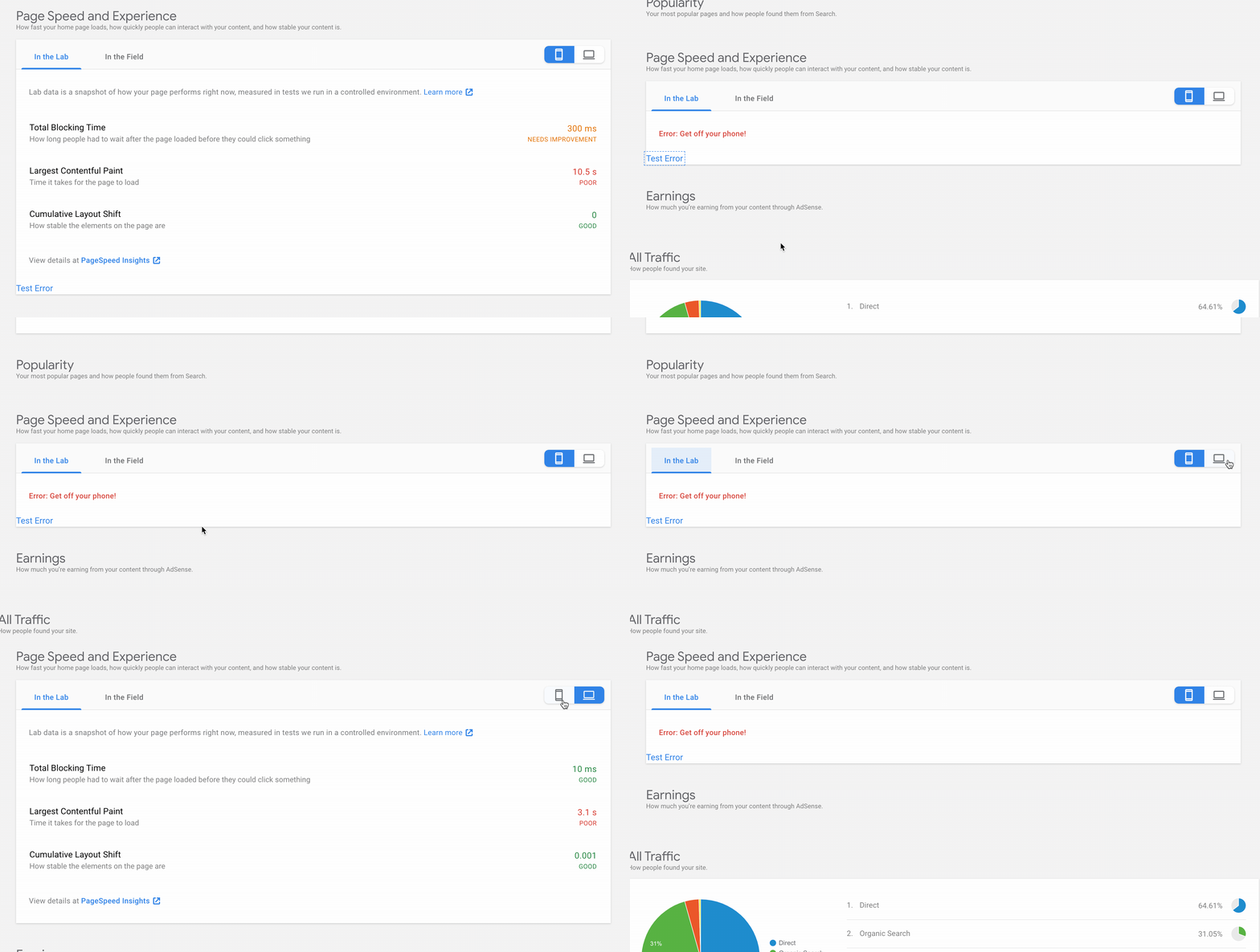
- The PageSpeed Insights dashboard widget should (basically as a first use-case) be modified to display errors for its API requests.
- If the mobile request fails, the error should only surface in the mobile tab, and the same way for desktop.
Implementation Brief
In essence, the aim of this issue is to map errors to baseName + arguments. This is similar to how resolvers (and their "resolution" state) are mapped to selector name + arguments (see: https://github.com/google/site-kit-wp/blob/64b9b2b04349641f6b8b452267b4d4d59bfa3280/assets/js/googlesitekit/modules/datastore/modules.js#L251).
Currently we store errors encountered on a per-store basis, which means they aren't specific to particular actions/selectors. Dispatching errors for a particular set of arguments solves this problem.
One thing to consider is that we should _clear any errors_ for a given baseName + args combo whenever it is invoked again. Forcing the developer to do this manually is silly, so the aim should be that any action/resolver ahould clear its error before making a new "async" part of the request.
This means, in addition to the ACs mentioned (which act as IB), we should add:
- action:
clearError( baseName, args )(should be marked as private)
- This will clear the existing error saved for this
baseName+argscombo so it no longer is returned bygetErrorFor*selectors and doesn't appear in content.
- This will clear the existing error saved for this
- Add
clearError( baseName, args )to https://github.com/google/site-kit-wp/blob/ddde4fa52bcdebd93a9dd11784a7a6972144928d/assets/js/googlesitekit/data/create-fetch-store.js#L148 (afterSTART_FETCH) - Aside from that, I think the IB largely covers the intent of the issue aside from the particulars of where to put the calls, but I think they're evident from the ACs.
- Convert all existing errors to use our new
createErrorStoreactions, but use the private, basicgetErrorandreceieveErrorfor now, withTODO:comments explaining the intent to convert them fully in a future issue. This cuts down on the amount of code to review.
QA Brief
- Test the PageSpeed Insights dashboard widget to ensure that errors encountered in the mobile tab appear in the mobile tab and ONLY the mobile tab. (Same goes for desktop.)
Changelog entry
- Introduce more granular error handling, with consistent error behavior in every store and API request errors being automatically stored.
 felixarntz
All 14 comments
Because the ACs here are largely something to follow for IB, I referenced them in the IB but added some context and also an extra clearError action to the IB. I think it's a good idea to integrate error clearing into our actions that dispatch errors so we don't wind up in a state where the error isn't cleared or needs to be cleared elsewhere.
 tofumatt
on 30 Jul 2020
tofumatt
on 30 Jul 2020
IB ✅
felixarntz
on 30 Jul 2020
@tofumatt / @felixarntz IB says to add clearError action to the createFetchStore factory but how can i get to the clear function itself without knowning the current datastore name? Without it I can't call registry.dispatch( STORE_NAME ).clearError(...) sequence. Do I need to addd an additional parameter to the createFetchStore function to receive the current store name?
 eugene-manuilov
on 31 Jul 2020
eugene-manuilov
on 31 Jul 2020
@eugene-manuilov Good point, yes createFetchStore should receive storeName then. Also, createFetchStore should check whether clearError (as well as the other error selectors/actions) exist on the store before calling them, since that is not a given.
felixarntz
on 31 Jul 2020
Created the #1864 PR with initial changes that include the createErrorStore partial store, changes in the createFetchStore, updates to existing stores and modification of the PSI dashboard widget to use the new approach to track and display errors. The PR itself seems to be pretty big, so I have decided to send it for review and process remaining tasks (if i miss anything) in separate PRs.
eugene-manuilov
on 3 Aug 2020
@eugene-manuilov I think you already covered everything in the PR overall, there are however a few things to fix. I think the only part that might have made sense to do separately is the PSI component changes, but since you have them there already, let's continue to cover everything in that PR.
felixarntz
on 5 Aug 2020
@felixarntz I have a question about Analytics' datastores. Do we really need to manually trigger receiveError actions? Error should be already processed by fetch stores and manually triggering receiveError means that we just generate duplicate actions. Am I right or do I miss something? :thinking:
eugene-manuilov
on 6 Aug 2020
@eugene-manuilov Yes we do. It might feel a bit odd from an engineering perspective, but the reason we need to do that in certain cases:
- The goal is that every error is stored under the
baseNameandargswhich are passed to the public action or selector. - Through the automated handling in the fetch stores, errors are stored based on the
baseNameandargsthat the fetch store receives. These usually match the public action/selector, but in few cases _may_ be different. - For most cases, this means the error is stored correctly. But for a few special cases, the fetch store uses a different
baseNameandargsthan the public action or selector that is using it. And the consuming code (e.g. the components) shouldn't need to know any internals about the action or selector's fetch mechanism to know where to look for the error.
- We should be adding these "duplicate" calls (with different parameters though) only where the fetch action's
baseNameandargsdiffer from the action/selector name and the action/selector args. Essentially, we're patching over these few inconsistencies. - It does mean that these errors will be in the datastore twice, but that doesn't matter - they'd be accessed through the
baseNameandargsthat we'd manually specify. - This isn't limited at all to Analytics, it just happens that the Analytics store has most of those cases for us.
- We should be adding these "duplicate" calls (with different parameters though) only where the fetch action's
The ACs have 3 of these cases (which probably is already most of such cases that we have at all), so you can look at those for examples: In each of them, something about the selector/action differs from the respective internal fetch action's signature.
felixarntz
on 6 Aug 2020
@felixarntz I have addressed your feedback in PR and I think it's ready for another review, but there are two components that rely on the legacy getError selector which I am not sure how to update:
Do you know how to update it?
eugene-manuilov
on 7 Aug 2020
@eugene-manuilov I don't think we should update these components here? Also not mentioned in the ACs. This PR should only be about the datastore, except for the PSI module widget for which we should add error handling (like you've already done).
felixarntz
on 7 Aug 2020
@felixarntz you asked me to remove error from the CATCH_FETCH action and from the appropriate reducer: here and here. By doing it, we are losing the default getError() selector (without arguments) because error hanlder in the fetch store itself always sets errors using baseName and arguments list. So, we need to rework all legacy getError occurrences to use the new approach (with selector/action name and arguments list).
eugene-manuilov
on 8 Aug 2020
@eugene-manuilov I mentioned not only removing error from CATCH_FETCH, but also handling it via the receiveError action, see https://github.com/google/site-kit-wp/pull/1864#discussion_r465956464: I believe you didn't implement the second bullet point, that's how we'd have parameter-less getError working still.
felixarntz
on 8 Aug 2020
Thanks @felixarntz. I missed that part :doh:. Ok, updated it and it's ready for review. I have updated js tests to use new errors for selectors and actions, plus found some other places where we need to manually call receiveError. Also, added hasErrors selector as it was needed in one of tests.
eugene-manuilov
on 8 Aug 2020
Tested by simulating an error for the mobile selector and the desktop selector, and only the appropriate section had an error based on the error triggered. Here's a screencast of the mobile-only error being simulated, but both were tested:
QA, very nice ✅
tofumatt
on 26 Aug 2020
Related issues
 aaemnnosttv
·
3Comments
felixarntz
·
4Comments
aaemnnosttv
·
3Comments
felixarntz
·
4Comments
 quindo
·
5Comments
felixarntz
·
5Comments
felixarntz
·
4Comments
quindo
·
5Comments
felixarntz
·
5Comments
felixarntz
·
4Comments