I'll explain the problem on an example. https://shields.io/ displays the statistic of "express" package as an example. It shows the value 195M (see https://img.shields.io/npm/dt/express.svg) as the total statistic of express downloads.

The npm-provider.js uses package download counts API to get NPM download statistic via request like
GET https://api.npmjs.org/downloads/point/{period}[/{package}]
One can easy verify that https://api.npmjs.org/downloads/point/2015-01-01:2017-12-31/express returns (today)
{"downloads":194785100,"start":"2016-05-20","end":"2017-11-20","package":"express"}
and 194785100 corresponds 195M displayed in the badge https://img.shields.io/npm/dt/express.svg. The problem is that one supposes that "2016-05-20" is really starting point of all downloads. On the other side one can make another request https://api.npmjs.org/downloads/point/2014-01-01:2016-05-19/express, which returns
{"downloads":57328706,"start":"2015-01-10","end":"2016-05-19","package":"express"}
(where "2016-05-19" is the date previous to "2016-05-20" from the "start" of the previous response). One more request https://api.npmjs.org/downloads/point/2014-01-01:2015-01-10/express returns
{"downloads":0,"start":"2015-01-10","end":"2015-01-10","package":"express"}
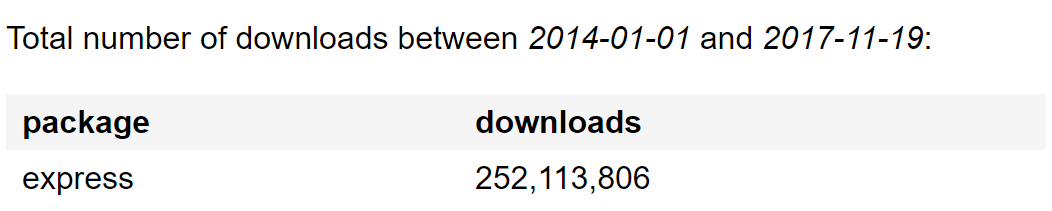
0 downloads. As the result, the total downloads in the interval from 2014-01-01 till today would be 194785100 + 57328706 = 252113806 and 252M instead of 195M would be the correct number of downloads of express.
As the reference one can open the page https://npm-stat.com/charts.html?package=express&from=2014-01-01&to=2017-11-19 and see exactly the same value:
 OlegKi
All 7 comments
Limits section in NPM package download counts API states:
All other queries are limited to at most 18 months of data. The earliest date for which data will be returned is January 10, 2015.
This case is similar to https://github.com/badges/shields/issues/672
I can see two options:
- load all data - currently we have to send 2 requests, but over time (every 18 months) number of requests will increase
- do not change NPM total downloads badge behaviour, but add a clarification at https://shields.io/ what does "total downloads" really means; this will only inform users who adds badges to their sites.
We could try add some explanation to badges generated at https://shields.io/ by adding titles, Markdown supports titles, e.g.
[]()->
 platan
on 19 Nov 2017
platan
on 19 Nov 2017
Thanks for the quick response!
I think that loading of all data in 2 (or later more) requests, would be mostly interesting for the users. There are exist already the "last year" button https://img.shields.io/npm/dy/express.svg, which corresponds the request https://api.npmjs.org/downloads/point/2016-11-20:2017-11-20/express. I don't think that "downloads in the last 18 months" will be more interesting from the users point of view as already existing "last year" button.
The Limits says
All other queries are limited to at most 18 months of data. The earliest date for which data will be returned is January 10, 2015.
Then one could divide the time interval from today till "2015-01-10" in 18 months intervals and makes the sum of all results. It's nor really more complex as implementing of one requests. Currently it's enough 2 requests (like https://api.npmjs.org/downloads/point/2015-01-10:2016-06-30/express and https://api.npmjs.org/downloads/point/2016-07-01:2017-11-20/express), but later 3 or more requests would be required. One could add optionally the tooltip (like you suggested) that the total count take in considerations only the interval starting with January 10, 2015.
OlegKi
on 19 Nov 2017
Good points all around.
Some other options we could consider:
- Cache it
- Ask npm for a static dump of the annual historical data
- Run a job once to fetch all the historical data and put it on s3 or something
 paulmelnikow
on 19 Nov 2017
paulmelnikow
on 19 Nov 2017
Hey there!
I'm just seeing this for thelounge where npm incorrectly says 76k total and npm-stat.com correctly says 102k total.
I think making a couple requests (I'm aware it will be one more request per 18 months) or caching historical data is preferable to inaccurate reports.
Since this project is a well-trusted project, an alternative could be to politely ask npm to whitelist an exception for your specific domain. Who knows, maybe they'd be open to that.
 astorije
on 25 Feb 2018
astorije
on 25 Feb 2018
Making multiple requests for every request is not a great option. We do need the data to be cached, or prefetched, in some way.
paulmelnikow
on 4 Mar 2018
Making multiple requests for every request is not a great option. We do need the data to be cached, or prefetched, in some way.
Having an incorrect count is probably a worse option...
 brandon-d-mckay
on 25 Apr 2019
brandon-d-mckay
on 25 Apr 2019
Just wanted to put out there that Shields is a community project, and that means you can help make this happen! 👐
- Ask npm for a static dump of the annual historical data
- Run a job once to fetch all the historical data and put it on s3 or something
These approaches, for example, could easily be taken on independently of Shields. We could definitely point our implementations at them. Our maintainer team is happy to provide guidance on the API!
paulmelnikow
on 25 Apr 2019
Related issues
 bruno-garcia
·
3Comments
bruno-garcia
·
3Comments
 chadwhitacre
·
4Comments
chadwhitacre
·
4Comments
 salaros
·
3Comments
salaros
·
3Comments
 irgolic
·
3Comments
irgolic
·
3Comments
 calebcartwright
·
3Comments
calebcartwright
·
3Comments
Most helpful comment
Good points all around.
Some other options we could consider: