Scanpy: Understanding normalization and log transformation
- [X] I have checked that this issue has not already been reported.
- [X] I have confirmed this bug exists on the latest version of scanpy.
- [ ] (optional) I have confirmed this bug exists on the master branch of scanpy.
This is probably a bug in my thinking, but naively I thought that sc.pp.normalize_total() normalizes counts per cell, thus allowing comparison of different cells by correcting for variable sequencing depth. However, the log transformation applied after normalisation seems to upset this relationship, example below. Why is this not problematic?
Incidentally, I first noticed this on my real biological dataset, not the toy example below.
Edit: relevant paper
We can show, mathematically, that if we normalize expression profiles to have the same mean across cells, the mean after the equation [log] transformation used for RNA-Seq data will not be the same, and it will depend on the detection rate...
And this one:
One issue of particular interest is that the mean of the log-counts is not generally the same as the log-mean count [1]. This is problematic in scRNA-seq contexts where the log-transformation is applied to normalized expression data.
Minimal code sample
>>> from anndata import AnnData
>>> import scanpy as sc
>>> import numpy as np
>>> adata = AnnData(np.array([[3, 3, 3, 6, 6],[1, 1, 1, 2, 2],[1, 22, 1, 2, 2], ]))
>>> X_norm = sc.pp.normalize_total(adata, target_sum=1, inplace=False)['X']
>>> X_norm_log = np.log1p(X_norm)
>>> X_norm_again = np.expm1(X_norm_log)
>>> adata.X.sum(axis=1)
array([21.,  7., 28.], dtype=float32)  # Different counts for each cell
>>> X_norm.sum(axis=1)
array([1., 1., 1.], dtype=float32)  # Normalisation means same counts for each cell
>>> X_norm_log.sum(axis=1)
array([0.90322304, 0.90322304, 0.7879869 ], dtype=float32)  # <<< Interested in this! Different counts for each cell
>>> X_norm_again.sum(axis=1)
array([1., 1., 1.], dtype=float32)  # Counts the same again
Versions
I'm not using the latest scanpy and anndata verions, but i don't think this will be different on the master branch
sc.logging.print_versions()
scanpy==1.4.5.post2 anndata==0.6.22.post1 umap==0.3.10 numpy==1.18.1 scipy==1.2.1 pandas==1.0.1 scikit-learn==0.22.1 statsmodels==0.11.0 python-igraph==0.8.0
 chris-rands
All 8 comments
An example with real data:
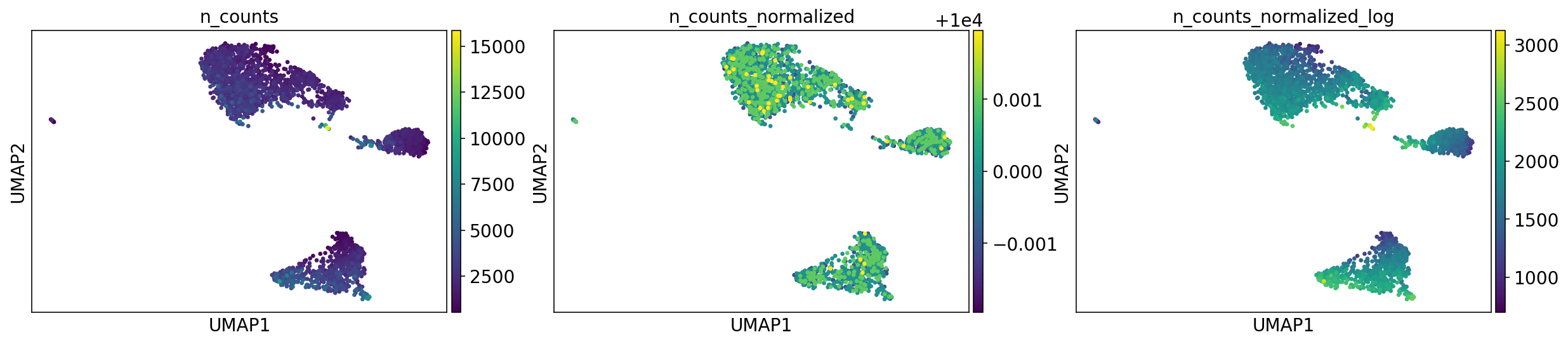
Code:
# Load the PBMC 3k data
adata = sc.read_10x_mtx(
    os.path.join(
        save_path, "filtered_gene_bc_matrices/hg19/"
    ),  # the directory with the `.mtx` file
    var_names="gene_symbols",  # use gene symbols for the variable names (variables-axis index)
)
adata.var_names_make_unique()

# Get counts
adata.obs["n_counts"] = adata.X.sum(axis=1).A1
sc.pp.normalize_per_cell(adata, counts_per_cell_after=1e4)
adata.obs["n_counts_normalized"] = adata.X.sum(axis=1).A1
sc.pp.log1p(adata)
adata.obs["n_counts_normalized_log"] = adata.X.sum(axis=1).A1

# Dim reduction
sc.tl.pca(adata, svd_solver="arpack")
sc.pp.neighbors(adata)
sc.tl.umap(adata)
sc.pl.umap(adata, color=["n_counts", "n_counts_normalized", "n_counts_normalized_log"])
@LuckyMD might be one of the people with the most informed opinion here
 flying-sheep
on 14 Aug 2020
flying-sheep
on 14 Aug 2020
Hey @chris-rands,
This is a really interesting topic. Sorry in advance for the wordy reply... You are absolutely correct that log transformation removes the perfect comparison of relative expression values that mean normalization provides. Aside from CPM normalization (as provided by sc.pp.normalize_total()) not being a good normalization technique anyway (this is argued by any more advanced normalization methods paper, e.g., the scran pooling paper), there are a couple of things to consider here:
- Do we even want relative expression counts?
- What assumptions do downstream methods have on the distribution of expression values.
For the first question: relative gene expression values ignore differences in cell sizes/number of molecules in the cell. There are some molecules whose numbers scale with the size of the cell, and others that don't (e.g., many housekeeping genes). Choosing relative over absolute expression values to compare gene expression across cells would be helpful to compare expression of those genes that scale with size, but not the others.... so there's not really a perfect answer here. Thus, removing all effects of total counts may not be the desirable outcome.
Secondly, many downstream methods assume normally distributed expression data (e.g., DE methods like: t-tests, limma, MAST, or several batch correction/data integration methods). Log transformation is used as a variance stabilization to approximate a normal distribution (quite often poorly, but better than without). This leads to many methods performing better with log transformation.
IMO, the ideal approach is probably something like scVI, GLMPCA, or scTransform, where you fit a model directly to the count data and use the residuals to describe the data. This would address both steps of normalization and variance stabilization at the same time. If we have a good model to describe the data, the residuals should quantify the biological variance + normally distributed noise.
Overall, I would use other normalization approaches than CPM, and use log-transformation with anything that uses size factors that scale per-cell expression values.
Note also that the effect described in the second paper you mention (from Aaron Lun) will mainly be relevant when you have biased distributions of sequencing depth between two samples that you are comparing. If the size factors are similarly distributed between both conditions, then the DE effect will not be so dramatic (as far as I understood it anyway).
 LuckyMD
on 21 Aug 2020
LuckyMD
on 21 Aug 2020
Thank you very much @LuckyMD for those insightful comments, that gives me plenty to think about beyond my original question about the mean normalisation being 'distorted' by log transformation. I had not considered how tricky a problem normalisation is. This actually makes me feel that perhaps the long term solution will be mostly experimental rather than computational, through developing better spike-ins. Anyway, I guess this discussion is not a Scanpy issue, so I will close this, but I appreciate your thoughts.
chris-rands
on 23 Aug 2020
I'm not sure spike-ins will be the solution, as there will probably always be differences due to tissue preparation and cell lysis efficiency as well, which spike-ins can't model... at least as far as I understand the limitations here. I'd be curious if you think otherwise though :).
LuckyMD
on 24 Aug 2020
Good point that spike-ins may not always behave like endogenous transcripts. However, since spike-ins can account for the later biases in the workflow (e.g. variable sequencing depth, capture efficiencies, amplification etc.), I do think that they are still an important part of the solution and a step closer to absolute quantification- would you disagree?
chris-rands
on 24 Aug 2020
I'm not sure spike-ins are so helpful if they only account for part of the technical effects that have to be normalized out. In the end you will have the same problem with the remaining effects you are not capturing on which you don't have a good experimental handle. Unless you can spike into a tissue directly somehow? I quite like the idea of spike-in cells though for batch effects, but those have similar limitations as well.
In general, I'm yet to see a spike-in approach that if modeled and used to normalize your data would compare well against a good normalization method. That doesn't mean it doesn't exist... but it seems that since droplet-based techniques took off spike-ins are being avoided as they just increase sequencing costs and the larger droplet-based datasets allow us to use model-based normalization techniques.
LuckyMD
on 24 Aug 2020
Unless you can spike into a tissue directly somehow?
You can transfect RNA into cells, but the amount of RNA taken up will not be very consistent, so unlikely to be useful for quantitative information. Do you have an idea for how much bias is actually introduced by tissue prep and cell lysis?
Anyway, all the scRNA-seq data I have actually worked with is droplet based and I certainly agree in the value of model-based normalisation techniques. I suspect most new scanpy users will just follow the tutorial and use sc.pp.normalize_total() so thanks again for highlighting the limitations of this
chris-rands
on 7 Sep 2020
Related issues
 koalap-2018
·
3Comments
koalap-2018
·
3Comments
 a-munoz-rojas
·
6Comments
a-munoz-rojas
·
6Comments
 falexwolf
·
4Comments
falexwolf
·
4Comments
 gokceneraslan
·
4Comments
gokceneraslan
·
4Comments
 zhangguy
·
5Comments
zhangguy
·
5Comments
Most helpful comment
Hey @chris-rands,
This is a really interesting topic. Sorry in advance for the wordy reply... You are absolutely correct that log transformation removes the perfect comparison of relative expression values that mean normalization provides. Aside from CPM normalization (as provided by
sc.pp.normalize_total()) not being a good normalization technique anyway (this is argued by any more advanced normalization methods paper, e.g., the scran pooling paper), there are a couple of things to consider here:For the first question: relative gene expression values ignore differences in cell sizes/number of molecules in the cell. There are some molecules whose numbers scale with the size of the cell, and others that don't (e.g., many housekeeping genes). Choosing relative over absolute expression values to compare gene expression across cells would be helpful to compare expression of those genes that scale with size, but not the others.... so there's not really a perfect answer here. Thus, removing all effects of total counts may not be the desirable outcome.
Secondly, many downstream methods assume normally distributed expression data (e.g., DE methods like: t-tests, limma, MAST, or several batch correction/data integration methods). Log transformation is used as a variance stabilization to approximate a normal distribution (quite often poorly, but better than without). This leads to many methods performing better with log transformation.
IMO, the ideal approach is probably something like scVI, GLMPCA, or scTransform, where you fit a model directly to the count data and use the residuals to describe the data. This would address both steps of normalization and variance stabilization at the same time. If we have a good model to describe the data, the residuals should quantify the biological variance + normally distributed noise.
Overall, I would use other normalization approaches than CPM, and use log-transformation with anything that uses size factors that scale per-cell expression values.
Note also that the effect described in the second paper you mention (from Aaron Lun) will mainly be relevant when you have biased distributions of sequencing depth between two samples that you are comparing. If the size factors are similarly distributed between both conditions, then the DE effect will not be so dramatic (as far as I understood it anyway).