Qmk_firmware: [Question] Is `pin_to_mux[]` table in `analog.c` for `analogRead()` correct?
Summary
I wonder that a pin_to_mux[] table in analog.c was NOT suitable for Pro Micro with AVR ATmega32U4.
👌👌👌👌 Expected 👌👌👌👌
Source:
- New keyboard from template, and initialize for debugging.
Add below lines in
default/keymap.c#include "pro_micro.h" #include "analog.h" #include "print.h"and
static void print_analog_pins(void) {
  int16_t val = analogRead(A0);
  print("  A0:"); print_dec(A0);
  print(" val:"); print_decs(val); println();
}

#define PRINT_INTERVAL 5000
void matrix_scan_user(void) {
  static int16_t counter = PRINT_INTERVAL;
  counter++;
  if (PRINT_INTERVAL < counter) {
    print_analog_pins();
    counter = 0;
  }
}
Add below lines in
ruels.mkSRC += analog.c- Build source and transfer into
Pro Micro.
- Schematic:
VCC->R1(10kOhm)->GND- case 1: Pin
A0toGND - case 2: Pin
A0toVCC
Result: case 1
A0:0 val:1023
or case 2
A0:0 val:0
Sounds good 👌👌👌👌
💩💩💩💩 Actual 💩💩💩💩
Results: case 1,2
A0:0 val:(at random)
Oh, 😢 ...
💻 An adhoc-patch
in analog.c:
 {
 #if defined(__AVR_ATmega32U4__)
    static const uint8_t PROGMEM pin_to_mux[] = {
-       0x00, 0x01, 0x04, 0x05, 0x06, 0x07,
-       0x25, 0x24, 0x23, 0x22, 0x21, 0x20};
+       0x07, 0x06, 0x05, 0x04, 0x01, 0x00,
+       0x20, 0x22, 0x23, 0x24, 0x24, 0x21};
📄 The circumstances
When I wrote Arduino sketch for trying an Analog Stick, I have no problem. But, I have problems when I am trying same things on qmk, This issue is one of them.
📚 References
- Analog pins on
Pro Micro: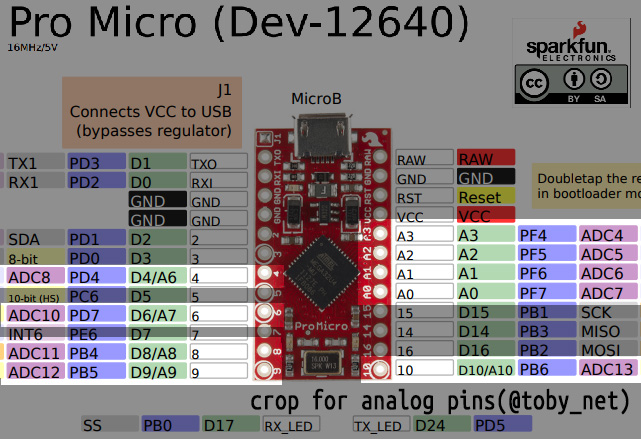
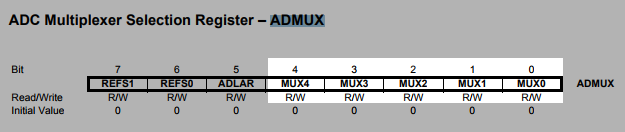
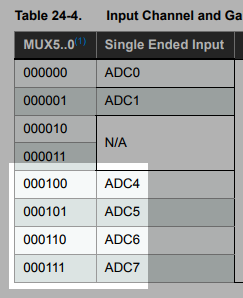
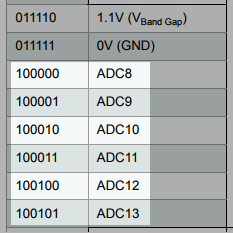
- ADC MUX on ATmega32U4: (ref. Datasheet of ATmega32U4)
 tobynet
All 7 comments
@jackhumbert? Or should somebody else be tagged here?
 drashna
on 25 Mar 2018
drashna
on 25 Mar 2018
I started making a dual joystick mouse with a pro micro and ran into the same issue. I managed to debug the signal of the pins to find the corresponding integers just to get it working. The ad-hoc patch given here also works for me.
This is my first attempt at making something custom with QMK, so I'm not sure what the correct solution is, but I'd love to see this resolved.
 JohnColvin
on 8 May 2018
JohnColvin
on 8 May 2018
I think there may have been a change recently that handles this better, but I'm not sure about that.
drashna
on 22 Oct 2018
I started making a dual joystick mouse with a pro micro and ran into the same issue. I managed to debug the signal of the pins to find the corresponding integers just to get it working. The ad-hoc patch given here also works for me.
This is my first attempt at making something custom with QMK, so I'm not sure what the correct solution is, but I'd love to see this resolved.
Hi John. Do you happen to have schematics for your dual joystick mouse? I have your mousepad branch's keymap compiled, a pro micro, & some joysticks. Would really like to try it out.
 equalunique
on 12 Apr 2019
equalunique
on 12 Apr 2019
Hey 👋 ,
- You missed
0x25, and have a duplicate0x24is your patch in the first comment. - Why follow the pin order of the pro micro in particular ?
have a great day (:
 pyrho
on 10 May 2019
pyrho
on 10 May 2019
analogRead is modeled after Arduino and Arduino Micro uses the following assignment. Pro Micro mostly follows the Arduino Micro’s pin naming, except that it exposes fewer pins.
|Arduino|Atmega32u4|ADC|MUX|
|-------|----------|---|---|
|A0|F7|7|7|
|A1|F6|6|6|
|A2|F5|5|5|
|A3|F4|4|4|
|A4|F1|1|1|
|A5|F0|0|0|
|A6=D4|D4|8|0x20|
|A7=D6|D7|10|0x22|
|A8=D8|B4|11|0x23|
|A9=D9|B5|12|0x24|
|A10=D10|B6|13|0x25|
|A11=D12|D6|9|0x21|
Arguably, that is not a good API either, because you have to use an Atmega32u4 pin name for a setPinInput call in the init function, and whichever analog pin index selects the correct mux for an analogRead in the scan function. As a QMK user, I think I would much prefer to just use the same Atmega32u4 pin names (F7, F6, F5, F4, F1, F0, D4, D7, B4, B5, B6, D6) in both places.
// renamed to communicate semantic difference from Arduino
int16_t analogPinRead(uint8_t pin)
{
#if defined(__AVR_ATmega32U4__)
    uint8_t mux;
    switch (pin) {
    case F7: mux = 7; break;
    case F6: mux = 6; break;
    // …
    case D6: mux = 0x21; break;
    default: return 0;
    }
    return adc_read(mux);
 yurikhan
on 10 May 2019
yurikhan
on 10 May 2019
Is there a PR open for this? I can't seem to find it. If not, we should probably make one.
 crides
on 28 Oct 2019
crides
on 28 Oct 2019
Related issues
 ShadowProgr
·
26Comments
ShadowProgr
·
26Comments
 awkannan
·
43Comments
awkannan
·
43Comments
 Syzygies
·
27Comments
Syzygies
·
27Comments
 kyren
·
24Comments
kyren
·
24Comments
 stanrc85
·
69Comments
stanrc85
·
69Comments