Pester: How to stop Pester at first failed test?
I need Pester to stop executing tests when one of them fails, but I cannot find any information on this. Can Pester do this?
 hero101111
All 34 comments
There's no option for that at the moment.
 dlwyatt
on 25 May 2015
dlwyatt
on 25 May 2015
I see. Maybe in a future version then :+1: Thanks for the quick answer!
hero101111
on 25 May 2015
I thought this is what happens if there's multiple assertions in the same 'It' block.
If one of those assertions fails, the remaining assertions won't be processed.
This might not be what the question relates to though.
 austoonz
on 18 Dec 2015
austoonz
on 18 Dec 2015
It fails on first failed assertion (or any other terminating exception for that matter), but the whole test suite does not fail on first exception. So stopping the while suite on first failure is not possible in Pester.
 nohwnd
on 18 Dec 2015
nohwnd
on 18 Dec 2015
This would be a great addition.
 W1M0R
on 29 Jun 2016
W1M0R
on 29 Jun 2016
@W1M0R Thanks for the comment. Could you please expand on what benefits/use cases do you see or have for it ?
nohwnd
on 29 Jun 2016
For me it would be useful that pester exits / throws after the first failed test, as we are using a bunch of sequential tests (e.g. install our product, check if it was installed correctly, logon to the admin interface etc...). This whole chain of tests assumes that the previous test has completed successfully. In the case of installation failed, it makes no further sense to test if we can logon to the admin interface or perform any other tests...
 flatwound
on 15 Oct 2016
flatwound
on 15 Oct 2016
@flatwound - You can always wrap the testing into seperate test scripts for each stage and have a controller script that only executes them if the prior test script for the previous stage passes.
Personally though it really seems like you should be using DSC with its notion of DependsOn.
That would in my opinion be better suited to your needs.
 kilasuit
on 15 Oct 2016
kilasuit
on 15 Oct 2016
Did this ever get added as a feature? - I don't really want to split my testing out in to seperate files, but I have a prereq set of steps I wish to pass and also like above in some cases I would like some tests to assume the previous completed successfully.
 davidwallis3101
on 14 Nov 2016
davidwallis3101
on 14 Nov 2016
No it did not. We might add it to V4. Here is a quick workaround that seems to work quite fine. It would need to check the internal state and print the actual description of the failed test to be useful, but a a quick workaround it might be good enough for you so I am sharing it anyway.
$script:__anyFailed__ = $false
function Assert-PreviousTestsSucceeded {
if ($script:__anyFailed__){
throw "Some previous test failed"
}
}
function MyShould {
process {
try {
$_ | Should $args[0] $args[1] $args[2]
}
catch {
$script:__anyFailed__ = $true
throw
}}
}
Describe "Fail on the first error" {
$script:anyFailed = $false
it "when this passes" {
Assert-PreviousTestsSucceeded
"a" | MyShould Be "a"
}
it "and this fails" {
Assert-PreviousTestsSucceeded
"a" | MyShould Be "b"
}
it "then this also fails" {
Assert-PreviousTestsSucceeded
"a" | MyShould Be "a"
}
it "and this fails as well" {
Assert-PreviousTestsSucceeded
"a" | MyShould Be "a"
}
}
I am simply adding a flag to the script scope that indicates if anything failed. To set that flag I use a wrapper to Should which set's the flag on failure and then re-throws the exception it.
nohwnd
on 14 Nov 2016
If you still want a use case, as a simple example (and embracing the laziness and hubris of all good devs ;)) I have a script with 160 tests. I'm working in an area of the script that is tested quite early on in those 160 and I want to have absolute certainty that the changes I make are making the existing tests fail before asserting the new behaviour and writing the new code.
I don't want to have to scroll up many lines in my terminal to confirm that the splash of red that whizzed past is the test I expect to now fail and not some other, unforeseen, happening. If there was a _-ExitOnFirstFailure_ switch, I would have greater confidence in my activities without having to rely (solely) on my eyeballs and (potentially rushed) perception.
The workaround above doesn't really work for that use case (I understand that it's just a quick script to help folks) as that would cause every subsequent test to fail and write to the terminal.
 danstuken
on 13 Dec 2016
danstuken
on 13 Dec 2016
You might be interested in #645, then. Rather than aborting on the first failure, that would only output the failures / summary to the console (or whatever combination you wanted.)
dlwyatt
on 13 Dec 2016
going on the above example using method overloading, this option may work - I haven't tested it in depth yet!
$script:__anyFailed__ = $false
function Assert-PreviousTestsSucceeded {
if ($script:__anyFailed__){
write-error "Some previous test failed" -ErrorAction stop
}
}
function Should {
process {
try {
$_ | pester\Should $args[0] $args[1] $args[2]
}
catch {
$script:__anyFailed__ = $true
throw
}}
}
Describe "Fail on the first error" {
$script:anyFailed = $false
it "when this passes" {
Assert-PreviousTestsSucceeded
"a" | Should Be "a" -verbose
}
it "and this fails" {
Assert-PreviousTestsSucceeded
"a" | Should Be "b"
}
it "then this also fails" {
Assert-PreviousTestsSucceeded
"a" | Should Be "a"
}
it "and this fails as well" {
Assert-PreviousTestsSucceeded
"a" | Should Be "a"
}
it "and this Should run fine" {
"a" | Should Be "a"
}
}
this looks to be working and can be done within a context block which makes it easier :)
davidwallis3101
on 29 Dec 2016
I assume that the issue can be closed now. Feel free to reopen if you need more assistance.
 it-praktyk
on 24 Aug 2017
it-praktyk
on 24 Aug 2017
I believe this is still a good option candidate and might bear re-opening.
My use case is as follows:
One of the core principles in continuous development/deployment is to "fail fast", and the stop on first failure is ideal for that scenario.
In the release/master branch you would run all tests, regardless, but on developer and feature branches you would use the switch. This way the build will fail much quicker, reducing the code/build/test cycle time, especially if there are lots of tests. Developers will know much faster that they broke something.
 MartinSGill
on 27 Dec 2017
MartinSGill
on 27 Dec 2017
They will know that they broke something, but they will lack the details to know what/how much they broke. There might be one test failing, or 100 tests failing, but you will never know, if you stop the build after first fail. I tried this approach on multiple projects and it always ended up with us developers re-running the tests locally. So we always ended up making groups of tests (unit tests / integration test etc.) and running them in multiple phases, which gave faster feedback than running all tests, and also quite a good idea about how much has been broken.
nohwnd
on 1 Jan 2018
Another use case would be Gherkin test cases, which is what I'm running into.
Given a prerequisite
When I execute my script
Then I should have this output
If my Given is not true, I don't want to execute the When, because otherwise I have a completely invalid use case, and why would I want to run something that could take a while, if I already know it's going to completely blow up?
We have a tool that pulls in the results, and so we have individual It blocks for the given/when/then statements, so we can't just put everything in one It block.
We are still on v3, and I know there's built in support in v4 for Gherkin. So maybe it would be appropriate to add in v4? We would certainly make the jump up then (we have to validate Pester for our purposes, hence we haven't made the jump).
Christoph
GE Healthcare
 Xoph
on 20 Feb 2018
Xoph
on 20 Feb 2018
@Jaykul would it make sense to you to hookup your blocks together so they fail if the Given block fails? Unless that's already how it works. :)
nohwnd
on 20 Feb 2018
I'll have to check not only the current behavior, but how the reference implementation handles it
It sort-of makes sense to me to skip the when if given fails, and even to skip the then if the when fails.
Having said that, I don't think It makes a whole lot of difference (in Gherkin syntax you should only care about the count of failed _scenarios_ not failed steps, right? Otherwise it's like counting failed assertions instead of tests).
 Jaykul
on 10 Aug 2018
Jaykul
on 10 Aug 2018
@Xoph, @nohwnd and @Jaykul
For Gherkin I suggest the implementation above (commit a45c887) which also includes a fix for #1173 (pull request #1174).
Shall I create a pull request for commit a45c887 too?
 cgnuechtel
on 18 Dec 2018
cgnuechtel
on 18 Dec 2018
I would like to suggest the following:
After pull request #1174 is merged into the master, I will start another pull request with the code in a45c887.
cgnuechtel
on 29 Dec 2018
Fixed by #1198
nohwnd
on 5 Jan 2019
I assume that the issue can be closed now. Feel free to reopen if you need more assistance.
@it-praktyk and @davidwallis3101 - I was trying to get this code to work - https://github.com/pester/Pester/issues/360#issuecomment-269493448 , but I've run into two issues:
- The tests keep running after the first failure, is there a way to get them to stop running (instead of failing)?
- If I try to change the code in https://github.com/pester/Pester/issues/360#issuecomment-269493448 to use the
Should -Besyntax instead ofShould Be, I get a
RuntimeException: '-Be' is not a valid Should operator.

Is that expected? I was hoping to keep all my Should -Be assertions without changing them to Should Be.
Thank you
 nathan-given-health-catalyst
on 15 Jan 2019
nathan-given-health-catalyst
on 15 Jan 2019
- not at the moment, unless you do
breakin your code. - you got me a bit scared. I tried with Pester 4.5.0 and
-Beworks fine, not sure what you did. Does it still fail?
nohwnd
on 15 Jan 2019
- you got me a bit scared. I tried with Pester 4.5.0 and
-Beworks fine, not sure what you did. Does it still fail?
I just tried it again, it is working as expected. I'm not sure what I did ¯\_(ツ)_/¯
nathan-given-health-catalyst
on 15 Jan 2019
I am trying to use the fail fast code posted here in comment above (https://github.com/pester/Pester/issues/360#issuecomment-269493448). It is not stopping the run of the tests. Instead it runs them all and marks them failed. seems to be the same issue mentioned in #issuecomment-454449612. In replies to that comment it is suggested to put a break in the code.
Where would a break help? I put one in Assert-PreviousTestsSucceeded but that did nothing different. I put a throw and error next to the call to Assert-PreviousTestsSucceeded but it did the same as before.
putting a break in the Should overload does not make sense sense the test would have already been run at that point.
My ultimate goal is to stop the tests before they get to the 'it' blocks that run multiple testcases. e.g.
it "finds at least 1 record in table <Table>" -TestCases $testcases {
param($table)
Assert-PreviousTestsSucceeded
run-test-code
}
This exacerbates the problem even more because All these tests are going to fail. I know this based on the previous failure and dont want the code to run them all.
 jtmoree-github-com
on 5 Apr 2019
jtmoree-github-com
on 5 Apr 2019
I know I probably shouldn't be fiddling about with Pester module variables, but this is a low impact way of skipping all tests after a fail:
BeforeEach {
    $PestterModule = Get-Module -Name Pester
    $PesterVar =  & $PestterModule get-variable Pester
    $PesterVarValue =  $PesterVar.Value

    if ($PesterVarValue.FailedCount -gt 0) {
        Set-ItResult -Skipped -Because 'previous test failed'
    }
}
 TigerBoom
on 27 Jun 2019
TigerBoom
on 27 Jun 2019
@TigerBoom You probably should not be fiddling with the internals, but they are most likely not going to change in v4. This is a simpler way to write the same:
BeforeEach {
    $FailedCount =  InModuleScope -ModuleName Pester { $Pester.FailedCount }

    if ($FailedCount -gt 0) {
        Set-ItResult -Skipped -Because 'previous test failed'
    }
}
I also find it interesting how you invoke the Get-Variable I knew that you can do it with scriptblock (e.g. & $pester { code }) but did not know that it can also be done without scriptblock.
nohwnd
on 27 Jun 2019
Based on these comments, in an implementation I'm playing around with, I've just wrapped the Context or It statements with the following:
if ( (InModuleScope -ModuleName Pester { $Pester.FailedCount } ) -eq 0 ) {
}
If any previous It statements have failed, $Pester.FailedCount is greater than zero, and thus skips the Context or It statements I've shoved in the if block.
It definitely doesn't seem as ideal as just adding a "If anything has failed so far, quit further testing" type function/option, but seems to be fine so far as a workaround.
 jasonrush
on 29 Nov 2019
jasonrush
on 29 Nov 2019
Any updates or is this issue closed with Pester 5, what is behavior with Pester 5?
 asears
on 16 Sep 2020
asears
on 16 Sep 2020
I still did not implement it in v5. Should be pretty easy though.
There would be plugin that would have EachTestSetupStart step which would check if any previous test failed, and if it did it would fail the test. Here WriteScreenPlugin is already conditionally added when output is not None. The same would happen for the new plugin. https://github.com/pester/Pester/blob/23a70c294c6724f799493cc52f8cdad4945a9d05/src/Pester.ps1#L960-L983
And option would be added (probably) to the Run section on the config object to enable this. https://github.com/pester/Pester/blob/23a70c294c6724f799493cc52f8cdad4945a9d05/src/csharp/Pester/Configuration.cs#L855
Anyone wants to PR it?
nohwnd
on 17 Sep 2020
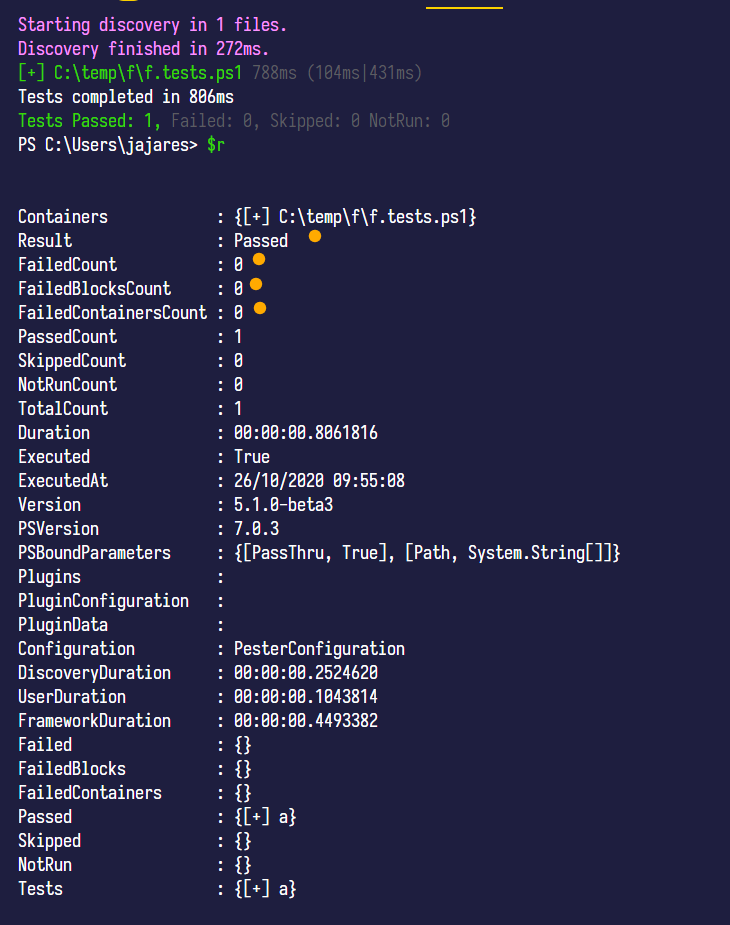
Looks like $Pester.FailedCount is not available in the current version of Pester...is there a corresponding property to check for the previous failure?
 admin-simeon
on 19 Oct 2020
admin-simeon
on 19 Oct 2020
You can use the properties marked with orange dot. The Result is the one that is useful to determine if the whole run passed, the next three ones are the counts of failures. And they have corresponding properties without the Count suffix pointing at collection that holds the failed tests / blocks / containers objects if you need more info than just count.
nohwnd
on 26 Oct 2020
Related issues
nohwnd
·
23Comments
 tribou
·
26Comments
nohwnd
·
22Comments
tribou
·
26Comments
nohwnd
·
22Comments
 ephracis
·
18Comments
ephracis
·
18Comments
 Mahendra1260
·
50Comments
Mahendra1260
·
50Comments
Most helpful comment
I know I probably shouldn't be fiddling about with Pester module variables, but this is a low impact way of skipping all tests after a fail: