Opennmt-py: How to use pretrained embeddings from Glove?
I am trying to train the model with pretrained word embeddings. The embeddings I am trying to use are from Glove, such as the Common Crawl 840B.
What I try to do is to run train.py file by adding the embedding '.txt' file in the -pre_word_vecs_enc argument. But the following error appears:
`Loading data from 'PaCo_data/En_eu_preprocessed.atok.low.train.pt'
- vocabulary size. source = 50003; target = 50004
- number of training sentences. 117056
- maximum batch size. 64
Building model...
Intializing params
Traceback (most recent call last):
File "OpenNMT-py/train.py", line 440, in
main()
File "OpenNMT-py/train.py", line 413, in main
encoder.embeddings.load_pretrained_vectors(opt.pre_word_vecs_enc)
File "/data/ijauregi/Desktop/CMCRC/OpenNMT/OpenNMT-py/onmt/Models.py", line 57, in load_pretrained_vectors
pretrained = torch.load(emb_file)
File "/data/ijauregi/Desktop/pyTorchPython/lib/python3.5/site-packages/torch/serialization.py", line 229, in load
return _load(f, map_location, pickle_module)
File "/data/ijauregi/Desktop/pyTorchPython/lib/python3.5/site-packages/torch/serialization.py", line 367, in _load
magic_number = pickle_module.load(f)
_pickle.UnpicklingError: invalid load key, 'O'.
(pyTorchPython)
`
What should be the format of the embedding file? Do I need to change the format somehow?
 ijauregiCMCRC
All 19 comments
maybe you can use the initialized method in torchtext
 hongweizeng
on 30 Aug 2017
hongweizeng
on 30 Aug 2017
That's a good idea. We don't support torchtext for this yet, but we will prioritize this now that torchtext is integrated.
 srush
on 30 Aug 2017
srush
on 30 Aug 2017
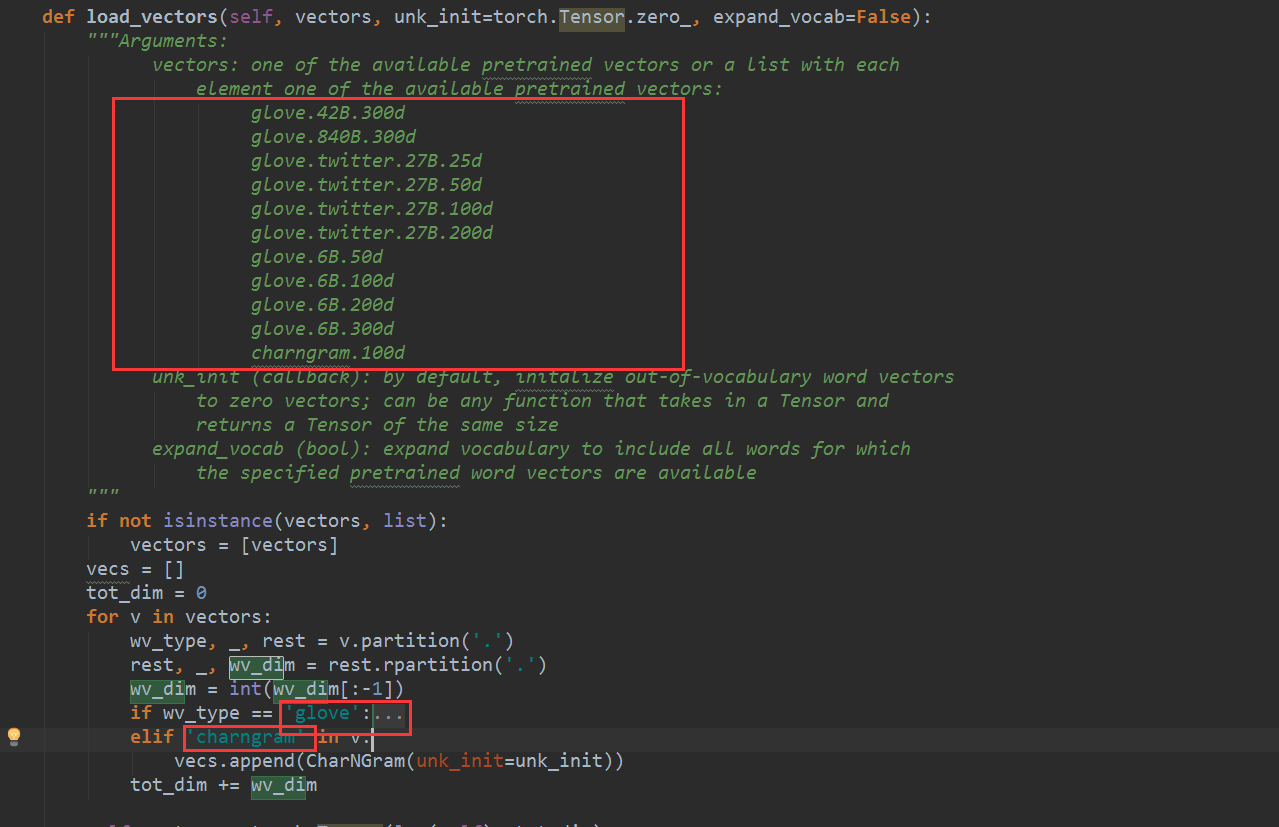
It's very convenient to use the methods in torchtext since the data saved in preprocess.py are classes defined in torchtext.

but you should define the word_vec_size equal to wv_dim, where there is 300 in the picture.
hongweizeng
on 30 Aug 2017
Fantastic. Maybe we can have this be a special case of "pre_word_vecs_enc"?
Something like "tt:glove.6b"?
On Aug 30, 2017 10:05 AM, "zeng" notifications@github.com wrote:
It's very convenient to use the methods in torchtext since the data saved
in preprocess.py are classes defined in torchtext.
[image: image]
https://urldefense.proofpoint.com/v2/url?u=https-3A__user-2Dimages.githubusercontent.com_15373554_29876163-2D9989e692-2D8dce-2D11e7-2D9630-2D107aa218cea0.png&d=DwMFaQ&c=WO-RGvefibhHBZq3fL85hQ&r=wnHFZ7D4m-9MRwk-CWlvCGbWEiQX_AvUO2LuMy4Vj7c&m=jC0j3mOSAzUsg1-dr3jX-pakrBW7H8SCMQGlDTZiXak&s=Yz6_X5mIGgKLKDiR2VJ-njVtTtaFv--r3_NC5CmXWjc&e=
—
You are receiving this because you commented.
Reply to this email directly, view it on GitHub
https://urldefense.proofpoint.com/v2/url?u=https-3A__github.com_OpenNMT_OpenNMT-2Dpy_issues_210-23issuecomment-2D326000736&d=DwMFaQ&c=WO-RGvefibhHBZq3fL85hQ&r=wnHFZ7D4m-9MRwk-CWlvCGbWEiQX_AvUO2LuMy4Vj7c&m=jC0j3mOSAzUsg1-dr3jX-pakrBW7H8SCMQGlDTZiXak&s=14TX4OmsFdW6aYihuCtExHydLcE4bYE2yATEeMrUwHw&e=,
or mute the thread
https://urldefense.proofpoint.com/v2/url?u=https-3A__github.com_notifications_unsubscribe-2Dauth_AACMKpStmkZ4l1hFHLGdGRNkhZ29ZO-5FIks5sdWwHgaJpZM4PG58K&d=DwMFaQ&c=WO-RGvefibhHBZq3fL85hQ&r=wnHFZ7D4m-9MRwk-CWlvCGbWEiQX_AvUO2LuMy4Vj7c&m=jC0j3mOSAzUsg1-dr3jX-pakrBW7H8SCMQGlDTZiXak&s=4Pl7h4YIx8c1rMP7wlBxQ1V7H1sWuQTswrdVSiW6L74&e=
.
srush
on 30 Aug 2017
the methods implemented in torchtext, maybe just need a judge to identify the string and choose the wanted embedding.
hongweizeng
on 30 Aug 2017
Adding @bpopeters who is the Pytorch Chief Embeddings Officer.
srush
on 30 Aug 2017
Hi!
Thank you @srush and @xjtu-zeng for your quick replies. But I still I am a bit lost. I am very new with pytorch. I am still confused about what kind of file needs to go in the argument -pre_word_vecs_enc and -pre_word_vecs_dec. In other occasions I have used the embeddings downloaded from Glove or Word2vec. They are usually in a '.txt' file and they follow the following structure:
"
word1 embedding1
word2 embedding2
word3 embedding3
...
"
But it seems that by just giving this kind of file as an argument doesn't work here.
Thanks,
ijauregiCMCRC
on 6 Sep 2017
I believe the argument for pre_word_vecs_enc/dec needs to be a serialized pytorch object representing a matrix whose size is (n x m), where n is the vocabulary size and m is the dimensionality of the word vectors. The nth entry in this matrix corresponds to the nth element of the vocabulary. So in order to use word vectors in another format, you'll need to write a script that puts them in a torch.Tensor and then run torch.save on that object to serialize it to a file.
 bpopeters
on 6 Sep 2017
bpopeters
on 6 Sep 2017
@bpopeters I think there is a request for a special option that instead loads the torchtext embeddings as above.

srush
on 6 Sep 2017
Thanks @bpopeters . I think I understand what I need to do. I started using a program called torchwordemb, which takes as input the path to the glove_embeddings.txt file, and returns:
- A dictionary with all the vocabulary mapped to unique IDs
-The vectors matrix (size: n_vocab X emb_dim)
Do I need to serialize both documents? Because, otherwise, if I only serialize the matrix, how does then OpenNMT know how to initialize each word in the source or target dictionary with these pre-trained embeddings?
Thanks
ijauregiCMCRC
on 7 Sep 2017
Hey, I have a remotely related question on this... I just tried the modified code to load pretrained word embedding from @xjtu-zeng: worked out of the box like charm!
However, I really wanted to understand how OpenNMT or torchtext handles out of vocabulary words, e.g. those word tokens that appear in source or target sentences but not in the pretrained word embeddings. I took a brief look at Embeddings.py and didn't seem to find the function/method that deals with out of vocab word tokens.
Maybe this issue is handled in torchtext? Could someone kindly explain how this issue is handled, or point to the file or places in a file that I should take a look at to understand it? Thanks so much in advance!
 moonlightlane
on 9 Oct 2017
moonlightlane
on 9 Oct 2017
There is an UNK token, that is always set to index 0. Since the vocab size is limited in training, it will learn to handle this token. At test time it can input and output UNK.
srush
on 10 Oct 2017
Based on how I've seen other pretrained loading things work it depends how you initialise your embedding matrix. For example here the matrix is initialised with random normals. So any word which is already in the vocabulary but doesn't appear in the pre-trained embeddings will be treated as a randomly initialised vector. And from there it depends whether you continue to train the embedding or leave them as they started.
The way that OpenNMT-py allows pretrained embeddings to be loaded all of this stuff has to be handled manually beforehand. So unless you go back and change your vocabulary as part of the preprocessing it's unlikely that the words not in the pretrained embeddings are going to register
as UNKs.
 Henry-E
on 10 Oct 2017
Henry-E
on 10 Oct 2017
@ijauregiCMCRC Hi, have u got it?
 caozhen-alex
on 19 Nov 2017
caozhen-alex
on 19 Nov 2017
I used the following script https://github.com/ylhsieh/OpenNMT-py/blob/master/embeddings_to_torch.py and it worked for me.
ijauregiCMCRC
on 20 Nov 2017
We have this checked in now.
srush
on 5 Dec 2017
PR https://github.com/OpenNMT/OpenNMT-py/pull/398 introduces a tool to do it easily.
see the tutorial: http://forum.opennmt.net/t/how-to-use-glove-pre-trained-embeddings-in-opennmt-py/1011
 pltrdy
on 6 Dec 2017
pltrdy
on 6 Dec 2017
@ijauregiCMCRC Thank u for reply. But it seems that the link is 404.
caozhen-alex
on 31 Jan 2018
You can go here http://opennmt.net/OpenNMT-py/FAQ.html
srush
on 1 Feb 2018
Related issues
 KelleyYin
·
6Comments
KelleyYin
·
6Comments
 lizamiller
·
3Comments
lizamiller
·
3Comments
 AyaNsar
·
4Comments
caozhen-alex
·
5Comments
AyaNsar
·
4Comments
caozhen-alex
·
5Comments
 anoidgit
·
4Comments
anoidgit
·
4Comments
Most helpful comment
It's very convenient to use the methods in torchtext since the data saved in preprocess.py are classes defined in torchtext.

but you should define the word_vec_size equal to wv_dim, where there is 300 in the picture.