Ontology: update definition of "has input"
Description of the issue
From the oeo-dev-meeting on energy subclasses 2021-02-02:
We should think about redefining the relation has input such that it holds not only for material entities but also for energies.
related to #662
Ideas of solution
If you already have ideas for the solution describe them here
Workflow checklist
- [ ] I discussed the issue with someone else than me before working on a solution
- [ ] I already read the latest version of the workflow for this repository
- [ ] The goal of this ontology is clear to me
I am aware that
- [ ] every entry in the ontology should have a definition
- [ ] classes should arise from concepts rather than from words
 stap-m
All 12 comments
An other solution my be to define separate relations has_energy_input and has_energy_output derived directly from has_participant.
 l-emele
on 2 Feb 2021
l-emele
on 2 Feb 2021
For some reason, the RO has the constraint to material entity only for has input, not for has output or has participant. This seems a bit counter-intuitive.
Also, we have defined several subproperties of has input:
has physical inputprobably refers to what is now the definition ofhas input, e.g. an input that is somematerial entity, but is also used for forms of energy.has constraintandhas numerical inputspecifically refer to things that are not material entities, so we need to redefinehas inputif we want to keep them.
My suggestion would be to
- change the definition of
has input: _p has input c iff: p is a process, ~c is a material entity,~ c is a participant in p, c is present at the start of p, and the state of c is modified during p._
- add a comment explaining that we made this change
- replace
has physical inputby two new properties, one for material entities, one for energies - find a definition for
has numerical input(~I will open a new issue for this~ see #618) - do the same for the subproperties of has output (
has outputitself can remain unchanged)
 sfluegel05
on 3 Feb 2021
sfluegel05
on 3 Feb 2021
Does the RO use an issue tracker system like GitHub? We might flag this there. @jannahastings, what do you think?
I like the idea of having a special relation for energy input (and output) as that could be a key relation of our open _energy_ ontology.
l-emele
on 3 Feb 2021
I'm not sure if it's useful to distiguish between has material input and has energy input (or however it will be called), because an input can be both energetical and material, especially for energy carrying materials. We could use has physical input for both energies and material, thus we won't cause any trouble there...
stap-m
on 3 Feb 2021
Can we agree on sth? The energy subclass issues rely on this issues...
stap-m
on 8 Feb 2021
I understood that we use has_input for the moment and update the relation later. We should anyway revisit all uses of has_input.
l-emele
on 8 Feb 2021
I'm not sure if it's useful to distiguish between
has material inputandhas energy input(or however it will be called), because an input can be both energetical and material, especially for energy carrying materials. We could usehas physical inputfor both energies and material, thus we won't cause any trouble there...
That's a good point. In that case, how should has physical input be defined? We could either say that it is for material entities and energies exclusively (e.g. the range is the union of energy and material entity) or we could also include everything in between (the range is continuant). In the latter case has physical input would again be the same as has input and should therefore be left out.
sfluegel05
on 22 Feb 2021
I prefer the first option. The range of _all_ continuants is to broad, e.g. a geografic coordinate or an information content entity can be input to a process, but not really in a physical way...
What about just extending the def of has input like that:?
_p has input c iff: p is a process, c is a material entity_ or energy_, c is a participant in p, c is present at the start of p, and the state of c is modified during p._
stap-m
on 23 Feb 2021
As you said, an information content entity can be an input as well, just not a physical one. So I would suggest to use continuant as the range of has input and material entity or energy as the range of has physical input.
A definition in the "RO style" could be: _p has physical input c iff: p has input c, and c is a material entity or energy_
sfluegel05
on 24 Feb 2021
Sounds like a solution!
@sfluegel05 is there an nice way to find out all implemented has input relations to find out which should be changed to has physical input?
stap-m
on 24 Feb 2021
Luckily, Protegé has a feature for that. Next to the annotations, you can find a tab about the usages of an entity.
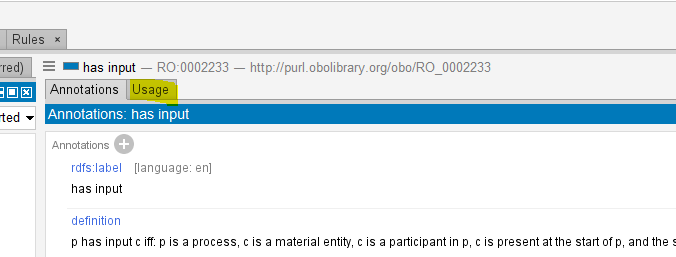
For has input we have energy transformation, hydro energy transformation, nuclear energy transformation, stam-electric process and wind energy transformation. All of them are energy-related, so we should move them to has physical input.
sfluegel05
on 24 Feb 2021
Thanks for that useful hint. I'll implement.
stap-m
on 24 Feb 2021
Related issues
sfluegel05
·
6Comments
 akleinau
·
8Comments
l-emele
·
4Comments
sfluegel05
·
7Comments
sfluegel05
·
8Comments
akleinau
·
8Comments
l-emele
·
4Comments
sfluegel05
·
7Comments
sfluegel05
·
8Comments
Most helpful comment
As you said, an
information content entitycan be an input as well, just not a physical one. So I would suggest to usecontinuantas the range ofhas inputandmaterial entity or energyas the range ofhas physical input.A definition in the "RO style" could be: _p has physical input c iff: p has input c, and c is a material entity or energy_