Ontology: Sector definitions
Our ideas on class Sector (as they can be characterised differently), and we will work on this
Add a class SectorConcept
Each Sector has a SectorConcept
SectorConcept contains subclasses of concepts that have specific names
    These subclasses can be filled with information accordingly
 han-f
han-f
All 46 comments
Could you specify the different characterisations of Sector?
 MGlauer
on 5 Feb 2019
MGlauer
on 5 Feb 2019
A sector could be characterised for example following "economic concepts" or "concepts according to a specific regulation (e.g. Renewable Energy Directive)" or according to a specified reporting format e.g. CRF sector definitions under UNFCCC and many more; even self-made definitions.
Sectors may have the same name, but defined differently in each of the concepts.
These are different ways of partitioning the system of interest.
han-f
on 5 Feb 2019
So basically:
:Sector :conforms_to some :SectorConcept
Sounds good, as long as the definition of sector is specific enough, so that one does not mix it up with geographical regions or so.
MGlauer
on 5 Feb 2019
Yes exactly. The definitions are very specific according to the various concepts and have nothing to do with geographic regions for example.
han-f
on 5 Feb 2019
We have added conforms_to
han-f
on 11 Feb 2019
Can this ticket be closed?
han-f
on 11 Jul 2019
No, I am still working on this.
 l-emele
on 11 Jul 2019
l-emele
on 11 Jul 2019
The definition of Sector has to be updated
MGlauer
on 13 Nov 2019
We have:
SectorConcept: generically dependent continuant
"A SectorConcept is a specific way to subdivide a system"
Sector: object aggregate
"A sector is a subdivision in an economic system"
@han-f are these definitions ok now?
 akleinau
on 2 Dec 2019
akleinau
on 2 Dec 2019
We need to:
- add conforms_to relation between Sector and SectorConcept
- discuss if sector is an object aggregate
akleinau
on 2 Dec 2019
Sector is not an object aggregate because its more than a collection of objects. I'd classify it as a generically dependent continuant because it depends on objects in it like power generators
akleinau
on 2 Dec 2019
@han-f, @l-emele, @stap-m can I implement those changes?
- Sector conforms_to some SectorConcept
- sector as generically dependent continuant
akleinau
on 12 Dec 2019
I think so.
l-emele
on 12 Dec 2019
Sector conforms_to some SectorConcept
sector as generically dependent continuant
Looks good to me. The def of sector should be more broad. There are Sectors apart from economy. A sector is a subdivision of anything? - This is not Aristotelian style, though. But I think, it becomes clearer than talking about Sector as GDC in the def... What do you think, is an exception ok here?
 stap-m
on 13 Dec 2019
stap-m
on 13 Dec 2019
I like the the definition _A sector is a subdivision of anything?_ a lot, because this implicitly also defines a subsector as a subsector is a sector of a sector.
l-emele
on 13 Dec 2019
@jannahastings can we make an exception here to aristotelean definitions or do you have a better idea?
akleinau
on 19 Dec 2019
I don't think _A sector is a subdivision of anything_ will work as a definition, because it is too broad. The number 2, for example, is a subdivision of the number 4, but it is not a sector. @stap-m @l-emele can you give examples of sectors that are not economic?
 jannahastings
on 19 Dec 2019
jannahastings
on 19 Dec 2019
Energy sectors or regional sectors for example. Each sector can be further split into subsectors. E.g. 'cooling' is a sector of 'heating', which itself can be an energy sector.
The idea for 'subdivision of anything' emerged from the sector concept. Basically, one can define a sector concept that devides a thing into certain subdivisions. The rules for the division are defined inside the sector concept.
German wikipedia says: _Der Begriff Sektor (lat.: sector = „Schneider“, im Sinne von etwas, das schneidet) bezeichnet allgemein einen Ausschnitt_. https://de.wikipedia.org/wiki/Sektor This reflects the idea quite good in my opinion.
This might be a topic for a telco discussion.
stap-m
on 8 Jan 2020
I added the test file for sectors and sector concepts we discussed today.
l-emele
on 21 Jan 2020
From the 7th oeo developer meeting:
- update classes: sector, sector division
- include general classes "transport sector" etc to catch similarity, use the existing classes
- add relations #460
- individuals for specific definitions from documents #461
stap-m
on 26 Jun 2020
No 2 is mainly redefining existing classes as we already have a couple:
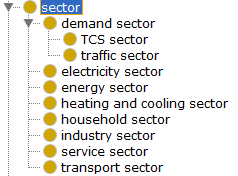
transport sector and traffic sector are probably synonyms, also TCS sector and service sector.
Most of the sectors definitions need to be changed, as they contain the energy consumption in the definition.
Bad example: traffic sector: _A traffic sector is a demand sector that includes the energy consumption from traffic._
Rather good example: household sector: _The household sector covers all private entities. A household is a shared living unit._ (Household should definitely be an own class, though.)
l-emele
on 26 Jun 2020
Sectoris currently classified asobject aggregate: I am not really happy with this. Sector as a subclass of system or something like subsystem? @jannahastings do you have an idea?
_Originally posted by @stap-m in https://github.com/OpenEnergyPlatform/ontology/issues/460#issuecomment-652873945_
l-emele
on 2 Jul 2020
A sector _can_ form a system but I does not necessarily be a system. The definition for system in #432 is currently work in progress but if I see correctly we tend to this definition for a system: "A material entity consisting of multiple components that are causally integrated."
With that definition e.g. building sector is not a system, as the building sector is just an aggregate of buildings without further integration.
l-emele
on 2 Jul 2020
I just found this comment from @akleinau regarding the classifiaction of sector: https://github.com/OpenEnergyPlatform/ontology/issues/30#issuecomment-560385016
Sector is not an object aggregate because its more than a collection of objects. I'd classify it as a generically dependent continuant because it depends on objects in it like power generators
It sounds good to me.
stap-m
on 2 Jul 2020
So direct subclass of generically dependent continuant? _A sector is generically dependent continuant that is a subdivision of a system_.
l-emele
on 2 Jul 2020
... of a system. ?
stap-m
on 2 Jul 2020
Yes, of course. I corrected above.
l-emele
on 2 Jul 2020
From the 7th oeo developer meeting:
1. update classes: sector, sector division
What do we want to change at the sector division? From the notes in the pad I don't see any changes for that class itself.
l-emele
on 2 Jul 2020
I looks fine to me as is, too. We could just think about changing the def to A sector division is a generically dependent continuant that is a specific way to subdivide a system.
But the other one reads nicer. I don't really have an opinion to that.
Implement?
stap-m
on 2 Jul 2020
I prefer the current definition and would suggest to keep it as it is.
I'll implement the new sector definition.
l-emele
on 2 Jul 2020
PR #477 solves only the sector definition. But this issue is also about the different sectors.
Currently we have:
demand sector: _A demand sector is a general term for different consumptions (households; industry; commercial sector; transport). It includes only energy demand sectors._
TCS sector: _A TCS sector is a demand sector that includes the energy consumption from trade, commerce and services._traffic sector: _A traffic sector is a demand sector that includes the energy consumption from traffic._
electricity sector: _Covers all areas that deal with electrical energy (power generation; electricity transmission; electricity storage; electricity use)._energy sector: _An energy sector is a sector that contains the energy production._heating and cooling sector: _Energy used for heating and cooling for buildings and industry_household sector: _The household sector covers all private entities. A household is a shared living unit._industry sector: _Industry consumption is specified as follows (energy used for transport by industry is not included here but is reported under transport): _ [And a long list of branches which I did not copy here].service sector: Currently without definitiontransport sector: _Consumption in transport covers all transport activity (in mobile engines) regardless of the economic sector to which it is contributing, and is specified as follows:_ [And a list of subsectors which I did not copy here].
In OEO Dev 7 we decided that our sector classes should be generic and the precise definitions of sectors following a specific sector division will then be individuals of these sector I propose the following structure and definitions:
transformation sector(alternative terms:energy sectorandenergy industry sector): _A transformation sector is a sector that contains energy production, energy transformation from primary to secondary energy and transport of energy to the demand sector._
electricity sector: _An electricity sector is a transformation sector that contains electricity generation and transport of electrical energy to consumers of electrical energy._
demand sector: _A demand sector is a sector that includes energy consumers._
transport sector(alternative term:traffic sector): _A transport sector is a sector that covers transport of people and/or goods._service sector(alternative terms:commercial sectorandtrading, commerce and service sector): _A service sector is a sector that covers service activities._ (We probably have to defineservice, but topic for a separate issue.)household sector(alternative term:private household sector): _A household sector is a sector that covers households._ (We could think about defining ahouseholdclass, but that would be a different issue.)building sector: _A building sector is a sector that covers buildings._ (Again, we could define in a separate issue abuildingclass if needed.)heating and cooling sector: _A heating and cooling sector is a sector that covers heating and cooling activities._
l-emele
on 3 Jul 2020
Via #192: Non-energy sectors: Land use, land-use change and forestry (LULUCF), agriculture, waste should also be covered.
Maybe then the upper structure
energy transformation sectorinstead oftransformation sectorenergy demand sectorinstead ofdemand sectornon-energy sector
l-emele
on 6 Jul 2020
Maybe it is useful to make commercial sector the main label? Then the definition would change to:
commercial sector(alternative terms:service sectorandtrading, commerce and service sector): _A commercial sector is a sector that covers commercial activities._
l-emele
on 8 Jul 2020
Maybe _... that covers non-industrial commercial activities_ to distinguish from industry?
l-emele
on 8 Jul 2020
I miss the industry sector in the discussion here. When we go with the sector concept according to UNFCC reports, the industry sector is diveded into energy use of industry and industry processes. So "industry" could be a subclass of energy demand sector and "industry processes" a subclass of non-energy sector.
My second question is: Why is a building sector required? Isn't it a part of the commercial and the houshould sector?
 Vera-IER
on 8 Jul 2020
Vera-IER
on 8 Jul 2020
I miss the industry sector in the discussion here. When we go with the sector concept according to UNFCC reports, the industry sector is diveded into energy use of industry and industry processes. So "industry" could be a subclass of energy demand sector and "industry processes" a subclass of non-energy sector.
Yes, right. Industry is missing in the list. It is currently defined as _Industry consumption is specified as follows (energy used for transport by industry is not included here but is reported under transport):_ [and a list of activities].
Maybe we should avoid the class non-energy sector and make industrial processes, agriculture etc. direct subclasses of sector.
My second question is: Why is a building sector required? Isn't it a part of the commercial and the houshould sector?
I could be also the other way round: households and commercial could be seen as parts of a building sector. That is why I propose that they are on the same level.
l-emele
on 8 Jul 2020
Looks good to me.
Maybe we should avoid the class non-energy sector and make industrial processes, agriculture etc. direct subclasses of sector.
Yes this would be also consistent to the UNFCC report sector division.
Vera-IER
on 8 Jul 2020
I've implemented what we've discussed so far.
For industry industry we had not yet a Aristolean definition. I've propose (and already implemented) the following definition: _An industry sector is a sector that covers industrial activities with other main purposes of energy transformation._ But there are probably better definitions.
I am unsure about the classification of industry sector and kept it at the moment as a direct subclass of sector as there is no exact line between industry sector and energy transformation sector due to things like industrial power plants, blast furnaces etc.
On the non-energy sectors I've implemented nothing so far as the discussion is not yet settled and most importantly we do not have definitions yet for these sectors.
(I already created a draft pull request #484 but that is mainly that I can already implement the term tracker items. The discussion should still be here.)
l-emele
on 10 Jul 2020
The non energy sectors (following the UNFCC report) are:
agriculture
land use, land use change and forestry
waste and wastewater
other
I actually don't know if we need the sectors "waste and wastewater" and "other"?
I suggest these first defenitions:
The agriculture sector is a sector that produces food, feed, fiber and many other desired products by the cultivation of certain plants and the raising of domesticated animals (livestock). (https://www.sciencedaily.com/terms/agriculture.htm)
The land use, land use change and forestry (LULUCF) sector is a sector that includes the carbon pools of living biomass (above and below ground), dead organic matter (dead wood and litter) and organic soil carbon and that can account emissions from land-use change (such as permanent pasture to arable) and deforestation. (https://www.emissions-euets.com/carbon-market-glossary/866-lulucf)
Vera-IER
on 10 Jul 2020
Maybe it makes sense to have something like an agriculture, forestry and land use sector where agriculture and LULUCF are either subclasses of or instances of.
We shouldn't define a class Other sector, as such _catch everything not included elsewhere classes_ are not good practice.
l-emele
on 10 Jul 2020
Regarding industrial processes I think, we do not need a class for an industrial process sector. This dividing industry into an energy part and an process part is something very specific to the UNFCCC/IPCC sector division. I think when implementing #461 we should simply have two individuals of industry sector, one covering the energy part and the other covering the process part.
I see similarly for agriculture/forestry/land use (AFOLU): In the UNFCCC sector division, agriculture is mainly separated from the forestry/land use because difference rules apply there. But again this is something very UNFCCC specific, the IPCC e.g. has a collective AFOLU sector. So I propose also to define one AFOLU class but have two individuals connected to the UNFCCC sector division via the is_defined_by object property from #460 / #480 .
l-emele
on 10 Jul 2020
I propose the following definitions:
agriculture, forestry and land use sector: _The agriculture, forestry and land use sector is a sector that covers agricultural, forestial and land-using activities._waste and wastewater sector: _The waste and wastewater sector is a sector that covers activities related the collection, treatment and of waste and wastewater._
l-emele
on 13 Jul 2020
I would change it a bit:
agriculture, forestry and land use sector: The agriculture, forestry and land use sector is a sector that covers activities and natural processes from agricultural, forestry, land use and land use change.
waste and wastewater sector: The waste and wastewater sector is a sector that covers activities related the collection and treatment of waste and wastewater.
Vera-IER
on 13 Jul 2020
what's the next step in this issue?
akleinau
on 29 Jul 2020
I think everything discussed here is already implemented?
Vera-IER
on 14 Aug 2020
I think I left this issue open as #461 might show some problems with these sector definitions. But we can close this issue and reopen if needed.
l-emele
on 14 Aug 2020
Related issues
han-f
·
6Comments
l-emele
·
7Comments
akleinau
·
6Comments
stap-m
·
8Comments
l-emele
·
6Comments