Next-i18next: defaultLanguage not working
Environment:
I have my backend (server) and frontend (client) on separate servers.
Therefore I have omitted the server config on Nextjs app and set up i18n without it.
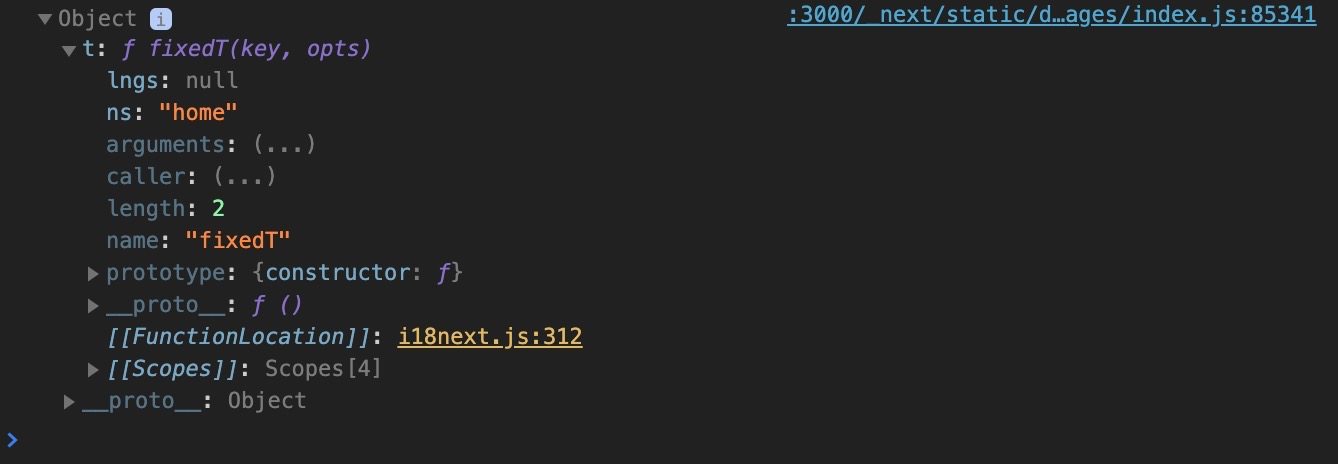
When I console log t() from { withNameSpaces } from:
const NextI18Next = require('next-i18next/dist/commonjs');

module.exports = new NextI18Next({
  defaultNS: 'common',
  defaultLanguage: 'en',
  otherLanguages: ['fr', 'ru', 'lv'],
  localeSubpaths: 'none'
});
the lngs field is null
As seen above, I have defined defaultLanguage, however, it is not being applied.
If the lang is manipulated via i18n.changeLanguage( 'en') the translations are applied just fine.
Switching between languages also is not a problem, however, in either case the lngs field remains null.
 ScottAgirs
All 13 comments
 joeyzone
on 22 Apr 2019
joeyzone
on 22 Apr 2019
269
the same
not the same #269 says other than 'en', in my case it's null - i.e. not loading at all.
ScottAgirs
on 22 Apr 2019
I have my backend (server) and frontend (client) on separate servers
Can you explain what this means? How are you doing SSR?
 isaachinman
on 22 Apr 2019
isaachinman
on 22 Apr 2019
I have my backend (server) and frontend (client) on separate servers
Can you explain what this means? How are you doing SSR?
Hey Isaac, thanks for replying!
I have NodeJS server in a folder that I deploy to (example - Heroku) and NextJS in another folder that I deploy to (example Zeit Now) - so 2 separate folders
EDIT:
Just noticed this line
https://github.com/isaachinman/next-i18next/blob/5dcdf7d9d40205bb3aafa53aaba4f4d201ced8f5/examples/simple/server.js#L15
So would this mean that if I have the client and server separated I would have to initiate another server on the frontend? If so, are there any good examples I could get inspiration from?
ScottAgirs
on 22 Apr 2019
NodeJS server in a folder [...] NextJS in another folder
Not sure I'm understanding what you mean. All we care about here is the NextJs process, which _is itself_ a NodeJs process. The process which serves your NextJs routes via Express is the process which must also use the nextI18NextMiddleware.
I think perhaps you are confusing the idea of "client" and "server" separation. The simple example in this repo provides a good outline for how to approach setup.
Let me know if you have any other questions.
isaachinman
on 22 Apr 2019
NodeJS server in a folder [...] NextJS in another folder
Not sure I'm understanding what you mean. All we care about here is the NextJs process, which _is itself_ a NodeJs process. The process which serves your NextJs routes via Express is the process which must also use the
nextI18NextMiddleware.I think perhaps you are confusing the idea of "client" and "server" separation. The simple example in this repo provides a good outline for how to approach setup.
Let me know if you have any other questions.
For now I only have the same, initial, question, which is not answered.. :) I have not set up NodeJS process on my front-end app. I'm running NodeJS process on the backend of the app, I use NextJS exclusively for the front-end.
In other words, I am not dealing with neither Express nor NodeJS within the repo of where my NextJS app is.
Here is a brief illustration of the structure:
Frontend
/FolderApple
└── NextJS App
├── /pages
├── /static
├── en
| └── common.json
└── ru
└── common.json
├── i18n.js // 1)
├── config.js // 2)
└── index.js
1) contains https://github.com/isaachinman/next-i18next/blob/5dcdf7d9d40205bb3aafa53aaba4f4d201ced8f5/examples/simple/i18n.js#L1-L8
2) contains the endpoint URL to feed into Apollo Client
Backend
/FolderBanana
└── NodeJS App
├── /src
├── resolvers
└── etc
└── index.js // all server stuff - Express, CreateGraphQLServer etc.
So:
- FolderApple does not deal with any server stuff at all
- FolderBanana deals with server stuff only
I then connect the two with an endpoint.
So my question better formed would be - do I have to create a NodeJS process with Express on my FolderApple in order for this to work or is there another way?
ScottAgirs
on 23 Apr 2019
In other words, I am not dealing with neither Express nor NodeJS within the repo of where my NextJS app is.
You will need to create a custom Node/Express server within your NextJs app as clearly stated in the docs. I also wrote a walkthrough article which you can find here.
isaachinman
on 23 Apr 2019
In other words, I am not dealing with neither Express nor NodeJS within the repo of where my NextJS app is.
You will need to create a custom Node/Express server within your NextJs app as clearly stated in the docs. I also wrote a walkthrough article which you can find here.
Okay, thank you will give it a go.
ScottAgirs
on 23 Apr 2019
I was able to resolve this issue by removing 'header' from detectors by adding the following to my config to override the default detectors:
detection: {
    lookupCookie: 'next-i18next',
    order: ['cookie', 'querystring', 'localStorage', 'path', 'subdomain'],
    caches: ['cookie'],
  },
so the set up would be:
import NextI18Next from 'next-i18next'

const NextI18NextInstance = new NextI18Next({
  defaultLanguage: 'ar',
  otherLanguages: ['de'],
  detection: {
    lookupCookie: 'next-i18next',
    order: ['cookie', 'querystring', 'localStorage', 'path', 'subdomain'],
    caches: ['cookie'],
  },
})

export default NextI18NextInstance

/* Optionally, export class methods as named exports */
export const {
  appWithTranslation,
  withTranslation,
} = NextI18NextInstance
the header detector check the request headers for accept-language which is en in most cases
 ahmedengu
on 11 Oct 2019
ahmedengu
on 11 Oct 2019
Hi , i have the bug with the same. How do you fix it ?
 josecao
on 13 Nov 2019
josecao
on 13 Nov 2019
Hi , i have the bug with the same. How do you fix it ?
i fixed that by doing this:
import NextI18Next from 'next-i18next'
const NextI18NextInstance = new NextI18Next({
localePath: 'static/locales',
defaultLanguage: 'en',
otherLanguages: ['de']
});
export default NextI18NextInstance.i18n.init({
lng: 'en',
});
 NoobJK
on 13 Nov 2019
NoobJK
on 13 Nov 2019
@NoobJK That's not a fix, that's a fundamental misunderstanding of what's going on. You need to disable header/browser detection if you do not want that behaviour.
isaachinman
on 13 Nov 2019
@isaachinman thanks for your reply, when i use defaultLanguage: 'en' my language is always undefined in console log and its never been set in cookies, unless i use i18n.changeLanguage('en') or doing that export default NextI18NextInstance.i18n.init({lng: 'en',}); can you help me how to fix that? please
NoobJK
on 14 Nov 2019
Related issues
 nataliaroque77
·
3Comments
nataliaroque77
·
3Comments
 HectorLS
·
6Comments
HectorLS
·
6Comments
 MrAvantiC
·
3Comments
MrAvantiC
·
3Comments
 dohomi
·
5Comments
dohomi
·
5Comments
 dimensi
·
4Comments
dimensi
·
4Comments
Most helpful comment
I was able to resolve this issue by removing 'header' from detectors by adding the following to my config to override the default detectors:
so the set up would be:
the header detector check the request headers for
accept-languagewhich isenin most cases