Neo: Should we use dependency injection in Neo 3?
Hi @neo-project/core,
I think it would be good for this project if we can update it to use dependency injection. This will make the code more modular and more testable. We already did this in neo-sharp and it worked really well.
I did some brief research and it seems that dependency injection fits with Akka:
https://doc.akka.io/docs/akka/current/actors.html#dependency-injection
What do you think? Shoud we use our own dependency injection or use an existing framework? We could copy from neo-sharp.
 lock9
lock9
All 18 comments
It has a lot of benefits for unit testing because this could help with isolation
 shargon
on 21 Aug 2019
shargon
on 21 Aug 2019
Definitely. This first thing @rodoufu told me too, when he first saw neo :joy: good to dettach and test components. I suppose this solves other concerns by @jsolman , on component load orders.
 igormcoelho
on 21 Aug 2019
igormcoelho
on 21 Aug 2019
That would make the project a lot easier to test and to mock.
We don't need to inject everything from the beginning, we may start with some objects and go moving then to DI as we can.
I had started a branch about that but it's too old, like 8 months old, I think:
https://github.com/rodoufu/neo/tree/IoC
 rodoufu
on 21 Aug 2019
rodoufu
on 21 Aug 2019
We may also improve some life scope implementations like the one related to Blockchain, so we don't need to handle the scope ourselves, leaving that to the DI container.
https://github.com/neo-project/neo/blob/master/neo/Ledger/Blockchain.cs#L74
rodoufu
on 21 Aug 2019
I fully agree @rodoufu , this is the most critical part.
igormcoelho
on 22 Aug 2019
I think that a good approach for that would be using AutoFac, it already has a project for DI using Akka framework "Akka.DI.AutoFac".
So we can register a dependency like Builder.RegisterType<Blockchain>().AsSelf();
After that we need to tell Akka actor system to use the DI container:
ActorSystem.UseAutofac(_neoContainer.Container)
Then an actor with a mailbox would be something like:
system.ActorSystem.DI().Props<Blockchain>().WithMailbox("blockchain-mailbox");
At December 2018, when I first started the fork Autofac was the only one able to integrate with Akka but now we may also use CastleWindsor and Ninject
https://getakka.net/articles/actors/dependency-injection.html
rodoufu
on 4 Sep 2019
@neo-project/core
Hi, if anyone wants to block this issue, now is the time to say.
lock9
on 27 Sep 2019
As long as DI is build on top of Microsoft.Extensions.DependencyInjection. Any container of choice should only be used in the top level and not pollute in-depth parts with its namespaces. Make this friendly for other containers.
 theofanis
on 13 Oct 2019
theofanis
on 13 Oct 2019
I'm creating an implementation for the DI using Autofac but I'm dealing with some coupling issues.
As you can see below, I've mapped the dependencies in the library.
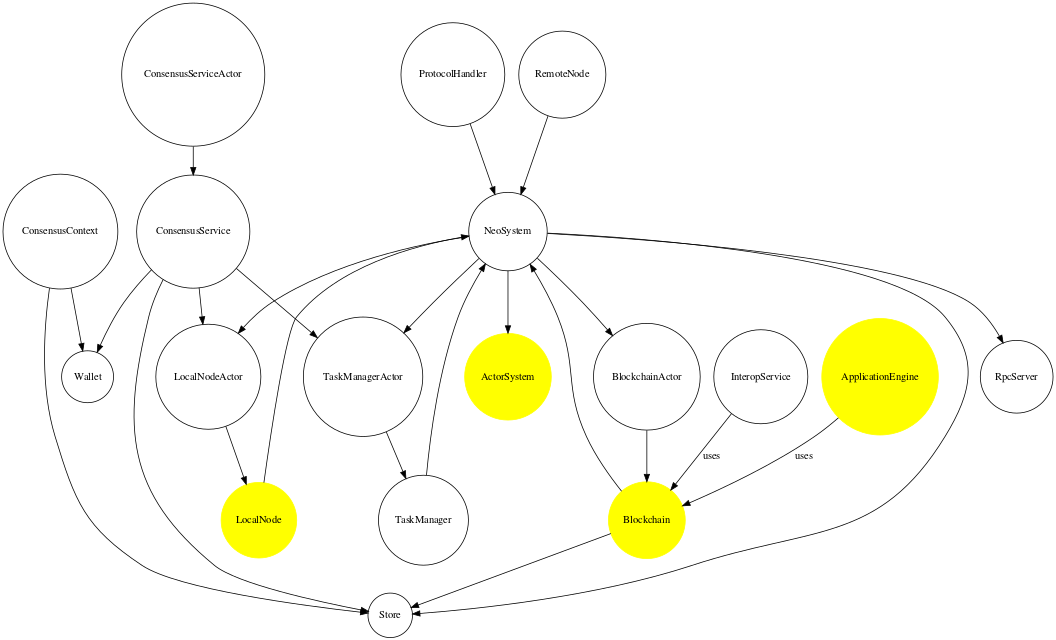
The yellow nodes are the explicit singleton on the code, and an arrow from A to B means that A depends on B to be created, the "Actor" nodes (e.g. BlockchainActor) are the Akka actor for the classes (Blockchain in the example).
The arrow with the label "uses" indicates that the Object needs the dependency but does not have it as an attribute.
We have a lot of cycles and the DI containers cannot handle it so I need to rewrite some of the code in order to make it possible.
rodoufu
on 4 Nov 2019
I've created another dependency graph but for removing the cycles involving the NeoSystem it's necessary to include the dependencies directly on the objects and it makes the graph a little more complex.
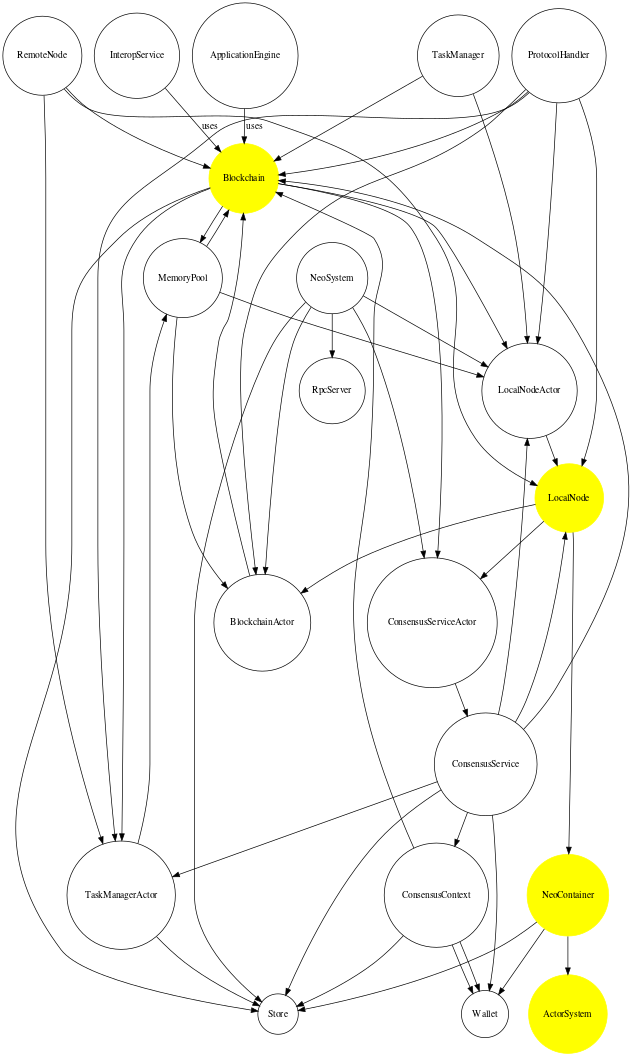
I've added a new class NeoContainer which registers and then resolves the dependencies.
It's going to transfer the singleton implementations from the code to the DI container.
rodoufu
on 4 Nov 2019
It seems odd to be using DI and Actor model. I mean, I can see using DI inside of an actor, but if we are managing dependencies between subsytems as actors, why do we need a system level DI model like this?
 devhawk
on 4 Nov 2019
devhawk
on 4 Nov 2019
It would make much easier to test and add new stuff.
We have a lot of circular dependencies what makes the code very coupled.
We have some objects that depends on NeoSystem but they don't really needs it, they only use it to access the Blockchain instance and some of the actors.
But I think the best thing would be not needing to handle the life scope of some components ourselves, we have some singleton objects and we need to make sure it has only one instance and at the same time control the concurrency on it.
rodoufu
on 5 Nov 2019
I'm not arguing against DI. I'm suggesting that we choose a single mechanism to eliminate circular dependencies and isolate subsystems from each other. I don't think it's a good idea to add DI to the system without also removing actor based abstractions.
devhawk
on 5 Nov 2019
My opinion is that DI should first solve this line: https://github.com/neo-project/neo/blob/b7be2c76dc5b67c66e0a7854904054bb745f60a3/neo/Ledger/Blockchain.cs#L79
By the way, very nice diagram Rodolfo :joy:
igormcoelho
on 5 Nov 2019
We could start re-routing stuff through NeoSystem (specially Blockchain dependencies), having it as our "centralizer" object. This may help unveiling some of the dependencies.
igormcoelho
on 5 Nov 2019
Agree with @devhawk , we should first remove the Blockchain.Singleton and other static variables.
shargon
on 5 Nov 2019
@rodoufu can we build a similar diagram at a higher level of abstraction? Subsystem level instead of classes?
devhawk
on 5 Nov 2019
@rodoufu can we build a similar diagram at a higher level of abstraction? Subsystem level instead of classes?
Yes @devhawk, I think some diagrams may help us getting the best solution for this.
But what do you mean by subsystem level?
rodoufu
on 6 Nov 2019
Related issues
 csmuller
·
3Comments
csmuller
·
3Comments
 realloc
·
4Comments
realloc
·
4Comments
 borovik96
·
4Comments
igormcoelho
·
4Comments
borovik96
·
4Comments
igormcoelho
·
4Comments
 vncoelho
·
4Comments
vncoelho
·
4Comments
Most helpful comment
I've created another dependency graph but for removing the cycles involving the
NeoSystemit's necessary to include the dependencies directly on the objects and it makes the graph a little more complex.I've added a new class
NeoContainerwhich registers and then resolves the dependencies.It's going to transfer the singleton implementations from the code to the DI container.