Summary or problem description
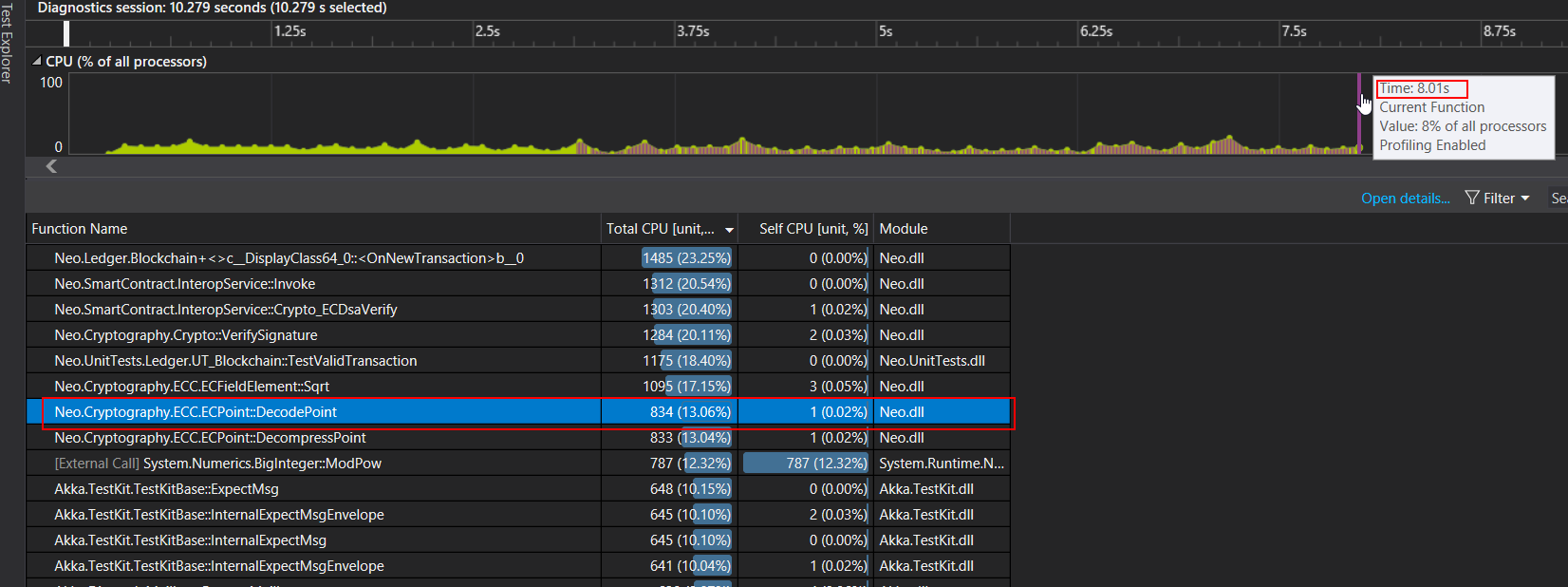
Decode ECPoint could be expensive, what do you think about caching the parsed ECPoint in local
Do you have any solution you want to propose?
Create a cache of the currently parsed ECPoints
Neo Version
- Neo 3
My tests are using a spam of 10K transactions like this:
        [TestMethod]
        public void TestValidTransaction()
        {
            var senderProbe = CreateTestProbe();
            var snapshot = Blockchain.Singleton.GetSnapshot();
            var walletA = new NEP6Wallet("wallet.json", "wallet");

            using (var unlockA = walletA.Unlock("123"))
            {
                if (walletA.GetAccounts().Count() == 0)
                {
                    walletA.CreateAccount();
                    walletA.Save();
                }

                var acc = walletA.GetAccounts().FirstOrDefault();

                // Fake balance

                var key = NativeContract.GAS.CreateStorageKey(20, acc.ScriptHash);
                var entry = snapshot.Storages.GetAndChange(key, () => new StorageItem
                {
                    Value = new Nep5AccountState().ToByteArray()
                });

                entry.Value = new Nep5AccountState()
                {
                    Balance = 100_000_000 * NativeContract.GAS.Factor
                }
                .ToByteArray();

                snapshot.Commit();

                typeof(Blockchain)
                    .GetMethod("UpdateCurrentSnapshot", BindingFlags.Instance | BindingFlags.NonPublic)
                    .Invoke(Blockchain.Singleton, null);

                // Make transaction

                var txs = new List<Transaction>();

                if (File.Exists("temp.dat"))
                {
                    txs.AddRange(File.ReadAllBytes("temp.dat").AsSerializableArray<Transaction>());
                }
                else
                {
                    for (int x = 0; x < 10_000; x++)
                    {
                        txs.Add(CreateValidTx(walletA, acc.ScriptHash, (uint)x));
                    }

                    File.WriteAllBytes("temp.dat", txs.ToArray().ToByteArray());
                }

                var st = Stopwatch.StartNew();

                foreach (var tx in txs)
                {
                    senderProbe.Send(system.Blockchain, tx);
                    senderProbe.ExpectMsg(RelayResultReason.Succeed);
                    senderProbe.Send(system.Blockchain, tx);
                    senderProbe.ExpectMsg(RelayResultReason.AlreadyExists);
                }

                st.Stop();
                Console.WriteLine(st.Elapsed);
            }
        }

        private Transaction CreateValidTx(NEP6Wallet wallet, UInt160 account, uint nonce)
        {
            var tx = wallet.MakeTransaction(new TransferOutput[]
                {
                    new TransferOutput()
                    {
                            AssetId = NativeContract.GAS.Hash,
                            ScriptHash = account,
                            Value = new BigDecimal(1,8)
                    }
                },
                account);

            tx.Nonce = nonce;

            var data = new ContractParametersContext(tx);
            Assert.IsTrue(wallet.Sign(data));
            Assert.IsTrue(data.Completed);

            tx.Witnesses = data.GetWitnesses();

            return tx;
        }
The original test are executed in around 8 seconds
And 7 seconds with caching
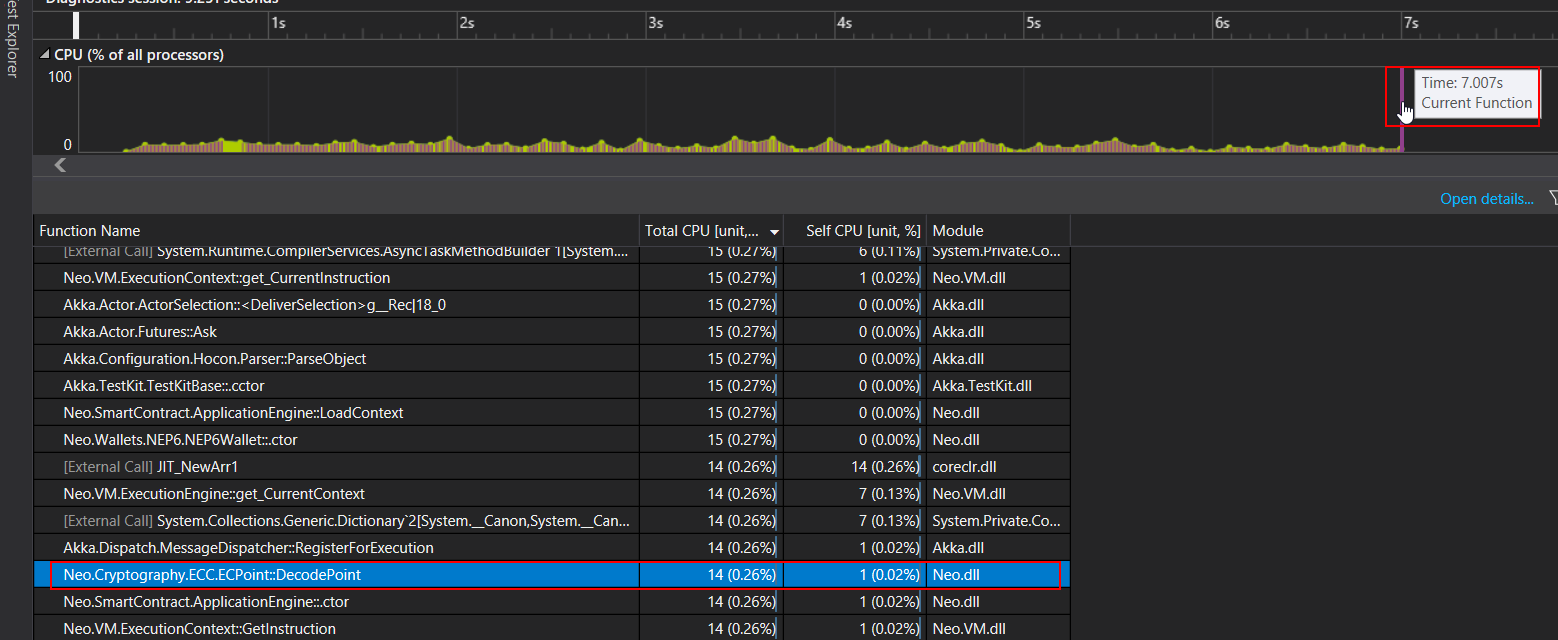
I understand that this improve it's better because all the TX are the same (and cached) but what do you think? it worth?
 shargon
All 3 comments
I don't think they differ much.
 erikzhang
on 3 Dec 2019
erikzhang
on 3 Dec 2019
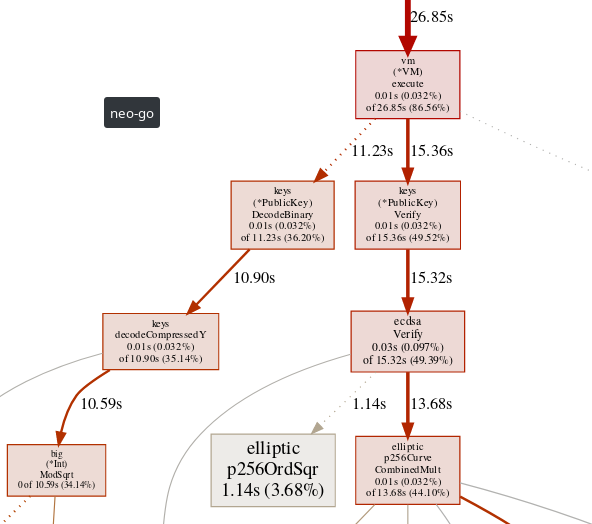
This may be interesting for block signatures checking, profiling block import in neo-go we see that it takes considerable amount of time to decode the keys, even comparable to signature checks. And these keys don't change much unlike the keys that come in transactions, so it's not hard to gain some 13% (as in your case with transactions) or even more (given that we check 5-7 signatures for a block) here.
 roman-khimov
on 10 Dec 2019
roman-khimov
on 10 Dec 2019
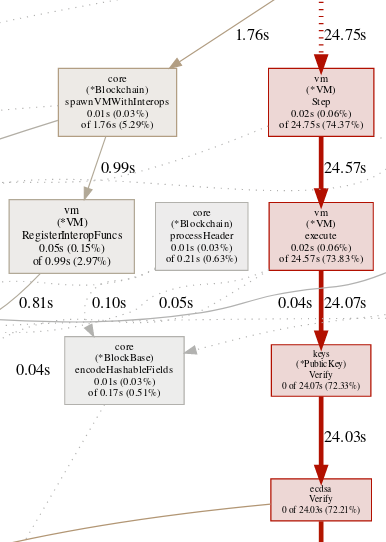
To add to that, I've just implemented a very simple key cache that is only used for block signature checks (nspcc-dev/neo-go#550) and that gave 30% improvement in 1.4M mainnet block importing (and by that I mean full import time, not some local unit-test). Granted, it's a very specific testcase (but we care about it a lot because we're constantly replaying mainnet blocks when debugging any existing differences between neo-go and C# Neo) and the impact is less influential at higher heights (just because blocks there have more transactions doing other things), but it looks like quite a significant improvement to me.
Now we're clearly ECDSA-bound when doing imports:
roman-khimov
on 10 Dec 2019
Related issues
shargon
·
4Comments
 igormcoelho
·
4Comments
igormcoelho
·
4Comments
shargon
·
3Comments
igormcoelho
·
4Comments
igormcoelho
·
4Comments
shargon
·
3Comments
 vncoelho
·
3Comments
vncoelho
·
3Comments
Most helpful comment
To add to that, I've just implemented a very simple key cache that is only used for block signature checks (nspcc-dev/neo-go#550) and that gave 30% improvement in 1.4M mainnet block importing (and by that I mean full import time, not some local unit-test). Granted, it's a very specific testcase (but we care about it a lot because we're constantly replaying mainnet blocks when debugging any existing differences between neo-go and C# Neo) and the impact is less influential at higher heights (just because blocks there have more transactions doing other things), but it looks like quite a significant improvement to me.
Now we're clearly ECDSA-bound when doing imports:
