Mudlet: Add missing strings for translation
Brief summary of issue / Description of requested feature:
A few messages in client are not yet marked for translation, would not be localized as of today:
- [x] Messages related to connecting profiles, around this area: https://github.com/Mudlet/Mudlet/blob/development/src/ctelnet.cpp#L274
- [ ] Splash screen text
To be continued..
 Kebap
Kebap
All 27 comments
Above mentioned strings in ctelnet.cpp sometimes have excessive space characters as in
[ INFO ] - text
as opposed to
[ INFO ] - text
like it is used elsewhere. Maybe use this opportunity to unify, as connection scroll currently alternates.
edit: Damn, github will nix the double space character after the first [INFO] and before the minus there.
Kebap
on 17 Sep 2018
Currently can't seem to find where these messages are created:
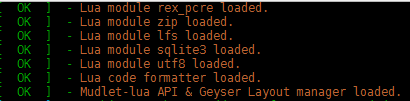
Searched this repository for "Lua module" text, but did not produce.
Kebap
on 17 Sep 2018
 vadi2
on 17 Sep 2018
vadi2
on 17 Sep 2018
Thanks Vadi. Maybe there is something wrong with the search function here on github.com and I should really search the downloaded files myself. What a pity!
Kebap
on 17 Sep 2018
SlySven reported:
One place I spotted that was not been fed with tr(....)wrapped texts was the item type comboBox on the end of each trigger item - so those will never get translated into other languages...
Kebap
on 23 Sep 2018
Not sure where this is located, third party module?
Kebap
on 27 Sep 2018
vadi2
on 27 Sep 2018
@Kebap wrote:
Above mentioned strings in ctelnet.cpp sometimes have excessive space characters as in
[ INFO ] - text
as opposed to
[ INFO ] - text
like it is used elsewhere. Maybe use this opportunity to unify, as connection scroll currently alternates.
edit: Damn, github will nix the double space character after the first [INFO] and before the minus there.
The spacing in the [ WORD ] - was ~tweaked twiddled~ frobnicated such that there is either one or two spaces (depending on WORD length) between the WORD and the [ or ] (the same on BOTH sides) and then enough spaces after the ] and the - so that all the different messages have the same number of characters - if I replace spaces with # it is perhaps easier to see as they become:
[##OK##]##-#
[##LUA##]#-#
[#INFO#]##-#
[#WARN#]#-#
[#ALERT#]#-#
[#ERROR#]#-#
This was done with the desire to ensure that all the messages have the same prefix length. However the existing code is not good for translations yet (I think I have code tucked away somewhere that {on language change} did a scan through all the translated headers and worked out the spacing to use for both them and any untranslated texts - even those with a single additional untranslated message marker prefix (the Qt default is # as it happens) so that this still worked for incomplete translation cases...
... however that has not been something that Vadim found if he was rummaging around in my previous I18n code attempts, assuming I ever published it... :disappointed:
 SlySven
on 27 Sep 2018
SlySven
on 27 Sep 2018
Let's move that discussion to #2005 shall we?
Kebap
on 27 Sep 2018

main.cpp around this area, research "show_splash"
Kebap
on 1 Oct 2018
Connection Popup will show "Cancel" button which stays in English and is not available for translation, yet.
Kebap
on 1 Oct 2018

Probably alike connection strings above
Kebap
on 1 Oct 2018
Trigger editor:
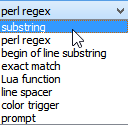
Code: https://github.com/Mudlet/Mudlet/blob/development/src/dlgTriggerEditor.cpp#L619
Kebap
on 13 Nov 2018
Re: Splash screen text - translation is not straightforward because the splash-screen is displayed before the main UI is constructed and the translation system is loaded.
I solved this in at least one of my versions that allowed run-time changes in the UI language without restarting Mudlet by: writing the translated strings out as a QStringList to a file in the Mudlet config directory (splashScreenTexts.dat IIRC) whenever the language was changed.
IIRC I also included a first entry being a count of the number of lines to avoid nasty problems if the number of different texts changed in later versions of Mudlet so that there was less lines in the variable than the code expected!)
On starting up Mudlet would load the default (en_US) text into a QStringList and then try to load that file and if it was present it would use it to overwrite the contents of that variable before then using whatever was then stored to generate the messages...
SlySven
on 2 Dec 2018
Connection Popup will show "Cancel" button which stays in English and is not available for translation, yet.
That is because the standard dialogue buttons are provided by the Qt library and the hackary done by Vadim to simplify my run-time UI changing code did not quite get it right.
My old code would, IIRC, allow the translation files source to be changed - so that one could change from a compiled-in set in a resource to an external set in the file-system - which could be edited on the fly and then reloaded; this meant that it had to check what translation files were available - by trying to load each one but not putting it into use - every time the dlgProfilePreferences class was used and the translation files source was changed. This code has been refactored to use a lambda function defined in (void) mudlet::loadTranslators() but it was only to do the Mudlet files - it did not load the Qt ones and the current code that tries to call the now anonymous function to do that is just plain borked... :stuck_out_tongue_closed_eyes:)
SlySven
on 2 Dec 2018
:bulb: I've got some code stashed to one side that will sort out that aspect of the Editor... :grinning:
SlySven
on 2 Dec 2018
Closing a profile without autosave - "Would you like to save this profile" will be translated, but not the options for answering: "Yes", "No", "Maybe" ah I mean "Cancel"
Kebap
on 21 Jan 2019
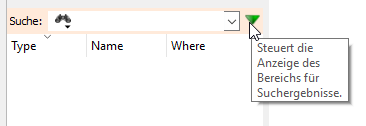
Headlines for columns in search pane in editor window.
edit: dlgTriggerEditor.cpp lists these texts here: https://github.com/Mudlet/Mudlet/blob/4dfafa21ca97875946d5335d8ee1e9f6141b4c39/src/dlgTriggerEditor.cpp#L602
Kebap
on 25 Jan 2019
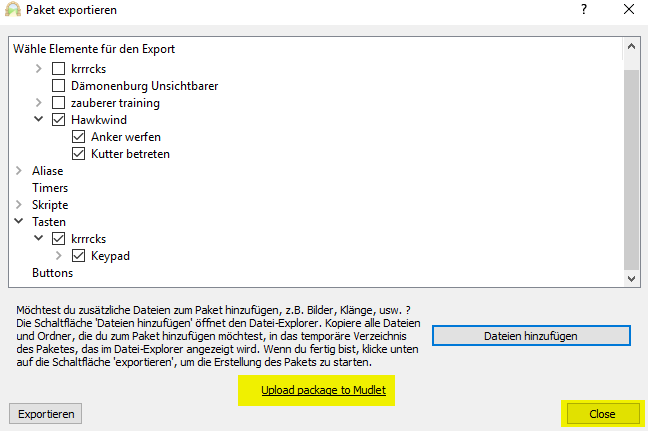
Package exporter (experimental) dialog window
Kebap
on 26 Jan 2019
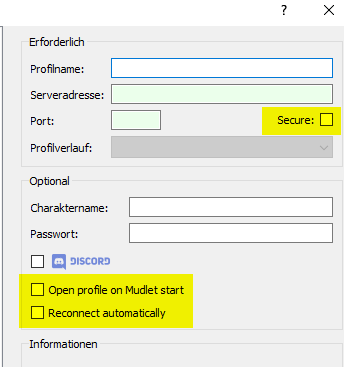
Profile creation window
Kebap
on 26 Jan 2019
Just need to update Crowdin strings to make those available!
vadi2
on 26 Jan 2019
In retrospect, we should have updated them as soon as development got merged.
vadi2
on 26 Jan 2019
I believe all of these are updated now, right?
vadi2
on 9 Mar 2020
I believe all of these are updated now, right?
I am not sure about _all_, haven't checked them in a while. For some, I am not even sure where they originate from. SlySven even mentioned some standard dialog buttons which didn't get translated at all.
Kebap
on 10 Mar 2020
So I went through and checked all of them, and the only thing left to tackle here, is the start-up splash screen.
SlySven mentioned above how this is a bit more difficult to solve, as the tr() function is not yet available during that time.
https://github.com/Mudlet/Mudlet/issues/1964#issuecomment-443542921
However it should be doable. I think I saw it done before somewhere. Just not sure spontaneously how the function is called at that time.
Kebap
on 12 Mar 2020
What about simply removing the text from the splash screen?
For most machines it starts too fast to read, and the information there is hardly useful or essential.
vadi2
on 12 Mar 2020
Fair enough, closing this then.
Kebap
on 13 Mar 2020
Related issues
vadi2
·
6Comments
 zesstra
·
6Comments
Kebap
·
9Comments
Kebap
·
7Comments
zesstra
·
6Comments
Kebap
·
9Comments
Kebap
·
7Comments
 Edru2
·
6Comments
Edru2
·
6Comments