Monogame: OpenGL implementation of VertexBuffer generates garbage
Hi, I've been trying to figure out what generates garbage in VertexBuffer.SetData and I believe I have nailed it. In OpenGL implementation most of the methods are wrapped in a Threading.BlockOnUIThread with a lambda. The thing is that this lambda refences local variables, like here:
c#
private void PlatformSetDataInternal<T>(int offsetInBytes, T[] data, int startIndex, int elementCount, int vertexStride, SetDataOptions options, int bufferSize, int elementSizeInBytes) where T : struct
        {
            Threading.BlockOnUIThread(() => SetBufferData(bufferSize, elementSizeInBytes, offsetInBytes, data, startIndex, elementCount, vertexStride, options));
        }
Even though the lambda it self may be referenced as a pointer to code, local variables referenced in this lambda have to be stored somewhere, and internally memory is allocated for them on heap (https://stackoverflow.com/a/7133064). I've tried to get rid of allocations in this case, but I believe it might be impossible. Actions are later stored in a List, so that they can be run on a main thread. Since there are different lambdas with different local variable counts and types referenced in each, it's not possible to hack it in a way that these arguments are stored in a List of some value type.
Right now I see the following possible solutions:
1) Create a class for each lambda type used in Threading.BlockOnUIThread, and keep them in an object pool.
2) Make user responsible for calling all these methods on ui thread, and just throw an exception if these methods are not called on ui thread (by a preprocessor directive or exposing additional methods)
3) Ignore this issue
What version of MonoGame does the bug occur on:
- dc4b541e3 commit
What operating system are you using:
- Windows
- Linux
What MonoGame platform are you using:
- DesktopGL
 nikarh
All 12 comments
Hi!
I think that _2_ should be avoided. MonoGame is designed to have a consistent behavior across all targets with the same API. So I guess the solution would be to find a way to cache that.
 mrhelmut
on 18 Sep 2019
mrhelmut
on 18 Sep 2019
I've also observed this and mitigated it with pretty simple code.
I used a local method nested inside the API method, e.g.
private void PlatformSetDataInternal<T>(int offsetInBytes, T[] data, int startIndex, int elementCount, int vertexStride, SetDataOptions options, int bufferSize, int elementSizeInBytes) where T : struct
{
void Body() => SetBufferData(bufferSize, elementSizeInBytes, offsetInBytes, data, startIndex, elementCount, vertexStride, options);
if(Threading.IsOnUIThread())
Body();
else
Threading.BlockOnUIThread(Body);
}
Local methods are just private methods that you can nest inside methods (no hidden allocations).
I don't remember what C# version the develop branch/different platforms use but it's surely not C# 7, so you would need to inline the Body() method:
private void PlatformSetDataInternal<T>(int offsetInBytes, T[] data, int startIndex, int elementCount, int vertexStride, SetDataOptions options, int bufferSize, int elementSizeInBytes) where T : struct
{
if(Threading.IsOnUIThread())
SetBufferData(bufferSize, elementSizeInBytes, offsetInBytes, data, startIndex, elementCount, vertexStride, options);
else
Threading.BlockOnUIThread(() =>
SetBufferData(bufferSize, elementSizeInBytes, offsetInBytes, data, startIndex, elementCount, vertexStride, options););
}
Pooling the lambdas seems like a lot of work, but would function fine I suppose.
 TechnologicalPizza
on 27 Sep 2019
TechnologicalPizza
on 27 Sep 2019
That technique does not prevent the allocation. The parameter values are used in the lambda or local function, so when you pass the function the current parameter values need to be stored. That's what's causing the allocation, capturing the parameter values in a closure, not the lambda by itself. If you use a lambda that does not capture variables outside its own scope, there's no allocation because the lambda can be stored in the program like a regular function. So the pooling solution would have us pool the _parameters_ that the lambda uses.
I don't think it was a good idea to support multithreaded OpenGL in the first place, but if we want to prevent the allocations here, I think the only acceptable solution fitting with MG's design is to go with pooling.
 Jjagg
on 27 Sep 2019
Jjagg
on 27 Sep 2019
void Body() => SetBufferData(bufferSize, elementSizeInBytes, offsetInBytes, data, startIndex, elementCount, vertexStride, options);
// also written as
void Body()
{
SetBufferData(bufferSize, elementSizeInBytes, offsetInBytes, data, startIndex, elementCount, vertexStride, options);
}
This is not a closure, it's a private method. Only Threading.BlockOnUIThread(Body); would actually allocate a closure, not the private method call.
TechnologicalPizza
on 27 Sep 2019
SetBufferData(bufferSize, elementSizeInBytes, offsetInBytes, data, startIndex, elementCount, vertexStride, options);
This uses parameters outside the scope of the local method. If you pass the local method as a method group, to be able to execute it you need to know the value of those parameters at execution time. Therefore it does create a closure when you pass that method as a method group. The runtime creates a class that can hold the parameter values and creates an instance of it. Otherwise, when the function is actually executed it would not be able to know the parameter values because they're not on the stack anymore.
I'm not actually sure if this allocates (I believe it does, because I think local methods are only different in that they are scoped to the method that contains them but I'm not sure):
void DoSomething(string value)
{
void DoSomethingInternal()
{
Console.WriteLine(value);
}
DoSomething();
}
But this definitely allocates:
void DoSomething(string value)
{
void DoSomethingInternal()
{
Console.WriteLine(value);
}
Task.Run(DoSomethingInternal);
}
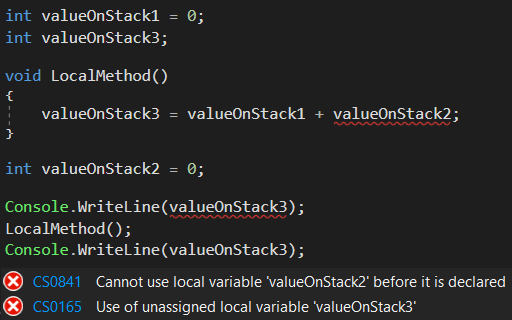
_Observe how valueOnStack3 is assigned after the method call._
Yes you are right about the lifetime of stack values, but local methods are practically just syntactic sugar for methods.
MonoGame doesn't support local methods because of the C# 7 requirement nonetheless. The best bet would be pooling or just writing out the method call twice.
TechnologicalPizza
on 27 Sep 2019
Yes, Task.Run needs a delegate, so DoSomethingInternal will allocate a closure.
But the first example does not allocate, C# magic 🌈
TechnologicalPizza
on 27 Sep 2019
@TechnologicalPizza Oh, I see where you're coming from know! I thought you were talking about not having the closure allocation in general, not just in case you are on the UI thread. Sorry about that. What I tried to say - using your first example - was that
Threading.BlockOnUIThread(Body);
allocates a closure.
But the first example does not allocate, C# magic
Didn't know about that, pretty cool!
Jjagg
on 27 Sep 2019
Great that we understood eachother, so now it's just to decide on the appropriate solution.
Keep in mind that System.Span<T> and System.Memory<T> will be available in the near future. I have a fork that uses Span<T> in a variety of places (Texture2D.SetData, [Vertex/Index]Buffer.SetData, GraphicsDevice APIs) where arrays are often used, and OpenGL is quite a hassle about this.
My solution was to add Memory<T> overloads so GL platforms can still call API's through other threads, where the Span<T> overloads throw if not on the UI thread (which was suggested solution 2).
DirectX supports the Span<T> overloads from any thread.
TechnologicalPizza
on 27 Sep 2019
This is an old discussion, but for anybody who reads about local functions not allocating
But the first example does not allocate, C# magic
C# compiler is pretty smart about local functions and instead of generating a class it will generate a struct.
For instance:
    private void PlatformSetDataInternal(int p)
    {
        void Buffer() => BufferData(p);

        Buffer();
    }

    private void BufferData(int p) {}
Then for local function void Buffer() the compiler will generate this:
    [StructLayout(LayoutKind.Auto)]
    [CompilerGenerated]
    private struct <>c__DisplayClass1_0
    {
        public C <>4__this;

        public int p;
    }
so it is stack allocated. But that is an extremely thin ice, because once you pass it to a delegate that is a reference type like Action:
public static void BlockOnUIThread(Action action)
the compiler no longer sees any reason in generating a struct, because it can no longer be used as such, so once you got this:
   private void PlatformSetDataInternal(int p)
    {
        void Buffer() => BufferData(p);

        Threading.BlockOnUIThread(Buffer);
    }
it decides to generate a class:
    [CompilerGenerated]
    private sealed class <>c__DisplayClass1_0
    {
        public C <>4__this;

        public int p;

        private void <PlatformSetDataInternal>g__Buffer|0()
        {
            <>4__this.BufferData(p);
        }
    }
same goes if you make your local function to return a type that requires compiler time class generation like an iterator block IEnumerator<T>.
So unless we get a value type delegates and thus stack allocated closures it won't be possible to pass local functions as arguments without garbage allocation.
For those who want dive a bit deeper, examples I've used:
local func as struct
local func as class
 tchanturia
on 25 Mar 2020
tchanturia
on 25 Mar 2020
The only reason for using a local method was to not write the SetData(...) code twice.
Only
Threading.BlockOnUIThread(Body);would actually allocate a closure, not the private method call.
It wasn't really meant to reduce garbage allocs but to reduce duplicated code 😉
TechnologicalPizza
on 25 Mar 2020
👍 just wanted to give more clarity on the topic.
tchanturia
on 25 Mar 2020
Related issues
 dazinator
·
5Comments
dazinator
·
5Comments
 griseus
·
5Comments
griseus
·
5Comments
 rds1983
·
5Comments
rds1983
·
5Comments
 Ellesent
·
5Comments
Ellesent
·
5Comments
 Grabiobot
·
5Comments
Grabiobot
·
5Comments
Most helpful comment
This is an old discussion, but for anybody who reads about local functions not allocating
C# compiler is pretty smart about local functions and instead of generating a class it will generate a struct.
For instance:
Then for local function
void Buffer()the compiler will generate this:so it is stack allocated. But that is an extremely thin ice, because once you pass it to a delegate that is a reference type like
Action:the compiler no longer sees any reason in generating a struct, because it can no longer be used as such, so once you got this:
it decides to generate a class:
same goes if you make your local function to return a type that requires compiler time class generation like an iterator block
IEnumerator<T>.So unless we get a value type delegates and thus stack allocated closures it won't be possible to pass local functions as arguments without garbage allocation.
For those who want dive a bit deeper, examples I've used:
local func as struct
local func as class