Modules: Proposal for dual ESM/CommonJS packages
@guybedford, @jkrems and I discussed the package dual-ESM/CommonJS case and we have a small proposal, based on the current ecmascript-modules implementation:
The
package.json"main"field reverts to its prior CommonJS-only use.A new field
"exports"is created that takes a string like"./src/index.js". This is the ES module entry point."exports"is toimportwhat"main"is torequire.
Notes:
"exports"may in the future take an object, preserving design space for the package exports proposal.If
"exports"points to a.jsfile and"type": "module"is not set, an error is thrown similar to the “type mismatch” errors (like using--type=commonjswith an.mjsfile). The error would also instruct the user to add"type": "module"topackage.json. The"exports"field does not imply"type": "module".
And that’s it! This should cover the case while preserving design space for future proposals, and for Node potentially switching to ESM by default someday.
 GeoffreyBooth
All 87 comments
this still feels like esm is second-class. allowing extension searching gets rid of the entire dual mode issue.
 devsnek
on 25 Feb 2019
devsnek
on 25 Feb 2019
I would prefer not to proceed with "exports" until we have extension lookup, at which point the easy way to get dual-mode packages will be foo.js and foo.mjs, where "main" is foo
 ljharb
on 25 Feb 2019
ljharb
on 25 Feb 2019
There’s nothing about the proposal above the prevents extension searching from happening, either opt-in or by default. This proposal need not be tied to that, and I think it’s better if it isn’t. Keep in mind that package.json isn’t only for Node’s use; build tools and other platforms will need to be able to read it, and it’s a burden on them if we force them to implement Node’s extension searching algorithm in order to determine the ESM entry point. Even if we allow automatic extension searching within the Node runtime itself, for compatibility with other tools and environments it would be better if it doesn’t extend to package.json.
GeoffreyBooth
on 25 Feb 2019
@GeoffreyBooth whether exports exists or not, they have to do searching for the main field. why not just keep it simple.
devsnek
on 25 Feb 2019
@devsnek Tools need only do extension lookup on main to support CommonJS, which will become increasingly uncommon as it's a Node-only thing.
GeoffreyBooth
on 25 Feb 2019
way to get dual-mode packages will be
foo.jsandfoo.mjs, where "main" isfoo
This seems to imply that you'd have to have both in the same directory which is really uncommon. This doesn't fit well with either compilation-to-CJS or "esm interface in root, source in lib". It would mean more empty junk files in package roots unless I'm missing something about this suggestion.
 jkrems
on 25 Feb 2019
jkrems
on 25 Feb 2019
@GeoffreyBooth You did great work anayzing packages with a "module" key. I'm curious if we've done any similar analysis of previous usage of the "exports" key. Does it conflict with any existing ecosystem usage? (Apologies if this belongs in another thread.)
 zenparsing
on 25 Feb 2019
zenparsing
on 25 Feb 2019
@zenparsing I looked it up, and it's been a while so I don't remember the usage number offhand but basically we can claim exports. It's either completely unused or used by only a handful of public npm packages.
GeoffreyBooth
on 25 Feb 2019
@GeoffreyBooth I believe that the last time package.exports came up the feature was discussed as something that might be useful for common.js as well. It seems like this proposal is making the assumption that the only things to be exposed by package.exports would be ESM. It seems a bit fragile if we would eventually want to support ESM, alternatively it also seems like it may fail as we introduce more goals e.g. wasm / json / etc
 MylesBorins
on 25 Feb 2019
MylesBorins
on 25 Feb 2019
@jkrems both ways leave a patterns of doing things out. assuming i'm not unique on this planet, this proposal is more junk for some people's package.json, but less junk for people who have a src and lib directory. personally i tend to prefer solutions for people that don't use build tooling since build tooling can automagically fill configurations in and whatnot. i think this is definitely something worth discussing more in call.
devsnek
on 25 Feb 2019
@mylesborins This proposes that the shorthand string value be the ESM entry point, but the verbose object form could define CommonJS values as well. That’s why exports on its own doesn’t imply "type": "module".
GeoffreyBooth
on 25 Feb 2019
@MylesBorins package.exports is to import as package.main is to require. Neither really implies a format of the thing being imported but it's about which (module) loading system they are meant for. You can set main to a native .node file just like you can set exports to a .wasm file.
jkrems
on 25 Feb 2019
i think there's some confusion here because with this proposal package.exports is now an overloaded term. there has already been a proposal for package.exports to control which files someone can import from your package.
devsnek
on 25 Feb 2019
I like the way this sets up a clear new modern entrypoint with strict semantics and leaves "main" with the pre-existing CJS meaning.
It feels very natural to add properties to expose independent entrypoints. Overloading main would worry me - it's harder to learn the subtleties.
 robpalme
on 25 Feb 2019
robpalme
on 25 Feb 2019
In past discussions we got sidetracked talking about some properties of package#exports. It was never meant as a way to control which files someone can import from your package. There was a some amount of nudging that fell out from import map compatibility. But it was never a design goal (nor was it ever true) that package#exports would have provided true encapsulation.
jkrems
on 25 Feb 2019
i think there's some confusion here because with this proposal
package.exportsis now an overloaded term
It's still the same proposal, we just stripped away some of the features that came from additional assumptions and requirements. This is the level 0 of the proposal: exports as a string that mirrors main but for import instead of require.
jkrems
on 25 Feb 2019
@zenparsing There are 7 packages in the public NPM registry that use "exports". In order of popularity: memorystorage, picolog, pinf-for-nodejs, insight.renderers.default, webdb, webstore, ws.suid. The first two are the only ones with weekly downloads greater than 2 per week.
Details
[ { name: 'memorystorage',
    version: '0.11.0',
    description: 'Memory-backed implementation of the Web Storage API',
    src: 'src/memorystorage.js',
    main: 'dist/memorystorage.umd.js',
    dist:
     { umd: 'dist/memorystorage.umd.js',
       min: 'dist/memorystorage.min.js',
       map: 'dist/memorystorage.min.js.map',
       shasum: 'b064f78c6f26c65a2b0f836c815c5748c6f1f39d',
       tarball:
        'https://registry.npmjs.org/memorystorage/-/memorystorage-0.11.0.tgz' },
    exports: [ 'MemoryStorage' ],
    directories: { test: 'tests' },
    repository:
     { type: 'git',
       url: 'git+https://github.com/download/memorystorage.git' },
    keywords:
     [ 'javascript',
       'persistence',
       'persistent objects',
       'localStorage',
       'Web Storage API' ],
    author:
     { name: 'Stijn de Witt',
       email: '[email protected]',
       url: 'http://StijnDeWitt.com' },
    contributors: [ [Object] ],
    copyright:
     '©2016 by Stijn de Witt and contributors. Some rights reserved.',
    license: 'CC-BY-4.0',
    licenseUrl: 'https://creativecommons.org/licenses/by/4.0/',
    bugs: { url: 'https://github.com/download/memorystorage/issues' },
    homepage: 'http://download.github.io/memorystorage',
    devDependencies:
     { grunt: '^0.4.5',
       'grunt-contrib-uglify': '~0.6.0',
       'grunt-umd': '^2.3.3',
       'load-grunt-tasks': '~1.0.0',
       'node-qunit-phantomjs': '^1.4.0' },
    dependencies: {},
    scripts: { test: 'node ./tests/test-node.js' },
    gitHead: 'ac7b6f9d2512a6ebc105ff61a5d27a69b98dbe5c',
    _id: '[email protected]',
    _shasum: 'b064f78c6f26c65a2b0f836c815c5748c6f1f39d',
    _from: '.',
    _npmVersion: '3.10.7',
    _nodeVersion: '6.3.1',
    _npmUser: { name: 'stijndewitt', email: '[email protected]' },
    maintainers: [ [Object] ],
    _npmOperationalInternal:
     { host: 'packages-16-east.internal.npmjs.com',
       tmp:
        'tmp/memorystorage-0.11.0.tgz_1472723856728_0.5229496594984084' } },
  { name: 'picolog',
    version: '1.0.4',
    description:
     'Tiny logging helper for use in the browser, Node and Nashorn.',
    src: 'src/picolog.js',
    main: 'dist/picolog.umd.js',
    dist:
     { umd: 'dist/picolog.umd.js',
       min: 'dist/picolog.min.js',
       map: 'dist/picolog.min.js.map',
       shasum: 'a8e0b70b081e864b88b4c858bbfcb838817585d5',
       tarball: 'https://registry.npmjs.org/picolog/-/picolog-1.0.4.tgz' },
    exports: [ 'log' ],
    directories: { test: 'tests' },
    repository:
     { type: 'git',
       url: 'git+https://github.com/download/picolog.git' },
    keywords: [ 'javascript', 'logging', 'browser', 'node', 'nashorn' ],
    author:
     { name: 'Stijn de Witt',
       email: '[email protected]',
       url: 'http://StijnDeWitt.com' },
    contributors: [],
    copyright:
     'Copyright 2015 by [Stijn de Witt](http://StijnDeWitt.com). Some rights reserved.',
    license: 'CC-BY-4.0',
    licenseUrl: 'https://creativecommons.org/licenses/by/4.0/',
    bugs: { url: 'https://github.com/download/picolog/issues' },
    homepage: 'http://download.github.io/picolog',
    scripts: { test: 'node tests/test-cjs.js' },
    devDependencies:
     { grunt: '~0.4.5',
       'grunt-contrib-jshint': '~0.10.0',
       'grunt-contrib-uglify': '~0.6.0',
       'grunt-umd': '^2.3.3',
       'load-grunt-tasks': '~1.0.0',
       mocha: '^2.3.4' },
    dependencies: {},
    gitHead: 'ab001c9cb7c4102c61296d78ab6be97631515eff',
    _id: '[email protected]',
    _shasum: 'a8e0b70b081e864b88b4c858bbfcb838817585d5',
    _from: '.',
    _npmVersion: '3.5.3',
    _nodeVersion: '5.4.0',
    _npmUser: { name: 'stijndewitt', email: '[email protected]' },
    maintainers: [ [Object] ],
    _npmOperationalInternal:
     { host: 'packages-12-west.internal.npmjs.com',
       tmp: 'tmp/picolog-1.0.4.tgz_1457918567954_0.08996963105164468' } },
  { name: 'pinf-for-nodejs',
    version: '0.6.1',
    pm: 'npm',
    publish: true,
    main: 'lib/pinf.js',
    bin: { pinf: './bin/pinf' },
    dependencies:
     { babel: '^6.5.2',
       colors: '~1.1.2',
       commander: '~2.9.0',
       deepcopy: '~0.6.3',
       deepmerge: '~1.1.0',
       'fs-extra': '~0.30.0',
       jsdom: '^9.6.0',
       'pinf-config': '0.1.x',
       'pinf-it-bundler': '0.1.x',
       'pinf-it-package-insight': '0.1.x',
       'pinf-it-program-insight': '0.1.x',
       'pinf-loader-js': '0.4.x',
       'pinf-primitives-js': '0.2.x',
       'pinf-vfs': '0.1.x',
       q: '~1.4.1',
       request: '~2.75.0',
       'require.async': '~0.1.1',
       send: '~0.14.1',
       waitfor: '~0.1.3' },
    devDependencies:
     { mocha: '~3.1.0', grunt: '~1.0.1', 'grunt-mocha': '~1.0.2' },
    'require.async': { './lib/main.js': './context' },
    scripts:
     { test: 'mocha --reporter list test/*.js',
       build: './bin/pinf bundle' },
    exports: { bundles: [Object] },
    overrides:
     { './node_modules/request/node_modules/hawk/node_modules/boom': [Object],
       './node_modules/request/node_modules/hawk/node_modules/sntp': [Object],
       './node_modules/request/node_modules/hawk/node_modules/cryptiles': [Object],
       './node_modules/request/node_modules/form-data': [Object] },
    config: { 'pio.deploy.converter': [Object] },
    gitHead: 'e2cc7499ad44764114b4e940fcbfb8e586ce8dc8',
    description: '*Status: DEV*',
    _id: '[email protected]',
    _shasum: 'df633378004044b3fd47b3f0242ada3ba240ab5a',
    _from: '.',
    _npmVersion: '3.10.8',
    _nodeVersion: '5.12.0',
    _npmUser: { name: 'cadorn', email: '[email protected]' },
    dist:
     { shasum: 'df633378004044b3fd47b3f0242ada3ba240ab5a',
       tarball:
        'https://registry.npmjs.org/pinf-for-nodejs/-/pinf-for-nodejs-0.6.1.tgz' },
    maintainers: [ [Object] ],
    _npmOperationalInternal:
     { host: 'packages-16-east.internal.npmjs.com',
       tmp:
        'tmp/pinf-for-nodejs-0.6.1.tgz_1475642069540_0.5849844384938478' },
    directories: {} },
  { uid: 'https://github.com/insight/insight.renderers.default/',
    name: 'insight.renderers.default',
    main: './lib/pack-helper.js',
    version: '0.0.5',
    pm: { publish: 'npm' },
    directories: { lib: './lib' },
    label: 'Default Insight Renderers',
    description:
     'Default JavaScript renderers for the Insight Intelligence Library',
    mappings: { domplate: './node_modules/domplate' },
    dependencies: { domplate: '^0.2.1' },
    exports: { images: [Object] },
    config: { 'pio.deploy.converter': [Object] },
    _id: '[email protected]',
    _npmVersion: '5.5.1',
    _nodeVersion: '9.2.0',
    _npmUser: { name: 'cadorn', email: '[email protected]' },
    dist:
     { integrity:
        'sha512-nNE76EOWoBNE8Eg006DfNshStZmogT+Hv3/PiBJacjWbXjhRoypBm99ogPwuh/6e1c9MhTJzqrS6UzI1GFaq2A==',
       shasum: '21807ef9ba71f16fcaf96d2ec2865964516e4d4a',
       tarball:
        'https://registry.npmjs.org/insight.renderers.default/-/insight.renderers.default-0.0.5.tgz' },
    maintainers: [ [Object] ],
    _npmOperationalInternal:
     { host: 's3://npm-registry-packages',
       tmp:
        'tmp/insight.renderers.default-0.0.5.tgz_1511146563550_0.14907408924773335' } },
  { name: 'webdb',
    version: '0.5.0',
    description:
     'Client-side database that can be synched with a remote server.',
    main: 'src/webdb.js',
    dist:
     { umd: 'dist/webdb.umd.js',
       min: 'dist/webdb.min.js',
       map: 'dist/webdb.min.js.map',
       shasum: '1acbeaa70f30c830a3c105954e01899bd10bef42',
       tarball: 'https://registry.npmjs.org/webdb/-/webdb-0.5.0.tgz' },
    exports: [ 'WebDB' ],
    directories: { test: 'tests' },
    repository:
     { type: 'git',
       url: 'git+https://github.com/download/webdb.git' },
    keywords:
     [ 'javascript',
       'persistence',
       'database',
       'localStorage',
       'synchronized',
       'client-server' ],
    author:
     { name: 'Stijn de Witt',
       email: '[email protected]',
       url: 'http://StijnDeWitt.com' },
    contributors: [],
    copyright:
     'Copyright 2015 by [Stijn de Witt](http://StijnDeWitt.com). Some rights reserved.',
    license: 'CC-BY-4.0',
    licenseUrl: 'https://creativecommons.org/licenses/by/4.0/',
    bugs: { url: 'https://github.com/download/webdb/issues' },
    homepage: 'http://download.github.io/webdb',
    devDependencies:
     { grunt: '~0.4.5',
       'grunt-contrib-jshint': '~0.11.0',
       'grunt-contrib-uglify': '~0.9.0',
       'grunt-jsdoc': '~1.0.0',
       'grunt-umd': '^2.3.3',
       'load-grunt-tasks': '~3.3.0' },
    dependencies: {},
    gitHead: 'ebeff7bb4753b231b7f34c1d0b62b9d0c86e1893',
    _id: '[email protected]',
    scripts: {},
    _shasum: '1acbeaa70f30c830a3c105954e01899bd10bef42',
    _from: '.',
    _npmVersion: '2.11.3',
    _nodeVersion: '0.12.7',
    _npmUser: { name: 'stijndewitt', email: '[email protected]' },
    maintainers: [ [Object] ] },
  { name: 'webstore',
    version: '0.9.0',
    description: 'One stop shop for Web Storage API compliant persistence.',
    main: 'src/webstore.js',
    scripts: { test: 'echo "Error: no test specified" && exit 1' },
    dist:
     { dbg: 'dist/webstore.js',
       min: 'dist/webstore.min.js',
       map: 'dist/webstore.min.js.map',
       shasum: '03b4705977512131e93714605e40751fb78ff6b9',
       tarball: 'https://registry.npmjs.org/webstore/-/webstore-0.9.0.tgz' },
    exports: [ 'WebStore' ],
    directories: { test: 'tests' },
    repository:
     { type: 'git',
       url: 'git+https://github.com/download/webstore.git' },
    keywords:
     [ 'javascript',
       'persistence',
       'persistent objects',
       'localStorage',
       'Web Storage API' ],
    author:
     { name: 'Stijn de Witt',
       email: '[email protected]',
       url: 'http://StijnDeWitt.com' },
    contributors: [],
    copyright:
     'Copyright 2015 by [Stijn de Witt](http://StijnDeWitt.com). Some rights reserved.',
    license: 'CC-BY-4.0',
    licenseUrl: 'https://creativecommons.org/licenses/by/4.0/',
    bugs: { url: 'https://github.com/download/webstore/issues' },
    homepage: 'https://github.com/download/webstore#readme',
    devDependencies:
     { grunt: '^0.4.5',
       'grunt-browserify': '^4.0.0',
       'grunt-contrib-jshint': '~0.10.0',
       'grunt-contrib-uglify': '~0.6.0',
       'grunt-jsdoc': '~0.6.7',
       'load-grunt-tasks': '~1.0.0' },
    dependencies: { memorystorage: '^0.9.4' },
    gitHead: 'a4d17e6e2f9b03d638694a21659b0941dc048aac',
    _id: '[email protected]',
    _shasum: '03b4705977512131e93714605e40751fb78ff6b9',
    _from: '.',
    _npmVersion: '2.11.3',
    _nodeVersion: '0.12.7',
    _npmUser: { name: 'stijndewitt', email: '[email protected]' },
    maintainers: [ [Object] ] },
  { name: 'ws.suid',
    version: '0.10.1',
    description: 'Distributed Service-Unique IDs that are short and sweet.',
    main: 'src/suid.js',
    dist:
     { min: 'dist/suid.min.js',
       map: 'dist/suid.min.js.map',
       shasum: 'cb9e89777f8aa90d04d4d974e5021b65254a1c1d',
       tarball: 'https://registry.npmjs.org/ws.suid/-/ws.suid-0.10.1.tgz' },
    exports: [ 'Suid' ],
    repository: { type: 'git', url: 'git://github.com/Download/suid.git' },
    author:
     { name: 'Stijn de Witt',
       email: '[email protected]',
       url: 'http://StijnDeWitt.com' },
    contributors: [],
    copyright:
     'Copyright 2015 by [Stijn de Witt](http://StijnDeWitt.com). Some rights reserved.',
    license: 'CC-BY-4.0',
    licenseUrl: 'https://creativecommons.org/licenses/by/4.0/',
    homepage: 'https://download.github.io/suid',
    devDependencies:
     { grunt: '~0.4.5',
       'load-grunt-tasks': '~1.0.0',
       'grunt-contrib-jshint': '~0.10.0',
       'grunt-contrib-uglify': '~0.6.0',
       'grunt-contrib-watch': '~0.6.1',
       'grunt-notify': '~0.3.1',
       'grunt-jsdoc': '~0.6.7' },
    gitHead: '90440bc80b99994326d07daf9cfb7d99dd274166',
    bugs: { url: 'https://github.com/Download/suid/issues' },
    _id: '[email protected]',
    scripts: {},
    _shasum: 'cb9e89777f8aa90d04d4d974e5021b65254a1c1d',
    _from: '.',
    _npmVersion: '3.5.3',
    _nodeVersion: '5.4.0',
    _npmUser: { name: 'stijndewitt', email: '[email protected]' },
    maintainers: [ [Object] ],
    _npmOperationalInternal:
     { host: 'packages-12-west.internal.npmjs.com',
       tmp: 'tmp/ws.suid-0.10.1.tgz_1457346412099_0.01512380107305944' },
    directories: {} } ]
I don't see why we should attempt to fix a solved problem. "main": "foo.mjs". Simple.
 adrianhelvik
on 15 Mar 2019
adrianhelvik
on 15 Mar 2019
I don't see why we should attempt to fix a solved problem. "main": "foo.mjs". Simple.
This thread is about dual mode packages (e.g. packages that ship both require and import code). Unfortunately main only allows one value and also in many cases source code wouldn't be at the top-level of the package but in a directory like lib. So it's not quite as simple. :)
jkrems
on 15 Mar 2019
Give precedence to .mjs over .js. Still simple. ;)
adrianhelvik
on 16 Mar 2019
and also in many cases source code wouldn't be at the top-level of the package but in a directory like lib.
Implied here: The code for import and require may be in different directories. Forcing them to live in the same directory is somewhat awkward.
jkrems
on 16 Mar 2019
@jkrems react does build like this, you just publish from different directory independent from your source
 goodmind
on 17 Mar 2019
goodmind
on 17 Mar 2019
I don't see why we should attempt to fix a solved problem. "main": "foo.mjs". Simple.
This will break every project running node that doesn't understand .mjs
The dual module is a natural migration pattern NodeJS shouldn't underestimate.
The de-facto standard to run ESM is through the module field, which is already widely adopted by the community and bundlers.
In that way, currently published dual module can still work by simply adding a type field that points to module, but the main one is still backward compatible for older version of node.
Me, and many others, write ESM Modules and transpile it as CJS so that anything consuming modules can still use either ways.
The current proposal will break dual modules, and won't be welcomed by developers that shipped these for the last 2 years.
Proposal
- if there is a
typefield, and its value ismodule
- if there is a
modulefield, use it as ESM entry - fallback using
mainas currently proposed
- if there is a
This is only one extra, very simple, check to perform, that won't break current state of modern npm modules.
I don't think there's any valid reason to break the whole ecosystem of dual modules so please do consider this proposal, thanks.
 WebReflection
on 22 Mar 2019
WebReflection
on 22 Mar 2019
we can't use the module field because a large amount of the modules in it are babel compatible modules not esm compatible modules.
devsnek
on 22 Mar 2019
@devsnek babel compatible modules will still need babel to work so they have practically no issues whatsoever because developers using module for babel will not need to add the type: module field in package.json.
Accordingly, I don't think that's a real issue, but if it is, then we need to come up with a way to publish dual modules.
I have packages with million downloads per months published as dual module, it'll be an absurdity to stop maintaining the CJS version because we could't find a field name that'd work for dual packaging, it'd be a community no-brainer to add such field instead, as long as dual modules are still possible.
WebReflection
on 22 Mar 2019
A New Field Proposal
If module is off the table, maybe we could just agree on a new field that everyone could start adopting as soon as they'll start eventually adopting the type field in package.json.
Following some name I wouldn't care/mind adding in my published module to keep backward compatibility and future one:
entry-file, only if--entry-typeflag will make it though - vote via 👍type-entry, sincetypeis already decided, hence reserved, let's use it as prefix - vote via 🎉type-main, just to simplify the understanding of what it is (themainfor the specifictype) - vote via 🚀
These names are generic on purpose, so that no module or commonjs or wasm, or whatever the future reserves, will be compromised.
The logic is simple:
- if there is a
typefield in thepackage.json
- if there is a
type-entryfield, use it as module entry point - otherwise fallback with
mainor whatever current mechanism we have
- if there is a
This will be also valid for "type": "commonjs", so that a module can be scoped as CJS, but babel users will still be able use the module field.
Thanks for considering this, I've also put the emoji poll in place
P.S. feel free to like this comment via ❤️
WebReflection
on 22 Mar 2019
@WebReflection For organization, do you mind opening a new issue for a new proposal? So that each thread stays tied to one topic.
GeoffreyBooth
on 22 Mar 2019
@GeoffreyBooth done https://github.com/nodejs/modules/issues/298
However, the underlying issue is exactly the same: make dual modules possible (since these are a reality already)
WebReflection
on 22 Mar 2019
@WebReflection Right but this issue is for the proposal in the top post, not the general feature of how to achieve dual packages. That already has its own thread in #93, though we can open a new one for more general discussion of competing approaches now that we have a few proposals put forward.
See also @devsnek's proposal in the comments in https://github.com/nodejs/ecmascript-modules/pull/41 (@devsnek, do you also mind opening an issue to explain your proposal in detail?)
GeoffreyBooth
on 22 Mar 2019
@weswigham's been the one working on that, i'm just a fan of it
devsnek
on 22 Mar 2019
To @GeoffreyBooth 's earlier point:
Keep in mind that
package.jsonisn’t only for Node’s use; build tools and other platforms will need to be able to read it, and it’s a burden on them if we force them to implement Node’s extension searching algorithm in order to determine the ESM entry point.
This is not just a hypothetical, see this conversation regarding pikapkg.com:
https://github.com/pikapkg/analyze-npm/issues/3#issuecomment-453015538
 jaydenseric
on 28 Mar 2019
jaydenseric
on 28 Mar 2019
@jaydenseric the algorithm for CJS is already trivially implemented in every bundler and resolution package; it's not actually a burden in practice to handle this.
ljharb
on 31 Mar 2019
@ljharb apparently their npm registry scraper doesn't have easy access to package files, only package.json fields.
jaydenseric
on 31 Mar 2019
There’s still the possibility that node will ship with ESM having extension and directory resolution; if so, that limitation seems like a design flaw.
ljharb
on 31 Mar 2019
@WebReflection I think the group's hesitation around the module field stems from a good-citizen debt where many packages used this field to denote pseudo-ESM entrypoints meant for transpilers (including for the web like unpkg).
 SMotaal
on 9 Apr 2019
SMotaal
on 9 Apr 2019
After re-reading various discussions, I still think this proposal would be the best to solve dual packaging while people migrate to 100% ESM in the next 8 years (speculative prediction is mine).
- it's backward compatible
- it doesn't require modules entry points to have a shared file in the same folder
- it doesn't require a same folder index redundant workaround to point at the real folder
- it's easy to explain and understand for both developers and tools
- it doesn't strictly enforce dual packaging neither
The only blocker to this proposal seems to be the exports field name, which I agree might be confusing due module.exports = ... in CJS, while ESM would've used export ... instead.
Why aren't we using a different name then, and keep the proposal as it is, except for such name?
type-export, type-main, type-entry, type-index ... we've already reserved type, let's use it as a prefix for a meaningful name that won't conflict in the wild, won't confuse, but will work.
WebReflection
on 15 Apr 2019
how about "main-module"?
 chase-moskal
on 15 Apr 2019
chase-moskal
on 15 Apr 2019
@chase-moskal while I'd +1 anything that works as field name, that particular one would bind the field name with the module type, so that if "type": "wasm", "main-module" wouldn't sound/feel/look right.
edit or would it? if I decouple the meaning of module from strictly ESM it might be fine after all 🤔
True that having a dual package CJS/WASM seems unlikely to happen, so that main-module would be used only for type: "module" packages, so ... maybe it should be just fine, and we could move this proposal forward?
WebReflection
on 15 Apr 2019
"module" doesn't mean that something is js source text, and neither does "esm", the only thing that does is "source text module". js defines source text modules explicitly, but you can stick anything conforming to a certain defined shape and behaviour into esm graphs, such as wasm modules, html modules, etc.
devsnek
on 15 Apr 2019
"module" doesn't mean that something is js source text
In other words, I think @devsnek is saying that even if your entry point was wasm it would still be in "type": "module" (though the type field would be unnecessary). Wasm would always be handled by the ESM loader just like .mjs.
It's convention for package.json fields to be camelcased like devDependencies so it should be mainModule. Another name that was considered is entrypoint.
GeoffreyBooth
on 15 Apr 2019
@devsnek fair enough, and thanks @GeoffreyBooth for expanding.
Accordingly, would "mainModule" be a better name than "exports", keeping the rest of the proposal as is?
WebReflection
on 15 Apr 2019
Sorry if I'm repetitive here, but why not just have .mjs have a higher precedence than .js. A project would have index.js and index.mjs delivering the right file for the right target. Feel free to educate me. I don't see the problem.
adrianhelvik
on 23 Apr 2019
@adrianhelvik i believe the concern is, when you have index.js and index.mjs, and import './index' brings in index.mjs and require('./index') brings in index.js - then you might have both ESM and CJS dependencies in your graph, thus having two conceptual copies of index in circulation at the same time.
ljharb
on 23 Apr 2019
That would be bad indeed. What if .mjs was always preferred and importing .mjs from .js using require would throw?
adrianhelvik
on 23 Apr 2019
then shipping mjs would be fatal to anything trying to consume your module from cjs land. i can't see many library authors going for that.
devsnek
on 23 Apr 2019
The whole point is to be able to make a module that can be imported and required in new node, and required in old node, so that "adding ESM" can be semver-minor instead of semver-major (even if other semver-major changes are required first).
ljharb
on 23 Apr 2019
2 cents here. GraphQL.js has been shipping ESM and CJS modules side by side since v14, so for about 8 months.
Library is written using ESM and ES2017 syntax and Flow for type checking, then using Babel to transpile to a CJS & ES2015 version alongside the ESM & ES2017 version, and both are shipped together with a single "main":"index" entry point with the .mjs and .js living side by side. If you use the --experimental-modules flag the .mjs files get precedence, but otherwise it's the same node resolution algorithm.
Most developers actually haven't noticed this at all because they carried on consuming the CJS module.
 antstanley
on 23 Apr 2019
antstanley
on 23 Apr 2019
@ljharb I'm not too sure why there is problem with having ESM and CJS modules in your dependency graph? Unless there is an expectation that every Node.js dependency is going to be rewritten, shouldn't this be expected? The v11 implementation of ESM supports this.
I would expect some performance hit by having both CJS and ESM loaded in your dependency graph, but it should still be supported.
antstanley
on 23 Apr 2019
@antstanley one challenge with that approach is that we do not currently support automatic file extension resolution in the new implementation of ESM. This will break the pattern you suggested
MylesBorins
on 23 Apr 2019
@MylesBorins if you require explicit extension definition in an import statement and you allow .js files to be ESM modules through "type" in package.json, then you start to paint yourself into a corner
If package.json has "type":"module" then expects all .js files in that package to be ESM, which means you have to ship .cjs files if you want to ship a CJS version and ESM version in the same package.
Which in turn means a package shipped with .js ESM and .cjs CJS modules will not be compatible with previous versions of Node as they won't understand .cjs or be able load the .js (as it expects it to be CJS not ESM).
The beauty of the way it is done in GraphQL.js is that it didn't break any downstream dependent packages using CJS and older versions of Node.
Trying to maintain strict compatibility with browsers as the default when browsers have the luxury of not having to support CommonJS is going to create too many backwards compatibility issues and corner cases in Node.
There is a working dual ESM/CommonJS package in production today with 1.2 million weekly downloads that didn't break any dependent packages when it moved to a dual ESM/CommonJS package. Why don't we just learn from that?
FWIW after reading #268 it doesn't seem like dual ESM/CJS packages were considered in the decision to remove automatic extension resolution, and the potential to break backwards compatibility.
Maybe an option is to add "type":"dual" to package.json which will support automatic resolution.
So something like ..
"type":"module" - No automatic type resolution, all .js files are ESM, essentially browser compatible, but not compatible with previous versions of Node.
"type":"dual" - Automatic type resolution using Node's resolution algorithm with .mjs being ESM modules with precedence over .js when using an import statement and .mjs ignored when require() is used, with an error if no module is found.
antstanley
on 24 Apr 2019
@antstanley One solution is the proposal at the top of this thread: a new field to define the ESM entry point, just like the community has adopted de facto with "module". That way we get dual packages while still preserving both .js everywhere and no extension searching in ESM.
To take your GraphQL.js as an example, you have src and dist folders, with ESM in the former and presumably CommonJS in the latter. Under this proposal, your package.json could include this:
"type": "module",
"main": "dist/index.js",
"exports": "src/index.js"
CommonJS ignores "type", so require('graphql') would load dist/index.js as CommonJS; and import 'graphql' would load src/index.js as ESM. So literally the only thing you would need to do to make GraphQL.js a compatible dual package would be to add "exports": "src/index.js". That’s it.
If you wanted to be more explicit, you could create a dist/package.json file containing "mode": "commonjs", and then both ESM and CommonJS environments would treat all the files in dist/ as CommonJS. You could do the same with src/package.json containing "type": "module", to fully separate the scopes of these folders from the root of your package.
One more thing to note is that older versions of Node treat unknown extensions as CommonJS, so a .cjs file would load as CommonJS JavaScript.
GeoffreyBooth
on 24 Apr 2019
I understood that the change is reasonable to allow different directories for commonjs and esm.
I have some questions:
- Why was the word
exportschosen? -exportsis a variable name in commonjs, andexportis a keyword in esm. I would guess theexportsis related to commonjs if I didn't know it. - About the example of https://github.com/nodejs/modules/issues/273#issuecomment-486046252, is the
typefield needed? Because themainandexportsindicate that the package supports both forms, thetypefield looks like confusion.
 mysticatea
on 24 Apr 2019
mysticatea
on 24 Apr 2019
Why was the word
exportschosen?
It's a reference to import maps which uses imports to declare mappers from the consumer ("importer") perspective. So exports is like imports but from the provider/package ("exporter") perspective. The name export, to me, would imply a single export but the file being referenced may have various exports. But I can definitely see where for somebody very familiar with CommonJS, it may look like a reference to module.exports.
jkrems
on 24 Apr 2019
- Why was the word
exportschosen? -exportsis the variable name in commonjs, andexportis the keyword in esm. I would guess theexportsis related to commonjs if I didn’t know it.
We’re also considering mainModule (see above). Names aren’t final.
- About the example of #273 (comment), the
typefield is needed? Because themainandexportsindicate that the package supports both forms, thetypefield looks like confusion.
A package can have multiple package.json files; you’re not restricted to just one at the root. The top-level one needs to be the “big one,” with your package’s name and version and so on; any others elsewhere in the package could contain a type field and nothing else, if you want. For example:
/package.json      - no "type"
/dist/package.json - {"type": "commonjs"}
/src/package.json  - {"type": "module"}
This avoids the confusion of “what is this "type" referring to?” while still being explicit about the type of each folder. I would avoid putting any JavaScript files at the top level in this case. You could also have all the src/ files be .mjs and all the dist/ files be .cjs for maximum explicitness.
GeoffreyBooth
on 24 Apr 2019
It's a reference to import maps which uses imports to declare mappers from the consumer ("importer") perspective.
I see. Thank you for the pointing.
But I can definitely see where for somebody very familiar with CommonJS, it may look like a reference to module.exports.
We’re also considering mainModule (see above). Names aren’t final.
This is the interop feature of commonjs and esm and many npm (commonjs) package authors will use it. Also, this feature is closely related to require/exports in commonjs and import/export in esm.
Personally, I think that it's better to avoid exports, an important keyword for commonjs.
A package can have multiple package.json files; you’re not restricted to just one at the root. The top-level one needs to be the “big one,” with your package’s name and version and so on; any others elsewhere in the package could contain a type field and nothing else, if you want. ...
Thank you for the elaboration.
Is those type field needed? Or can we omit the type field if we used both main and exports (mainModule) fields?
Personally, I don't see the reason that the type field is important in that case.
mysticatea
on 24 Apr 2019
As a conversational nitpick, I think we should steer clear of using src/ and dist/ as examples of ESM and CJS entrypoints, as this is almost always incorrect practice in real world projects. Both entry points should be transpiled or "dist".
The community has had problems in the past with people naively pointing the package module field at source files which causes app bundles to contain untranspiled syntax that's experimental or unsupported by browsers.
The only time you can do that is if the only thing you transpile is ESM to CJS. Howsever, most people are using Babel presets such as @babel/preset-env and @babel/react to transpile all sorts of stuff such as object rest spread, JSX, etc.
jaydenseric
on 24 Apr 2019
As a conversational nitpick, I think we should steer clear of using
src/anddist/as examples of ESM and CJS entrypoints, as this is almost always incorrect practice in real world projects. Both entry points should be transpiled or “dist”.
Yes, you’re correct. I was using src/dist just to make my example simpler. But a more realistic example would be something like:
/package.json               - no "type"
/dist-commonjs/package.json - {"type": "commonjs"}
/dist-module/package.json   - {"type": "module"}
And then it doesn’t matter what’s in src, or whether src contains a package.json or not. The src folder could contain TypeScript or anything else, since the files in src aren’t intended to be run.
GeoffreyBooth
on 24 Apr 2019
catching up from the last bunch of messages and feedback from people, my suggested plan is to:
- re-enable extension resolution by default
- get rid of
"type"in package.json - add
--entry-format-bikeshedwhich only applies to the process entry point, encourages people to reify packages so we don't need to over-complicate flags (reminder that flags in general are not intended to provide long term configuration, we have config files for that (package.json)) - add
"formatsBikeshed"map in package.json which would look kinda like{ ".js": "stmBikeshed" }(could also use arrays to pack loaders into this)
- keep package.json scoping to allow many package.json files to define format change boundaries
""(no extension) should be a valid target
- add
require(esm) - add
"moduleMainBikeshed"field to package.json
what we get from the above:
resolve('./file'),resolve('./file.whatever')resolve('package/thing')wherepackage/thing.jsand/orpackage/thing.mjs(or.wasmor whatever) exist (ex.@babel/runtime/register)resolve('package')wherepackage/index.mjsand/orpackage/index.jsexistresolve('package')wherepackage/dist-mod/index.mjsandpackage/dist-cjs/index.jsexist if"moduleMainBikeshed"is specified in addition to"main"- a specifier always maps to a single resource whether used via
importorrequire - humans who don't like .mjs for whatever reason can use .js or whatever
- free declarative loader mapping if we use the array design
- library authors can ship esm which will be used in new node and cjs which will be used in old node
- applications can target and organize legacy code that can't be migrated to esm using
"formatsBikeshed"similar to how it was suggested to use"type"
😅
devsnek
on 24 Apr 2019
@devsnek it'd be great to share numbers of feedbacks before changing everything again, but regardless, I wonder if the dist part could be revisited so that you might have both extension resolution by default, but also future friendly path, example:
- if
"moduleMainBikeshed": "esm", look fordist/esm/index.*and use esm/module as parse goal (keep .mjs and .js valid) - if
"moduleMainBikeshed": "cjs", look fordist/cjs/index.*and use cjs as parse goal (keep .cjs and .js valid) - if
"moduleMainBikeshed": "json", look fordist/jsion/index.json... - if
"moduleMainBikeshed": "wasm", look fordist/wasm/index.wasm...
and so on and so fort. This would allow dual packaging, but it would also keep modules with just data available to ESM too.
The main field would remain untouched, but it'd be sensible for authors that like CJS to use dist/cjs/index.js as main entry point in their future/revisited packages.
Last, but not least, if we could confine all the things inside a single package.json field, it'd be easier to change/expand without bothering the community, or ever conflicting with it (as it's been for the module field).
Example
{
  "moduleHandling": {
    "formats": {".js": "esm"},
    "main": "dist/esm" // will look for dist/esm/index.js
    // ... other fields either today or tomorrow
  }
}
I think @devsnek's suggestion could work. To better understand the changes we would have a package.json with the following
{
  ...
  "main": "dist/cjs/index.js",
  "moduleMainBikeshed": "dist/bikeshed/index.js",
  "formatsBikeshed": [
    { ".js": "stmBikeshed" },
    { ".wasm": "stmGardenshed" }
   ]
  ...
}
My question is what happens if you've got dependencies with only CJS (ie 99.9% of npm), but you've mapped .js to ESM in your package.json, and but none of your dependencies have any of these new package.json fields in to map .js back to CJS? Would the behaviour be if a package.json file is found it reverts back to the default of .js is CJS unless explicitly defined as otherwise in that package.json?
Going back to the reasons for dual ESM/CJS packages, the biggest for me is compatibility to allow library authors to migrate their code base to ESM. They need to be able to do this with the following constraints
- don't break downstream dependent packages
- be able to consume CJS dependencies without requiring the authors of those dependencies to move to ESM/CJS dual packages
Adding .cjs for CJS, to allow .js for ESM breaks downstream dependents (they don't understand .cjs and expect .js to be CJS).
The proposal above to add moduleMainBikeshed and formatsBikeshed to package.json could work with the follow caveats around default behaviour for future versions of Node that support ESM without a flag...
- if
moduleMainbikesheddoes not exist in package.json, then module resolution behaves as it does today, until apackage.jsonfile is hit in a sub-module or dependency - if
moduleMainbikesheddoes exist, then that is the entry point for the package/module andmainis ignored. - if
formatsBikesheddoes not exist, there is a well documented default file extension resolution, mapping, and precedence (ie.[{ ".mjs": "esm" }, { ".js": "cjs" }]) - if
formatsBikesheddoes exist, then the array defined there determines precedence and extension resolution. - if a
package.jsonfile is found in a sub-module or dependency, the decision tree above is repeated to determine mapping of.jsto ESM or CJS
I would add two more options to formatBikeshed namely the ability to add strings default and browser, which are just predefined resolution definitions. default is just there if you want to explicitly use the default file extension resolution. The browser option would be to use browser compatible resolution, so no CJS, and no automatic file resolution, for those library authors that require it.
So the decision tree would look like this every time a package.json is hit.
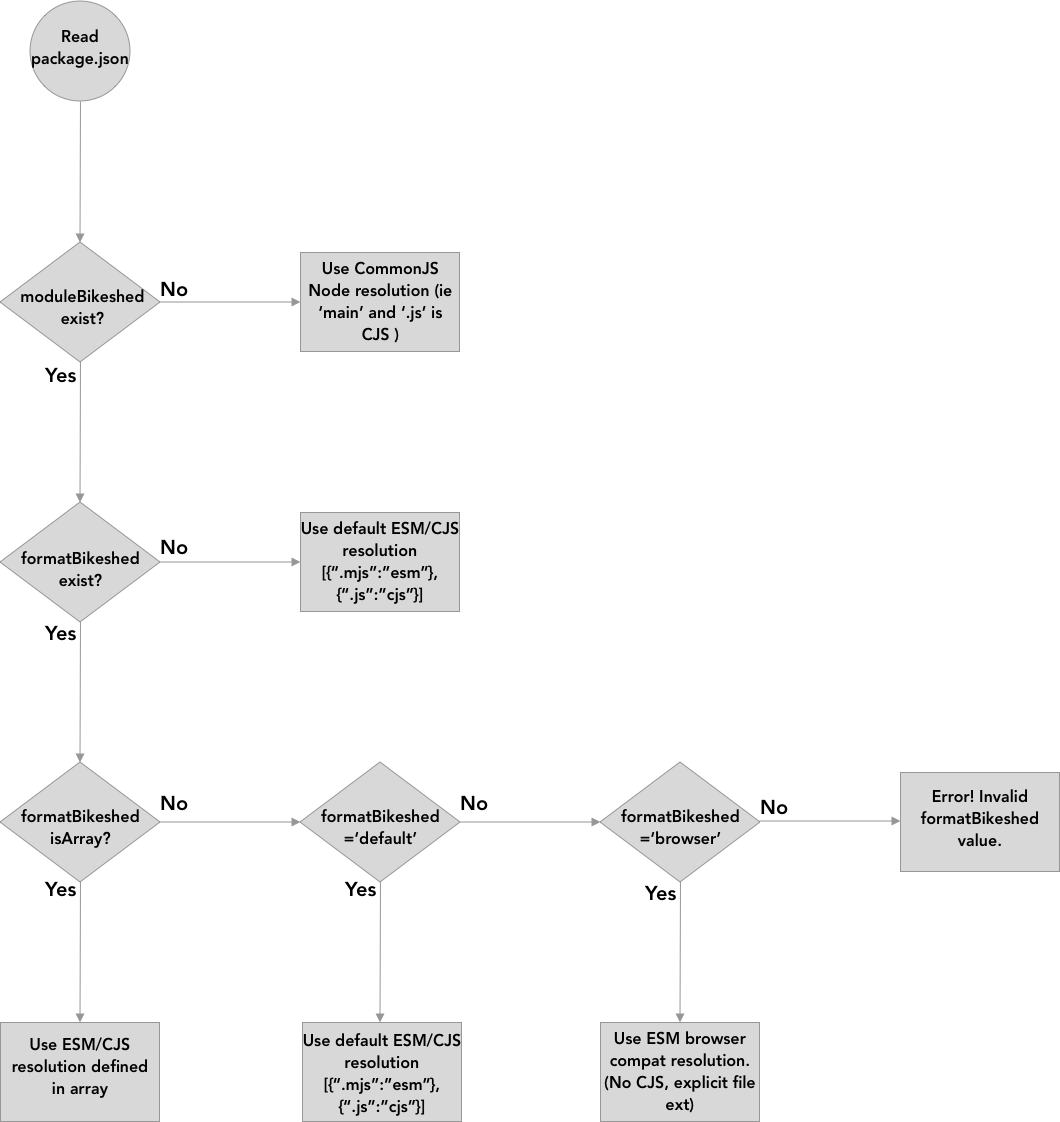
This essentially relegates main in package.json to legacy CJS behaviour only, but it does resolve compatibility issues for upstream and downstream modules.
antstanley
on 24 Apr 2019
@antstanley if "formatBikeshed": "browser" means both .js and .mjs are loaded as ESM then above graph might make sense. I still think having this inside a single moduleBikeshed field would make everyone life easier (including bundlers).
what happens if you've got dependencies with only CJS (ie 99.9% of npm), but you've mapped .js to ESM in your package.json
I think dependencies are still all independently resolved so this issue won't actually happen, right?
WebReflection
on 24 Apr 2019
@WebReflection "formatBikeshed": "browser" would be for browser compatibility, so no CJS, explicit file references, though no extension validation. Match browser resolution exactly.
The other options would support mixed modules in the graph, with the ability for a package author to define their own resolution precedenc, and supported extensions mapped to a module loader scoped just to their package. This also adds a level of future proofing when wasm modules come along.
If we named moduleBikeshed to just module and that resolution default for it was .js with ESM syntax with precedence over CJS, then bundlers would work with no changes as they support module today for ESM. One advantage bundlers and transpilers have is they can parse module to evaluate what type of module it is, as they are working at build time, not execution time, so less time sensitive.
When shipping we probably want to change moduleBikeshed -> module and formatBikeshed -> moduleFormat
With regard to
what happens if you've got dependencies with only CJS (ie 99.9% of npm), but you've mapped .js to ESM in your package.json
I was looking for clarity. My assumption is that the resolution used would be scoped to that package and not follow through to sub packages with their own package.json, it just wasn't explicitly said in the previous comment.
antstanley
on 24 Apr 2019
You can't magically allow .js in moduleMainBikeshed because it doesn't actually signal a change. If I, in the same application, deep imported package/dist-mod/index.js, we can't scour every file on the file system to check if one of them has moduleMainBikeshed pointing to that file, and even if we can, what happens if we find two files that conflict? This is why only the formatBikeshed field can be used to change the format of a file.
devsnek
on 24 Apr 2019
@devsnek I agree with you. The point of moduleMainbikeshed would be to signal the entry point, and formatBikeshed would be to signal the module system and extension mapping to use at that entry point.
I think I've just confused things in my response to @WebReflection who mentioned bundlers, which don't have the performance constraints of evaluating modules at run time. It was a hypothetical on what would need to happen to for bundlers to work without change to existing modules.
In the context of bundlers, for them to work they would just need a module field, but this wouldn't run in Node, as there is no signal to change module loader. For it work in node, with the proposed new fields, it would need module and a format field ie formatBikeshed.
Apologies for any confusion.
antstanley
on 24 Apr 2019
app.js
// ESM
import ns from './module.js|pkg'
import { name1, name2, nameN } from './module.js|pkg'

const require = import.meta.require

// CJS
const ns = require('./|pkg')
const { name1, name2, nameN } = require('./|pkg')
package.json
{
  name: 'pkg',
  main: 'path/to/cjs',
  module: 'path/to/esm.js' // or exports
  ...
}
node -m|--module ./app.js
// No interop (What's the point with 'default' (ns) only anyways)
import ns from '/.cjs.js' ❌

const { name, name2, nameN } = ns
- No
typeand 'package scope' needed - No
--enty-type|input-typeneeded (just use a boolean flag e.g-m|--module) - No new extensions
.mjs|.cjsneeded - Supports 'dual-mode' packages
The inferior interop complicates the current implementation a lot, while having zero benefit
import ns  from 'pkg'
import ns2 from 'pkg2'

const { a, b, c } = ns
const { c, d, e } = ns2
// ----------------------------------
const require = import.meta.require

const { a, b, c } = require('pkg')
const { c, d, e } = require('pkg2')
 michael-ciniawsky
on 24 Apr 2019
michael-ciniawsky
on 24 Apr 2019
Hi,
I've been experimenting with ESM for over a year and wanted to share my experience.
I definitely agree that dual modules are needed for the transition period. A library should transparently support ESM and CJS consumers. It means that there should be a way to select the file based on the import mechanism (
requireorimport). The previous implementation used a different priority for file extensions, this proposal uses a different field inpackage.json.Extension-based dual packages such as GraphQL definitely worked with the old
--experimental-modules. I published all of my libraries this way and it allowed users to seamlessly use either the CJS or ESM versions. I am not aware of any transparent dual package solution with the current implementation. (Extension-based resolution now requires the user to use--es-module-specifier-resolution=node). I am okay to perform a build step on my side if it allows user to consume the package more easily.Deep imports / namespaced imports / paths within packages are an important use case. I consider any proposal that does not handle them to be incomplete. Extension-based dual packages handle them naturally. This proposal depends on the
proposal-pkg-exportfor this. I'd like you to expand on how to handle these imports.
 demurgos
on 29 Apr 2019
demurgos
on 29 Apr 2019
@demurgos Thanks for your feedback. With the implementation as things stand today, the closest one can come to a dual package is to have "main" point to the CommonJS entry point and to tell users via your README to access the ESM entry point via a deep import, e.g. import { foo } from 'pkg/esm.mjs'; (yes, deep imports also currently work, but they require full filenames with extensions). There are many members of the group eager to allow that 'pkg/esm.mjs' to be simply 'pkg' for both CommonJS and ESM. The issue is how to achieve that within the constraints of the design decisions that have been made so far.
The group has some enthusiastic supporters of extension searching and overloading "main" to allow "main" to behave differently for CommonJS and ESM, but the group also has some who are strongly opposed. Since we operate by consensus, that means that extension searching/overloading "main" aren’t options unless several people change their minds. That’s why we shipped --es-module-specifier-resolution, and why its default is explicit. There might never be a consensus to drop this flag or flip its default. I’m operating under the assumption that the current behavior is what we have to work with, as it’s safer to assume the status quo than to assume otherwise. Even if we eventually enable extension searching, there’s possibly even stronger opposition to overloading "main", as people want to not need entry points to be side-by-side in the same folder and also people want to use .js everywhere and not need a secondary extension. That’s why I’ve said above that this proposal is still relevant even if --es-module-specifier-resolution=node becomes the default.
So the political issue that we have is that 'pkg/esm.mjs' might be considered good enough for enough people in the group such that no other solution finds consensus. I think introducing a new field is less controversial than overloading "main"—it at least avoids depending on the already-controversial extension searching, and if extension searching someday gets turned on by default it can apply to the new field too. Or the new field could get removed as part of enabling extension searching. I also proposed #324 as a different proposal that aims for satisfying the need with as little unnecessary complexity as possible, to present as small a target as possible for dissension.
I would like to solve this problem. I would like to provide a better UX than 'pkg/esm.mjs'. I think the way to get there is to work within the design we have, either via this proposal or #324. I think the require of ESM proposal in #299 can get added on top of either base “new field” proposal, as can an enabling of extension searching by default if that ends up happening. This new field could be changed or even removed when those later PRs get approved, if they do. But I think the way forward is to take small steps and work within the framework we’ve established, as that seems to be the most likely path to finding consensus.
GeoffreyBooth
on 30 Apr 2019
Thank you for your detailed reply.
The main strength of extension-based dual packages was that consumers did not have to change specifiers. This opened a path where consumers could migrate to ESM without waiting for their dependencies, and then the dependencies could update to a dual package while keeping the interface compatible. Manually appending /esm.mjs or extensions requires more coordination.
I like your user story in #324. What I am calling for is to keep deep import specifiers such as import { map } from 'rxjs/operators'; as part of the discussion. Even if most packages have a single entry point, deep imports are common too since they are simpler to tree-shake. I regret that they are deferred to import maps or pkg-exports, even if I really like the pkg-exports proposal. But I guess you're right: "the way forward is to take small steps".
demurgos
on 30 Apr 2019
the closest one can come to a dual package is to have "main" point to the CommonJS entry point and to tell users via your README to access the ESM entry point via a deep import
that would make the module ambiguous in case it's meant to be published as "type": "module"
With the current state that doesn't really help with dual modules, there is a not too ugly workaround that seems to work already.
The _TL;DR_ is that you specify the type as module, but you point at the CJS entry, and you use the module field to point at the module file. Such field could point directly at esm/index.js or it could be shortcut as m.js (see the example).
package.json
{
  "type": "module",
  "main": "cjs",
  "module": "m.js"
}
folder structure
cjs/index.js + others
esm/index.js + others
m.js
package.json
m.js
export * from './esm/index.js';

// in case the default should be exported too
import $ from './esm/index.js';
export default $;
Doing this way you have the following benefits:
- old version of node will simply use
mainand work via CJS - all bundlers will pass through the
modulefield if present (for the time being, and until this dual packaging has been solved concretely) - all you have to write in your
READMEisimport stuff from 'module/m.js'in case bundlers are not used or are incapable of solving - this workaround is future proof, you just need to keep
m.jsin there so that everyone won't need to maintain their imports once they wrote themodule/m.jspath - last, but not least, you don't need to write a single
.mjsextension in your whole project
edit
You can already verify/experiment this workaround via dual-packaging-test module, already in _npm_
import log, {name} from 'dual-packaging-test/m.js';

log(name); // will log "dual-packaging-test"
With the current state that doesn’t really help with dual modules, there is a not too ugly workaround that seems to work already.
@WebReflection I think what we’re looking for is a good solution that works without needing bundlers or loaders. Certainly once the user is using bundlers or loaders, all rough edges can be smoothed away and the user can get whatever they want. It would be nice if the vanilla experience was good as well, if only to lessen the load on bundlers/loaders and reduce the need for them.
@demurgos Yes, I also like the look of 'pkg/deep' rather than 'pkg/deep/index.js'. I suppose if we allowed import of extensionless files, one could create a deep extensionless file that was something like export * from './deep/index.js';; or a symlink from deep to ./deep/index.js. Both of those solutions have their own issues: extensionless files are hard for IDEs to work with, and symlinks have cross-platform concerns. But they’re options, I suppose, if package path maps don’t happen. But I think path maps will happen, as there hasn’t been opposition voiced to them and they provide a new benefit that people want, namely that they define a public API for a package. They also dovetail nicely with the import maps that are coming to browsers.
So anyway, we’re getting there. The fact that at this point what we’re debating is the appearance of import specifiers and how many or few ugly characters they need to contain is, to me, a sign of success 😄
GeoffreyBooth
on 30 Apr 2019
@GeoffreyBooth
I think what we’re looking for is a good solution that works without needing bundlers or loaders
not sure it's clear but my workaround doesn't need bundlers to work: it works already ... but ...
It would be nice if the vanilla experience was good as well, if only to lessen the load on bundlers/loaders and reduce the need for them.
agreed, indeed mine is a workaround due current limitations where pointing at CJS in the main when publishing a primary ESM module is a no-go for me, and it makes the type field misleading.
I've tried to combine all features (vanilla + bundlers + legacy) in one, but I'm looking forward to not needing the workaround at all, being able to specify the type too.
WebReflection
on 2 May 2019
Should we perhaps add to the docs the import 'pkg/module.mjs' solution as a recommendation for now? Where pkg’s "main" points to the CommonJS entry point, and pkg’s README tells people to use 'pkg/module.mjs' as the ESM entry point. (With module.mjs just an example, any path would work.)
That’s a solution for dual packages that works today and I think is likely to continue to work under any of the proposals we’re considering. If this PR is accepted or if the require of ESM PR is accepted, and/or if extension searching is enabled, under all those scenarios I think import pkg from 'pkg/module.mjs' would still work as intended, even if the later improvements make the /module.mjs part unnecessary. We would definitely include a warning that this area is still a work-in-progress and likely to change, but documenting this method sends a message that there is already at least this method for publishing both CommonJS and ESM sources in the same package, that will likely remain workable while other options hopefully improve the usability.
Two more thoughts, though probably not to add to the docs:
- If the package wanted to release a breaking change, it could set its
"main"to the ESM entry point and the CommonJS entry point could be accessed via something likerequire('pkg/commonjs'). - This is a pattern for any number of potential future entry points, like
import 'pkg/browser-modern.mjs'and so on. There’s an argument for this deep import style being the preferred approach, over our various proposals how Node should map the bare specifier ('pkg'), as the “deep import for each entry point” style makes explicit both that a package has multiple entry points and also which one the user wants.
GeoffreyBooth
on 8 May 2019
I don't think we should bother trying to document a non-programmatic approach like "read the readme".
ljharb
on 8 May 2019
I would like to explicitly object to dual mode packages. I genuinely believe that the removal of dual mode due to lack of automatic extension searching is a feature not a bug. Have a single specifier mean two different things depending on what graph you load it into is a massive hazard. I will spend some time this week going through some scenarios to explain some situations that we might be creating with dual mode and ways in which it creates extremely nasty and hard to debug errors.
edit:
to clarify I meant dual mode packages sharing a single specifier @GeoffreyBooth does a good job of explaining what I meant in https://github.com/nodejs/modules/issues/273#issuecomment-492408041
MylesBorins
on 14 May 2019
Have a single specifier mean two different things depending on what graph you load it into is a massive hazard.
Disagree with lack of a kind of dual mode, but agree with this sentiment, which is why I think the cjs and esm resolver need to be unified (and then cross-format calls made ok via a syncification of the resolution process as described in the other proposal).
Even if you disagree with require(esm) for whatever reason, this sentiment should be a good driver for unifying the cjs and esm resolvers (related: we probably need to reserve .wasm in cjs same as .mjs in preparation for wasm modules).
 weswigham
on 14 May 2019
weswigham
on 14 May 2019
(We may want to reserve all unknown extensions in .cjs, in preparation for whatever module types we might want to add in the future)
ljharb
on 14 May 2019
I think what is becoming more visible is the disconnect that exists between simulated interoperability and actual interoperability hidden behind some form of conventionally opinionated façade.
Even if you disagree with require(esm) for whatever reason
So maybe we can recognize that historically this has been actually doing a require(transpileToCJS(esm)) and that is probably where various concerns about failing to meet expectations for all forms of conventionally opinionated façades in a one-size de facto implementation are challenging (at least at this moment).
Have a single specifier mean two different things depending on what graph you load
So if we said a specifier can mean two things depending how the means by which it was specified — as in require(‹x⑴›) == import(‹x⑵›) where x⑴ ≃ x⑵ then imho we can say that the module record for both can be a single record; assuming of course a conforming module map keys x⑵ and use two-way mapping facilitator to adapt calls to require(…).
Yeah, that sounds like two specifiers, but they are actually one specifier meaning one this, with a separate form that adapts them to the CJS layer.
SMotaal
on 14 May 2019
I would like to explicitly object to dual mode packages. … Have a single specifier mean two different things depending on what graph you load it into
Specifically, I think @MylesBorins is objecting to the latter—a single specifier (like 'pkg') resolving to different files based on whether it’s referenced via import in ESM or require in CommonJS. I’m assuming he doesn’t object to the limited “dual packages” support we have in --experimental-modules now, where "main" can point to a single entry point in either ESM or CommonJS and deep paths like 'pkg/module.mjs' can point to one or more other entry points also in either ESM or CommonJS. That’s the recommended best practice I wrote about above in https://github.com/nodejs/modules/issues/273#issuecomment-490376184, that I suggested we add to the docs. I think if we’re not likely to move forward on any other version of dual packages, that’s all the more reason we should write this up and put it in the docs to start setting expectations that this is all that’s likely to ship.
And @weswigham, this still applies even if require of ESM happens, because people will still want to publish packages that are required into CommonJS in older versions of Node. If and when require of ESM lands, this new section of the docs can be updated appropriately.
GeoffreyBooth
on 14 May 2019
In relation to https://github.com/nodejs/modules/issues/323#issuecomment-511273657 I just wanted to say that while the deep import option (import 'pkg/module.mjs', documented here) does work, it's far from ideal especially from a tooling perspective.
It's not so bad if everyone who uses your package only uses it for ESM, but if you are also making a dual package which depends on another dual package you might run into issues.
Suppose you write the following, where you import something from one of those dual packages:
import {something} from 'pkg';
Now suppose you want to transpile it so other people can use both your MJS and CJS modules. Here you run into an issue, because you need to output two different files like the following:
const {something} = require('pkg');
import {something} from 'pkg/module.mjs';
Essentially, the path needs to be different based on the module system you are compiling for. This is also the case for relative imports to files in your own package (since automatic extension resolution was disabled), but that's a relatively easy problem for tooling to solve. This is more complicated, and requires knowledge of the layout of 3rd-party packages (how should it know?), and the expectation that layout will not change.
 AlexanderOMara
on 15 Jul 2019
AlexanderOMara
on 15 Jul 2019
if you are also making a dual package which depends on another dual package you might run into issues.
Can you give an example? I'm not seeing this in the example you gave above. What's different about dual depending on dual?
GeoffreyBooth
on 15 Jul 2019
@GeoffreyBooth You somehow need to have your ESM modules import that 3rd-party module as 'pkg/module.mjs'; while your CJS modules import it as 'pkg';.
Currently that would mean editing every file that references it after transpiling.
Ideally all one would need to do is transpile it and be done, but how can the transpiler know what to change to do that for you?
AlexanderOMara
on 15 Jul 2019
Technically the CommonJS and ESM versions of a package are really two separate packages, that just happen to be published in the same folder tree. They don't necessarily behave identically, so it's not safe to assume that they're interchangeable.
If you're outputting a dual package, then all of your package's dependencies need to be the CommonJS ones, at least for the CommonJS version of your dual package. But your ESM version could also use all CommonJS dependencies; there's no reason it needs to be ESM all the way down. Switch to ESM dependencies when you stop publishing a CommonJS version of your package.
GeoffreyBooth
on 15 Jul 2019
then all of your package's dependencies need to be the CommonJS ones
Couldn't they also be dual packages? I've had no problem doing that.
Also, for tree-shaking purposes, it's ideal to have it be ESM as far down as possible.
AlexanderOMara
on 15 Jul 2019
Couldn't they also be dual packages? I've had no problem doing that.
They'd need to be the CommonJS exports of dual packages, unless you want the CommonJS side of your dual package to only be usable in Node 12+ (where ESM is supported).
GeoffreyBooth
on 15 Jul 2019
Okay, trying to recap @AlexanderOMara's concern (let me know if I'm off):
- I maintain package
minethat depends ondeep-dep. deep-depis using the recommended flow of exposingdeep-dep/cjsanddeep-dep/esm.- I want to support both CJS and ESM in
mine. - To do that, I want to write ESM code and compile it to CJS.
- In my ESM code, I would write something like this:
// file:///mine/lib/mine.mjs
import 'deep-dep/esm';
Problem: No compiler is smart enough right now to rewrite that to a working CJS file (if that's even reliably possible). Without manually fixing the compiled code, I will not be able to publish a package that supports both webpack's ESM-only tree-shaking and being required in node.
P.S.: I think @GeoffreyBooth's read of the situation is correct and right now the solution is "if you want to use ESM dependencies anywhere, you have to drop CJS support or write additional code manually".
jkrems
on 15 Jul 2019
I think this deserves its own issue. Apologies if I sounded dismissive, I was only trying to explain how to do this in current --experimental-modules, not to imply that that shouldn’t change.
Off the top of my head I would think that dual packages should continue publishing their ESM entry point in "module", and CommonJS entry point in "main", and that should provide build tools with all the information they’d need to output the two variations for each version of your package.
GeoffreyBooth
on 15 Jul 2019
Closing in favor of https://github.com/nodejs/node/pull/29978.
GeoffreyBooth
on 31 Oct 2019
Related issues
GeoffreyBooth
·
64Comments
 guybedford
·
62Comments
MylesBorins
·
61Comments
WebReflection
·
64Comments
zenparsing
·
73Comments
guybedford
·
62Comments
MylesBorins
·
61Comments
WebReflection
·
64Comments
zenparsing
·
73Comments
Most helpful comment
Hi,
I've been experimenting with ESM for over a year and wanted to share my experience.
I definitely agree that dual modules are needed for the transition period. A library should transparently support ESM and CJS consumers. It means that there should be a way to select the file based on the import mechanism (
requireorimport). The previous implementation used a different priority for file extensions, this proposal uses a different field inpackage.json.Extension-based dual packages such as GraphQL definitely worked with the old
--experimental-modules. I published all of my libraries this way and it allowed users to seamlessly use either the CJS or ESM versions. I am not aware of any transparent dual package solution with the current implementation. (Extension-based resolution now requires the user to use--es-module-specifier-resolution=node). I am okay to perform a build step on my side if it allows user to consume the package more easily.Deep imports / namespaced imports / paths within packages are an important use case. I consider any proposal that does not handle them to be incomplete. Extension-based dual packages handle them naturally. This proposal depends on the
proposal-pkg-exportfor this. I'd like you to expand on how to handle these imports.