Mne-python: BUG: Extreme topomap valuse still too strong
@agramfort pointed out that the examples/time_frequency/plot_source_power_spectrum_opm.py example had edges that are too strong:

Doing border='mean' plus extrapolate='local' gives:

I wonder if:
- The default extrapolation mode of
boxshould actually add the local points, then also add the four points in the corners. It might be a good compromise. border='mean'should be the default
If we did these two things, this is what the new default would look like (hacked together the box change for now and set border='mean'):

I know we've had some conversations about (2) at least, but I'd also like (1) because it might combine the local focality of 'local' with the smoothness (bounded by matplotlib mask instead of interpolation grid extent) of 'box'. Thoughts @mmagnuski ?
 larsoner
All 17 comments
Also, using np.median rather than np.mean seems to work a tiny bit better to deal with the blob-like appearance at the edges of `local (or box+local) interp:
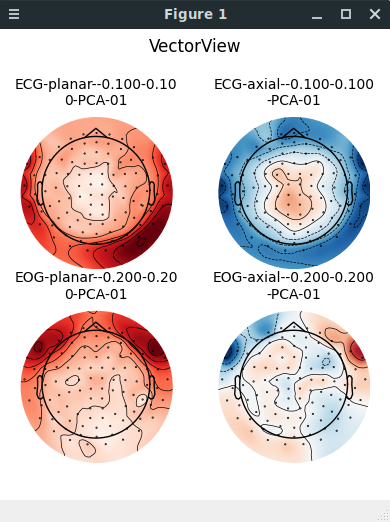
I tried weighting the points by inverse distance and it didn't seem to help much. But we can always improve this aspect of appearance later, the real questions are the two posed above.
larsoner
on 13 Apr 2020
is it possible to extrapolate a bit less far from sensors with "
border='mean' plus extrapolate='local'"
maybe divide by 2 the extra area beyond the convex hull?
I would consider changing then our defaults here.
>
 agramfort
on 13 Apr 2020
agramfort
on 13 Apr 2020
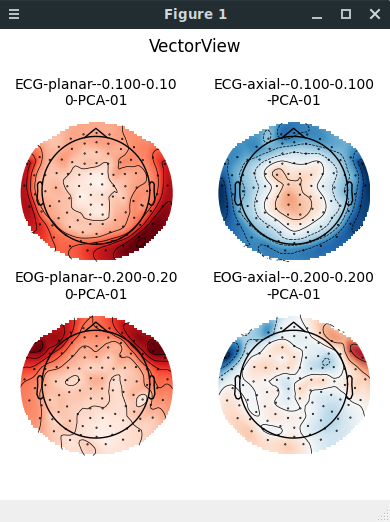
Halving the distance fixes the blob problem, and also makes sense in terms of the "represented area" each channel gets, here shown for the new 'box' mode (which does local then adds box; #7602)
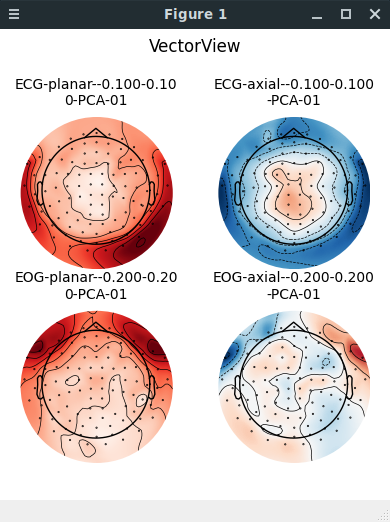
I prefer this over pure 'local' mode, which has jagged edges:
larsoner
on 13 Apr 2020
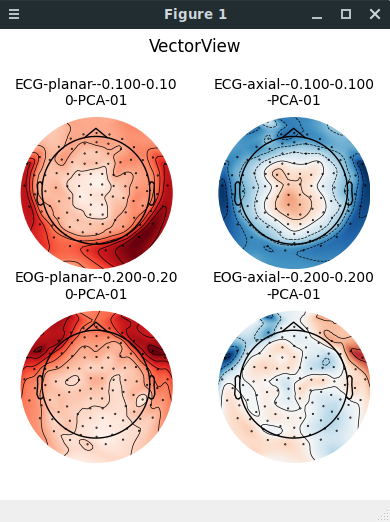
Actually there was a bug, this is what it looks like if you use half the distance for local mode (it's pretty tight):
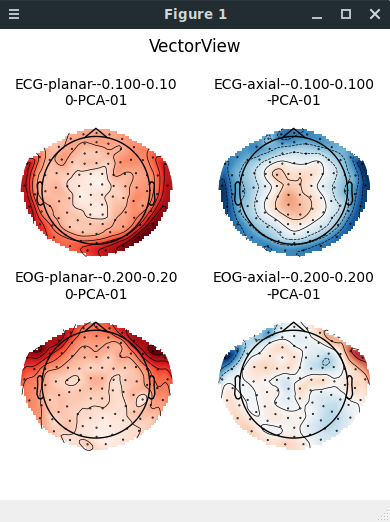
And what it looks like for box on #7602:
larsoner
on 13 Apr 2020
@larsoner
The extrapolate='local' should have a corresponding mask, that's true.
What's the difference between the new box mode and the local?
If it's doing just what local does but just optimizes the circle mask placement, maybe mask='circle' or something like that would be better? Or maybe the distance in local should just be larger by default?
 mmagnuski
on 13 Apr 2020
mmagnuski
on 13 Apr 2020
What's the difference between the new box mode and the local?
box still extrapolates to a box. It just extrapolates to local first, then out to the box.
The extrapolate='local' should have a corresponding mask, that's true.
I wonder if we can / should actually pass the outer edges from the triangulation. We have functions to figure out the vertices of mesh edges so it might not be so difficult. Then that could be passed to Matplotlib as a polygon mask.
If it does, maybe we kill the box changes I'm proposing and just let local be the default? In that case what we probably really want to do is keep interpolating to distance, but have the mask only extend distance / 2. beyond the sensors to keep uniform represented area.
larsoner
on 13 Apr 2020
local could use a clean polygon mask?
>
agramfort
on 13 Apr 2020
Yes, that's the idea if we continue extrapolating to 1x the median distance and mask to 0.5 the median distance I think it should work (if it still have chunks, we can extrapolate to 1.5 or 2x the median distance)
larsoner
on 13 Apr 2020
I wonder if we can / should actually pass the outer edges from the triangulation. We have functions to figure out the vertices of mesh edges so it might not be so difficult. Then that could be passed to Matplotlib as a polygon mask.
Yes, something like this, was what I had in mind. The convex hull is computed in extrapolation, and then slightly stretched out to create local points - so the mask could be half that distance (the distance between channels and local points).
mmagnuski
on 13 Apr 2020
Okay I'll try making the local changes to use a polygon based on the convex hull.
One issue is that this will make the outlines='head' | 'skirt' stuff even worse, since we will no longer extrapolate far enough to even choose where the outlines will go.
larsoner
on 13 Apr 2020
If it does, maybe we kill the box changes I'm proposing and just let local be the default? In that case what we probably really want to do is keep interpolating to distance, but have the mask only extend distance / 2. beyond the sensors to keep uniform represented area.
I suspect some (many?) users would still like to have circular mask. In other words: there are still cases where extrapolate='local' + mask='circle' would be useful. There could also be two masks: the circular one and the polygon mask (+ larger distance than 1 * median inter-channel?).
outlines='head' | 'skirt'
Do you see noticable differences between these two?
mmagnuski
on 13 Apr 2020
I suspect some (many?) users would still like to have circular mask. In other words: there are still cases where extrapolate='local' + mask='circle' would be useful. There could also be two masks: the circular one and the polygon mask (+ larger distance than 1 * median inter-channel?).
This I don't really understand. Can you explain what you mean? The extrapolate='local' makes it so that the data shown extend to just past the (a slightly extended convex hull of) the electrodes. If you throw a circular mask on top of this, it's either a no-op (if it includes all electrodes) or cuts off some electrodes. In this sense there is an interaction between our extrapolation mode and the mask, in that they can both limit the visible data extent.
larsoner
on 13 Apr 2020
For head vs skirt so far I've been avoiding thinking about it, and don't have relevant experience messing with those. I'm just aware that it's an issue and our docs about it are wrong (#7397)
larsoner
on 13 Apr 2020
This I don't really understand. Can you explain what you mean? The extrapolate='local' makes it so that the data shown extend to just past the (a slightly extended convex hull of) the electrodes. If you throw a circular mask on top of this, it's either a no-op (if it includes all electrodes) or cuts off some electrodes. In this sense there is an interaction between our extrapolation mode and the mask, in that they can both limit the visible data extent.
Sure, my explanation was very unclear, sorry for that. It's just that circular mask will usually look nicer than convex hull based mask (its smoother). You can see in your own examples that some parts of the topos are circulary masked in the local mode already (on the left and right):
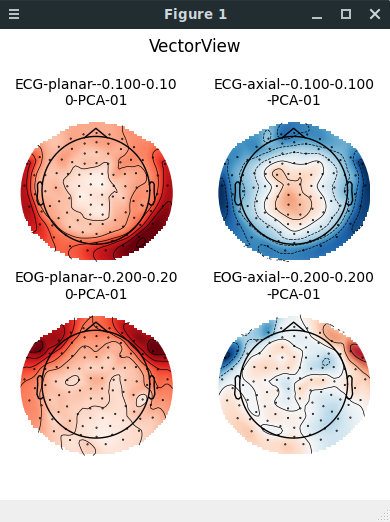
If the default distance at which extrapolation points are placed was higher - then the circular mask would mask not only sides but also the back in the example above. Then the convex hulll based mask would only be effectively masking the front. Of course it may be different for each case, so its not necessarily a general rule. But the circular mask would not cut off any channels (its created this way), and it is alread not a no-op.
mmagnuski
on 13 Apr 2020
If the default distance at which extrapolation points are placed was higher - then the circular mask would mask not only sides but also the back in the example above. Then the convex hulll based mask would only be effectively masking the front. Of course it may be different for each case, so its not necessarily a general rule. But the circular mask would not cut off any channels (its created this way), and it is alread not a no-op.
Yes but having the top look bad is not great, and masking differently for one part (convex hull at the top) and another (circle at the bottom) is also not great.
it's just that circular mask will usually look nicer than convex hull based mask (its smoother)
I just finished an implementation of the local at 1x + patch at 0.5x already looks pretty good and smooth. I'd prefer it to some combination of extra-circle-plus-convex-hull stuff:

If the slight angularity at the bottom really bothers people then I think we can probably fix it later, but it really does not bother me here. Basically if you use local extrapolation, I think you should only ever see data close to the channels, and we should do something to smooth the jagged edges. This seems like it would make a pretty nice default, as it:
- Accurately allocates areas to channels
- Accurately portrays the channel geometry
- Does not have (big) issues at the boundaries
For EEG people that want data extrapolated and need circles, I don't think it's too much to have them set extrapolate='box', and then we can make the skirt options do something again separately.
larsoner
on 13 Apr 2020
@larsoner - it looks better than I imagined, I like it the way it is. :)
mmagnuski
on 13 Apr 2020
Excellent, it was pretty easy to implement and test because someone already wrote nice convex hull / local code :)
larsoner
on 13 Apr 2020
Related issues
 annesodub
·
3Comments
annesodub
·
3Comments
 hoechenberger
·
6Comments
hoechenberger
·
6Comments
 erfpak7
·
5Comments
erfpak7
·
5Comments
 jasmainak
·
3Comments
jasmainak
·
3Comments
 sappelhoff
·
6Comments
sappelhoff
·
6Comments