Mbed-os: SPI read always returns 0xff on Ublox EVK ODIN W2
Description
- Type: Bug
Bug
Target
Ublox EVK ODIN W2
Toolchain:
GCC_ARM
Expected behavior
Ublox EVK ODIN W2 board with Atmel RF shield attached, following code should return the radio ID register value 0x0b on 2.4 GHz devices.
#include "mbed.h"
#include "NanostackRfPhyAtmel.h"
#include "AT86RFReg.h"

#define SPI_SPEED 7500000

int main()
{
    DigitalOut CS(ATMEL_SPI_CS);
    DigitalOut RST(ATMEL_SPI_RST);
    SPI spi(ATMEL_SPI_MOSI, ATMEL_SPI_MISO, ATMEL_SPI_SCLK);
    spi.frequency(SPI_SPEED);

    // Reset the chip
    RST = 0;
    CS = 1;
    wait(0.1);
    RST = 1;
    wait(0.1);

    const char cmd = 0x80 | PART_NUM;
    char rx[2];

    for (;;) {
        CS = 0;
        wait(0.001);
        spi.write(&cmd, 1, rx, 2);
        CS = 1;

        printf("Part num %.2x\n", rx[1]);
        wait(1);
    }
}
When device behaving correctly,
Part num 0b
Part num 0b
Part num 0b
Part num 0b
Actual behavior
On devices with the error condition,
Part num ff
Part num ff
Part num ff
Part num ff
Steps to reproduce
That one is the hardest part. I don't know how to get the device into this condition.
We have CI instance with over 10 Ublox devices. All of them are in this state. They all have been running mesh-minimal earlier.
Reflashing or resetting the device does not fix the state.
Power cycling fixes.
 SeppoTakalo
All 13 comments
Steps to reproduce
- Get Ublox EVK ODIN W2 board
- Get Atmel AT86RF212B SubGhz shield. (NOTE: I cannot make this happen on 2.4Ghz, even that in CI it seems to happen)
mbed import mbed-os-example-mesh-minimal- Edit
mbed_app.jsonto match following
"mbed-mesh-api.6lowpan-nd-channel-page": 2, "mbed-mesh-api.6lowpan-nd-channel": 1, "mbed-mesh-api.6lowpan-nd-channel-mask": "(1<1)", "mbed-trace.enable": true, - Set target:
mbed target UBLOX_EVK_ODIN_W2 - Set toolchain:
mbed toolchain GCC_ARM - Build. Store the binary
- Modify
main.cppto match the example in first message. - Build.
- Flash the first binary
- Wait for message
[DBG ][m6LND]: Link Layer Scan Fail: No Beacons - Flash the second binary.
- Observe the serial port:
Part num ff - Unplug the USB & replug
- Observe the serial port:
Part num 07
Part num 07
Notes
Part number 0x07 is SubGhz
Part number 0x0b is 2.4Ghz
Happens with both GCC6 and GCC 4.9
SeppoTakalo
on 1 Aug 2017
SPI read requires default byte to be written on SPI bus, usually that is 0xFF. SPI driver was recently updated to set this default value by user using 'set_default_write_value' api. Please verify what was default transmit earlier (successful case) and with failure. Hope this helps
 deepikabhavnani
on 1 Aug 2017
deepikabhavnani
on 1 Aug 2017
Default byte should be 0xff and it is set on build time, so makes no sense if the behaviour changes just when power plugging the device. I starting to suspect hardware related things.
The SPI bus on this device is shared with SD card (but its not attached now), and also contains level shifters.
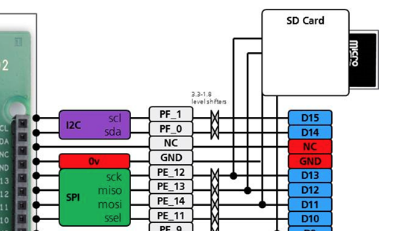
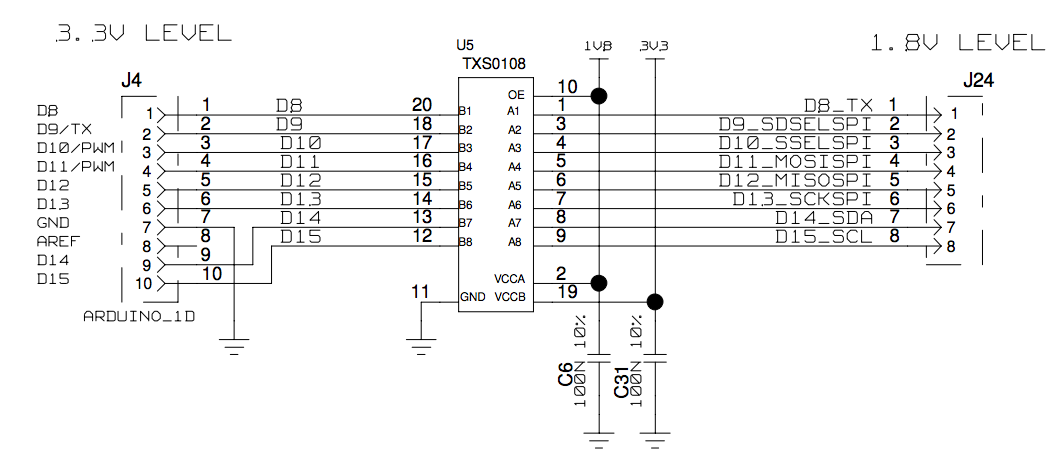
We are now studying how the lines actually behave.
SeppoTakalo
on 2 Aug 2017
@andreaslarssonublox @andreaspeterssonublox
 bulislaw
on 2 Aug 2017
bulislaw
on 2 Aug 2017
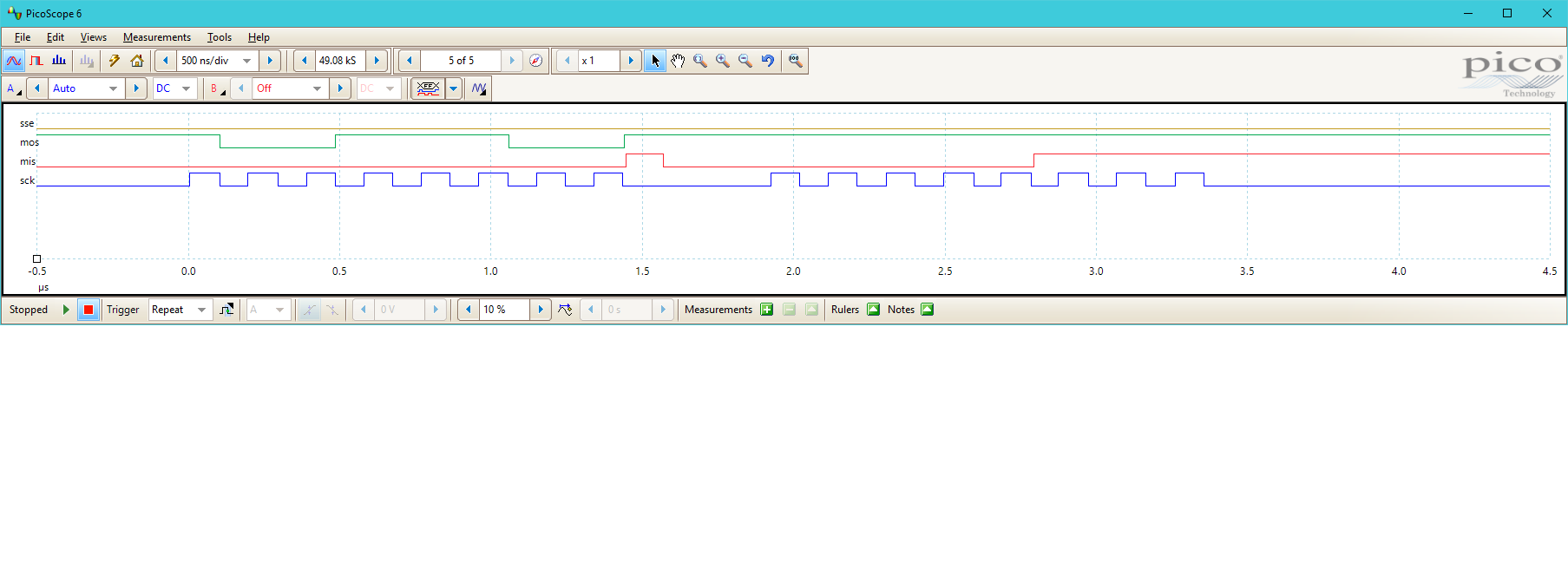
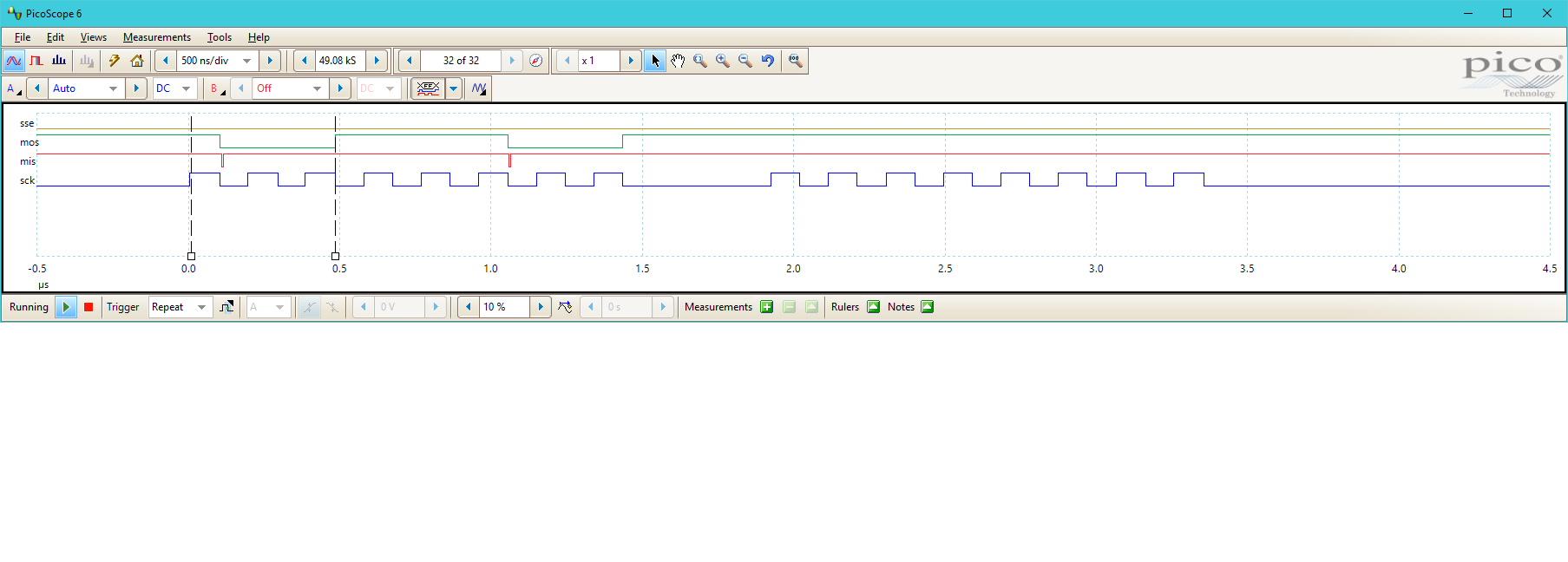
Here are 2 pictures, showing what is happening
Succesful case:
- Chip select stays low(sse)
- Mosi line has command 0x9c (0x80 | 0x1C)
- Miso line has a correct response 0x07
Failure case:
- Chip select stays low(sse)
- Mosi line has command 0x9c
- Miso line stays high, resulting 0xff
 KariHaapalehto
on 2 Aug 2017
KariHaapalehto
on 2 Aug 2017
These measurements were done from 3.3 V side of the voltage converter.
SeppoTakalo
on 2 Aug 2017
Hi, where can we get the "Atmel AT86RF212B SubGhz shield" you are using to verify with?
@SeppoTakalo
 andreaslarssonublox
on 15 Aug 2017
SeppoTakalo
on 26 Sep 2017
andreaslarssonublox
on 15 Aug 2017
SeppoTakalo
on 26 Sep 2017
Would this also impact the SD-card if one had an SD-card in the SPI-bus?
CC: @geky @deepikabhavnani
 JanneKiiskila
on 5 Oct 2017
JanneKiiskila
on 5 Oct 2017
It could. needs verification.
SeppoTakalo
on 5 Oct 2017
Would this also impact the SD-card if one had an SD-card in the SPI-bus?
Yes if read response is always 0xFF, than no device (including SD card) on SPI bus will work properly. If it is randomly 0xFF than we may see corruption not related to actual data on SD card, but because of SPI.
In this case of corruption data on SD card will be correct, and device may work again after reset.
I would like to know if this behavior is observed on all devices on SPI bus?
deepikabhavnani
on 5 Oct 2017
Hi,
I looked at the code in NanostackRfPhyAtmel:rf_if_reset_radio and the SLP_TR is set to 0 which is not done in the example above. If this is inserted in the example it seems to work. Can you verify it @SeppoTakalo?
DigitalOut SLP_TR(ATMEL_SPI_SLP);

// Reset the chip
RST = 0;
CS = 1;
wait(0.1);
SLP_TR = 0;
RST = 1;
wait(0.1);
andreaslarssonublox
on 16 Oct 2017
@andreaslarssonublox
Good finding.
I applied the SLP_TR control to the example code and it seems to fix the situation.
Looking at datasheets of AT86RF212B and AT86RF233 the SLP_TR pin is used to control PLL_ON -> TX transitions but also SLEEP modes.
So apparently leaving it low runs the chip into sleep mode.
However, datasheet does not specify that tranceiver sleep mode also disables SPI bus. Therefore this confusion.
The differences between hardwares are clearly that on some (For example K64F) the pin is probably configured high by default, but here it is low by default. That might explain why I'm only able to reach this state in Ublox HW.
I'll close this bug as the original issue is not valid but instead based on false assumption that the Atmel chip's SPI bus is always awake.
References:
SeppoTakalo
on 17 Oct 2017
Related issues
 pilotak
·
3Comments
pilotak
·
3Comments
 cesarvandevelde
·
4Comments
cesarvandevelde
·
4Comments
 toyowata
·
4Comments
toyowata
·
4Comments
 drahnr
·
4Comments
drahnr
·
4Comments
 0xc0170
·
3Comments
0xc0170
·
3Comments