Lightgbm: monotonic constraints not working?
I have rerun my checks on monotonic constraints and could not reproduce them under the current lightgbm release 2.2.3 as well as under 2.1.x. The constraints are not satisfied.
Environment info
Operating System: Windows
CPU/GPU model: CPU
C++/Python/R version: R 3.5.0
Error message
None.
Reproducible examples
Steps to reproduce
library(tidyverse)
library(caret)
library(lightgbm)
library(xgboost)

# Generate function with one input x
set.seed(20)
x <- seq(-0.2, 1, by = 0.001)
y <- x^2 + rnorm(length(x), sd = 0.1)

dat <- data.frame(x, y)

base_plot <- ggplot(dat, aes(x = x, y = y)) +
  geom_point()
base_plot

# train/test split
ind <- caret::createDataPartition(y, p = 0.8, list = FALSE) %>% c
train <- dat[ind, ] %>% data.matrix
test <- dat[-ind, ] %>% data.matrix

# LGB
lgb_data <- lgb.Dataset(train[, "x", drop = FALSE], label = train[, "y"])

# Some reasonable parameters (would need to be optimized)
params <- list(learning_rate = 0.03,
               num_leaves = 31,
               min_data_in_leaf = 10,
               bagging_fraction = 0.7,
               bagging_freq = 4,
               nthread = 4,
               max_bin = 255,
               metric = "rmse",
               objective = "regression")

# Use cross-validation to figure out an appropriate number of iterations
fit_cv <- lgb.cv(params = params,
                 data = lgb_data,
                 nfold = 5,
                 nrounds = 1000,
                 early_stopping_rounds = 20,
                 verbose = 0)
fit_cv$best_iter

fit <- lgb.train(params = params,
                 data = lgb_data,
                 nrounds = fit_cv$best_iter,
                 verbose = 0)

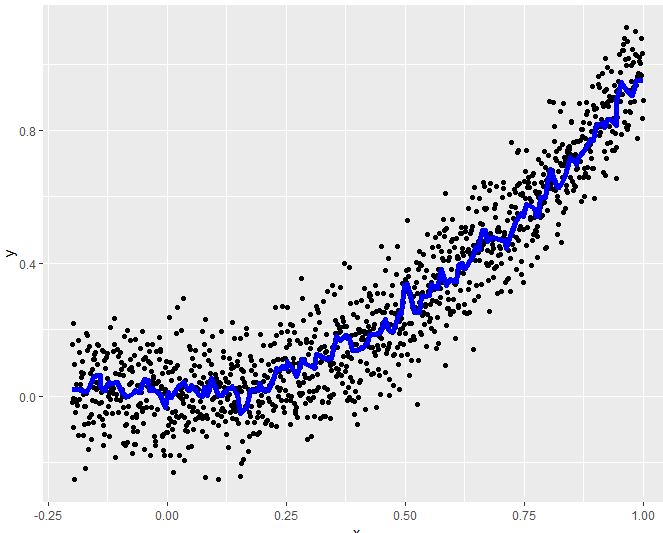
# Visualize predictions on test data
test_pred <- data.frame(test, pred = predict(fit, test))

base_plot +
  geom_line(data = test_pred, aes(x = x, y = pred),
            col = "blue", lwd = 2)

# Now with monotonicity constraints
fit_monotone <- lgb.train(params = c(params, monotone_constraints = '1'),
                          data = lgb_data,
                          nrounds = fit_cv$best_iter,
                          verbose = 1)

# Visualize predictions on test data
test_pred$pred_monotone <- predict(fit_monotone, test)

base_plot +
  geom_line(data = test_pred, aes(x = x, y = pred_monotone),
            col = "blue", lwd = 2)
 mayer79
All 7 comments
@mayer79
we have test for mc in python package: https://github.com/Microsoft/LightGBM/blob/af3c4f89ff3989516c60d3f1f1d1e10c7758b855/tests/python_package_test/test_engine.py#L670-L708
can you try to pass mc parameter to dataset? (or remave the cv).
 guolinke
on 18 Nov 2018
guolinke
on 18 Nov 2018
@guolinke: I could not reproduce the problem in Python, so I tried out different things to identify what goes wrong in the example code above.
It seems that old instances of "params" are stuck somewhere in C++ aether (?) and are not being updated by the next call of lgb.train. Adding one row
lgb_data <- lgb.Dataset(train[, "x", drop = FALSE], label = train[, "y"])
just before calling the constrained model solves the problem. Do you think when running gridsearch-CV, we would need to construct the data set like this within the gridsearch loop?
mayer79
on 18 Nov 2018
The Dataset will be initialized only one-time, and use the parameter it got first to initialize. For example, in you case, the parameter in the cv is used to initialize the dataset.
After initialize of dataset, the parameter cannot be override.
guolinke
on 19 Nov 2018
For grid search, it depends. Some parameter don't affect the dataset object, like num_trees.
guolinke
on 19 Nov 2018
Oh - this is a very valuable information, best thanks. So, nothing is wrong with monotonic constraints and we can close this issue. I am wondering how complex it would be to provide an warning (or even error) if the current parameters are inconsistent with those used in initialization of the data set?
mayer79
on 19 Nov 2018
@guolinke is there a way to get the parameters of the Dataset and update them? Or should we use free data parameter when creating the Dataset?
 Laurae2
on 22 Nov 2018
Laurae2
on 22 Nov 2018
I think it is not possible to updata dataset's parameters now.
Free_raw_data cannot help as well, since the constructed dataset is not freed.
I will fix this when I have time.
guolinke
on 22 Nov 2018
Related issues
 StrikerRUS
·
48Comments
StrikerRUS
·
48Comments
 geoHeil
·
36Comments
geoHeil
·
36Comments
 Yorko
·
30Comments
Yorko
·
30Comments
 Merudo
·
38Comments
Merudo
·
38Comments
 AdityaJuvali
·
44Comments
AdityaJuvali
·
44Comments
Most helpful comment
The Dataset will be initialized only one-time, and use the parameter it got first to initialize. For example, in you case, the parameter in the cv is used to initialize the dataset.
After initialize of dataset, the parameter cannot be override.