Feature interaction
Monotonicity constraints is one way to make the black-box more intuitive and interpretable. For tree based models, using Interaction constraints is another highly interesting possibility: Passing a nested list like [[0, 1], [2]] specifies which features may be selected in the same tree branch, see explanations in https://github.com/dmlc/xgboost/issues/4075 in general and https://discuss.xgboost.ai/t/feature-interaction-constraint-overlap/506 for what happens if the sets overlap.
Quoting hcho3: "Let S the set of features used in all the ancestor nodes of the proposed split (plus itself). The proposed split is admitted whenever at least one set in the interaction constraint is a superset of S."
I think this would be a big step towards making boosted trees more interpretable and to e.g. being able to specify "additive" components as well as to reflect ethical constraints into a model.
 mayer79
All 3 comments
It seems is a very interesting feature, contribution is very welcomed.
And I will implement it when I have time and if no PR is proposed.
 guolinke
on 21 Mar 2020
guolinke
on 21 Mar 2020
That would be simply fantastic as my C++ skills are even worse than me speaking French. Still, you can test the implementation e.g. with Friedman's H statistic, a model agnostic approach to measure interaction strength. It is implemented in R packages iml and flashlight (mine):
library(xgboost)

n <- 1000
m <- 4

set.seed(1)
X <- matrix(rnorm(n * m), ncol = m, dimnames = list(NULL, paste0("X", 1:m)))
cols <- colnames(X)
y <- X[, 1] * X[, 2] * X[, 3] + X[, 4] + rnorm(n)

params <- list(
  learning_rate = 0.1,
  depth = 4,
  objective = "reg:linear",
  #interaction_constraints = list(0, c(1, 2, 3)) # col index starts at 0
  interaction_constraints = list(0, 1, 2, 3) # col index starts at 0
)

train <- xgb.DMatrix(X, label = y)

fit <- xgb.train(params, train, nrounds = 50)


library(flashlight)
fl <- flashlight(model = fit, data = data.frame(y, X), y = "y", label = "xgb",
                 predict_fun = function(m, X) predict(m, data.matrix(X[, cols])))
plot(imp <- light_interaction(fl, v = cols, pairwise = FALSE))
The first parametrization gives
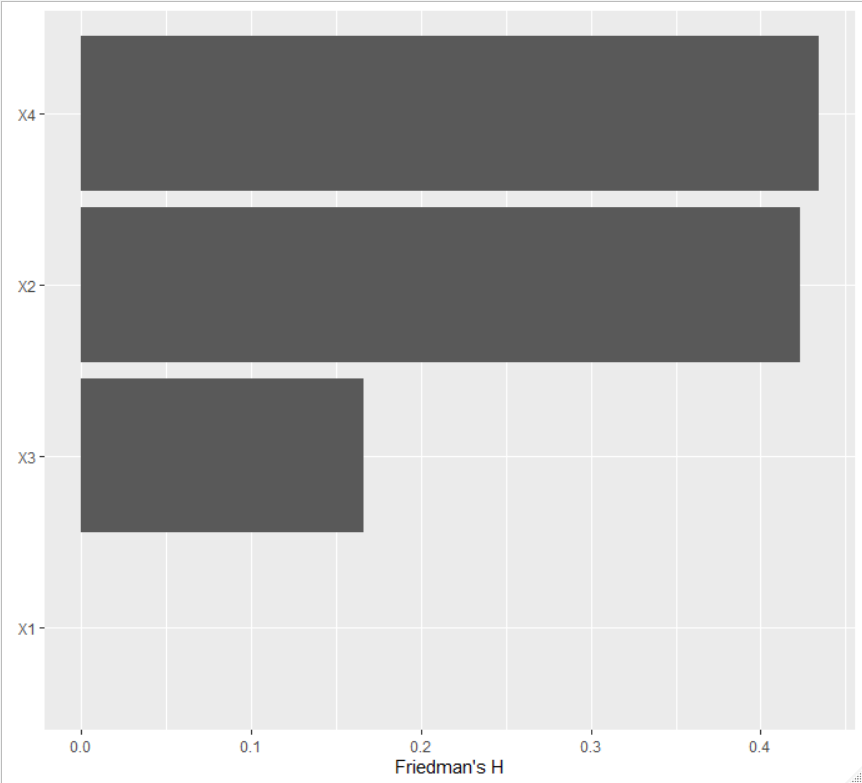
while the second one gives
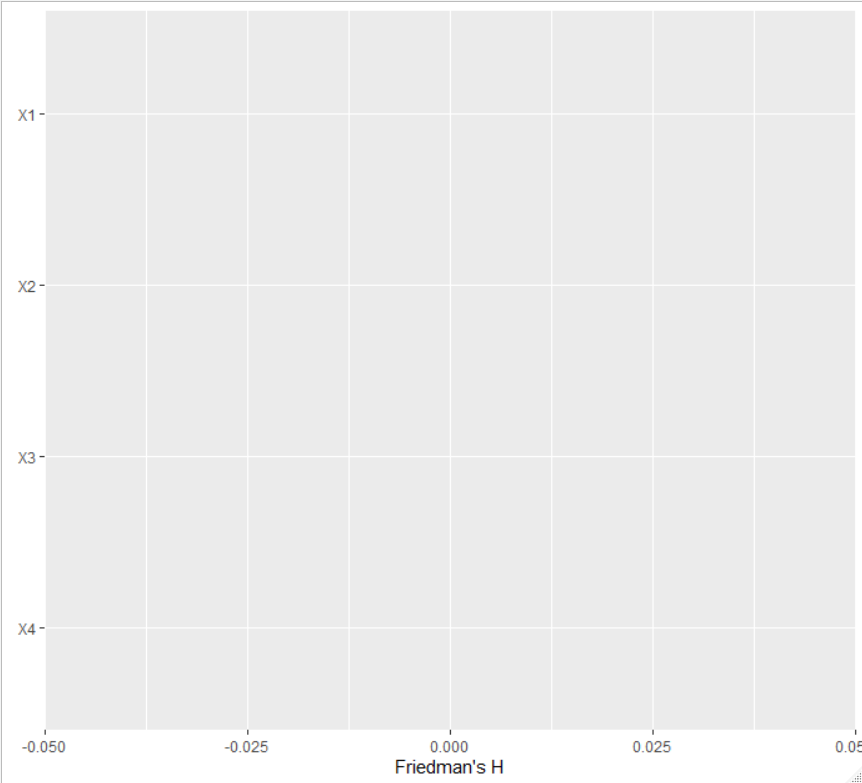
Setting pairwise = TRUE would show bars for each variable pair.
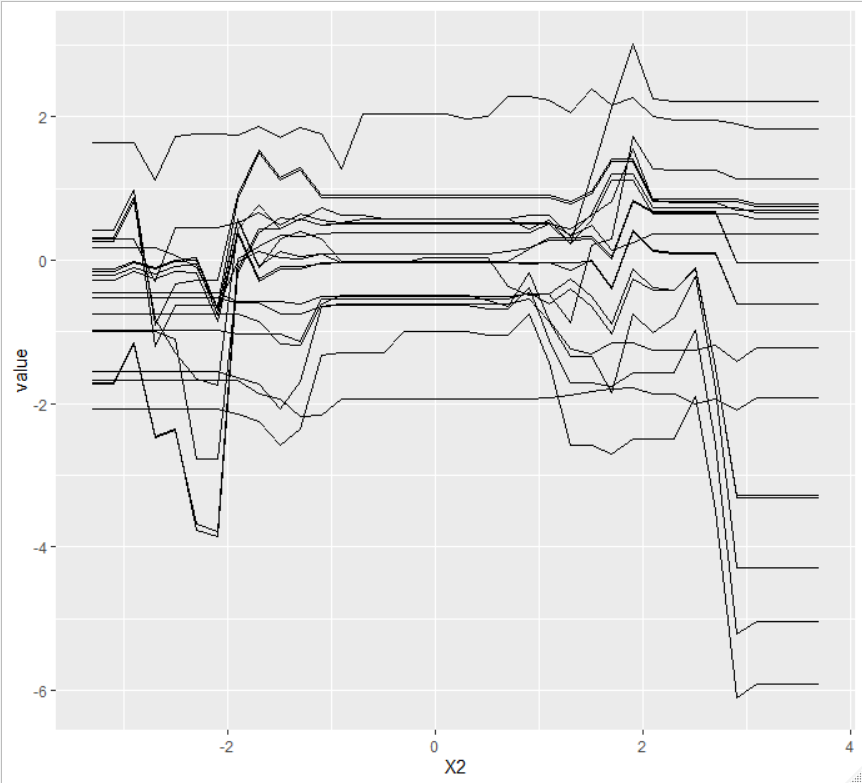
An even simpler approach is to look at ceteris paribus profiles (the heart of partial dependence plots). For variables without interactions, the curves must be parallel.
For the first parametrization of the interaction_constraints, we get for the first variable:
plot(light_ice(fl, v = "X1", seed = 1))

And for the second variable:
mayer79
on 22 Mar 2020
Implemented in #3126.
 StrikerRUS
on 23 Jun 2020
StrikerRUS
on 23 Jun 2020
Related issues
 vinhdizzo
·
4Comments
vinhdizzo
·
4Comments
 hlee13
·
3Comments
hlee13
·
3Comments
 jameslamb
·
3Comments
jameslamb
·
3Comments
 John-Curcio
·
3Comments
John-Curcio
·
3Comments
 hack-r
·
4Comments
hack-r
·
4Comments
Most helpful comment
Implemented in #3126.