Keras: Training works in keras 2.2.2 but not in 2.2.3 and 2.2.4
Hi, I'm training a semantic image segmentation model.
And I've built a generator that yields:
(images, masks, sample_weights)
my batch size is 8.
at the following shapes:
( (8, 256, 256, 3) , (8, 65536, 1) , (8, 65536) )
In the compilation I also defined sample_weight_mode = "temporal"
and this is the error I'm getting:
(it looks like these versions reshape the validation labels to be a 1D vector)
InvalidArgumentError: Incompatible shapes: [524288] vs. [8,65536]
     [[Node: metrics/acc/Equal = Equal[T=DT_FLOAT, _device="/job:localhost/replica:0/task:0/device:GPU:0"](metrics/acc/Reshape, metrics/acc/Cast)]]
     [[Node: training/Adam/gradients/activation_1_1/concat_grad/Slice_1/_799 = _Recv[client_terminated=false, recv_device="/job:localhost/replica:0/task:0/device:GPU:1", send_device="/job:localhost/replica:0/task:0/device:CPU:0", send_device_incarnation=1, tensor_name="edge_2406_training/Adam/gradients/activation_1_1/concat_grad/Slice_1", tensor_type=DT_FLOAT, _device="/job:localhost/replica:0/task:0/device:GPU:1"]()]]
When I set batch_size=1 it works.
 Golbstein
All 20 comments
Can you give us a script to reproduce?
 gabrieldemarmiesse
on 10 Oct 2018
gabrieldemarmiesse
on 10 Oct 2018
Sure. Training is on the VOC dataset
The training images in:

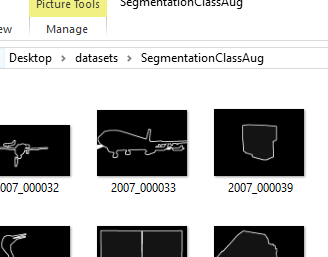
The masks in:
from keras.applications import imagenet_utils

def create_unet(image_size, n_classes):
    s = Input(image_size+(3,))
    c1 = Conv2D(8, 3, activation='relu', padding='same') (s)
    c1 = BatchNormalization()(c1)
    c1 = Conv2D(8, 3, activation='relu', padding='same') (c1)
    p1 = MaxPooling2D() (c1)
    c2 = Conv2D(16, 3, activation='relu', padding='same') (p1)
    c2 = BatchNormalization()(c2)
    c2 = Conv2D(16, 3, activation='relu', padding='same') (c2)
    p2 = MaxPooling2D() (c2)
    c3 = Conv2D(32, 3, activation='relu', padding='same') (p2)
    c3 = Conv2D(32, 3, activation='relu', padding='same') (c3)
    p3 = MaxPooling2D() (c3)
    c4 = Conv2D(64, 3, activation='relu', padding='same') (p3)
    c4 = Conv2D(64, 3, activation='relu', padding='same') (c4)
    p4 = MaxPooling2D() (c4)
    c5 = Conv2D(128, 3, activation='relu', padding='same') (p4)
    c5 = Conv2D(128, 3, activation='relu', padding='same') (c5)
    u6 = Conv2DTranspose(64, 2, strides=(2, 2), padding='same') (c5)
    u6 = Concatenate(axis=3)([u6, c4])
    c6 = Conv2D(64, 3, activation='relu', padding='same') (u6)
    c6 = Conv2D(64, 3, activation='relu', padding='same') (c6)
    u7 = Conv2DTranspose(32, 2, strides=(2, 2), padding='same') (c6)
    u7 = Concatenate(axis=3)([u7, c3])
    c7 = Conv2D(32, 3, activation='relu', padding='same') (u7)
    c7 = Conv2D(32, 3, activation='relu', padding='same') (c7)
    u8 = Conv2DTranspose(16, 2, strides=(2, 2), padding='same') (c7)
    u8 = Concatenate(axis=3)([u8, c2])
    c8 = Conv2D(16, 3, activation='relu', padding='same') (u8)
    c8 = Conv2D(16, 3, activation='relu', padding='same') (c8)
    u9 = Conv2DTranspose(8, 2, strides=(2, 2), padding='same') (c8)
    u9 = Concatenate(axis=3)([u9, c1])
    c9 = Conv2D(8, 3, activation='relu', padding='same') (u9)
    c9 = BatchNormalization()(c9)
    c9 = Conv2D(8, 3, activation='relu', padding='same') (c9)
    c9 = BatchNormalization()(c9)
    outputs = Conv2D(n_classes, 1) (c9)
    outputs = Reshape((image_size[0]*image_size[1], n_classes)) (outputs)
    outputs = Activation('softmax') (outputs)

    model = Model(inputs=[s], outputs=[outputs])
    return model

def preprocess_input(x):
    return imagenet_utils.preprocess_input(x, mode='tf')

def preprocess_mask(x):
    x = x.astype('int32')
    th = round(x.shape[0]*x.shape[1]*0.005) # object at size less then 1% of the whole image
    x[(x>20) & (x<255)] = 255
    ctr = Counter(x.flatten())
    for k in ctr.keys():
        if ctr[k]<th:
            x[x==k] = 255
    return x

def segmentation_generator(image_gen, mask_gen):
    while True:
            X = image_gen.next()
            y = mask_gen.next()
            y = np.reshape(y, (-1, np.prod(mask_gen.image_shape), 1))
            y = y.astype('int32')
            sample_weights = np.ones(y.shape)
            sample_weights[y==0] = .1
            sample_weights[y==255] = 0
            y[y==255]=21
            yield X, y, sample_weights[...,0]

data_trn_gen_args_mask = dict(preprocessing_function = preprocess_mask,
                              horizontal_flip=True,
                              rotation_range=45,
                              width_shift_range=0.01,
                              height_shift_range=0.01,
                              zoom_range=0.2,
                              validation_split = .2,
                              )

data_trn_gen_args_image = dict(preprocessing_function = preprocess_input,
                               horizontal_flip=True,
                               rotation_range=45,
                               width_shift_range=0.01,
                               height_shift_range=0.01,
                               zoom_range=0.2,
                               validation_split = .2,
                               channel_shift_range = .2
                               )

model = create_unet(image_size = (256,256), n_classes = 22)
model.compile(optimizer = Adam(), sample_weight_mode = "temporal",
              loss = 'sparse_categorical_crossentropy',
              metrics = ['acc'])

mask_datagen = ImageDataGenerator(**data_trn_gen_args_mask)
image_datagen = ImageDataGenerator(**data_trn_gen_args_image)

image_generator = image_datagen.flow_from_directory(PATH+'JPEGImages',
                                                    classes = ['train'],
                                                    class_mode=None,
                                                    batch_size=8, shuffle=True,
                                                    seed=29)

mask_generator = mask_datagen.flow_from_directory(PATH+'JPEGImages',
                                                  color_mode = 'grayscale',
                                                  classes = ['SegmentationClassAug'],
                                                  class_mode=None,
                                                  batch_size=8,
                                                  shuffle=shuffle,
                                                  seed=29)

train_generator = segmentation_generator(image_generator, mask_generator)

h = model.fit_generator(train_generator, class_weight = None,
                        steps_per_epoch=1000,
                        epochs = 10, verbose=1,
                        max_queue_size=10,
                        workers=8, use_multiprocessing=True)
Have the same issue, working with keras 2.2.2, not with 2.2.3 or 2.2.4.
Simple example:
import numpy as np
from keras.models import Model
from keras.layers import Input, Conv1D, Reshape, Activation

inp = Input((None, 12))
conv = Conv1D(48, kernel_size=1, activation='linear')(inp)
out = Reshape((-1, 3, 16))(conv)
act = Activation('softmax')(out)
model = Model(inputs=inp, outputs=act)
model.compile('adam', 'sparse_categorical_crossentropy', metrics=['acc'])
model.summary()

inp_data = np.random.rand(32, 10, 12)
out_data = np.random.randint(0, 16, size=(32, 10, 3, 1))
model.fit(inp_data, out_data)
Traceback:
Traceback (most recent call last):
  File "<stdin>", line 1, in <module>
  File "/home/tom/.ve/lib/python3.7/site-packages/keras/engine/training.py", line 1039, in fit
    validation_steps=validation_steps)
  File "/home/tom/.ve/lib/python3.7/site-packages/keras/engine/training_arrays.py", line 199, in fit_loop
    outs = f(ins_batch)
  File "/home/tom/.ve/lib/python3.7/site-packages/keras/backend/tensorflow_backend.py", line 2715, in __call__
    return self._call(inputs)
  File "/home/tom/.ve/lib/python3.7/site-packages/keras/backend/tensorflow_backend.py", line 2675, in _call
    fetched = self._callable_fn(*array_vals)
  File "/usr/lib/python3.7/site-packages/tensorflow/python/client/session.py", line 1399, in __call__
    run_metadata_ptr)
  File "/usr/lib/python3.7/site-packages/tensorflow/python/framework/errors_impl.py", line 526, in __exit__
    c_api.TF_GetCode(self.status.status))
tensorflow.python.framework.errors_impl.InvalidArgumentError: Incompatible shapes: [960] vs. [32,10,3]
     [[{{node metrics/acc/Equal}} = Equal[T=DT_FLOAT, _device="/job:localhost/replica:0/task:0/device:GPU:0"](metrics/acc/Reshape, metrics/acc/Cast)]]
     [[{{node loss/mul/_53}} = _Recv[client_terminated=false, recv_device="/job:localhost/replica:0/task:0/device:CPU:0", send_device="/job:localhost/replica:0/task:0/device:GPU:0", send_device_incarnation=1, tensor_name="edge_409_loss/mul", tensor_type=DT_FLOAT, _device="/job:localhost/replica:0/task:0/device:CPU:0"]()]]
Seems to be caused by the accuracy metric, without the accuracy metric it works fine in the latest versions as well.
 tomgankema
on 16 Oct 2018
tomgankema
on 16 Oct 2018
sparse_categorical_accuracy seems to cause the same issue
 mogeid
on 2 Nov 2018
mogeid
on 2 Nov 2018
train work in keras2.2.4 meet the same problem
 zhangjiantong
on 6 Nov 2018
zhangjiantong
on 6 Nov 2018
I tested this function:
def test_mse_bug():
    inp = Input((None, 12))
    conv = Conv1D(48, kernel_size=1, activation='linear')(inp)
    out = Reshape((-1, 3, 16))(conv)
    act = Activation('softmax')(out)
    model = Model(inputs=inp, outputs=act)
    model.compile('adam', 'sparse_categorical_crossentropy', metrics=['acc'])
    model.summary()

    inp_data = np.random.rand(32, 10, 12)
    out_data = np.random.randint(0, 16, size=(32, 10, 3, 1))
    model.fit(inp_data, out_data)
and this was fine with the latest version of master with TF 1.9. So I think that this bug has been solved in the master branch since 2.2.4. Closing this issue. Feel free to post a script to reproduce if you think that I did a mistake.
gabrieldemarmiesse
on 6 Nov 2018
The issue happens with tf 1.11
mogeid
on 7 Nov 2018
My bad. Keras is currently tested against tf 1.9. I'll make a PR to update the tests for 1.11/1.12. Hopefully we'll be able to track better this bug. Thanks for the feedback. As a quick fix, I recommend using tf.keras. Same API but it might not have this bug.
gabrieldemarmiesse
on 7 Nov 2018
It added a test for this bug in #11602 with TF 1.12 and python 3.6. There doesn't seem to have a bug. Could you upgrade TF and report back?
gabrieldemarmiesse
on 8 Nov 2018
I haven't tested with 3.6 but with 3.5 and tf 1.12, the bug's still there.
mogeid
on 9 Nov 2018
Under python 3.5, I tested with tf 1.7 through 1.12, and the bug is there. So it seems the problem is with keras 2.2.3, 2.2.4 and python 3.5
mogeid
on 9 Nov 2018
It's very strange. In any case, if we can't reproduce the bug, it's going to be really hard to fix it. I'll give a shot at python 3.5, but I don't think that the python version matters in this bug.
gabrieldemarmiesse
on 9 Nov 2018
Having the same issue. Broke after update to 2.2.4 with pip.
It's caused by K.flatten in
def sparse_categorical_accuracy(y_true, y_pred):
    # flatten y_true in case it's in shape (num_samples, 1) instead of (num_samples,)
    return K.cast(K.equal(K.flatten(y_true),
                          K.cast(K.argmax(y_pred, axis=-1), K.floatx())),
                  K.floatx())
Master uses K.squeeze which is correct for n-dimensional shapes
Though the same bug remains in sparse_top_k_categorical_accuracy
 KonstZ
on 19 Nov 2018
KonstZ
on 19 Nov 2018
The issue happens with tf1.9 and keras2.2.4
 mrluin
on 19 Dec 2018
mrluin
on 19 Dec 2018
Have the same problem ubuntu 18.04. Two anaconda envs: one with python 3.5, tensorflow 1.9 and keras 2.2.2, cuda 9.0 works fine, while python 3.6, tensorflow 2.2.4, cuda 9.2 does not work. Simply switching between the environments makes the script (not) work. I can provide the script is so desired.
 RnoldR
on 10 Jan 2019
RnoldR
on 10 Jan 2019
As @golbstein remarked, batch_size=1 makes it work.
RnoldR
on 10 Jan 2019
I coincidentally noticed not always the error is generated. This depends on the model to be trained. Below is a script in which two models are defined. The one (simple_model) trains, the other (char_model) gives the invalid argument error. You can choose the model in line 16: when model_type='rnn' the model runs ok, when model_type='char' it does not. Data used is the Kaggle dataset: ner_dataset.csv.
#!/usr/bin/env python3
# -*- coding: utf-8 -*-
import random
import pandas as pd
import numpy as np
from sklearn.metrics import classification_report

from keras.preprocessing.sequence import pad_sequences
from keras.utils import to_categorical
from sklearn.model_selection import train_test_split
from keras.models import Model, Input
from keras.layers import CuDNNGRU, Embedding, Dense, TimeDistributed, Dropout
from keras.layers import Bidirectional, concatenate, SpatialDropout1D, GlobalMaxPooling1D

# model_type can be 'rnn' or 'char'
model_type = 'char'
max_len_char = 10
test_fraction = 0.25

class SentenceGetter(object):
    """
    get Sentences from the Kaggle dataset: ner_dataset.csv
    """
    def __init__(self, data):
        self.n_sent = 1
        self.data = data
        self.empty = False
        agg_func = lambda s: [(w, p, t) for w, p, t in zip(s["Word"].values.tolist(),
                                                           s["POS"].values.tolist(),
                                                           s["Tag"].values.tolist())]
        self.grouped = self.data.groupby("Sentence #").apply(agg_func)
        self.sentences = [s for s in self.grouped]

    def get_next(self):
        try:
            s = self.grouped["Sentence: {}".format(self.n_sent)]
            self.n_sent += 1
            return s
        except:
            return None

def unique_tokens(tokens, elements, idx):
    words = [word[idx] for tweet in tokens for word in tweet]
    for word in words:
        if not word in elements:
            elements.append(word)

    return elements

def create_input(token2idx, sentences, idx, padding, unknown):
    X = [[token2idx[w[idx]] if w[idx] in token2idx else unknown for w in s]
                for s in sentences]
    X = pad_sequences(maxlen=max_len, sequences=X, padding="post", value=padding)

    return X

def create_char_seqs(sentences, char2idx, max_len, max_len_char):
    """ Creates a sequence of characters for each word

    Args:

    Returns:
    """
    X_char = []
    for sentence in sentences:
        sent_seq = []
        for i in range(max_len):
            word_seq = []
            for j in range(max_len_char):
                try:
                    word_seq.append(char2idx.get(sentence[i][0][j]))
                except:
                    word_seq.append(char2idx.get("<PAD>"))
            # for
            sent_seq.append(word_seq)

        # for
        X_char.append(np.array(sent_seq))
    # for

    return np.array(X_char)

def simple_model(n_words, max_len):
    """ Builds a model with an embedded layer and an RNN layer

    Args:
        n_words (int): number of unique words
        max_len (int): maximum length of sentences

    Returns:
        Compiled model
    """
    input = Input(shape=(max_len,))
    model = Embedding(input_dim=n_words, output_dim=50, input_length=max_len)(input)
    model = Dropout(0.1)(model)
    model = Bidirectional(CuDNNGRU(units=200, return_sequences=True))(model)
    #model = Bidirectional(CuDNNGRU(units=100, return_sequences=True))(model)
    out = TimeDistributed(Dense(n_tags, activation="softmax"))(model)  # softmax output layer
    model = Model(input, out)
    model.compile(optimizer="adam", loss="categorical_crossentropy",
                  metrics=["accuracy"])
    model.summary()

    return model, "acc", "val_acc"

def char_model(n_words, max_len, n_chars, max_len_char):
    """ Builds a model for sequencing words and characters

    Args:
        n_words (int): number of unique words
        max_len (int): maximum length of sentences
        n_chars (int): number of characters
        max_len_char (int): maximum number of characters in a characterized word

    Returns:
        Compiled model
    """
    # Input and embedding for words
    word_in = Input(shape=(max_len,), name='word_input')
    emb_word = Embedding(input_dim=n_words, output_dim=50, input_length=max_len,
                      name='word_embedding')(word_in)

    # Input and embedding for chars
    char_in = Input(shape=(max_len, max_len_char,), name='char_input')
    emb_char = TimeDistributed(Embedding(input_dim=n_chars + 2, output_dim=10,
                               input_length=max_len_char),#, mask_zero=True),
                               name='char_embedding')(char_in)

    # Character RNN
    char_enc = TimeDistributed(CuDNNGRU(units=20, return_sequences=False,
                                        name='char_GRU'))(emb_char)

    # Concatenate char and word sub systems
    x = concatenate([emb_word, char_enc])
    model = SpatialDropout1D(0.3)(x)

    model = Bidirectional(CuDNNGRU(units=100, return_sequences=True))(model)
    out = TimeDistributed(Dense(n_tags, activation="softmax"))(model)  # softmax output layer
    model = Model([word_in, char_in], out)
    model.compile(optimizer="adam", loss="sparse_categorical_crossentropy",
                  metrics=["accuracy"])
    model.summary()

    return model, "acc", "val_acc"

seed = 42
np.random.seed(seed)
random.seed(seed)

#test_model(model, word2idx, idx2tag, test_sentences)
#sys.exit()

# Read all data sets
data = pd.read_csv("data/ner_dataset.csv", encoding="latin1")
data = data.fillna(method="ffill")
getter = SentenceGetter(data)
sentences = getter.sentences

sentences = sentences[:5000]

print('Total sentences:', len(sentences))

# Compute max length of all sentences
max_len = 0
for sentence in sentences:
    if len(sentence) > max_len:
        max_len = len(sentence)

print('max_len:', max_len)
if max_len > 50:
    max_len = 50
    print('max_len set to', max_len)

# Create dictionary and inverse dictionary of words and tags
words = unique_tokens(sentences, ['<PAD>', '<UNK>'], 0)
n_words = len(words)
word2idx = {w: i for i, w in enumerate(words)}
idx2word = {v: k for k, v in word2idx.items()}
print('Words', n_words)

tags = unique_tokens(sentences, ['O'], 2)
n_tags = len(tags)
tag2idx = {t: i for i, t in enumerate(tags)}
idx2tag = {v: k for k, v in tag2idx.items()}
print(n_tags, 'tags:', tag2idx)

# Convert words and tags numpy arrays
X_word = create_input(word2idx, sentences, 0, word2idx['<PAD>'], word2idx['<UNK>'])
y_word = create_input(tag2idx, sentences, 2, tag2idx["O"], tag2idx["O"])

# Create train and validation set
X_word_train, X_word_val, y_word_train, y_word_val = train_test_split(X_word,
                        y_word, test_size=test_fraction, random_state=seed)

# Create and fit model
epochs = 1
print('Type of model is:', model_type)
if model_type == 'rnn':
    model, acc_name, val_acc_name = simple_model(n_words, max_len)
    y_word_train = np.array([to_categorical(i, num_classes=n_tags) for i in y_word_train])
    y_word_val = np.array([to_categorical(i, num_classes=n_tags) for i in y_word_val])

    pred_list = [X_word_val]
    history = model.fit(X_word_train, y_word_train, batch_size=32, epochs=epochs,
                        validation_data=(pred_list, y_word_val), verbose=1)
    y_true = np.argmax(y_word_val, axis=2)

elif model_type == 'char':
    # Additionally compute character recognition sub system
    chars = set([w_i for w in words for w_i in w])
    n_chars = len(chars)

    char2idx = {c: i + 2 for i, c in enumerate(chars)}
    char2idx["<UNK>"] = 1
    char2idx["<PAD>"] = 0
    idx2char = {v: k for k, v in char2idx.items()}
    print(n_chars, 'chars:', char2idx)

    # Compute the character training and validation sets
    X_char = create_char_seqs(sentences, char2idx, max_len, max_len_char)

    # Create train and validation set
    X_char_train, X_char_val = train_test_split(X_char, test_size=test_fraction,
                                                random_state=seed)

    model, acc_name, val_acc_name = char_model(n_words, max_len, n_chars, max_len_char)
    X_char_train = np.array(X_char_train).reshape((len(X_char_train), max_len, max_len_char))
    X_char_val = np.array(X_char_val).reshape((len(X_char_val), max_len, max_len_char))
    y_word_train = np.array(y_word_train).reshape(len(y_word_train), max_len, 1)
    y_word_val = np.array(y_word_val).reshape(len(y_word_val), max_len, 1)
    #X_word_train = X_word_train.reshape(X_word_train.shape[0], X_word_train.shape[1], 1)
    #X_word_val = X_word_val.reshape(X_word_val.shape[0], X_word_val.shape[1], 1)
    pred_list = [X_word_val, X_char_val]
    history = model.fit([X_word_train, X_char_train], y_word_train,
                         validation_data=(pred_list, y_word_val),
                         batch_size=64, epochs=epochs,
                         verbose=1)
    y_true = y_word_val.reshape(y_word_val.shape[0:2])

else:
    raise ValueError('Unknown model type: ' + model_type)
I updated to tensorflow-gpu 1.12.0 and now all works ok
 jamartinh
on 18 Jan 2019
jamartinh
on 18 Jan 2019
I have a similar issue using tf.keras. My keras version is 2.2.4, my tensorflow version is 1.12.0, and I use Python 3.6.
I train a simple RNN with one embedding layer, one GRU layer with return_sequences=True, one Dense layer (using TimeDistributed or not with the Dense layer doesn't change the problem, I get the same error). My metric is sparse_categorical_entropy.
The length of my sequences is 4, and there are 60 categories, so the shape of my input is (batch_size, 4, 60). The shape of my output is also (batch_size, 4, 60) since return_sequences=True.
The error I get is
InvalidArgumentError: Incompatible shapes: [batch_size] vs. [batch_size,4] [Op:Equal]
Note that, like in the posts above, the error does not occur when batch_size=1 or when I don't use any metric. In both cases the neural network trains without error.
Note also that if I set return_sequences=False, that is, I only try to predict one category instead of a sequence and my output is of shape (batch_size,60), then the network trains also without error.
EDIT : I managed to make my training work by replacing
    model.compile(
      optimizer = tf.train.AdamOptimizer(),
      loss = 'sparse_categorical_crossentropy',
      metrics=['sparse_categorical_accuracy'])
by
    model.compile(
      optimizer = tf.train.AdamOptimizer(),
      loss = 'sparse_categorical_crossentropy',
      metrics=[new_sparse_categorical_accuracy])
where I defined new_sparse_categorical_accuracy by copying the code taken from https://github.com/tensorflow/tensorflow/blob/master/tensorflow/python/keras/metrics.py, that is:
    from tensorflow.python.ops import math_ops
    from tensorflow.python.framework import ops
    from tensorflow.python.keras import backend as K
    from tensorflow.python.ops import array_ops
    def new_sparse_categorical_accuracy(y_true, y_pred):
        y_pred_rank = ops.convert_to_tensor(y_pred).get_shape().ndims
        y_true_rank = ops.convert_to_tensor(y_true).get_shape().ndims
        # If the shape of y_true is (num_samples, 1), squeeze to (num_samples,)
        if (y_true_rank is not None) and (y_pred_rank is not None) and (len(K.int_shape(y_true)) == len(K.int_shape(y_pred))):
            y_true = array_ops.squeeze(y_true, [-1])
        y_pred = math_ops.argmax(y_pred, axis=-1)
        # If the predicted output and actual output types don't match, force cast them
        # to match.
        if K.dtype(y_pred) != K.dtype(y_true):
            y_pred = math_ops.cast(y_pred, K.dtype(y_true))
        return math_ops.cast(math_ops.equal(y_true, y_pred), K.floatx())
 durandg12
on 15 Feb 2019
durandg12
on 15 Feb 2019
durandg12
I have a similar issue using tf.keras. My keras version is 2.2.4, my tensorflow version is 1.12.0, and I use Python 3.6.
I train a simple RNN with one embedding layer, one GRU layer withreturn_sequences=True, one Dense layer (using TimeDistributed or not with the Dense layer doesn't change the problem, I get the same error). My metric is sparse_categorical_entropy.The length of my sequences is 4, and there are 60 categories, so the shape of my input is
(batch_size, 4, 60). The shape of my output is also(batch_size, 4, 60)sincereturn_sequences=True.
The error I get is InvalidArgumentError: Incompatible shapes: [batch_size] vs. [batch_size,4] [Op:Equal]Note that, like in the posts above, the error does not occur when batch_size=1 or when I don't use any metric. In both cases the neural network trains without error.
Note also that if I set
return_sequences=False, that is, I only try to predict one category instead of a sequence and my output is of shape(batch_size,60), then the network trains also without error.EDIT : I managed to make my training work by replacing
    model.compile(
      optimizer = tf.train.AdamOptimizer(),
      loss = 'sparse_categorical_crossentropy',
      metrics=['sparse_categorical_accuracy'])
by
    model.compile(
      optimizer = tf.train.AdamOptimizer(),
      loss = 'sparse_categorical_crossentropy',
      metrics=[new_sparse_categorical_accuracy])
where I defined
new_sparse_categorical_accuracyby copying the code taken from https://github.com/tensorflow/tensorflow/blob/master/tensorflow/python/keras/metrics.py, that is:from tensorflow.python.ops import math_ops from tensorflow.python.framework import ops from tensorflow.python.keras import backend as K from tensorflow.python.ops import array_ops def new_sparse_categorical_accuracy(y_true, y_pred): y_pred_rank = ops.convert_to_tensor(y_pred).get_shape().ndims y_true_rank = ops.convert_to_tensor(y_true).get_shape().ndims # If the shape of y_true is (num_samples, 1), squeeze to (num_samples,) if (y_true_rank is not None) and (y_pred_rank is not None) and (len(K.int_shape(y_true)) == len(K.int_shape(y_pred))): y_true = array_ops.squeeze(y_true, [-1]) y_pred = math_ops.argmax(y_pred, axis=-1) # If the predicted output and actual output types don't match, force cast them # to match. if K.dtype(y_pred) != K.dtype(y_true): y_pred = math_ops.cast(y_pred, K.dtype(y_true)) return math_ops.cast(math_ops.equal(y_true, y_pred), K.floatx())
bro that was great .....thanks for sharing
you r pure dope
 martian07
on 1 Mar 2019
martian07
on 1 Mar 2019
Related issues
 harishkrishnav
·
3Comments
harishkrishnav
·
3Comments
 MarkVdBergh
·
3Comments
MarkVdBergh
·
3Comments
 anjishnu
·
3Comments
anjishnu
·
3Comments
 vinayakumarr
·
3Comments
vinayakumarr
·
3Comments
 Imorton-zd
·
3Comments
Imorton-zd
·
3Comments
Most helpful comment
The issue happens with tf1.9 and keras2.2.4