short tl;dr; of the release
🗺 What's left for release
- [x] [Release a new js-ipfs-api](https://github.com/ipfs/js-ipfs-api/pull/751)
- [x] [Fix config reuse](https://github.com/ipfs/js-ipfs/issues/1316)
- [x] [Release Subcomandante to fix tests for Node.js 10](https://github.com/jbenet/node-subcomandante/issues/8)
- [x] https://github.com/ipfs/js-ipfs/pull/1319
- [x] [IPFS Repo Configuration Example](https://github.com/ipfs/js-ipfs/pull/1303)
- [ ] https://github.com/ipfs/js-ipfs/pull/1297
- [x] [Seek through files](https://github.com/ipfs/js-ipfs/pull/1231)
- [x] [Updated PubSub API](https://github.com/ipfs/interface-ipfs-core/pull/260)
- [x] [Ping](https://github.com/ipfs/js-ipfs/pull/1342)
- [x] [Faster tests](https://github.com/ipfs/js-ipfs/pull/1350)
- [ ]
Complete Pin API(next release) - [ ]
Connection Manager(next release) - [ ]
Better error handling for the CLI(next release)
🔦 Highlights
🏎 Bitswap is 30% faster
Bitswap is now 30% thanks to fixing a bug on js-ipfs-bitswap that was causing every message to be sent individually.
👓 js-ipfs now works with uglify-es just fine
The duck typing throughout js-ipfs has been improved and that means that now you can use uglify-es again to minify your js-ipfs code. The result is that the js-ipfs bundled version is now back to its minified size as well.
☎️ Circuit Relay was merged in
Circuit Relay enables connectivity between any two nodes through a third relay node. This ensures connectivity in almost every scenario, that is, as long as peers can connect to some public IP node. Learn how to use it here. This was one of the two features that js-ipfs was missing to get full connectivity.
🗑 S3 backend for IPFS
Ever wished you could use an external storage backend to store all your IPFS blocks? Now you do and we got a tutorial for you! See how to configure a repo at https://github.com/ipfs/js-ipfs/tree/master/examples/custom-ipfs-repo and if you want to learn how to use S3 as your external backend, then consult https://github.com/ipfs/js-datastore-s3/tree/master/examples/full-s3-repo.
📜 README Overhaul
The js-ipfs README keeps improving, now with 40% more information about the multiple arguments you can pass to IPFS. Read all the options at https://github.com/ipfs/js-ipfs#api
🎷 Project Tracking
If you haven't already, I welcome you to check how the js-ipfs team tracks their work at https://github.com/ipfs/js-ipfs/blob/master/MGMT.md. It is fun to see the issues fly through the waffle board.
✅ Config validation and config reuse fix
In addition to better documentation on how to configure your node, you now get some config validation in case you mistype something. Also as a bonus, you can now spin multiple nodes in the same process without them getting confused and using the same config.
📖 interface-ipfs-core keeps getting more API calls documented and tested
Make yourself familiar with the IPFS Core API at https://github.com/ipfs/interface-ipfs-core/tree/master/SPEC. New additions include files.add --wrapWithDirectory, --onlyHash and others.
📊 Bandwidth stats now available
Bandwidth statistics for your IPFS node from the libp2p layer are now exposed and available to query for the whole node, per peer or per protocol. You can also use Node streams or pull streams to get a continuous feed of that tasty statistical juice.
📡 Fully Async PubSub API
Writing in Progress
🛎 Ping API implemented
JS IPFS now has API calls for pinging other peers. Fun fact, this was actually the first thing a js-ipfs node did, but it got lost in a massive refactor and now it is back and not only in js-ipfs core, it is also available through the CLI and HTTP API
⚛️ Electron Main Process support with Electron 2.0
Writing in Progress
ref: https://github.com/ipfs/js-ipfs/pull/1351
🏗 API Changes
- Argument order for
pubsub.subscribehas changed:
- Old:
pubsub.subscribe(topic, [options], handler, [callback]): Promise - New:
pubsub.subscribe(topic, handler, [options], [callback]): Promise
- Old:
- The
pubsub.unsubscribemethod has become async meaning that it now takes a callback or returns a promise:
- Old:
pubsub.unsubscribe(topic, handler): undefined - New:
pubsub.unsubscribe(topic, handler, [callback]): Promise
- Old:
- Property names on response objects for
pingare now lowered:
- Old:
{ Success, Time, Text } - New:
{ success, time, text }
- Old:
- In the CLI,
jsipfs object datano longer returns a newline after the end of the returned data
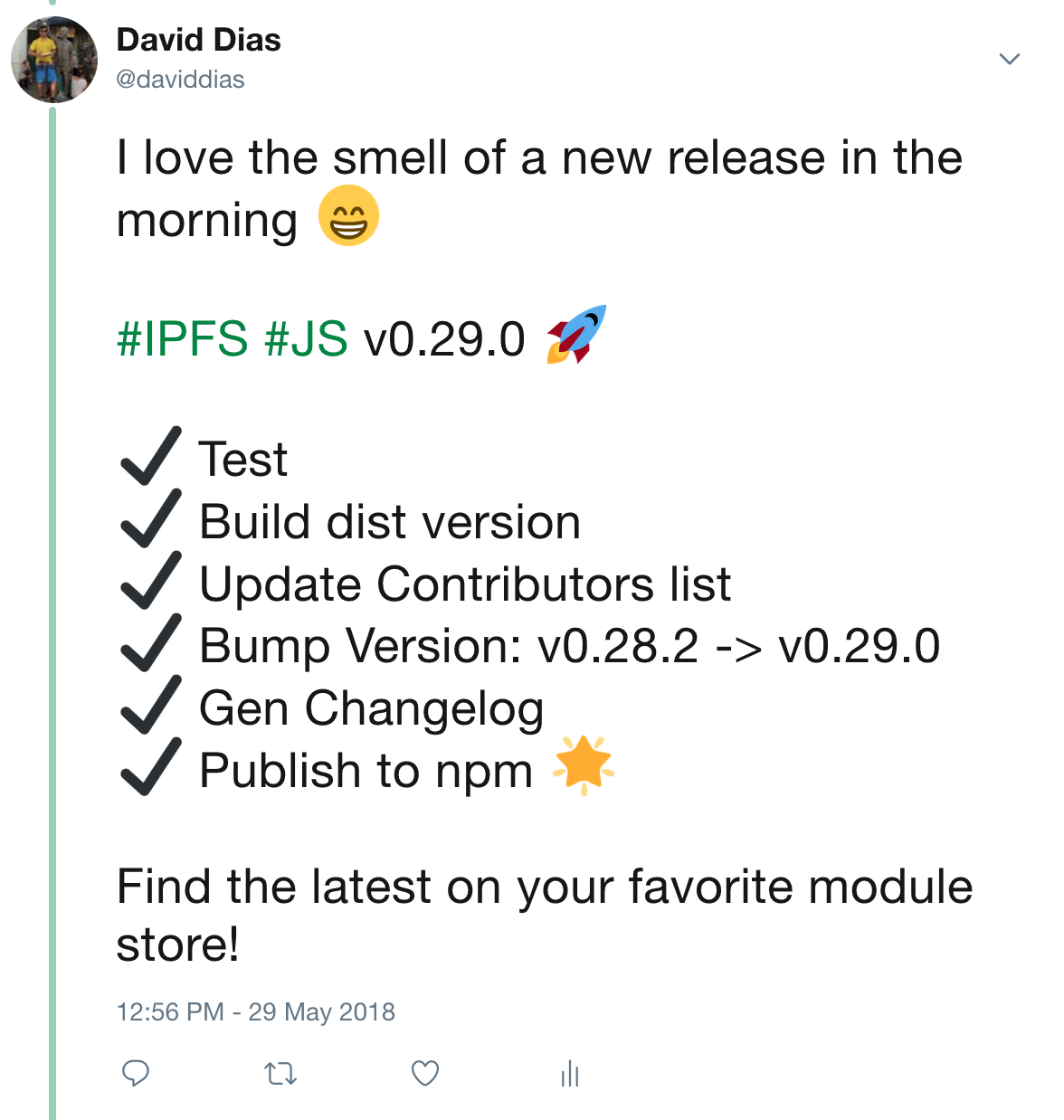
✅ Release Checklist
- Robustness and quality
- [x] Ensure that all tests are passing, this includes:
- [x] unit
- [x] interop
- [x] sharness
- [x] Run tests of the following projects with the new release:
- [x] [ipfs-pubsub-room](https://github.com/ipfs-shipyard/ipfs-pubsub-room/issues/43)
- [x] [peerpad-core](https://github.com/ipfs-shipyard/peer-pad-core/issues/17)
- [x] [ipfs-log](https://github.com/orbitdb/ipfs-log/issues/124)
- [x] [orbit-db](https://github.com/orbitdb/orbit-db/issues/369)
- Documentation
- [x] Ensure that README.md is up to date
- [x] Ensure that all the examples run
- Communication
- [x] Create the release issue
- [x] Announcements (both pre-release and post-release)
- [x] [Twitter](https://twitter.com/daviddias/status/1000996706211725312)
- [x] IRC
- [x] [Reddit](https://www.reddit.com/r/ipfs/comments/8mo6q3/v0290_release_is_coming_this_week/)
- [x] [Blog post](https://github.com/ipfs/blog/pull/163)
🙌🏽 Want to contribute?
Would you like to contribute to the IPFS project and don't know how? Well, there are a few places you can get started:
- Check the issues with the
help wantedlabel at the Ready column in our waffle board - https://waffle.io/ipfs/js-ipfs?label=help%20wanted - Join an IPFS All Hands, introduce yourself and let us know where you would like to contribute - https://github.com/ipfs/pm/#all-hands-call
- Hack with IPFS and show us what you made! The All Hands call is also the perfect venue for demos, join in and show us what you built
- Join the discussion at http://discuss.ipfs.io/ and help users finding their answers.
- Join the ⒿⓈ⚡️ js-ipfs Dev Team Weekly Sync 🙌🏽 and be part of the Sprint action!
⁉️ Do you have questions?
The best place to ask your questions about IPFS, how it works and what you can do with it is at discuss.ipfs.io. We are also available at the #ipfs channel on Freenode.
 daviddias
All 3 comments
@diasdavid
Can we add the link to the circuit relay example to the its respective section?
Something like this:
Circuit Relay enables connectivity between any two nodes through a third relay node. This ensures connectivity in almost every scenario, that is, as long as peers can connect to some public IP node. Learn how to use it here. This was one of the two features that js-ipfs was missing to get full connectivity.
 dryajov
on 28 May 2018
dryajov
on 28 May 2018
@dryajov of course! Added in :)
daviddias
on 29 May 2018
 daviddias
on 29 May 2018
daviddias
on 29 May 2018
Related issues
 witten
·
4Comments
witten
·
4Comments
 mnts
·
3Comments
mnts
·
3Comments
 mitra42
·
3Comments
mitra42
·
3Comments
 ya7ya
·
3Comments
ya7ya
·
3Comments
 lidel
·
3Comments
lidel
·
3Comments
Most helpful comment
Release published!
https://twitter.com/daviddias/status/1001432008302694400