Incubator-mxnet: Example on Deconvolution Layer's Configuration
Dear mxnet community,
The current documentation on Deconvolution layer is somehow difficult to catch up.
In particular, I want to reproduce u-net (for image segmentation purpose) available at http://lmb.informatik.uni-freiburg.de/people/ronneber/u-net/
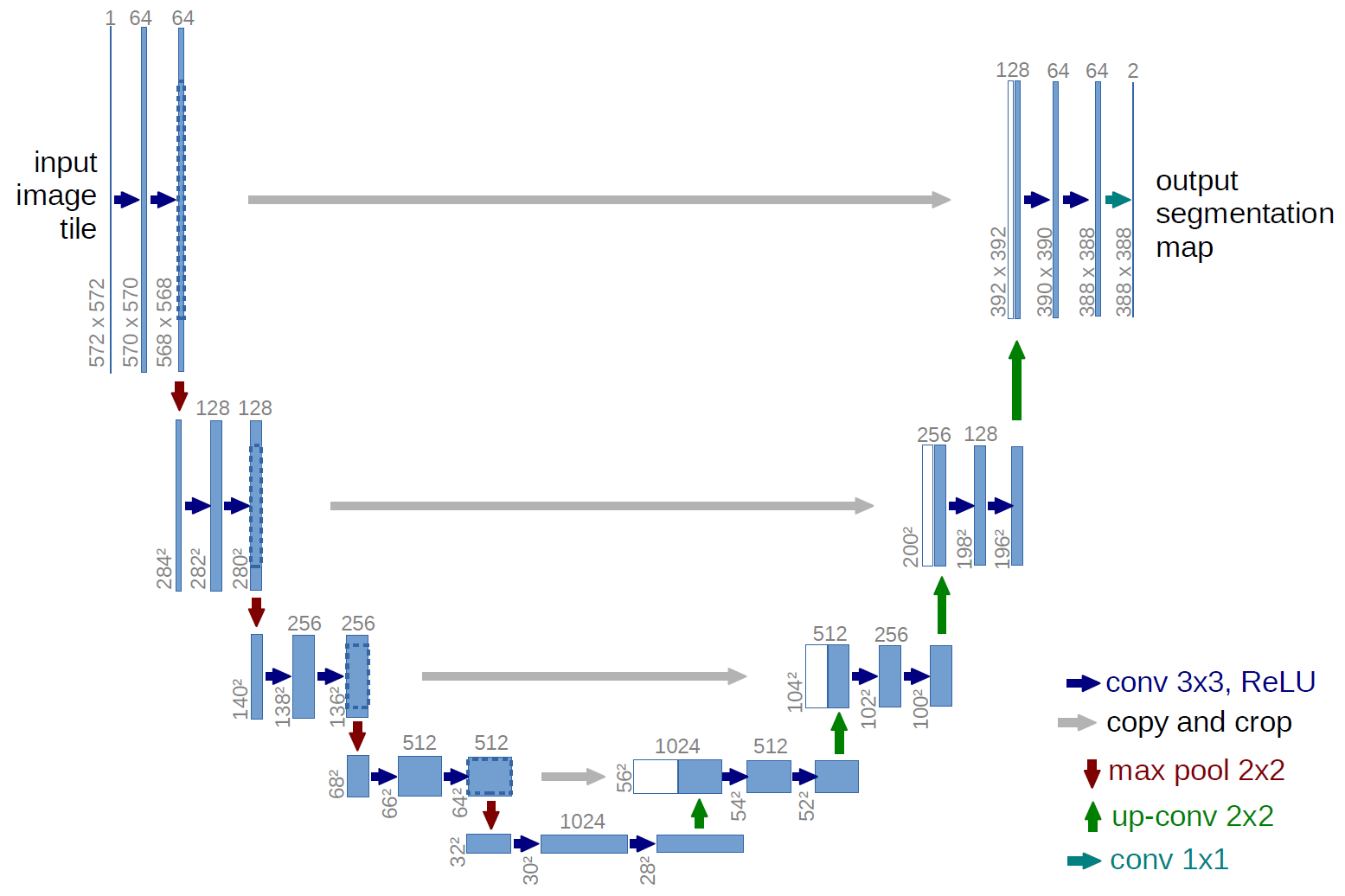
I stopped by the example https://github.com/dmlc/mxnet/blob/master/example/fcn-xs/symbol_fcnxs.py
and its utilization is still fuzzy, too.
Could you give me some direction (or example) how to use Deconvolution layer for such image segmentation task as follows:
I have a collection of n training volume images (t+xy) and their associative segmentation
(n, 64, 128, 128) ~> (n, 64, 128, 128)
where n is number of training instances, 64 is the temporal dimension, 128 is the spatial dimension.
How to construct a simple fully convolutional network using mxnet on this problem?
data ~> convolutional layer ~> pooling (downsample by 2) ~> deconvolutional layer ~> Upsampling by 2 ~> segmentation?
Thanks a lot
 tmquan
All 5 comments
deconvolution with 2x upsampling can be done like this:
scale = 2
pred1 = mx.symbol.Deconvolution(data=pred1, kernel=(2*scale, 2*scale), stride=(scale, scale), pad=(scale/2, scale/2), num_filter=33, no_bias=True, workspace=workspace, name=prefix+'deconv_pred1')
 piiswrong
on 22 Feb 2016
piiswrong
on 22 Feb 2016
Thanks @piiswrong ,
I have another question regarding to the prediction.
My prediction is a segmented image (256x256) which has 2 classes (membrane at value 0 and non-membrane at value 255). In this case, how to write a softmax layer? (as the network can output the right image)

I appreciate your helps a lot.
Sincerely,
tmquan
on 23 Feb 2016
I think you should define your label as 0 and 1, where 0 is membrane and 1 is not. It is not a good option to use 255 unless you want this label to be ignored. @tmquan
 ascust
on 15 Mar 2016
ascust
on 15 Mar 2016
@ascust
Thank you for response in this thread.
Actually, I tried that too as following:
I set the output from the network as (30,2,512,512) where (30,:0:,512,512) is the label of non-membrane and (30,:1:,512,512) for membrane classification.
Then I set the deconvolutional output as a LogisticRegressionOutput as following:
sm = mx.symbol.LogisticRegressionOutput(data=deconv_out, name="softmax")
In contrast, the example on fcn-xs folder said that I should use the SoftmaxOutput layer to make a prediction on entire segmentation.
It confused me and I am struggling with that issue quite a bit.
Best regards,
tmquan
on 15 Mar 2016
LogisticRegressionOutput is for binary classification, it is supposed to work. Since I never use this layer before, I can not say much about it. Anyway, SoftmaxOutput is for Multiclass classification and binary classification is only a special case, I am sure this will work. Just like your settings, if 30 is your batch size, there is a (2, 512, 512) score map for each image in the batch. For prediction task, you can simply choose use argmax along the first axis.
ascust
on 15 Mar 2016
Related issues
 luoruisichuan
·
3Comments
luoruisichuan
·
3Comments
 xzqjack
·
3Comments
xzqjack
·
3Comments
xzqjack
·
3Comments
xzqjack
·
3Comments
 JonBoyleCoding
·
3Comments
JonBoyleCoding
·
3Comments
 Ajoo
·
3Comments
Ajoo
·
3Comments
Most helpful comment
LogisticRegressionOutput is for binary classification, it is supposed to work. Since I never use this layer before, I can not say much about it. Anyway, SoftmaxOutput is for Multiclass classification and binary classification is only a special case, I am sure this will work. Just like your settings, if 30 is your batch size, there is a (2, 512, 512) score map for each image in the batch. For prediction task, you can simply choose use argmax along the first axis.