hledger-web on sandstorm is not satisfying [$30]
Negative feedback is accumulating at https://apps.sandstorm.io/app/8x12h6p0x0nrzk73hfq6zh2jxtgyzzcty7qsatkg7jfg2mzw5n90 , need better Sandstorm integration to fix this.
There is a $30 open bounty on this issue. Add to the bounty at Bountysource.
 simonmichael
All 72 comments
A thought I had: Is there any current Git integration? Can the web interface make a commit whenever a transaction is added or modified, or does it already?
One feature I've played with for some more recent Sandstorm apps I've developed is backing them with a Git repo. If the web interface could detect or be told that the ledger is in a repository, and if I can expose that repo via Git, then the ledger could be updated both via the web interface and by the repository. Not sure how to handle incoming pushes while the web interface is open, so the idea obviously needs some additional thought.
 ndarilek
on 15 Nov 2016
ndarilek
on 15 Nov 2016
No, we don't have that feature yet. It would be nice. filestore is a haskell library that can talk to git and other VCS's.
simonmichael
on 15 Nov 2016
FWIW, my hledger-web on sandstorm.io + git workflow is as follows:
create all transactions in the web interface (there's no way to import a ledger file, and no way to update it except by adding transactions with the web interface).
periodically use the Download Backup button in the middle of the top bar, and then run a shell script I created that moves the .zip file from my Downloads directory, extracts it, commits the ledger file, and finally pushes it to GitLab.
 AaronM04
on 31 Dec 2016
AaronM04
on 31 Dec 2016
there's no way to import a ledger file
Actually there is; just reverse the backup I think. It was described recently on the hledger mail list.
simonmichael
on 31 Dec 2016
@simonmichael Cool, I didn't know about that. 💯 What's the link to this thread?
AaronM04
on 31 Dec 2016
simonmichael
on 31 Dec 2016
The sandstorm reviews situation is getting pretty serious. I would almost prefer we were removed from Sandstorm until ready rather than keep accumulating bad first impressions and bad reviews. @ndarilek is there a way to mark an app as experimental/work in progress/not ready for review ?
simonmichael
on 3 Jan 2017
Also, is there any way to contact reviewers, to understand their issues better ? Eg "Could not find a way to enter a single transaction".
simonmichael
on 3 Jan 2017
I will work on some new text for the app description, to try and manage expectations.
PS, also version 1.1 is out, though it won't affect the sandstorm app much.
simonmichael
on 3 Jan 2017
I'm not aware of either a way to mark apps as experimental, or to
contact reviewers. Sorry. I can ask to have the app pulled if you like,
though I don't know enough Haskell to do any work on it. I was just
looking for a quick and secure way to run the web interface and thought
I'd make a package.
ndarilek
on 3 Jan 2017
It's appreciated @ndarilek. Let's see what we can do with the description, which I'll work on later. Possibly we should open new issues or start a checklist here or a new Project to track the sandstorm issues reported.
simonmichael
on 3 Jan 2017
Getting back to this. I've updated my app review to include a link to this issue and a call for help. @ndarilek, I think only you can update the app description, right ? Can you update to:
hledger (http://hledger.org) is a dependable, precise, cross-platform
program for tracking money, time, or any other commodity, using
double-entry accounting and a simple plain text file format.  It is a
haskell reimplementation of Ledger, provides command-line, curses and
web interfaces, and aims to be a robust, practical tool for daily use.

Sandstorm users, thanks for your feedback. hledger's web UI is a simple one
to fit current development resources, and I'm sorry that Sandstorm integration is lacking.
Your help is needed. We have an open issue for this where you can add a bounty or
contribute patches ( https://github.com/simonmichael/hledger/issues/425 ).
We also welcome bug reports with more detail ( http://bugs.hledger.org/new ),
general hledger-web improvements, backers and sponsors ( http://hledger.org ).
I expect this will need ongoing updates, so feel free to add me as a co-editor if that's possible.
simonmichael
on 11 Jul 2017
Testing help wanted: please try to find out why three reviewers have said "Could not find a way to enter a single transaction.". There's supposed to be a visible "Add a transaction" link, and the a key mentioned in the help accessible from the ? button, as at http://demo.hledger.org.
simonmichael
on 11 Jul 2017
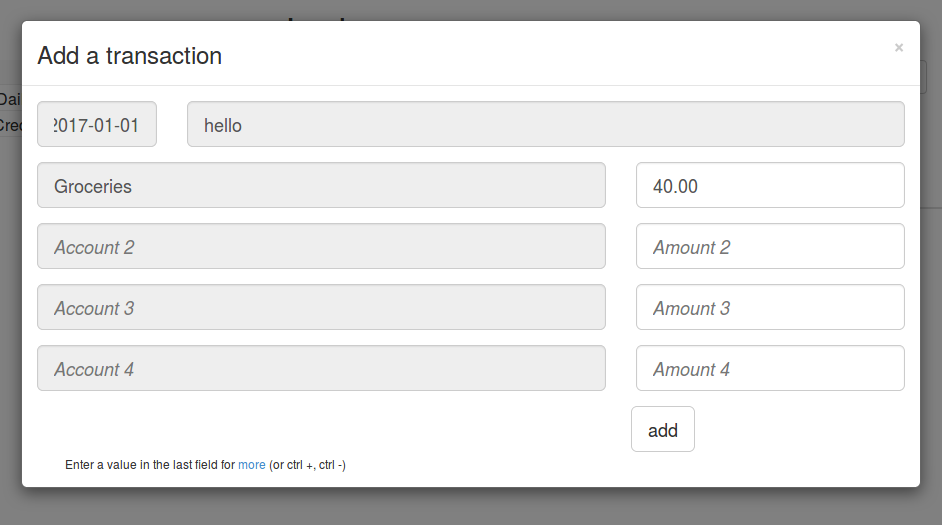
I think the reason they couldn't add a single transaction is because you have to understand double-entry accounting. Currently, if you enter a new transaction that doesn't balance, then it just clears out the input fields. It would be better if it left your input fields filled in and gave you an error message, saying that it doesn't balance, and perhaps with a link to a helpful explanation.

 agarrharr
on 28 Jan 2018
agarrharr
on 28 Jan 2018
Ah! Thanks, that makes sense.
simonmichael
on 28 Jan 2018
@simonmichael I found this issue poking around Sandstorm's reviews. I can definitely say I was confused with what this accounting did, and I think after some fiddling/experimenting I managed to make it do things, but yeah, the "double-entry accounting" bit is completely lost on me.
Generally I'd expect an error message if something wasn't right, not for it to dump the data that I entered, as @agarrharr said.
As a note, if someone is interested in working on the Sandstorm package in the future, I can help with that, I've got a strong desire to help move the app situation on Sandstorm forward as a whole.
I don't feel that the review situation is as tragic as it appears: A lot of Sandstorm packages are currently out of date, and that's a relatively well known problem amongst the Sandstorm community. (That being said, I'd love to someday see the way reviews are presented improved, such as displaying which version a given review was made from, and one could argue new reviews should be weighted more heavily than old reviews.)
 ocdtrekkie
on 25 May 2018
ocdtrekkie
on 25 May 2018
@ocdtrekkie any help would be welcome! Nobody is working on the sandstorm support currently.
simonmichael
on 25 May 2018
As the case is, I now have the publishing key for pushing updates to it. I am not much of a coder though, and have never touched Haskell in my life. Is the state of HLedger Web compared to where it was as of the previous Sandstorm package, that there'd be significant value in just getting a refreshed/current Sandstorm build out there? I am reasonably good at version bumping things. :)
ocdtrekkie
on 25 May 2018
That would be great, if you can assist or take over from @ndarilek. We are happy to help with haskell know-how in the #hledger IRC channel.
https://apps.sandstorm.io/app/8x12h6p0x0nrzk73hfq6zh2jxtgyzzcty7qsatkg7jfg2mzw5n90 looks like it's based on 1.1, which is about 1.5y behind the current 1.9.2. There has been no major hledger-web work for a while, but http://hackage.haskell.org/package/hledger-web/changelog shows some useful fixes. There may be other useful changes mentioned in http://hackage.haskell.org/package/hledger-lib/changelog .
simonmichael
on 25 May 2018
Tips:
- http://hledger.org/download.html#c
- stack install hledger-web
- stack test hledger-web
- stack install ghcid; make ghcid-web
simonmichael
on 25 May 2018
So, the current Sandstorm version repo Nolan used is very simple, and everything is contained in the /.sandstorm directory. How would you feel about bringing it "in-house"? Nolan isn't actively maintaining this, so bringing it here might not be a bad idea, otherwise I can fork his repo.
https://github.com/ndarilek/hledger-sandstorm
I have bad Git fu (the GitHub Desktop app is my secret shame), but I wonder if it's possible to pull his commits in, preserving his authorship, and "just" removing the submodules bit, and adding the .gitignores together.
ocdtrekkie
on 25 May 2018
Merging .sandstorm in the main hledger repo sounds good if there's a good chance it'll continue to be maintained. Perhaps hledger-web/sandstorm ?
I'm not a git expert, but yes I bet you can do that.
simonmichael
on 25 May 2018
PS hopefully we'll hear confirmation from @ndarilek in due course.
simonmichael
on 25 May 2018
I may experiment with this this weekend. I was reading http://voidcanvas.com/cherry-pick-format-patch/ just now. Presumably I can fork HLedger, make a branch, cherry-pick the 15 commits from Nolan's repo, make one commit of my own after that to remove the .gitmodules and adjust the .gitignore so it adds to your existing .gitignore instead of replacing it.
Then I'll need to update the metadata for the version, point the source repo back here directly, update the packaged by signature, and then I should, in theory, be able to package it at that point and submit a PR to merge that branch in here. As a note, I should also update the description as a part of this, based on the discussion above.
ocdtrekkie
on 25 May 2018
Yeah, no worries, and authorship preservation is a non-issue for me.
Sorry I don't maintain this anymore--Sandstorm never took off in my
organizations the way I hoped it would, and I need a bit more in the way
of permissions/easy outbound network access than it currently allows.
So, IOW, I'm just glad this app has a home, and don't mind losing
authorship info if that's what it takes to continue with it.
ndarilek
on 25 May 2018
It looks like you can almost just merge the hledger-sandstorm repo; but ideally we'd ignore the changes to anything but .sandstorm. Probably overkill, but if all else fails http://www.catb.org/esr/reposurgeon/reposurgeon.html could do the job.
simonmichael
on 25 May 2018
@simonmichael As I said, I think I can just drop the .gitmodules, and merge the .gitignore manually in a single commit at the end of my branch. You'll want the small addendum to .gitignore so anyone who works on the Sandstorm build doesn't accidentally commit files generated as part of the build process.
Helpfully, since I don't have commit rights to either yours or his repos, I can do a lot of bad experimenting, without doing anything destructive with my git commands. :)
ocdtrekkie
on 25 May 2018
Another worthwhile thought: Once I get the package updated and upstreamed here, either I can sign the package and do releases, or if you are so inclined, I can transfer the publishing key to you, and you can do so directly. (When it's working, it should only be a couple of commands to push a release.)
Other people packaging and maintaining apps for Sandstorm is common, but some of our best-maintained apps are released straight from the original developer. It really depends on how much desire you have to support the platform or users using the platform. (Which probably has a close relationship with how often people ask you about the Sandstorm version.)
Additionally, if HLedger Web on Sandstorm can be made to be a good representation of what HLedger Web can do, you can actually use Sandstorm.io to provide a free demo of the app, with a link such as this: https://oasis.sandstorm.io/appdemo/8x12h6p0x0nrzk73hfq6zh2jxtgyzzcty7qsatkg7jfg2mzw5n90
ocdtrekkie
on 25 May 2018
Pull request #789 makes no changes to fix/update the Sandstorm build yet, it just brings the existing commits in house. And it was a horror nightmare of looking for git commands on Stack Overflow.
ocdtrekkie
on 26 May 2018
I updated some of the vagrant-spk files to more modern versions, but I hit this:
Downloaded nightly-2018-04-25 build plan.
AesonException "Error in $.packages.cassava.constraints.flags{'bytestring--lt-0_10_4']: Invalid flag name: \"bytestring--lt-0_10_4\""
I tried adding --resolver nightly to my stack install as I found in one issue, but that didn't get me anywhere so I took it back out. (This is in /.sandstorm/build.sh)
ocdtrekkie
on 26 May 2018
All good thoughts. I would love hledger-web to be great on Sandstorm, but I can't afford much time on that myself. I heard only one squeak about Sandstorm (see above) in the last year. The app is highlighted on our download page. If you would be able to act as hledger-web sandstorm packager, that would be a big help. That aeson issue looks like one that requires stack 1.6.x, I recommend always using the latest stack release (1.7.1) to minimize such breakages.
simonmichael
on 26 May 2018
Hmm, at https://github.com/ocdtrekkie/hledger/blob/upstream-sandstorm/.sandstorm/setup.sh it is adding a repo to install stack for Debian Jessie. If I change that to Stretch, do you think I'll get the newer version of stack?
ocdtrekkie
on 26 May 2018
Current instructions have different installation suggestions, I'll go ahead and swap them out and see where I get. https://docs.haskellstack.org/en/stable/install_and_upgrade/
ocdtrekkie
on 26 May 2018
Status update is that I made progress last night replacing basically the entirely of setup.sh with the curl | sh from the install instructions, hit a new issue, figured out the likely solution... and then fell asleep. So I'll probably find time to make additional progress later today. (Specifically, I think it ran out of RAM in the VM trying to install everything, so I need to adjust the Vagrantfile to be a bit more generous.)
ocdtrekkie
on 26 May 2018
I kept getting RAM allocation errors and upping the amount of RAM I let the build tool use. Currently I'm at this, if you have any ideas?
Progress 133/185: haskell-src-exts-1.20.2, language-javascript-0.6.0.11, vector-                                                                                language-javascript-0.6.0.11: copy/register
vector-0.12.0.1: copy/register
Progress 136/185

--  While building custom Setup.hs for package wizards-1.0.2 using:
      /home/vagrant/.stack/setup-exe-cache/x86_64-linux/Cabal-simple_mPHDZzAJ_2.2.0.1_ghc-8.4.2 --builddir=.stack-work/dist/x86_64-linux/Cabal-2.2.0.1 build --ghc-options " -ddump-hi -ddump-to-file -fdiagnostics-color=always"
    Process exited with code: ExitFailure 1
    Logs have been written to: /opt/app/.stack-work/logs/wizards-1.0.2.log

    Configuring wizards-1.0.2...
    Preprocessing library for wizards-1.0.2..
    Building library for wizards-1.0.2..

    on the commandline: warning:
        -XOverlappingInstances is deprecated: instead use per-instance pragmas OVERLAPPING/OVERLAPPABLE/OVERLAPS
    [1 of 5] Compiling System.Console.Wizard.Internal ( System/Console/Wizard/Internal.hs, .stack-work/dist/x86_64-linux/Cabal-2.2.0.1/build/System/Console/Wizard/Internal.o )
    [2 of 5] Compiling System.Console.Wizard ( System/Console/Wizard.hs, .stack-work/dist/x86_64-linux/Cabal-2.2.0.1/build/System/Console/Wizard.o )
    [3 of 5] Compiling System.Console.Wizard.Haskeline ( System/Console/Wizard/Haskeline.hs, .stack-work/dist/x86_64-linux/Cabal-2.2.0.1/build/System/Console/Wizard/Haskeline.o )
    [4 of 5] Compiling System.Console.Wizard.BasicIO ( System/Console/Wizard/BasicIO.hs, .stack-work/dist/x86_64-linux/Cabal-2.2.0.1/build/System/Console/Wizard/BasicIO.o )
    [5 of 5] Compiling System.Console.Wizard.Pure ( System/Console/Wizard/Pure.hs, .stack-work/dist/x86_64-linux/Cabal-2.2.0.1/build/System/Console/Wizard/Pure.o )
    /usr/bin/ld.gold: error: cannot find -ltinfo
    collect2: error: ld returned 1 exit status
    `gcc' failed in phase `Linker'. (Exit code: 1)
Connection to 127.0.0.1 closed.
Command failed with a non-zero exit status (1).
jweisz@Inspiron-620:~/Projects/hledger$
@ocdtrekkie this is the issue mentioned at http://hledger.org/download.html#link-errors . stack doesn't know how to install C libraries. It would be very helpful if you can figure out the precise debian package which solves this (and any similar errors), and I'll update that list. For this one I would guess apt install libtinfo5.
simonmichael
on 31 May 2018
I tried installing libtinfo5, no dice. Tried libncurses5, which is what the linked article suggests for Debian installs, also no dice. (libncurses5 was already installed, so it says.)
ocdtrekkie
on 3 Jun 2018
Ah.. https://stackoverflow.com/questions/48855854/gcc-failed-in-phase-linker-cant-build-hint-package suggests it is libtinfo-dev that's needed.
simonmichael
on 3 Jun 2018
It builds! Though now I need to destroy the VM I've been playing in and recreate it from scratch to make sure just that install command will work. Then I just need to update the metadata and stuff.
ocdtrekkie
on 5 Jun 2018
Do you have an example of an entry I can make which won't error out/cancel on me, so I can test things?
ocdtrekkie
on 5 Jun 2018
Got it. One of the things that throws me is I tend to use 2018/06/04 (or 06/04/2018) as a date format, and hledger-web doesn't like that very much, it wants dashes. When I used the date picker, it was much easier to get a working submission. While some sort of date validation might be nice to correct the date format automatically, in the meantime, providing an example of how it should be entered on the form would probably help?
From the screenshot above, it doesn't look like the old Sandstorm version even had the date picker, so that would definitely explain some of the cause of failure to submit a transaction.
ocdtrekkie
on 5 Jun 2018
Started updating the metadata. As a middle paragraph to the description you had requested above, I typed up:
In double-entry accounting, each transaction must be balanced: An equal amount added to one account must be subtracted from another. You may wish to consult hledger documentation or other tutorials on the web to learn how to use double-entry accounting.
I was trying to find a good first link to send people to to explain it, but I didn't find one that put it into a something simple enough to tell me "this is how you use it", and I am hoping this is correct enough a description to use?
ocdtrekkie
on 5 Jun 2018
Improved metadata can now be seen at: https://apps.sandstorm.io/app/8x12h6p0x0nrzk73hfq6zh2jxtgyzzcty7qsatkg7jfg2mzw5n90?experimental=true (and the app can be tested there)
- Packaged by info and signature updated to mine
- Issues/source repos have been directed here
- License correctly identified as GPL3 instead of GPL2
- Updated description should alleviate confusion
If this is good to you, @simonmichael, I'll push one more commit to #789 with the updated metadata, and publish this update.
ocdtrekkie
on 5 Jun 2018
Got it. One of the things that throws me is I tend to use 2018/06/04 (or 06/04/2018) as a date format, and hledger-web doesn't like that very much, it wants dashes. When I used the date picker, it was much easier to get a working submission.
That looks worthy of a bug report. hledger-web is supposed to accept the same date formats valid in the journal (http://hledger.org/manual#simple-dates). From quick testing it looks like the date picker auto-converts to dashes if you paste, but if you manually type slashes it showed the add form again and added nothing to the journal.
simonmichael
on 5 Jun 2018
I was trying to find a good first link to send people to to explain it, but I didn't find one that put it into a something simple enough to tell me "this is how you use it", and I am hoping this is correct enough a description to use?
Sure, it looks correct. There are a lot of intros on hledger.org and plaintextaccounting.org. What about things in the User Cookbook > Getting started. None of them are geared towards hledger-web data entry; you might have to write that. There's also the hledger-web manual.
simonmichael
on 5 Jun 2018
I am a little baffled that #430 is fixed in demo.hledger.org but not fixed in my new Sandstorm package which is built on master (as of the date when I made my branch). I am wondering if there is some part of the build process or Sandstorm that strips out href="#" for some reason.
ocdtrekkie
on 5 Jun 2018
@simonmichael Arguably, #433 is still open with regards to the date bug, though it was significantly improved by the date picker being added.
ocdtrekkie
on 5 Jun 2018
Yes agreed, that is an annoying UX bug.
simonmichael
on 5 Jun 2018
Oh, nevermind, I didn't update my test grain properly! #430 is fixed on Sandstorm as well, that one should be closed.
ocdtrekkie
on 5 Jun 2018
I am going to publish the new version because it is better than the existing with regards to the description and date picker in particular. It's objectively better than the existing release.
ocdtrekkie
on 5 Jun 2018
Another note (for myself) is that next time I push an update here we should include screenshots in the Sandstorm metadata so that people can see what to expect when they install the app. Also, the screenshots will provide another way to give an example of what the app's data entry should look like.
ocdtrekkie
on 5 Jun 2018
+1. Great work, thank you! And adding screenshots, or a screenshot-based mini-tutorial, is a great idea.
simonmichael
on 5 Jun 2018
So my big question is: What is the expected workflow of an average hledger-web user? Since it's currently view/add-only, do we assume people will maybe run it on a PC they have terminal access to, and do more intensive ledger operations when they return home/work?
I am wondering how much effort would be entailed in adding a basic "Import Ledger" and "Export Ledger" button set that overwrote the ledger file from an upload, or offered up the ledger file for download. Then users could, say, export to whatever PC they're working on, carry out their ledger operations locally with a CLI, and then re-import it to store on their server.
(I know you can use grain backup and restore to hackily do this on Sandstorm, but there's a lot of problems with that, since restoring creates a new grain, rather than updating an existing one. If you share it, you'd have to share it anew with everyone each time you did this.)
ocdtrekkie
on 6 Jun 2018
Hi @ocdtrekkie , speaking as a hledger-web-on-Sandstorm user, I can say that "Import Ledger" would be very useful. "Export Ledger" is not that big a deal for me, because I can click the backup grain button in Sandstorm and then run a script I wrote to unzip and copy the ledger file over.
An import button would save a lot of work, since there's currently no way to do this other than restoring a grain, as you described.
AaronM04
on 6 Jun 2018
@AaronM04 That's good feedback to hear. Note that export is still probably very important both because others don't have your script, and ideally, any work done on hledger-web should be useful to non-Sandstorm users if possible.
ocdtrekkie
on 6 Jun 2018
Editing the full journal was supported previously. You could “import” by just pasting in the whole new journal. The code is probably just commented out.
I disabled to make hledger-web safer/easier to deploy out of the box, in the scenario where you want to expose your accounts to viewers or collaborators, without worrying that your journal could be rewritten or broken. I figured technical folks can still edit the file by other means, or reenable the edit form and set up an access controlling proxy if needed.
We should add some built in access control and then lots of rich editing features.
For export, I think there is a route that will serve text right now - /raw or something.
A related general question is: does it make sense to keep building on/evolving the current web app, which is server side and in places ad hoc ? Or would a new start or new architecture/ framework be better ?
simonmichael
on 6 Jun 2018
@simonmichael The plan for what to do with hledger-web should likely be closely aligned with how much interest there is in working on it. (In my case, I am not a Ledger user, I'm just hoping to see what we can do to hit that "satisfying" mark for the Sandstorm version.) I don't know any Haskell, so the amount I can contribute is minimal as it is.
From the changelog, it appears the raw view, edit option, etc. was all dropped back in 2014 from the UI, my guess is there's a good chance it's significantly broken (even if I could find it).
ocdtrekkie
on 6 Jun 2018
What is the expected workflow of an average hledger-web user?
A little more context: an early goal was: "What's the quickest cheapest maintainable way to make hledger usable by less-technical folk ? How can I let my non-CLI-using spouse see/add data ?" The current app is strongly influenced by two forces: 1. scarce developer/maintainer time and 2. desire to be usable by non-techies.
Of course, it can grow in any direction we want.
simonmichael
on 6 Jun 2018
As a hledger-web (but not Sandstorm) user, the most painful issue for me is #586.
However, if hledger-web was to become a full Sandstorm app (or a self-hosted solution), I think at least splitting the codebase into a well-defined API and a client should help a lot. I have no idea how much work extending the current Yesod app would be (e.g. adding proper AJAX authentication to solve the above import/export vs access problems), but one thing I thought about a bit last summer was a mobile (h)ledger app, and this would help it out quite a bit.
 zarybnicky
on 7 Jun 2018
zarybnicky
on 7 Jun 2018
For quick reference, since it took a while to find it, https://github.com/simonmichael/hledger/commit/ec51d28839b2910eea360b1b8c72904b51cf7821 is the removal of all of the old features hledger-web had. JournalEditR.hs and JournalEntriesR.hs have been completely deleted since then, which I gather are required files for those routes.
@zarybnicky : Fun bounty fact: Bountysource doesn't take their cut until you withdraw a bounty, so you could also use your bounty from #430 to reassign it to your pet peeve of choice. ;)
ocdtrekkie
on 7 Jun 2018
@ocdtrekkie Nice. I guess I might as well dump it back into hledger, assuming my claim gets approved.
zarybnicky
on 7 Jun 2018
@ocdtrekkie agreed. Good to know more about your situation. It's kind of you to contribute to a project you don't use! (I will scheme on how we could tempt you. :)
This issue I opened was quite broad and vague. Defining some success/quality criteria or milestones for the sandstorm app would be quite useful. You probably have a lot of insight into what's expected in a good/well-regarded sandstorm app. Promoting/teaching about sandstorm in the hledger community is also pretty useful, most don't know about it and I have no real sense of how many sandstorm and sandstorm hledger users might exist, the health and growth rate of that community, etc.
I can't focus too much on growing the hledger-web app myself (except when I have a sudden personal need for it, which at the moment is rare). I feel sure we can attract more hledger-web devs though, especially if we can show people are using it. There's a bit of chicken and egg here.
@zarybnicky (weird; github doesn't autocomplete your nick), what do you mean by "a full Sandstorm app" ? If you feel like hacking a bit, we would love the help and I will mentor. Assuming sticking with the current codebase, next step would probably be to migrate it to latest yesod, then adding authentication should be a breeze. If exploring client-side alternatives, you could build it in to hledger-web, or use the more recent hledger-api if that's preferable.
simonmichael
on 7 Jun 2018
From a "solve issue 425" standpoint, I see two categories of issues with HLedger Web on Sandstorm.
People who hadn't heard of HLedger Web but found it on Sandstorm may have thought it was going to work like a traditional budgeting app and didn't know the right way to use it. I'd argue between the better description, and screenshots soon to come, this should be pretty much solved.
People who want to use HLedger (and know how to do so) specifically with their Sandstorm server don't have a good experience doing so. Which, since HLedger is primarily a CLI-based app, means we need to figure out how to make grabbing and working with your ledger less painful. So this is why I kinda lean to import/export as a top issue to resolve.
Adding editing back, permissions, etc. would be really good things, but will also require significant developer effort, which doesn't currently appear to be there. Whereas a smooth process for bringing a ledger in and out of your server means you can install/run hledger's CLI wherever you want, and store up your data in a central spot.
ocdtrekkie
on 7 Jun 2018
PS essentially, stopping the negative reviews (by turning them positive) is what this issue wants to accomplish.
simonmichael
on 7 Jun 2018
I would add another reason for a suboptimal experience to category 2 above: scalability. hledger-web makes an HTML file containing all transactions and sends that. This becomes very cumbersome as the number of transactions increases. I believe this was mentioned on some other issue here. My workaround is a script to rotate the ledger file (this involves exporting and importing).
AaronM04
on 7 Jun 2018
From what #327 says, adding permissions is just a question of reading the X-Sandstorm-Permissions and conditionally displaying the relevant UI elements. Supporting that won't be difficult, just re-adding the old code and making sure it works.
That would solve the authentication problem on Sandstorm but not on standalone hledger-web. Though once we have this, adding proper authentication and hiding these features for certain roles/auth. levels can be a whole separate follow-up issue.
I'm not in the best position time-wise right now, but I think I'd be able to spare some time to do the first part, essentially solving #327 (I'd like to solve #586 as well, but that'll come later). Long-term though, I'd really like to see hledger-web split into a server and a client, as that would open several new avenues (hledger-cli querying a remote server, a mobile application, ...).
Edit: I missed that hledger-api exists. In that case, splitting hledger-web into a server and a client gets somewhat easier, though that'd also require significant changes to hledger-api (e.g. not only querying the file but also writing to it, authentication, etc.)
zarybnicky
on 7 Jun 2018
I was intending to do built-in access control first, useful for all users, with sandstorm integration as a thin layer on top. (Until I hear otherwise, I continue to think of sandstorm as a relatively niche part of our [potential] user base.)
Re architectural changes, feel free to start new prototypes at least to validate the idea (like the example in hledger-api); there's room for multiple different web tools.
simonmichael
on 7 Jun 2018
Yes, general access control would be good, but given the sandstorm headers, I thought it would maybe half the work to implement this. Once it is done, then this functionality could be exposed as a set of hledger-web flags (--view-only, --edit, ...). Further improvements, like login, will likely need extensions to the hledger file format, unless the extra info is to be stored in a separate storage.
zarybnicky
on 7 Jun 2018
The existence of this option for Kanboard suggests that using a HTTP header to authenticate the user is not an unheard of strategy outside of Sandstorm: https://docs.kanboard.org/en/latest/admin_guide/reverse_proxy_authentication.html
Of course, that solely grabs the username from a HTTP header, whereas Sandstorm supports roles. But I would assume that perhaps there is some way that you could configure a reverse proxy, based on what user has authenticated, to offer up an HTTP header listing that user's roles.
Presumably then, one might offer up X-User-Permissions or something as a default header for setting roles, but make it configurable, so that X-Sandstorm-Permissions can be used instead.
ocdtrekkie
on 7 Jun 2018
Whatever you think best, as long as the overall architecture does not become too sandstorm-specific.
simonmichael
on 7 Jun 2018
Yeah, I think the best case is for the hooks to be there to control permissions in a few different ways, and then the options are there to use it for Sandstorm or elsewhere.
The hledger-web flags, for example like --view-only, --edit, mentioned above, wouldn't help with say, different users having different permissions, but would allow us to extend hledger-web's featureset without surprising or upsetting users: For example, I would argue the default behavior without a permission-related flag, would be for hledger-web to assume --add-only. So that hledger-web started with the same command that is currently used today, would not change what it can do. But a user who wanted to add edit capability to theirs could do so just by editing the command.
ocdtrekkie
on 7 Jun 2018
I've added #811 to complete bullet one of my defined issues here: https://github.com/simonmichael/hledger/issues/425#issuecomment-395230454
ocdtrekkie
on 17 Jun 2018
Related issues
simonmichael
·
8Comments
 MisterY
·
9Comments
MisterY
·
9Comments
 cdepillabout
·
7Comments
cdepillabout
·
7Comments
 adityag81
·
5Comments
adityag81
·
5Comments
 alerque
·
3Comments
alerque
·
3Comments