Gutenberg: API Fetch fetch-all middleware can not be prefetched.
The fetch-all middleware, loads all pages of an API request, if -1 is passed. To do this, it uses, parse: false to get headers and total page headers. However requested that are parse: false are not prefetched. See this line. It would be amazing if this change, so the something like users, could be prefeteched.
Describe the solution you'd like
A clear and concise description of what you want to happen.
Describe alternatives you've considered
A clear and concise description of any alternative solutions or features you've considered.
 spacedmonkey
All 22 comments
Previously #22510. cc @epiqueras.
 TimothyBJacobs
on 3 Jul 2020
TimothyBJacobs
on 3 Jul 2020
Didn't that PR fix it?
 epiqueras
on 3 Jul 2020
epiqueras
on 3 Jul 2020
I don't see how it would.
See the all to get first 100.
https://github.com/WordPress/gutenberg/blob/5078c43a3d72eded68d94488dbe6093454815a0e/packages/api-fetch/src/middlewares/fetch-all-middleware.js#L61-L67
To see headers, parse: false, is passed.
But in the preload middleware, parse: true, is required.
https://github.com/WordPress/gutenberg/blob/5078c43a3d72eded68d94488dbe6093454815a0e/packages/api-fetch/src/middlewares/preloading.js#L48-L50
I think we can fix this issue with https://github.com/WordPress/gutenberg/issues/23674
spacedmonkey
on 7 Jul 2020
What happens if we just change parse to true there?
epiqueras
on 7 Jul 2020
What happens if we just change parse to
truethere?
The reason parse: false, is sent here, as to get the next page, you need to get the headers for the request that contain the next page link ( using a function called getNextPageUrl ). See this example.
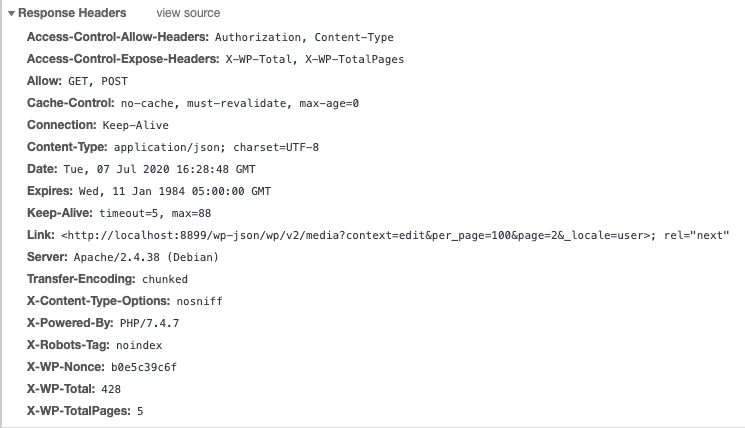
See link field above ^
Using enveloping would simple fix this.
Adding ?_envelope=1 to a request, means that headers, status and body are returned in the body of the request. Take this example.
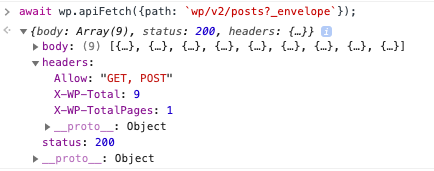
Meaning parse: true could be set and still get the next page url from the body of the request, instead of the header.
spacedmonkey
on 7 Jul 2020
Got it, that makes sense.
epiqueras
on 7 Jul 2020
@epiqueras Are you interesting working on a PR for this?
spacedmonkey
on 8 Jul 2020
I can see other ways to make this work without making an envelope option. What are the third party use cases for envelope?
epiqueras
on 8 Jul 2020
The main use case, AFAIK, for envelope is for scenarios where the user cannot access the headers of a response. If we can make preloading work with parse: false I think that would be ideal.
TimothyBJacobs
on 8 Jul 2020
When would they need the headers to be preloaded like that?
epiqueras
on 8 Jul 2020
For stock core, the pagination headers themselves. So you can preload how many items are in a list. In more custom use cases, the defacto way to add information to a collection response in the REST API is via headers.
TimothyBJacobs
on 8 Jul 2020
Got it. So making preloading work with parse: false would remove the need for an envelope parameter.
epiqueras
on 8 Jul 2020
Yep!
TimothyBJacobs
on 8 Jul 2020
@TimothyBJacobs @spacedmonkey
I'm trying to implement this, but rest_preload_api_request is not returning headers as expected:
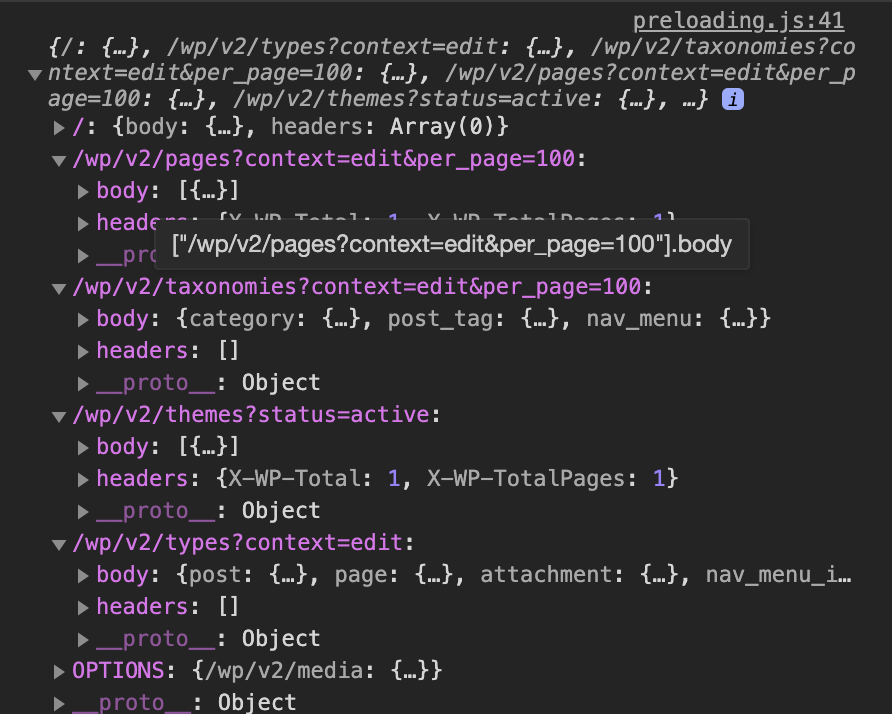
epiqueras
on 8 Jul 2020
That looks right to me. Not all of the responses have additional headers, the types and taxonomies endpoints don't support pagination so they don't add any.
Were there other headers you were expecting?
TimothyBJacobs
on 8 Jul 2020
Seem right to be also. Not all requests have headers. Like type, but I can see headers in wp/v2/themes for example.
spacedmonkey
on 8 Jul 2020
The Fetch All Middleware needs the Link header.
epiqueras
on 8 Jul 2020
The Fetch All Middleware needs the Link header.
Not all the requests are using Fetch All Middleware anyway. Types don't need those headers, are they are not paginated. Also, these requests would not be return headers currently.
spacedmonkey
on 8 Jul 2020
Hm, I'm seeing the Link header in my tests.
rest_preload_api_request([], '/wp/v2/posts');
=> phar:///usr/local/Cellar/wp-cli/2.4.0/bin/wp/vendor/wp-cli/shell-command/src/WP_CLI/Shell/REPL.php:52:
array(1) {
  '/wp/v2/posts' =>
  array(2) {
    'body' =>
    array(10) {
      [0] =>
      array(24) {
        ...
      }
      [1] =>
      array(24) {
        ...
      }
      [2] =>
      array(24) {
        ...
      }
      [3] =>
      array(24) {
        ...
      }
      [4] =>
      array(24) {
        ...
      }
      [5] =>
      array(24) {
        ...
      }
      [6] =>
      array(24) {
        ...
      }
      [7] =>
      array(24) {
        ...
      }
      [8] =>
      array(24) {
        ...
      }
      [9] =>
      array(24) {
        ...
      }
    }
    'headers' =>
    array(3) {
      'X-WP-Total' =>
      int(269)
      'X-WP-TotalPages' =>
      int(27)
      'Link' =>
      string(58) "<http://trunk.test/wp-json/wp/v2/posts?page=2>; rel="next""
    }
  }
}
Not all the requests are using Fetch All Middleware anyway. Types don't need those headers, are they are not paginated. Also, these requests would not be return headers currently.
This issue is about supporting preloading for requests made by the Fetch All Middleware. To do this, we need the Link headers.
Hm, I'm seeing the Link header in my tests.
Try logging the preloaded data the editor is bootstrapped with.
epiqueras
on 8 Jul 2020
There isn't a collection route in edit-form-blocks.php so I added one. It looks right to me:
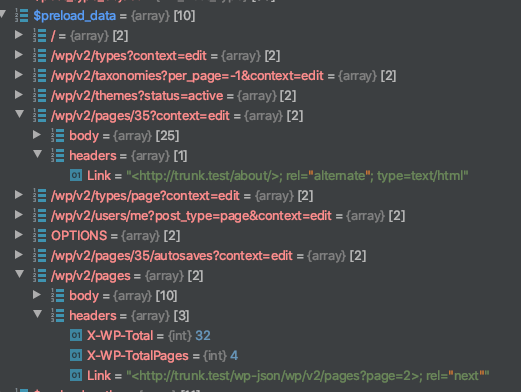
Do you have less than one page of pages?
TimothyBJacobs
on 9 Jul 2020
Do you have less than one page of pages?
That was it.
epiqueras
on 9 Jul 2020
Related issues
 maddisondesigns
·
3Comments
maddisondesigns
·
3Comments
 nylen
·
3Comments
nylen
·
3Comments
 aaronjorbin
·
3Comments
aaronjorbin
·
3Comments
 aduth
·
3Comments
aduth
·
3Comments
 franz-josef-kaiser
·
3Comments
franz-josef-kaiser
·
3Comments