Groupie: GroupUtils.getItem from DiffUtil takes several seconds for large lists
Describe the bug
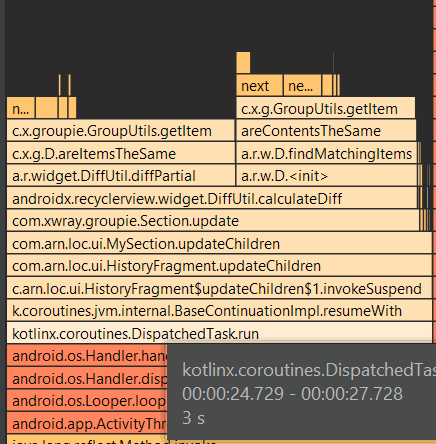
In my case, I had 4500 items, which shouldn't be considered as large. I have expandable groups with sections, which cannot be updated asynchronously, so, a section.update() with detectMoves=false freezes the UI for 3 seconds.
Screenshot of profiler:
To Reproduce
Run example code for Section.update with about 5000 entries
Expected behavior
Better performance
Library version
2.8.0
 kawaiiDango
All 5 comments
I'm having similar issues, with a similar number of items - ~5k. However i'm doing it with updateAsync so no UI jank, just seriusly slow to update the items.
I have two Sections with headers, one section with 5 items, one with 5k items.
With 1000 items, it takes 0.5s

With 2000 it takes 7.5s

With 2500 items, it takes 13.45s

Wwith 3000 items, it takes 45s
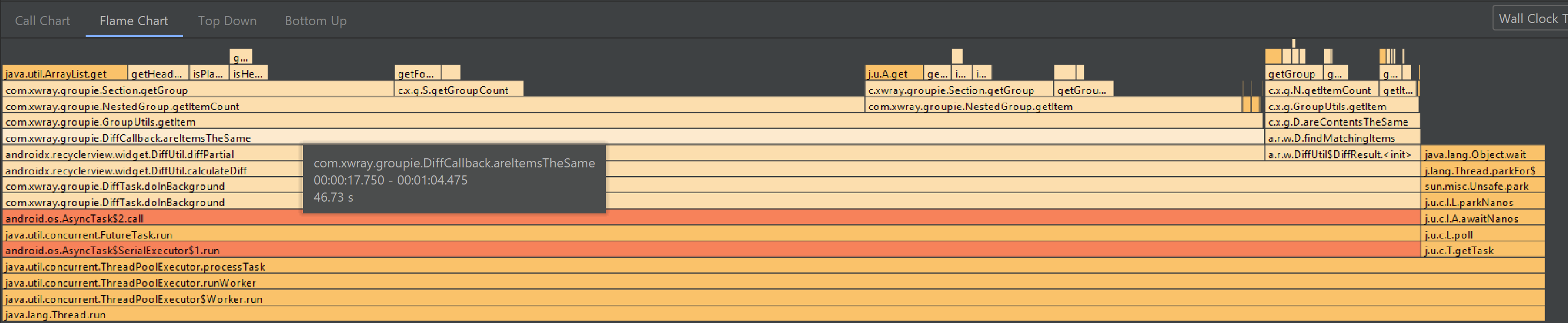
I have the following overrides in my item class btw:
override fun isSameAs(other: Item<*>): Boolean {
return other is SearchItem
}
override fun hasSameContentAs(other: Item<*>): Boolean {
return other is SearchItem && other.text == text
}
Without them, its much worse
 OliverCulleyDeLange
on 22 Jun 2020
OliverCulleyDeLange
on 22 Jun 2020
I hacked around this by just clearing the adapter before updating... this avoid doing the pointless (in my use case) diff
adapter.clear()
adapter.updateAsync(...)
+1 for this issue; using a for loop in GroupUtils.getItem and GroupUtils.getItemCount doesn't help with performance. Couldn't it be possible to use a solution based on groups.get(position) instead, to avoid a nested loop?
 herbeth1u
on 26 Jul 2020
herbeth1u
on 26 Jul 2020
The problem can actually be easily reproduced on the example sample project, by changing these lines:
for (i in 1..1200) {
    add(UpdatableItem(rainbow200[i % 12], i))
}
I identified two major performance issues :
- Shuffling the 1200 items takes ~1 minute on my device.
DiffCallbackis slow because of the use ofGroupUtils.getItemin each ot its methods. Fortunately, it looks like it can be fixed by flattening the items only once when theDiffCallbackis built (rather than recursively search for items again and again), and usingArrayList.getafterwards on the flattened list (which is fast). It is not perfect (we still have to loop through all the items once before theDiffCallbackcan actually run) but way faster ( < 0.5s ).
Commit here: https://github.com/herbeth1u/groupie/commit/8eaa5bc8ced409f387e3b89427bc00d547b7ae7f
I didn't make a PR because I'm not extremely familiar with the code base, and this could have impacts I'm not aware of. Feel free to use and do whatever you want with it though.
- Scrolling down through the 1200 items is ok, but when trying to scroll up, I can barely reach the top before a minute. The profiler tells me
GroupAdapter.getItem(int position)is one of the main root causes for this; it indeed callsGroupUtils.getItemon the main thread (which is ultimately the same problem as above). I tried to flattenGroupAdapter.groupsthe same way, so we can simply useArrayList.getinstead, butGroupAdapter.groupsis altered in a lot of places, and I wasn't able to make it work.
Edit : This second issue is actually mentioned in #161 and has been around for quite some time.
It doesn't look like Groupie is very friendly with large lists, but the code could use some optimizations (more or less easy to implement).
herbeth1u
on 30 Jul 2020
I don't see a better solution other than to replace Section in your code with List<Item> + groupieAdapter.updateAsync(). 🤔
 Zhuinden
on 13 Jan 2021
Zhuinden
on 13 Jan 2021
Related issues
 forntoh
·
3Comments
forntoh
·
3Comments
 andhie
·
3Comments
andhie
·
3Comments
 ValCanBuild
·
6Comments
ValCanBuild
·
6Comments
 alvin-nt
·
3Comments
alvin-nt
·
3Comments
 punitda
·
3Comments
punitda
·
3Comments
Most helpful comment
The problem can actually be easily reproduced on the
examplesample project, by changing these lines:I identified two major performance issues :
DiffCallbackis slow because of the use ofGroupUtils.getItemin each ot its methods. Fortunately, it looks like it can be fixed by flattening the items only once when theDiffCallbackis built (rather than recursively search for items again and again), and usingArrayList.getafterwards on the flattened list (which is fast). It is not perfect (we still have to loop through all the items once before theDiffCallbackcan actually run) but way faster ( < 0.5s ).Commit here: https://github.com/herbeth1u/groupie/commit/8eaa5bc8ced409f387e3b89427bc00d547b7ae7f
I didn't make a PR because I'm not extremely familiar with the code base, and this could have impacts I'm not aware of. Feel free to use and do whatever you want with it though.
GroupAdapter.getItem(int position)is one of the main root causes for this; it indeed callsGroupUtils.getItemon the main thread (which is ultimately the same problem as above). I tried to flattenGroupAdapter.groupsthe same way, so we can simply useArrayList.getinstead, butGroupAdapter.groupsis altered in a lot of places, and I wasn't able to make it work.Edit : This second issue is actually mentioned in #161 and has been around for quite some time.
It doesn't look like Groupie is very friendly with large lists, but the code could use some optimizations (more or less easy to implement).