Ghidra: SLEIGH: how to implement an "erepeat" instruction
Hello,
I'm trying to add Toshiba MeP support to ghidra however I'm having trouble implementing the erepeat instruction.
The instruction works as follows:
                 erepeat loc_80B5AA
                 lw      $3, ($2)

 loc_80B5AA:
                 and3    $1, $3, 1
                 beqz    $1, loc_80B5B0
is equivalent to
while (1) {
                 lw      $3, ($2)

 loc_80B5AA:
                 and3    $1, $3, 1
                 beqz    $1, loc_80B5B0
}
(Notice that 1 more instruction is executed past the label specified in erepeat)
The problem is that there is no instruction at the end of the loop so I cannot add a symbol at the end which would perform a branch back to the top. The instruction/symbol is only present at the start of the loop so I need to propagate the label somehow.
What I've tried:
I've implemented erepeat as follows:
:erepeat rpe_ctx is op0015=0xe019 ; simm1631 [ rpe_ctx = inst_start + (simm1631 << 1); repeat_end = 2; globalset(rpe_ctx, repeat_end); ] {
    rpb = inst_next;
    rpe = rpe_ctx;
}
I'm using globalset to set a context variable on the end instruction that indicates it is the end of repeat. Also, I'm saving the next instruction address (beginning of the loop) to the $rpb register.
Then,
# Simulate mep delay slot in repeat/erepeat instructions
:^instruction is repeat_end=2 & instruction [ repeat_end=1; globalset(inst_next, repeat_end); repeat_end=0; ] {
    build instruction;
}

:^instruction is repeat_end=1 & instruction [ repeat_end=0; ] {
    build instruction;
    goto [rpb];
}
I'm propagating the end 1 instruction further. Once the "real" end instruction is identified, I append a branch back to the start of the loop.
Now, the problem is that since I'm performing a jump to a register, it generates BRANCHIND rpb p-code. Understandably, this confuses the decompiler a lot and it generates very weird code:
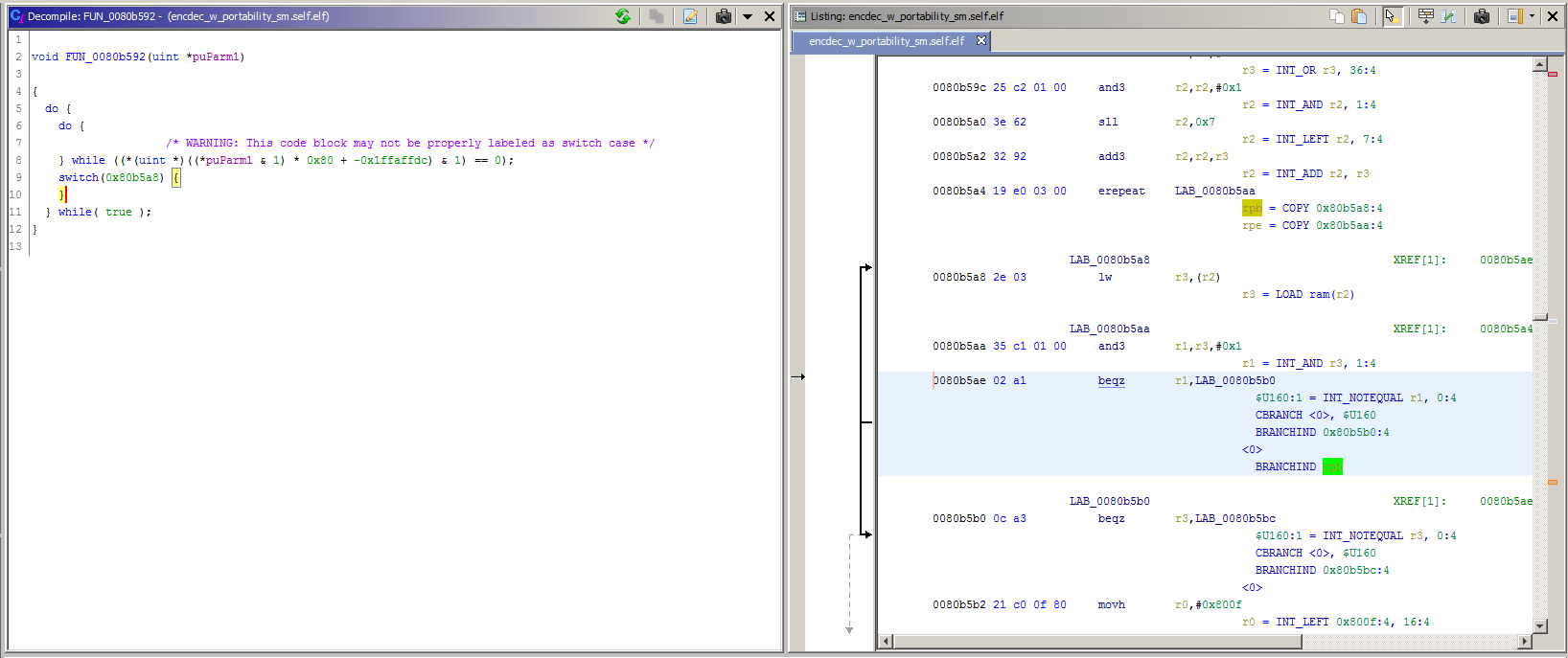
As a test I've tried replacing goto [rpb]; with a hardcoded integer value specific to that function, and the generated code looked much better:
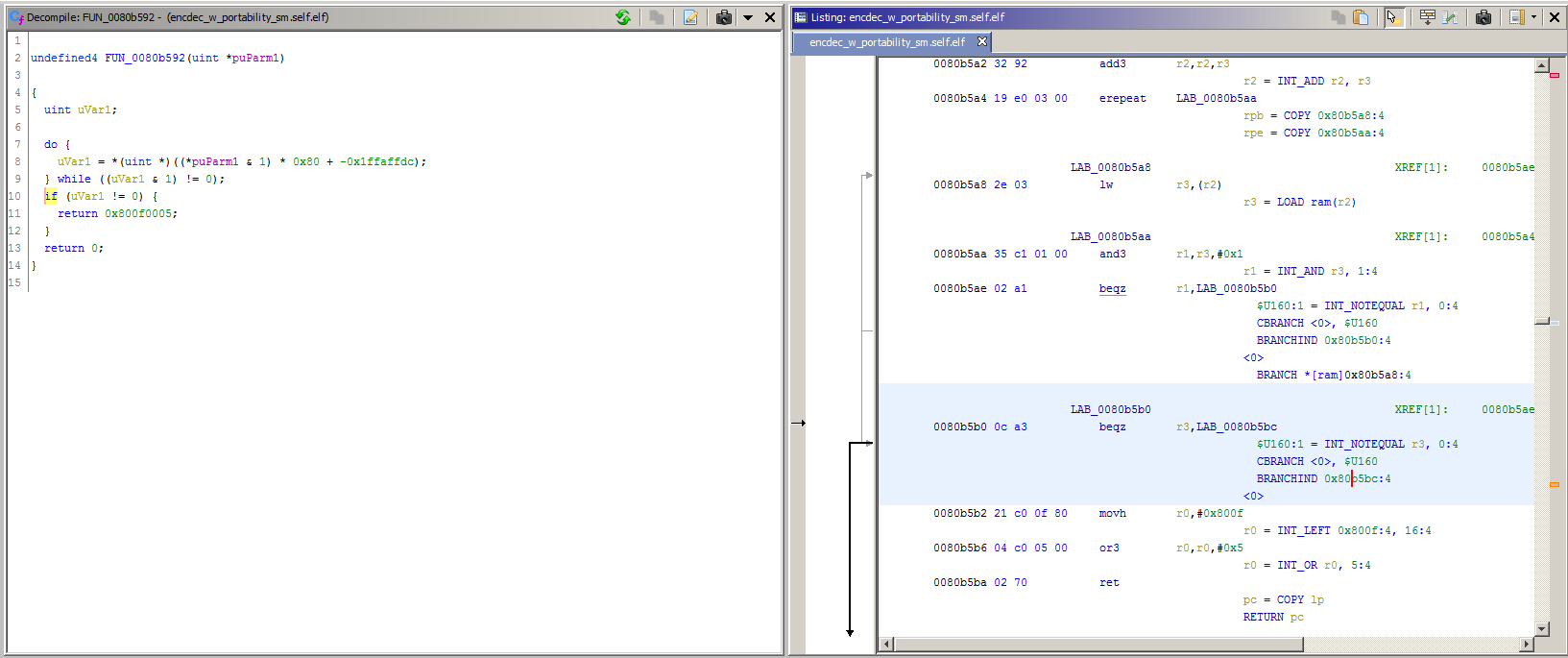
So my question is how should I do it properly? Is there a way to propagate the label specified in erepeat into instructions below it as a constant, or maybe there's some other way to implement it I'm not thinking of?
 xyzz
xyzz
All 2 comments
Okay, I figured out a possible solution:
So first I need to propagate repeat-begin in the context so that we know where to jump (the globalset(end, rpb_ctx); part):
:erepeat end is op0015=0xe019 ; simm1631 [ rpb_ctx = inst_start + 4; end = inst_start + (simm1631 << 1); repeat_end = 2; globalset(end, repeat_end); globalset(end, rpb_ctx); ] {
    rpb = inst_next;
    rpe = end;
}
As well as propagate it in the delay-slot emulator:
# Simulate mep delay slot in repeat/erepeat instructions
:^instruction is repeat_end=2 & instruction [ repeat_end=1; globalset(inst_next, repeat_end); repeat_end=0; globalset(inst_next, rpb_ctx); ] {
    build instruction;
}
Then I'm making a new symbol that makes use of that context variable:
RepeatTgt: is rpb_ctx {
    export *[ram]:4 rpb_ctx;
}
and using it:
:^instruction is repeat_end=1 & instruction & RepeatTgt [ repeat_end=0; ] {
    build instruction;
    goto RepeatTgt;
}
And now it generates a constant branch and the decompile looks just like I expected it to:
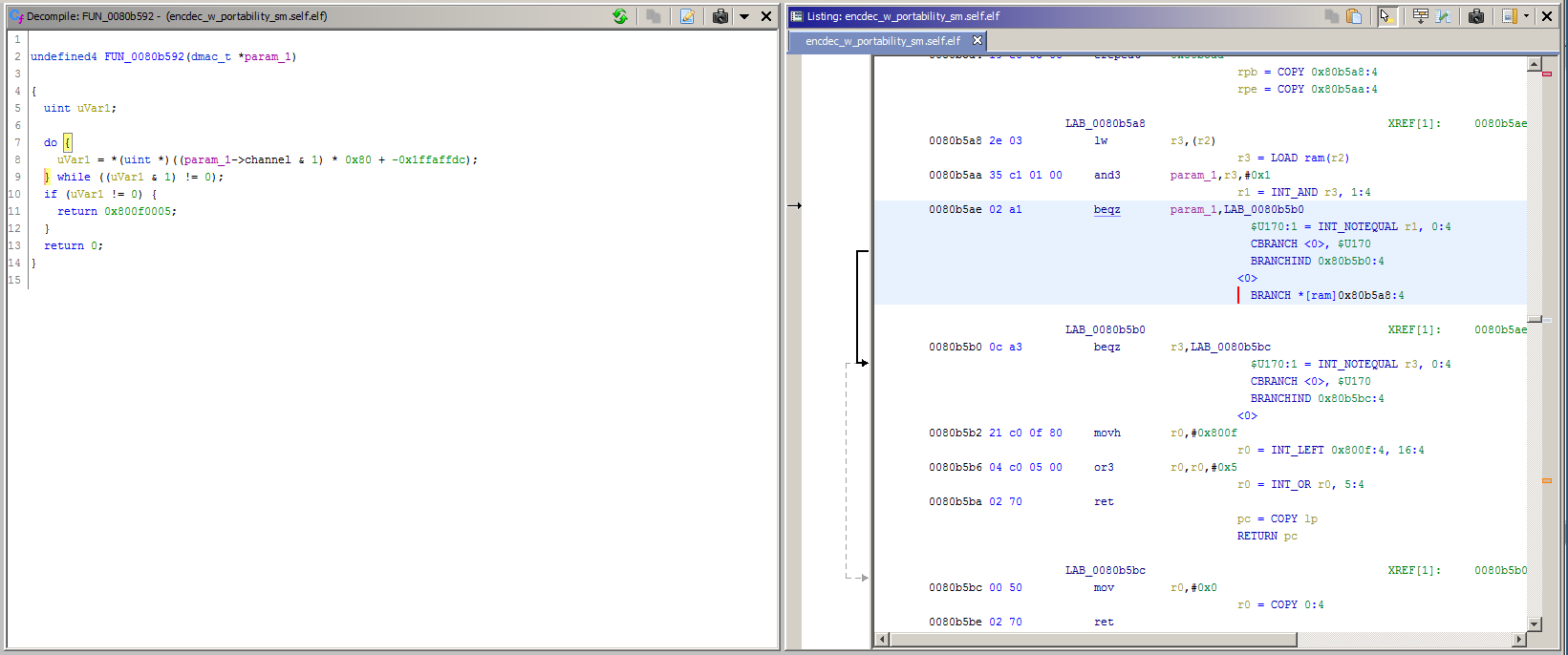
I'll leave this open just in case there's a better solution I'm not aware of (which to be honest there probably is).
xyzz
on 7 Mar 2019
Closing this out due to inactivity.
 ryanmkurtz
on 22 Apr 2019
ryanmkurtz
on 22 Apr 2019
Related issues
 rrivera1849
·
3Comments
rrivera1849
·
3Comments
 tambry
·
3Comments
tambry
·
3Comments
 Merculous
·
3Comments
Merculous
·
3Comments
 0x6d696368
·
3Comments
0x6d696368
·
3Comments
 astrelsky
·
3Comments
astrelsky
·
3Comments
Most helpful comment
Okay, I figured out a possible solution:
So first I need to propagate repeat-begin in the context so that we know where to jump (the
globalset(end, rpb_ctx);part):As well as propagate it in the delay-slot emulator:
Then I'm making a new symbol that makes use of that context variable:
and using it:
And now it generates a constant branch and the decompile looks just like I expected it to:

I'll leave this open just in case there's a better solution I'm not aware of (which to be honest there probably is).