Exporters: Maya To GLTF Missing Mesh
If I export with mesh optimisations on a mesh get lost in the conversion.
with mesh optimizations
    {
      "skin": 0,
      "mesh": 0,
      "name": "Head"
    },
    {
      "name": "Body"
    },
without
    {
      "skin": 0,
      "mesh": 0,
      "name": "Head"
    },
    {
      "skin": 1,
      "mesh": 1,
      "name": "Body"
    },
I can't provide the asset unfortunately, but this is in the Maya graph.
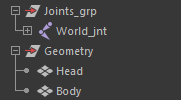
I realise there are a million things that can go wrong here.
 philSG
All 8 comments
So I've got a fix for this that works for us.
C#
// GlobalVertex.cs
if (UV2 != null && other.UV2 != null && !other.UV2.IsAlmostEqualTo(UV2, Tools.Epsilon))
{
    return false;
}
other.UV2 was null, and adding a check solves our issue. Happy to raise a PR for this, but unsure if I should add this change to the other attributes (Position,Normal,UV,Weights...)?
philSG
on 11 Aug 2020
Yes, thanks for looking into this! I agree that we should be doing a more sophisticated check here.
Imagine 3 scenarios:
v1 does not have uv2, v2 does not have uv2:
these have equivalent uv2 values.
v1has uv2, v2 does not have uv2, or v1 doesnt have UV2, v2 has UV2:
one vertex has coordinates, the other doesnt, we can't consider these vertices as equivalent.
v1 has UV2, v2 has UV2:
we should consider these as equivalent if they both have equivalent uv2 values.
Using this criteria, I'd rather we do something similar to:
if (UV2 == null && other.UV2 != null || UV2 != null && other.UV2 == null || !other.UV2.IsAlmostEqualTo(UV2, Tools.Epsilon)
{
    return false;
}
I agree that we should add similar checks to all other attributes as well (though we probably don't need to add these checks for Position)
 Drigax
on 11 Aug 2020
Drigax
on 11 Aug 2020
Would you like to open a PR with these changes? :)
Drigax
on 11 Aug 2020
Yep I can do these changes :+1:
philSG
on 12 Aug 2020
Hey @philSG do you mind sending a new PR?
 deltakosh
on 19 Aug 2020
deltakosh
on 19 Aug 2020
Yes Sorry I got side tracked with a high priority thing, I'm getting back on this area today.
philSG
on 20 Aug 2020
I assume while PR has been done and no activity has been recorded since a while on the topic, issue is solved.
 pandaGaume
on 13 Nov 2020
pandaGaume
on 13 Nov 2020
Seems the PR introduce invalid logic when testing and this is related to #874.
following code
if ((UV2 == null && other.UV2 != null) || (UV2 != null && other.UV2 == null) || !other.UV2.IsAlmostEqualTo(UV2, Tools.Epsilon))
let possibility of other.UV2 to be null (UV2 == null && other.UV2 == null) and throw exception, preventing the node to be exported.
To simplify, because only used into Maya exporter, we may introduce the null checking logic into the IsAlmostEqualTo(..) extensions
       public static bool IsAlmostEqualTo(this float[] current, float[] other, float epsilon)
        {
        if( current == null )
        {
        return other == null;
            }
        if( other == null )
        {
        return false;
        }
            if (current.Length != other.Length)
            {
                return false;
            }
            for (int index = 0; index < current.Length; index++)
            {
                if (Math.Abs(current[index] - other[index]) > epsilon)
                {
                    return false;
                }
            }
            return true;
        }
And change the Global Vertex Equals accordly
if (!XXXX.IsAlmostEqualTo(other.XXXX, Tools.Epsilon) { return false; }
then the GlobalVertex Equals become
        public override bool Equals(object obj)
        {
            if (obj != null && obj is GlobalVertex other)
            {
                // Note the logic located into the Tools.IsAlmostEqualTo Extension is also check for null parameters.
                return
                    other.BaseIndex == BaseIndex &&
                    other.Position.IsAlmostEqualTo(Position, Tools.Epsilon) &&
                    other.Normal.IsAlmostEqualTo(Normal, Tools.Epsilon) &
                    other.UV.IsAlmostEqualTo(UV, Tools.Epsilon) &&
                    other.UV2.IsAlmostEqualTo(UV2, Tools.Epsilon) &&
                    other.Weights.IsAlmostEqualTo(Weights, Tools.Epsilon) &&
                    other.WeightsExtra.IsAlmostEqualTo(WeightsExtra, Tools.Epsilon) &&
                    other.Color.IsAlmostEqualTo(Color, Tools.Epsilon) &&
                    other.BonesIndices == BonesIndices;
            }
            return false;
        }
I made the test and this is solving the issues so far.
pandaGaume
on 13 Nov 2020
Related issues
 echadwick-wayfair
·
4Comments
echadwick-wayfair
·
4Comments
 jsellam
·
7Comments
jsellam
·
7Comments
 qualmon
·
6Comments
echadwick-wayfair
·
3Comments
qualmon
·
6Comments
echadwick-wayfair
·
3Comments
 MaximeOrlandi
·
7Comments
MaximeOrlandi
·
7Comments