How should we annotate floating quantifiers?
I found many diverse strategies in actual English and French corpora
In English LinES, I found
(a) _they all go out_ : advmod(_go_, _all_)
(b) _they all had gone_ : obl(_gone_, _all_)
In EWT, I found
(c) _we are all suffering_ : advmod(_suffering_, _all_)
(d) _you all remember_ : det(_you_, _all_)
In French_Sequoia :
(e) _que nous connaissons tous_ : advmod(_connaissons_, _tous_)
(f) _qui seront tous deux mis en examen_ : iobj(_deux_, _mis_en_examen_)
In SpokenFrench :
(g) _les constructeurs ne réagissent pas tous_ : advmod(_réagissent_, _tous_)
(h) _on est tous très inquiets_ : obl:mod(_inquiets_, _tous_)
In (e) and (g) the quantifier floats are tagged ADJ, but it might be a mistake because _tous_ here are pronouns I think
The (f) sentence relates to another problem : the delimitation of quantifier floats.
In French_Sequoia :
(i) _d'autres chefs d'entreprise semblent, eux aussi ..._ : iobj(_semblent_, _eux_)
In fact "exclusivity markers" like these pronouns and quantifier floats have similar distributions (see Larrivée 2008):
_Les caporaux ont_ [_tous_, _eux-mêmes_, _eux aussi_] _été renseignés_
_Les caporaux qui_ [_tous_, _eux-mêmes_, _eux aussi_] _avaient été renseignés_
_Il aurait fallu_ [_tous_, _eux-mêmes_, _eux aussi_] _qu'ils se renseignent_
Floating quantifiers behave like secondary predicates, they could be replaced by secondary predicate _seul_
_Les caporaux ont_ [_tous_, _seuls_] _été renseignés_
_Les caporaux qui_ [_tous_, _seuls_] _avaient été renseignés_
_Il aurait fallu_ [_tous_, _seuls_] _qu'ils se renseignent_
So I propose the following strategy :
(e') _que nous connaissons tous_ : acl(_nous_, _tous_)
(i') _d'autres chefs d'entreprise semblent, eux aussi ..._ : acl(_chefs_, _eux_)
 rafael75012
All 34 comments
@rafael75012 some of those cases are normal ambiguities, don't you think? So, maybe it is normal to do have different annotations.
 arademaker
on 1 Nov 2018
arademaker
on 1 Nov 2018
Hi @arademaker, to what cases do you refer?
rafael75012
on 2 Nov 2018
Try examples (a) and (b) in a grammar like http://erg.delph-in.net/logon. You will see that both can have many different analyses.
In the IBM English Slot Grammar we got fewer analyses for (a) because of the parse prune mechanism:
They all go out.
------------------------------------------------------------------------
.- subj(n)  they(1)        noun pron pl def nom perspron
.- vadv     all3(2,3)      adv nounadv noadvpre nwh
o- top      go1(3,1,4,u,u) verb vfin vpres pl vsubj invertv vmove (nform going go-ahead) (ernform goer)
`- comp(pt) out1(4,3,u)    prep motionp badobjping
------------------------------------------------------------------------
------------------------------------------------------------------------
.- subj(n)  they(1)        noun pron pl def nom perspron
.- vadv     all3(2,3)      adv nounadv noadvpre nwh
o- top      go1(3,1,u,u,4) verb vfin vpres pl vsubj invertv vmove (nform going go-ahead) (ernform goer)
`- comp(lo) out1(4,3,u)    prep motionp badobjping
------------------------------------------------------------------------
If I am not wrong, http://erg.delph-in.net/logon, for "they all go out" and "they all had gone", propose two analyses of the quantifier float, attached to the pronoun "they" with a 'det' link, or attached to the verb with an 'adv' link.
Could you indicate me how "they--det-->all had gone" would differ semantically from "they all<--advmod--had gone"?
rafael75012
on 2 Nov 2018
Hi @rafael75012, this can be a long discussion about semantic representations. I recently read a very interesting article about it: https://aclweb.org/anthology/W/W15/W15-0128.pdf. The question is if these two different analyses are semantically identical and so they do not deserve to be considered ambiguities, right?
I read the first one as an emphasis on the fact that the subject of the action is the whole set of people in the mind of the speaker. The second one is an emphasis on the completeness of the action.
arademaker
on 2 Nov 2018
I read the first one as an emphasis on the fact that the subject of the action is the whole set of people in the mind of the speaker. The second one is an emphasis on the completeness of the action.
I can only see the first reading. The use of "all" in that position is contingent on the subject being plural or mass. The following are terrible:
*John all had gone.
*John all has eaten the candies.
So I don't see an adverbial reading as a possibility here.
 nschneid
on 2 Nov 2018
nschneid
on 2 Nov 2018
@nschneid I am not a native speaker, but for both cases, given a singular subject, the adverbial reading was returned by the ERG/HPSG grammar.
arademaker
on 2 Nov 2018
Then I think that indicates a problem with or limitation of the grammar.
(That sentence is definitely grammatical, by the way, but ERG rejects it.)
nschneid
on 3 Nov 2018
@nschneid sorry, I didn't understand. ERG didn't reject John all has eaten the candies. nor John all had gone.. If you are talking about the sentence
Then, I think that indicates a problem with or limitation of the grammar.
you are right, all grammars leak, right? But the version below was accepted.
Then, I think that indicates a problem or limitation of the grammar.
I was just saying that grammars help us to see ambiguities that we missed sometimes. Moreover, making annotations on corpora force us to adopt one particular interpretation. Does it make sense?
arademaker
on 3 Nov 2018
Thank you @arademaker and @nschneid for your contributions
@arademaker , yes it was my question !
The use of "all" in that position is contingent on the subject being plural or mass
Then wouldn't it be more accurate to use the treatment for depictives : acl when the verb is finite (linked to the argument) and advcl when the verb is non finite (linked to the verb)?
And there is also the question of the POS of these FQ
Would it be possible in English to remove the original subject, so that the role of subject would be taken by the FQ? If yes, it would be in favour of a PRON analysis?
They all go out ==> ??All go out
They all had gone ==> All had gone
We are all suffering ==> All are suffering
you all remember ==> ??All remember
In French, I am more inclined to tagg the FQ "tous" as a PRON, rather than ADJ as it has been done in Sequoia_UD and FrenchSpoken
que nous connaissons tous ==> que tous connaissons (a bit strange, but can be ok in some contexts)
on est tous très inquiets ==> tous sommes très inquiets
rafael75012
on 3 Nov 2018
When "all" is used by itself as a subject, it feels like a quantifier/determiner being coerced into a pronoun. I think the policy is still to tag it as DET, but as nsubj.
When "all" is a floating quantifier, I think it makes sense to treat it as a dependent within the noun phrase—but probably not acl/advcl, as it is not a clause. EWT uses det, which seems reasonable:
they all have the same unique grammar structure:
det(they, all)the other five companies making the short list all proposed alternative structures:
det(companies, all)
nschneid
on 3 Nov 2018
But we need first to decide whether the floating quantifier forms a phrase with the subject or with verb. It seems quite clear that it forms a phrase with the verb. For instance, it must be after the auxiliary:
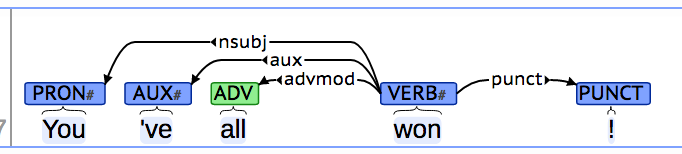
or can cooccur with a relative pronoun:

So advmod seems a very good option, that has been adopted by most treebanks (even if we can find some inconstitencies sometimes).
The POS of _all_ is another story.
 sylvainkahane
on 3 Nov 2018
sylvainkahane
on 3 Nov 2018
No, it need not be after the auxiliary: "You all have won" and "You have all won" are both fine and semantically equivalent. Let's try VP coordination:
Pre-aux
- They all have eaten breakfast but haven't eaten lunch.
- *They have eaten breakfast but all haven't eaten lunch. (only grammatical with the pronominal reading of "all", it which case it's not VP coordination)
Conclusion: if it precedes the auxiliary, this test suggests it's not part of the VP.
I think other adverbs can precede the aux, though it sounds a bit old-fashioned to my ears:
- They always have eaten lunch together but haven't played cards.
- They have eaten lunch together regularly and always have played cards.
The second one is no worse than the first, which distinguishes "always" from "all".
Post-aux
- They have all eaten breakfast but haven't eaten lunch.
- They have eaten breakfast but haven't all eaten lunch.
Conclusion: this test doesn't rule out post-auxiliary "all" as part of the VP.
Incidentally, the following uses of "always" sound more natural than the pre-aux ones above:
- They have always eaten lunch together but haven't played cards.
- They have eaten lunch together regularly and have always played cards.
There are probably other tests that I'm not thinking of that could help.
nschneid
on 3 Nov 2018
In French, data are much simpler. The pronominal subject is clitic and the FQ cannot be between it and the verb: * _ils tous partent_, lit. they all leave vs _ils partent tous_ 'they all leave'
But we have a so-called strong form of the pronoun: _eux tous partent_ '(they all) leave' vs _eux partent tous_ 'they (all leave)'.
So it is likely that English has two constructions (with different prosodies?). But I guess that the default analysis is _they (all leave)_, which is the most most common in French. Just French intuition ;)
sylvainkahane
on 3 Nov 2018
@nschneid , you said :
When "all" is a floating quantifier, I think it makes sense to treat it as a dependent within the noun phrase—but probably not acl/advcl, as it is not a clause
Do you mean that we cannot get :
She entered the room sad : She entered the room + She was sad
They all got out : They go out + *They were all
EWT uses det, which seems reasonable
So it would be a "floating" version of determiners?
Determiners accompany NP normally, not pronouns...?
FQ and determiners still differ a lot on these two properties
rafael75012
on 5 Nov 2018
Right, *They were all. doesn't work.
Certainly FQs are not typical determiners. But if one takes the view that "They all" is a noun phrase, I'm not sure there's a better relation than det.
nschneid
on 5 Nov 2018
In accordance with the guidelines, _all_ must be DET, whatever its position is. (The POS is an inherent value.)
But I'm not convinced by the relation det in _they all_. It is a very unusual position for a determiner in English. What is the commutation paradigm of _all_ in this position? In French, we can have _eux tous_ 'they all', _eux autres_ 'THEY', lil. 'they other', _eux seuls_ 'only they', lit. 'they alone'. Both _autres_ and _seuls_ are ADJs. So I think I would prefer to have amod.
sylvainkahane
on 5 Nov 2018
Here's what the Cambridge Grammar of the English Language (p. 413) has to say:
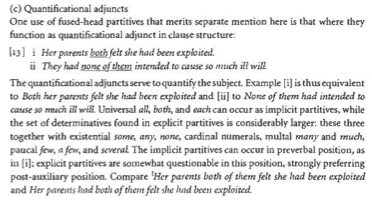
I think it's just "all", "both", and "each" that can occur in this postmodifier construction (what they call implicit partitives).
nschneid
on 5 Nov 2018
It's perhaps worth noting that "only" and "just" are tagged as ADV and accordingly attached as advmod when they modify nouns. So one could argue that even though these FQ constructions bear semantic and word order similarities between English and French, they deserve different dependency relations because they draw on different lexical categories.
(Or that the criteria for DET/ADJ/ADV are applied inconsistently across languages.)
nschneid
on 5 Nov 2018
@nschneid, would you annotate "explicit partitives" and "implicit partitives" in the same way? With det relation and DET pos?
@sylvainkahane
What is the commutation paradigm of _all_ in this position? In French, we can have eux tous 'they all', eux autres 'THEY', lil. 'they other', eux seuls 'only they', lit. 'they alone'
In French, do we have an equivalent to English PRON + all (i.e. "they all")?
(1) *Ils tous sortent
they + all + go out
(2) *Ils chacun sortent
they + both + go out
If not, then "eux aussi", etc. commute with "tous" solely in the two following positions : (3) placed after in between AUX + VERB, (4) placed after the verb
(3) Ils sont [tous, eux-mêmes, eux aussi] sortis
they + AUX + ['all', 'themselves', 'them too'] + gone out(4) Ils sortent [tous, eux-mêmes, eux aussi]
they + go out + ['all', 'themselves', 'them too']
French FQ would be syntactically equivalent to English "expliticit partitives" mentioned in the Cambridge Grammar, but not with "implicit partitives"
Note that the inclusion of FQ is marked prosodically with an emphasis (which can be transcribed with commas), and we also have the dislocation alternation :
(5) [Tous, eux-mêmes, eux aussi], ils sont sortis
['all', 'themselves', 'them too'] + they + AUX + gone out(6) Ils sortent, [tous, eux-mêmes, eux aussi]
they + go out + ['all', 'themselves', 'them too']Using
dislocatedcould also make sense...
rafael75012
on 6 Nov 2018
For FQ in French, could we use acl?
Once we admit that they behavior is similar to secondary predicates, and that advcl has been proposed to replace acl for their description (*https://github.com/UniversalDependencies/docs/issues/476), advcl for FQ could be an option to
rafael75012
on 17 Jan 2019
I am inclined to use det, as proposed by @nschneid above. It may be unusual from the point of view of traditional grammar, but it seems in line with how quantifiers are treated in UD.
 dan-zeman
on 17 Jan 2019
dan-zeman
on 17 Jan 2019
det is a very particular relation that we need for languages such as English were a special word is the functional head of the noun phrase (and cannot in particular be easily erased). This construction is so special that I would be very reluctant to use it for something else.
For FQ in French, we have two constructions: one where the FQ forms a phrase with the verb (_ils sont tous venus_ 'they all came', lit. they have all come) and one, more marginal, where the FQ forms a phrase with a (strong form of a) pronoun (_eux tous sont venus_ 'all of them came', lit. they all have come). It seems simpler to use advmod when the FQ depends on a verb and amod when it depends on a pronoun.
sylvainkahane
on 17 Jan 2019
@dan-zeman Even for French, in which we find FQ made of a two tokens? And in which the placement is more free, and in which they are not adjacent to the element they are supposed to modify?
Ils sortent, [tous, eux-mêmes, eux aussi]
they + go out + ['all', 'themselves', 'them too']
Just note in passing that FQ in English are very similar to FQ in Chinese, so if DET is adopted in English, it may also fit for Chinese :
(1) 他们 都 走 了
tāmen + dōu + zǒu + le
they + all + go + PFV(2) 他们 俩 走 了
Tāmen + liǎ + zǒu +le
they + two + go + PFV
In (2) 俩 is a numeral.
rafael75012
on 17 Jan 2019
@rafael75012 : Yes, why not. There is no universal rule that a modifier must be adjacent to the element it modifies. Or that it must consist of a single token.
In your Chinese examples, I would do
det(tāmen, dōu)
and
nummod(tāmen, liǎ),
respectively.
@sylvainkahane : Maybe the det relation in UD is not as specific as outside UD, but it has a misleading name. I just had a look at the guidelines and the det page does not mention quantifiers but the nummod page says that indefinite quantifiers should be attached via det.
I find it difficult to accept that _tous_ forms a phrase with the verb in _ils sont tous venus_. Why couldn't _ils tous_ be a (discontinuous) phrase? And isn't there some sort of agreement in number and gender? I suppose _*il est tous venu_ is ungrammatical, no?
dan-zeman
on 17 Jan 2019
@dan-zeman About the Chinese example, do you refer to this rule "However, cardinal numerals in the narrow sense (one, five, hundred) are not tagged DET even though some authors would include them in quantifiers. Cardinal numbers have their own tag NUM."? https://universaldependencies.org/u/pos/DET.html
So it would be like in the French
Ils sont tous (les) deux venus
Where you would get :
nummod (ils, deux/NUM)
det (deux/NUM, tous/DET)
det (deux/NUM, les/DET)
By the way, do we agree that "tous/toutes" when they are not substantival pronouns, are DET and not ADJ?
tous les chats sont gris ('all cats are grey')
toutes les fenêtres sont cassées ('all windows are broken')
rafael75012
on 17 Jan 2019
_tous_ DET is fine with me. Accompanied by PronType=Tot.
dan-zeman
on 17 Jan 2019
@dan-zeman Agreement between two units does not mean that they form a phrase together (cf. anaphoric relations). I don't see any serious argument to consider that the FQ forms a phrase with the subject. French weak subject pronouns such as _ils_ are clitics and cannot have a dependent. They can only be separated from the verb by other clitics.
sylvainkahane
on 17 Jan 2019
@dan-zeman It agrees with the subject/object like a depictive would agree with it
Ils sont rentrés tristes | Ils sont tous rentrés
Il est rentré triste | Elles sont toutes rentrées
Il les a vues tristes | Ils les a toutes vues
So if there is no "any serious argument to consider that the FQ forms a phrase with the subject" (@sylvainkahane), except if there are arguments to consider that FQ forms a phrase with the verb, acl would be ok I think, as FQ relation is neither fully with the verb neither with its argument
rafael75012
on 12 Feb 2019
倆 liǎr = two pieces
I do not think it is a numeral while 倆liar refers to 他們tamen. I would use appos(倆, 他們).
What is the problem of treating 都dou as an adverb?
 wongtaksum
on 30 Mar 2019
wongtaksum
on 30 Mar 2019
Note: This issue seems to overlap with older #484.
dan-zeman
on 6 Oct 2019
No one has mentioned xcomp? This seems a clear case to me, as it looks like a secondary predication of the subject.
They are all gone = They are gone, and "_those who went were all_"
Something along these lines. Of course the DET always stays DET and, in languages with richer morphology, it concords with the subject. It is by no means different than the famous Latin sentence:
_Galli laeti in castra pergunt_ 'The Gauls gladly enter the camp'
One could unproblematically substitute _laeti_ 'glad (masculine plural nominative)' with _omnes_ 'all':
_Galli omnes in castra pergunt_ 'The Gauls all enter the camp', 'The Gauls enter the camp _in their totality_'
On a semantic level, it is not _all the Gauls_: it is just _all those Gauls_ at hand.
It is similar to a depictive and it is core inasmuch as it involves the subject. By the way, hoping not to be off-topic, I exploit this occasion to comment that the final line in the guidelines about the xcomp deprel regarding the use of acl instead of xcomp in such occasions does not seem acceptable to me as it stands now: on the one hand, it makes a point using a complement/adjunct logic (_leaving it out will neither affect grammaticality nor significantly alter the meaning of the verb_) alien to UD, and on the other hand it would lead to an analysis that, at least in Latin (especially given its freer word order), is simply wrong (it is not the _happy Gauls_ that enter the camp, but the Gauls that _enter gladly_).
 Stormur
on 25 Jun 2020
Stormur
on 25 Jun 2020
I exploit this occasion to comment that the final line in the guidelines about the
xcompdeprel regarding the use ofaclinstead ofxcompin such occasions does not seem acceptable to me as it stands now: on the one hand, it makes a point using a complement/adjunct logic (_leaving it out will neither affect grammaticality nor significantly alter the meaning of the verb_) alien to UD, and on the other hand it would lead to an analysis that, at least in Latin (especially given its freer word order), is simply wrong (it is not the _happy Gauls_ that enter the camp, but the Gauls that _enter gladly_).
I recently bumped up against this issue for English, where I expected depictives to be xcomp and was surprised to find the guidelines specify acl. (Maybe I missed or forgot the discussion that led to this.) In #476 there seems to be some support for moving away from acl.
nschneid
on 25 Jun 2020
(Maybe I missed or forgot the discussion that led to this.)
This may be baggage from the Stanford Dependencies. The section was already in the v1 guidelines, added by @manning on 8 October 2014 (e5e3018045cca7ad5bd6b9f52a6e7d270aa8d3de), following e-mail-based discussion (we were not using Github issues yet). I admit that it has been criticised repeatedly because of the reference to obligatoriness/optionality, which is otherwise taboo in UD. I'm afraid we have to live with it for now (and maybe forever), as changing the guideline would mean that the phenomenon has to be identified and re-annotated in all treebanks.
dan-zeman
on 10 Jul 2020
Related issues
 ryszardtuora
·
11Comments
arademaker
·
10Comments
nschneid
·
5Comments
nschneid
·
9Comments
ryszardtuora
·
11Comments
arademaker
·
10Comments
nschneid
·
5Comments
nschneid
·
9Comments
 vin-ivar
·
4Comments
vin-ivar
·
4Comments