Deeplearning4j: ND4j: Memory leak if calling INDArray.getRow()
Issue Description
Hi,
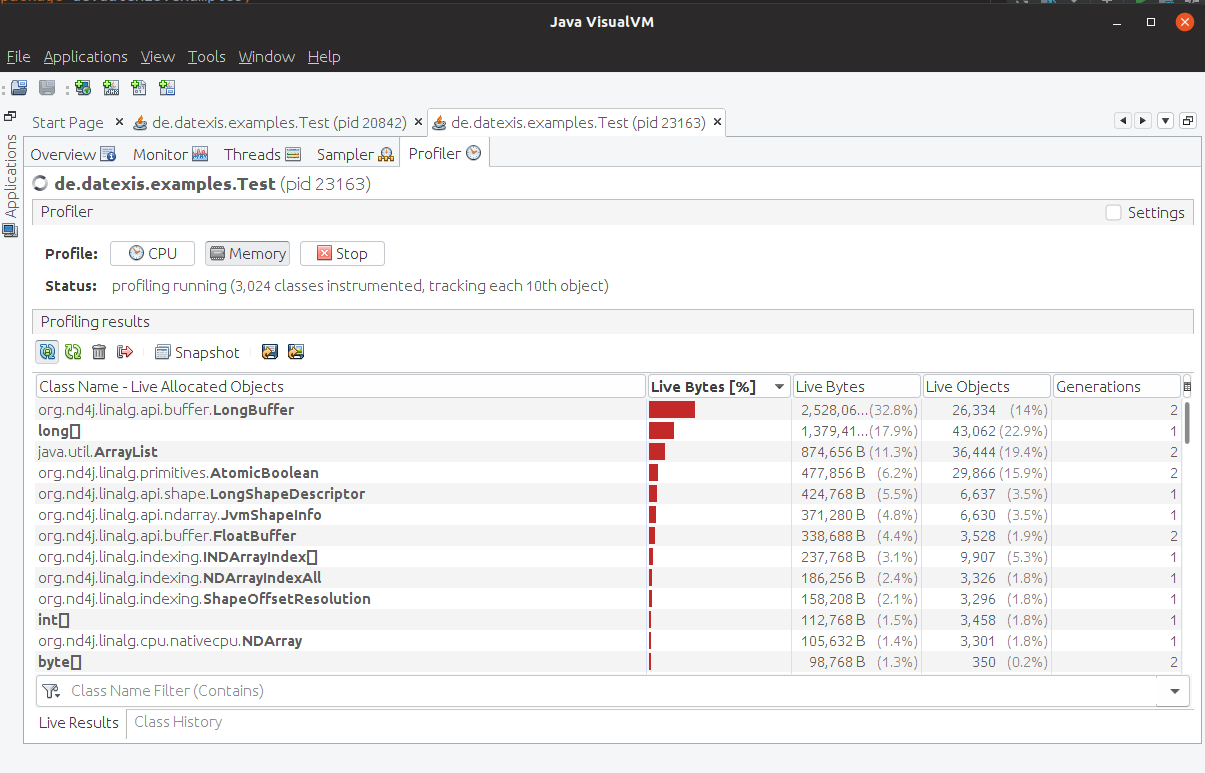
I'm working on the current snapshot build of DL4J/ND4J. If I call INDArray.getRow() this creates LongBuffer, AtomicBoolean and ArrayList instances which the garbage collector can't discard. This behavior leads finally to an OutOfMemoryException in the heap space. I encounter this problem if running a CpuBackend.
This error is not happening in Beta3. I have not tested if it is present on CUDA.
You can find minimal example code for reproduction here: https://gist.github.com/SchmaR/5291bf21d812ac020307251eb4cdcf97
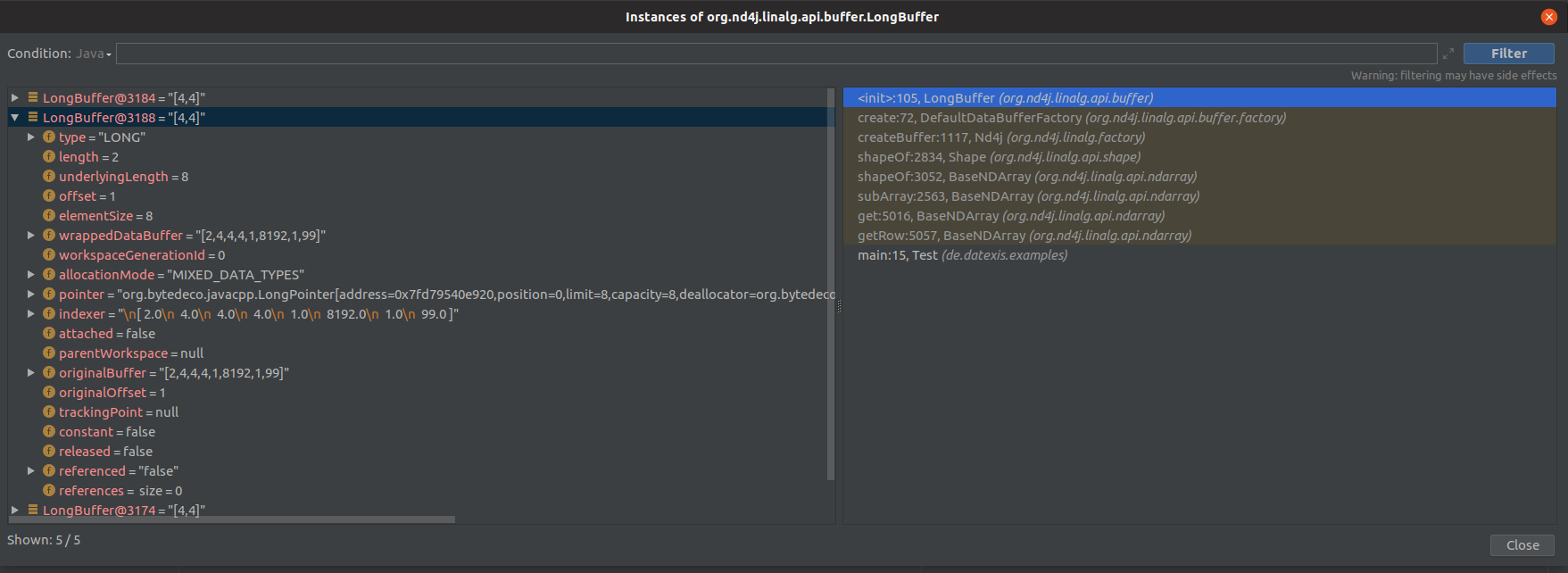
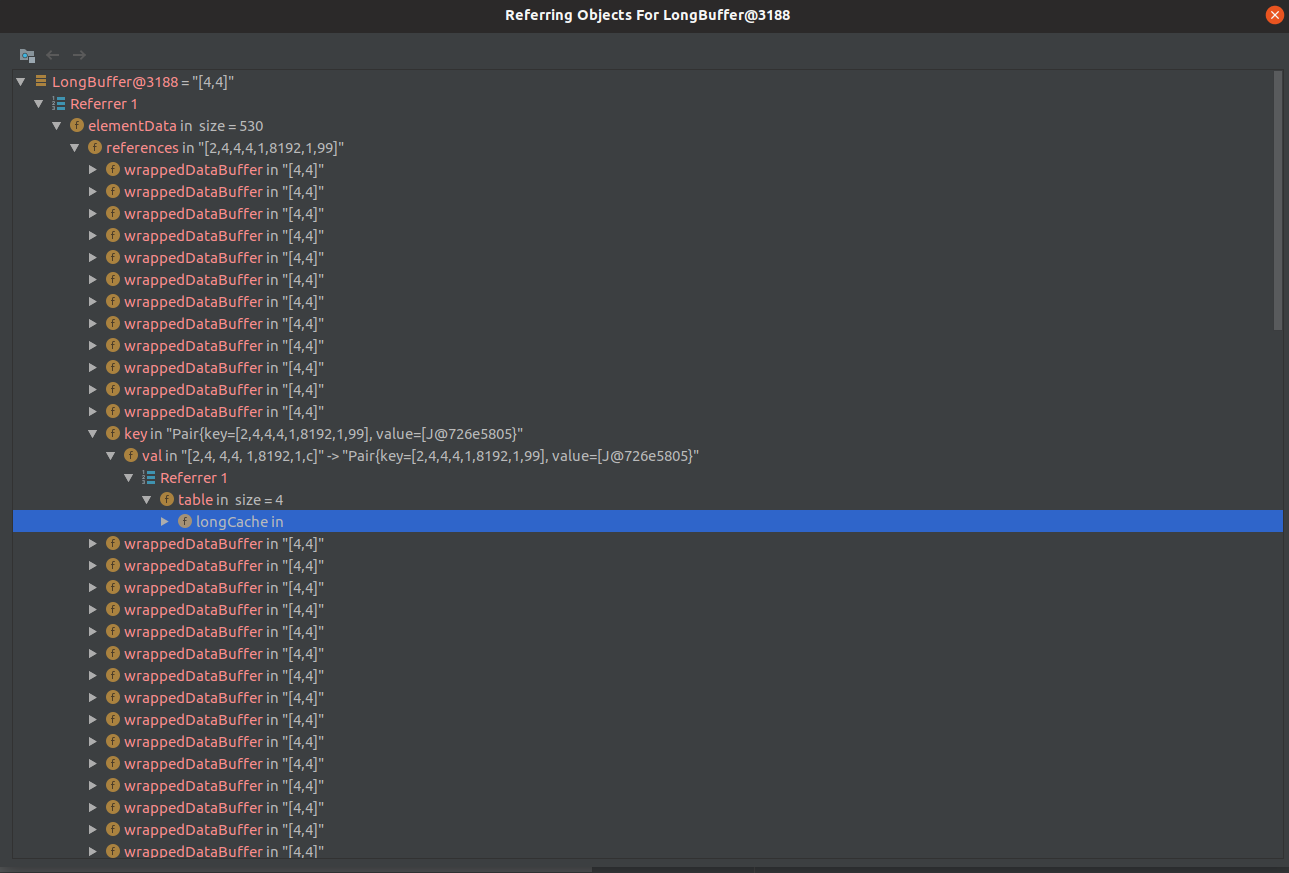
While I was investigating the problem, I noticed that it might be linked to a reference in DirectShapeInfoProvider.longCache, which seems to hold the last existing reference to the LongBuffer objects. Attached you find screenshots showing the reference chain as well as the stack trace of the initialitation of the LongBuffer objects.
Backend Configuration Log
16:29:34.633 [main] INFO  org.nd4j.linalg.factory.Nd4jBackend - Loaded [CpuBackend] backend
16:29:35.346 [main] INFO  org.nd4j.nativeblas.NativeOpsHolder - Number of threads used for NativeOps: 4
16:29:35.608 [main] INFO  org.nd4j.nativeblas.Nd4jBlas - Number of threads used for BLAS: 4
16:29:35.616 [main] INFO  o.n.l.a.o.e.DefaultOpExecutioner - Backend used: [CPU]; OS: [Linux]
16:29:35.617 [main] INFO  o.n.l.a.o.e.DefaultOpExecutioner - Cores: [8]; Memory: [1.8GB];
16:29:35.617 [main] INFO  o.n.l.a.o.e.DefaultOpExecutioner - Blas vendor: [MKL]
Version Information
Please indicate relevant versions, including, if relevant:
- Deeplearning4j version 1.0.0 SNAPSHOT build: nd4j-api-1.0.0-20190207.151315-14704.jar
- platform information: Ubuntu 18.10, 64 Bit, Intel I7
- ~CUDA version, if used~
- ~NVIDIA driver version, if in use~
Contributing
If I can help to figure out what's going wrong let me know.
Aha! Link: https://skymindai.aha.io/features/ND4J-57
 SchmaR
All 13 comments
Not a bug.
Shape buffers are cached, reused. And never released. And since they are very small, you have to do something VERY unusual to make a problem out of that.
 raver119
on 7 Feb 2019
raver119
on 7 Feb 2019
So, please tell us what you're doing there in order to help you.
raver119
on 7 Feb 2019
Or, you mean that cache is broken somehow?
raver119
on 7 Feb 2019
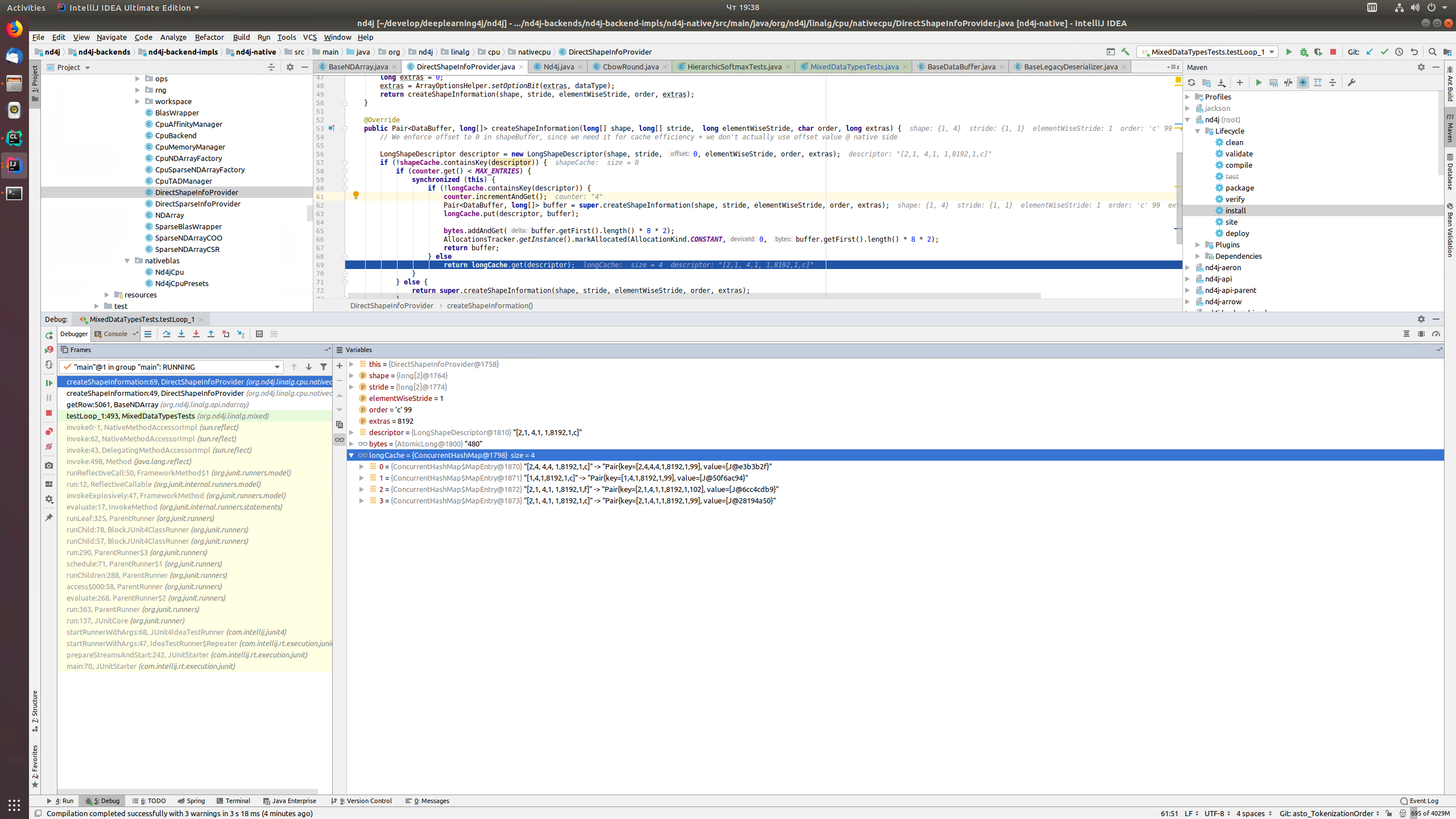
No, i've checked with debugger - after 100k iterations there's only 4 shapes in cache, and they are perfectly reused.
raver119
on 7 Feb 2019
raver119
on 7 Feb 2019
Hmm, if I run the code in the gist on my machine I end up with a large amount of LongBuffers which are consuming all of my heap memory. I don't face the behavior on beta3 but in the current snapshot.
Is there any information I could provide which could help to figure out what's going wrong?
SchmaR
on 7 Feb 2019
Where exactly you see those LongBuffers?
raver119
on 7 Feb 2019
If I either use Visual JVM or the Memory profiling view in IntelliJ. According to Visual JVM the buffers are consuming the most of my memory. If I trigger a garbage collection step in Visual JVM none of the LongBuffers are cleaned up. (in the snapshot build) If I do the same on beta3 the LongBuffers get discarded and I don't run out of heap memory while iterating over indArray.getRow(i % 3).
SchmaR
on 7 Feb 2019
Obviously, i'm using snapshots too, and i can't reproduce behavior you're describing. Maybe you're running some different code?
raver119
on 7 Feb 2019
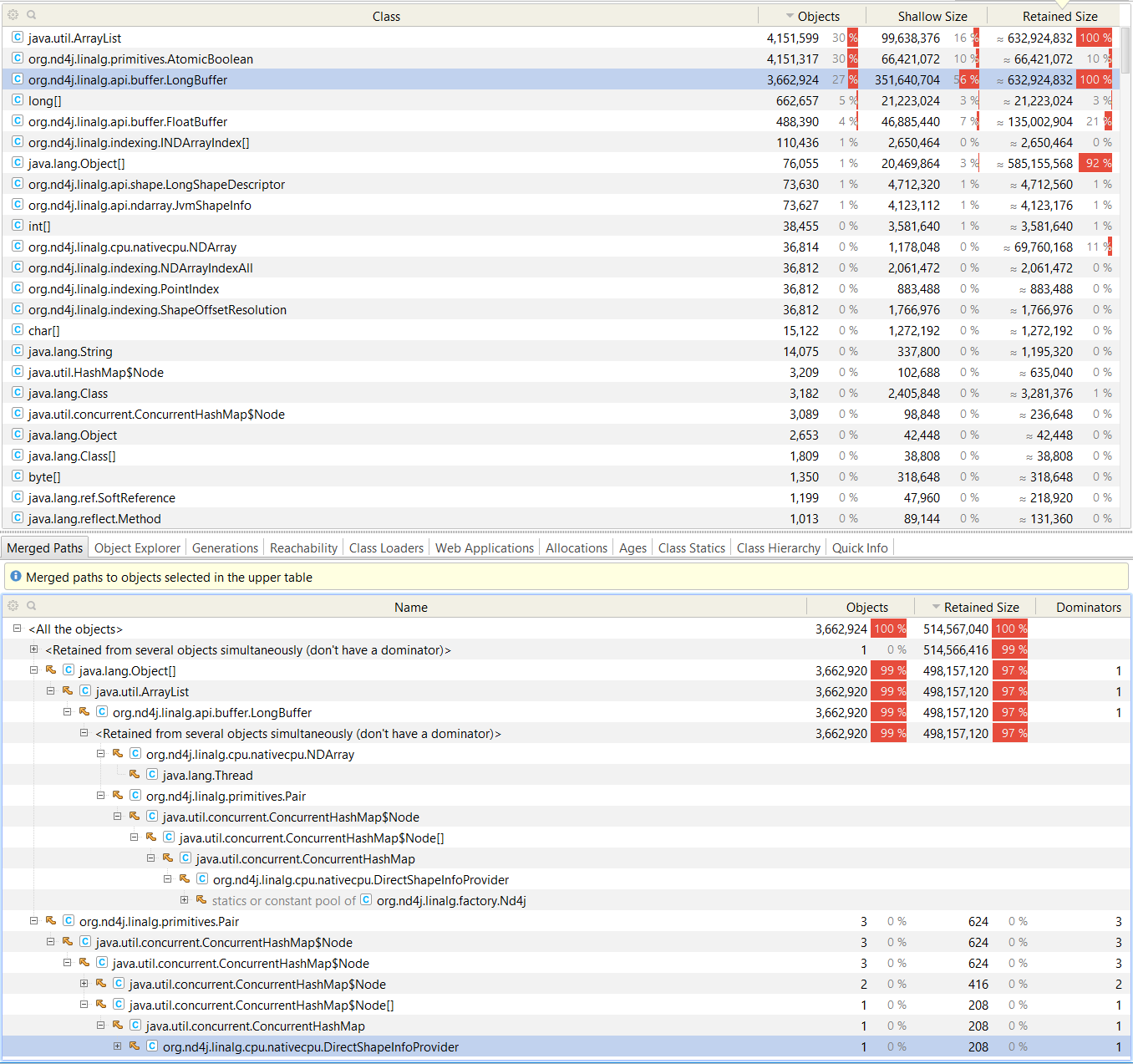
This is what I'm seeing (Snapshots, master, windows 10, native):
https://gist.github.com/AlexDBlack/83041fa0511954f97cd85e9a6544f6cb
---
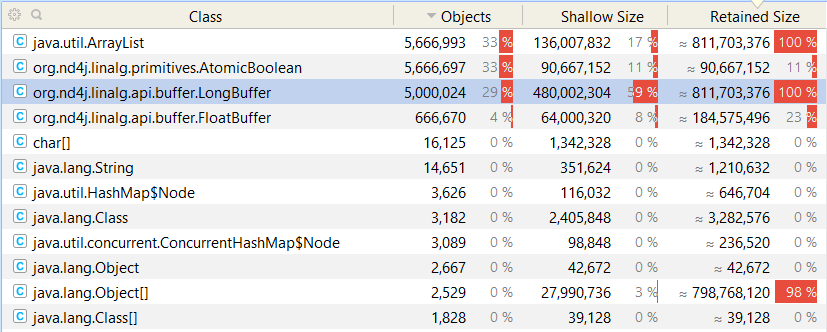
Here's the same thing slightly modified to add GC. The memory snapshot was collected after "DONE GC" was printed in the code.
https://gist.github.com/AlexDBlack/db9b37bd041628f6c32b4acb64c7a1b2
 AlexDBlack
on 8 Feb 2019
AlexDBlack
on 8 Feb 2019
Hmmm.... wrappedBuffer abused somewhere?
raver119
on 8 Feb 2019
Hi,
I've further investigated this issue.
Every call of Shape.shapeOf() results in a new LongBuffer. (NDArrayIndex.java:329, NDArrayIndex.java:300, BaseNDArray.java:3070) Let's name it "Shape LongBuffer". The (underlying) DataBuffer of the INDArray which calls it holds a reference to this new "Shape LongBuffer". The "underlying DataBuffer" is the result of INDArray.shapeInfoDataBuffer() of the original INDArray on which we call getRow(). (ShapeOffsetResolution.java:365) This "underlying LongBuffer" is referenced by the "Shape LongBuffer" as wrappedBuffer. (BaseDataBuffer.java:176) I assume that, because of these cyclic references, the garbage collection can't remove the no longer needed local instances. This holds even if INDArray.close() is called and null is assigned to the INDArray variable. This reference cycle seems to be not cleaned up at any point.
Before the creation of the Shape "LongBuffer" it is not checked if already a suitable Buffer exists. There are a lot of equal objects (DataBuffer references seem to be all equal screenshot) with different System.identityHashCode (DataBuffer references System.identityHashCode screenshot ) building up.
Here is a visualization of the cyclic references dataBufferReferences.png
I've tested this using the following code based on @AlexDBlack code. (Gist MemoryLeakTest.java)
I've further investigated the matter and isolated a call of Shape.shapeOf() (Gist MemoryLeakShapeTest.java)
After Garbage Collection I end up with the following memory consumption:
DONE GC
Max memory:7090
total memory:1365
free memory:684
used memory:680
Do you see a workaround or a way to fix this issue properly?
Stack Traces for MemoryLeakTest.java
A call of INDArray.getRow results in the following stack traces that can be categorized in Shape Information Views and Data Views. I track every call to BaseDataBuffer(DataBuffer underlyingBuffer, long length, long offset) because its the only point I'm are aware of which adds new elements to either INDArray.data.references or INDArray.shapeInformation.references.
Shape Information Views
At first this stack is generated:
<init>:162, BaseDataBuffer (org.nd4j.linalg.api.buffer)
<init>:105, LongBuffer (org.nd4j.linalg.api.buffer)
create:72, DefaultDataBufferFactory (org.nd4j.linalg.api.buffer.factory)
createBuffer:1122, Nd4j (org.nd4j.linalg.factory)
shapeOf:2834, Shape (org.nd4j.linalg.api.shape)
resolve:329, NDArrayIndex (org.nd4j.linalg.indexing)
get:4993, BaseNDArray (org.nd4j.linalg.api.ndarray)
getRow:5076, BaseNDArray (org.nd4j.linalg.api.ndarray)
main:19, MemoryLeakTest (org.nd4j)
<init>:162, BaseDataBuffer (org.nd4j.linalg.api.buffer)
<init>:105, LongBuffer (org.nd4j.linalg.api.buffer)
create:72, DefaultDataBufferFactory (org.nd4j.linalg.api.buffer.factory)
createBuffer:1122, Nd4j (org.nd4j.linalg.factory)
shapeOf:2834, Shape (org.nd4j.linalg.api.shape)
isRowVectorShape:1594, Shape (org.nd4j.linalg.api.shape)
resolve:336, NDArrayIndex (org.nd4j.linalg.indexing)
get:4993, BaseNDArray (org.nd4j.linalg.api.ndarray)
getRow:5076, BaseNDArray (org.nd4j.linalg.api.ndarray)
main:19, MemoryLeakTest (org.nd4j)
Secondly this one:
<init>:162, BaseDataBuffer (org.nd4j.linalg.api.buffer)
<init>:105, LongBuffer (org.nd4j.linalg.api.buffer)
create:72, DefaultDataBufferFactory (org.nd4j.linalg.api.buffer.factory)
createBuffer:1122, Nd4j (org.nd4j.linalg.factory)
shapeOf:2834, Shape (org.nd4j.linalg.api.shape)
resolve:329, NDArrayIndex (org.nd4j.linalg.indexing)
exec:365, ShapeOffsetResolution (org.nd4j.linalg.indexing)
get:4995, BaseNDArray (org.nd4j.linalg.api.ndarray)
getRow:5076, BaseNDArray (org.nd4j.linalg.api.ndarray)
main:19, MemoryLeakTest (org.nd4j)
Third:
<init>:162, BaseDataBuffer (org.nd4j.linalg.api.buffer)
<init>:105, LongBuffer (org.nd4j.linalg.api.buffer)
create:72, DefaultDataBufferFactory (org.nd4j.linalg.api.buffer.factory)
createBuffer:1122, Nd4j (org.nd4j.linalg.factory)
shapeOf:2834, Shape (org.nd4j.linalg.api.shape)
isRowVectorShape:1594, Shape (org.nd4j.linalg.api.shape)
resolve:336, NDArrayIndex (org.nd4j.linalg.indexing)
exec:365, ShapeOffsetResolution (org.nd4j.linalg.indexing)
get:4995, BaseNDArray (org.nd4j.linalg.api.ndarray)
getRow:5076, BaseNDArray (org.nd4j.linalg.api.ndarray)
main:19, MemoryLeakTest (org.nd4j)
Fourth
<init>:162, BaseDataBuffer (org.nd4j.linalg.api.buffer)
<init>:105, LongBuffer (org.nd4j.linalg.api.buffer)
create:72, DefaultDataBufferFactory (org.nd4j.linalg.api.buffer.factory)
createBuffer:1122, Nd4j (org.nd4j.linalg.factory)
shapeOf:2834, Shape (org.nd4j.linalg.api.shape)
shapeOf:3070, BaseNDArray (org.nd4j.linalg.api.ndarray)
subArray:2579, BaseNDArray (org.nd4j.linalg.api.ndarray)
get:5035, BaseNDArray (org.nd4j.linalg.api.ndarray)
getRow:5076, BaseNDArray (org.nd4j.linalg.api.ndarray)
main:19, MemoryLeakTest (org.nd4j)
Data Views
<init>:162, BaseDataBuffer (org.nd4j.linalg.api.buffer)
<init>:79, FloatBuffer (org.nd4j.linalg.api.buffer)
create:67, DefaultDataBufferFactory (org.nd4j.linalg.api.buffer.factory)
createBuffer:1122, Nd4j (org.nd4j.linalg.factory)
<init>:192, BaseNDArray (org.nd4j.linalg.api.ndarray)
<init>:80, NDArray (org.nd4j.linalg.cpu.nativecpu)
create:390, CpuNDArrayFactory (org.nd4j.linalg.cpu.nativecpu)
create:4375, Nd4j (org.nd4j.linalg.factory)
create:2172, BaseNDArray (org.nd4j.linalg.api.ndarray)
subArray:2589, BaseNDArray (org.nd4j.linalg.api.ndarray)
get:5035, BaseNDArray (org.nd4j.linalg.api.ndarray)
getRow:5076, BaseNDArray (org.nd4j.linalg.api.ndarray)
main:19, MemoryLeakTest (org.nd4j)
This thread has been automatically locked since there has not been any recent activity after it was closed. Please open a new issue for related bugs.
![lock[bot] picture](https://avatars1.githubusercontent.com/in/6672?v=4&s=40) lock[bot]
on 1 May 2019
lock[bot]
on 1 May 2019
Related issues
 Vigasto
·
3Comments
Vigasto
·
3Comments
 tintinxue1
·
5Comments
tintinxue1
·
5Comments
 zhangy10
·
3Comments
AlexDBlack
·
4Comments
AlexDBlack
·
4Comments
zhangy10
·
3Comments
AlexDBlack
·
4Comments
AlexDBlack
·
4Comments
Most helpful comment
Hi,
I've further investigated this issue.
Every call of Shape.shapeOf() results in a new LongBuffer. (NDArrayIndex.java:329, NDArrayIndex.java:300, BaseNDArray.java:3070) Let's name it "Shape LongBuffer". The (underlying) DataBuffer of the INDArray which calls it holds a reference to this new "Shape LongBuffer". The "underlying DataBuffer" is the result of INDArray.shapeInfoDataBuffer() of the original INDArray on which we call getRow(). (ShapeOffsetResolution.java:365) This "underlying LongBuffer" is referenced by the "Shape LongBuffer" as wrappedBuffer. (BaseDataBuffer.java:176) I assume that, because of these cyclic references, the garbage collection can't remove the no longer needed local instances. This holds even if INDArray.close() is called and null is assigned to the INDArray variable. This reference cycle seems to be not cleaned up at any point.
Before the creation of the Shape "LongBuffer" it is not checked if already a suitable Buffer exists. There are a lot of equal objects (DataBuffer references seem to be all equal screenshot) with different
System.identityHashCode(DataBuffer references System.identityHashCode screenshot ) building up.Here is a visualization of the cyclic references dataBufferReferences.png
I've tested this using the following code based on @AlexDBlack code. (Gist MemoryLeakTest.java)
I've further investigated the matter and isolated a call of
Shape.shapeOf()(Gist MemoryLeakShapeTest.java)After Garbage Collection I end up with the following memory consumption:
Do you see a workaround or a way to fix this issue properly?
Stack Traces for MemoryLeakTest.java
A call of INDArray.getRow results in the following stack traces that can be categorized in Shape Information Views and Data Views. I track every call to
BaseDataBuffer(DataBuffer underlyingBuffer, long length, long offset)because its the only point I'm are aware of which adds new elements to eitherINDArray.data.referencesorINDArray.shapeInformation.references.Shape Information Views
At first this stack is generated:
Secondly this one:
Third:
Fourth
Data Views