Cudatext: Using CudaText in hex viewer mode produces screen artifacts after closing the program
Steps to reproduce
- Right click an _exe_ file and choose _Open with CudaText_ from context menu. Alternatively you can also drag'n drop the icon of an _exe_ file to the _CudaText_ desktop icon or to the window of a running _CudaText_ instance.
- In the selection dialog popping up choose _Viewer - hex mode_.
- After the program has started respectively the file has been loaded, close it using window close box in upper right corner.
- Artifacts appear in an area left and top of the former _CudaText_ window.
This is how it looks on my machine. Please note: I use the _Zeus_ theme, therefore the artifacts have the color of that theme's default background color.
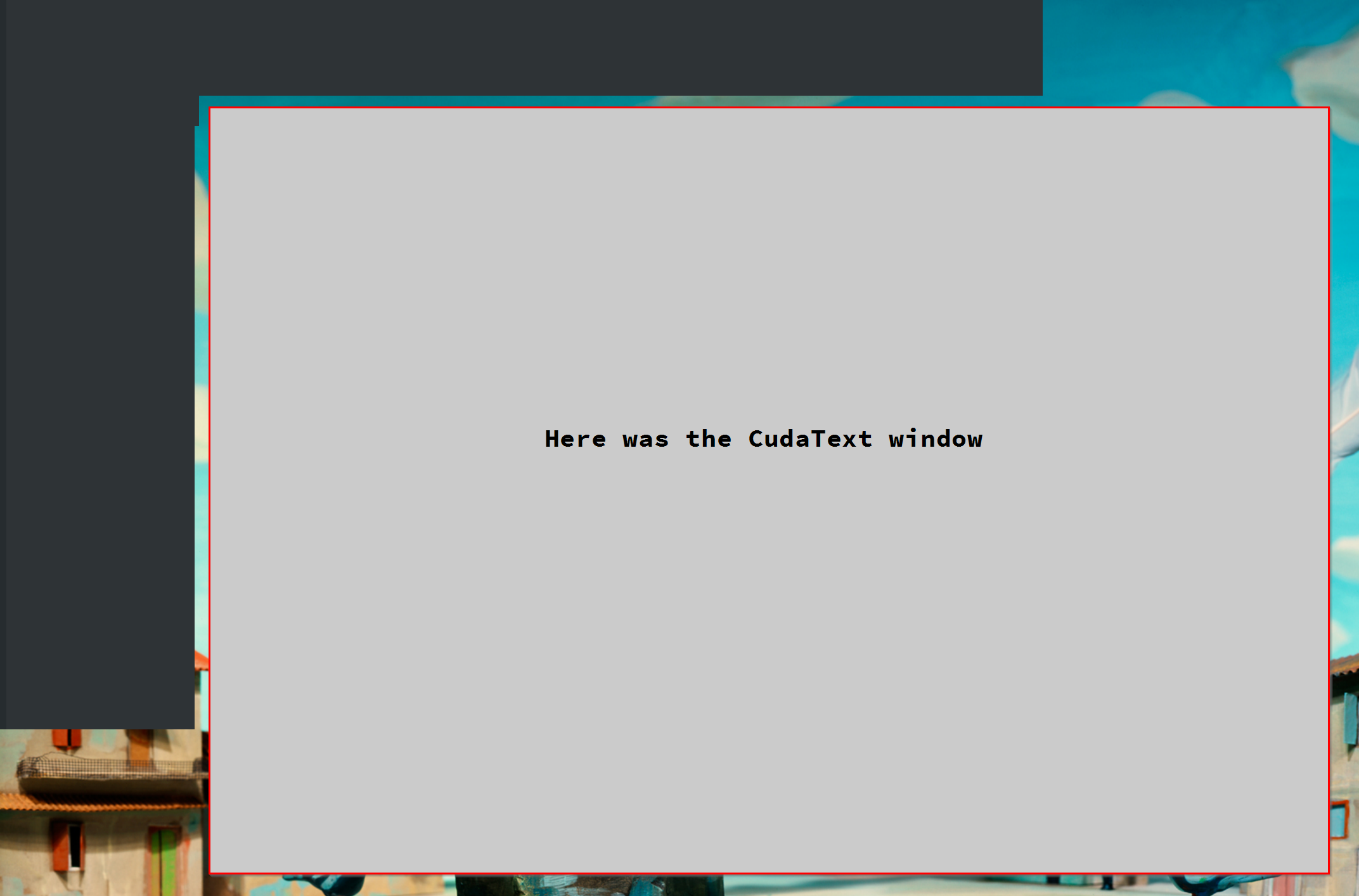
The artifacts do not disappear until the affected screen region is redrawn, for example by maximizing an _Explorer_ window.
Tested on Windows 7 x64 and Windows 10 x64 with _CudaText_ v1.98.0. But this is an old bug, I've noticed it in much older versions as well.
 dinkumoil
All 12 comments
This issue also exists with the other viewer modes:
- _Viewer - text mode_
- _Viewer - binary mode_
- _Viewer - unicode mode_
dinkumoil
on 28 Apr 2020
I see such artifact. top left corner. it's very strange, Cud cannot paint on desktop area.
 Alexey-T
on 28 Apr 2020
Alexey-T
on 28 Apr 2020
seems my Lazarus build is broken. on Linux i see new floating point error bug. :( I don't know. revert Lazarus build?
Alexey-T
on 28 Apr 2020
FYI: The artifacts have the same width and height as the document output area of the former _CudaText_ window.
Maybe the text output control you use (is it _ATSynEdit_?) tries to redraw itself after the main _CudaText_ window has been closed. The artifacts always appear at screen origin (0, 0).
I saw this bug as well in the first version of _CudaText_ I have used, could be 1.8x.x or even 1.7x.x, I'm not sure. Thus I guess it's not an issue with a recently broken Lazarus build.
dinkumoil
on 28 Apr 2020
thanks for your help. now I see it's valid bug. found the reason (ATBinhex.Destroy).
Alexey-T
on 28 Apr 2020
@dinkumoil I want to write small help topic to wiki, "Perfomance of file loading", ".. saving". need to make some tests. with n editor programs. on huge log files (eg 100-300Mb logs). without lexer/syntax. how many seconds Cud loads, saves file - vs other editors. maybe you can help?
then I want the topic "Perfomance of editing huge lines"- i tested it. only on Linux.
Alexey-T
on 28 Apr 2020
What do you think what I could do helping with this topic? Doing the tests?
There are many text editors out there and I don't know much of them. For doing the tests I need a list of editors to test (including download links from sites that are likely to be secure and malware free, preferably the project's site) and an exact description what and how to test.
To protect my machine (which I use also for my daily job) from catching malware with the downloaded editors, I would create an HD image before testing to be able to return to the system's state before the tests. Thus I would like to do the testings all at once to avoid multiple system restores. This would be possible at the next weekend because 1st of May is a holiday in Germany and I would have extra time.
dinkumoil
on 28 Apr 2020
Okay, now I see it's not simple task. sorry.
what is good for CudaText - maybe you can help?
repo https://github.com/sublimehq/Packages/issues has many issues with Sublime lexers. open + closed issues. i have looked at 20-40 of them and repeated 4 bugs in Cud lexers. so we need all these bugs in Cud lexers. one bug- one Cud github issue
Alexey-T
on 28 Apr 2020
1 May is holiday in Russia too, of course. don't ask me what is _main holiday in Russia.
Alexey-T
on 28 Apr 2020
Lexer testing needs at least some knowledge of the lexer's language.
The following languages I know more or less:
- Pascal
- C
- SQL (limited)
- VBScript
- Windows batch script (but I think it is nearly impossible to make a perfect lexer for that because of its quirky syntax)
Based on the languages above I can deal with source code of similar languages and things like XML and JSON.
But the biggest challenge for testing lexers is finding source code that contains a broad spectrum of its language's features to be able to find bugs. To find suitable source code you need some knowledge of the language. Can you help with that?
dinkumoil
on 28 Apr 2020
I mean you can read SublimeHQ github issues, they have sample code of lexer bugs.
Alexey-T
on 28 Apr 2020
OK, I can do that. And I read some already, but often I even did not understand the problem, so do not await too much.
dinkumoil
on 28 Apr 2020
Related issues
Alexey-T
·
5Comments
 JairoMartinezA
·
5Comments
Alexey-T
·
3Comments
JairoMartinezA
·
5Comments
Alexey-T
·
3Comments
 jczanfona
·
5Comments
jczanfona
·
5Comments
 xcme
·
5Comments
xcme
·
5Comments