Chart.js does not import as es6 module
The instructions on http://www.chartjs.org/docs/latest/getting-started/integration.html show chart.js being imported as an es6 module:
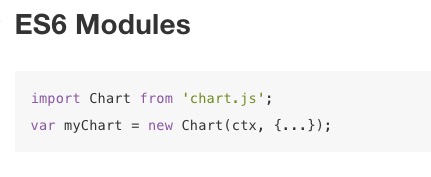
When I use this import statement within a module using chrome latest, it fails:
import Chart from 'https://cdnjs.cloudflare.com/ajax/libs/Chart.js/2.7.1/Chart.js'
The error is:
Uncaught SyntaxError: The requested module does not provide an export named 'default'
Expected Behavior
I think this is a bug, the docs say it should work. However, looking at the code, I see no es6 export.
Current Behavior
It fails with the above error.
Possible Solution
You might try converting to an es6 build using rollup for all conversions to other modules.
https://medium.com/@backspaces/es6-modules-part-1-migration-strategy-a48de0b7f112
Steps to Reproduce (for bugs)
- Within a browser supporting modules, create a
<script type="module"> - Inside that, import Chart.
- The error will occur.
<html>
<head>
  <title>test</title>
</head>
<body>
  <script type="module">
    import Chart from 'https://cdnjs.cloudflare.com/ajax/libs/Chart.js/2.7.1/Chart.js'

    console.log(Chart)
  </script>
</body>
</html>
Context
I am using chart.js to visualize results of agent based models. The repos are:
Environment
- Chart.js version: latest .. 2.7.1
- Browser name and version: chrome 63.0.3239.132
- Link to your project: Above.
 backspaces
All 46 comments
@simonbrunel any thoughts? I know this got tested at one point
 etimberg
on 24 Jan 2018
etimberg
on 24 Jan 2018
We currently use browserify to generate UMD but we didn't upgrade for a long time so maybe there is an easy fix that doesn't break any integration?
I don't know from where this documentation about ES6 import compatibility comes from but are UMD builds compatible with es6 import since it doesn't provide a default export? For example, UMD generated by rollup: I'm not sure it works because there is no default export. That might be an extra step / option to enable es6 import support?
(function (global, factory) {
    typeof exports === 'object' && typeof module !== 'undefined' ? module.exports = factory() :
    typeof define === 'function' && define.amd ? define([], factory) :
    (global['Chart'] = factory());
}(this, (function () {
  // ...
  return Chart;
})
4478 is about migrating to rollup but this might not happen until v3 because it could break node.js integrations.
 simonbrunel
on 24 Jan 2018
simonbrunel
on 24 Jan 2018
The huge advantage of converting the code to es6 modules is that then, using rollup and possibly babel (for es5) is that you can then convert to every format. It should not impact your node compatibility because rollup easily converts to commonJS.
It also lets you rollup subsets of your project, which support fewer chart types.
Can you say just what node problems you have?
backspaces
on 24 Jan 2018
We don't have any problem with node :) We care to not break projects that use Chart.js and I'm pretty sure some people integrated it using var Chart = require('./node_modules/chart.js/src/chart.js'), which would break if we switch to es6 exports (src/chart.js being an es6 module in that case). That's why it would need to wait until the next major version.
I agree that migrating to rollup/es6 modules is a good thing but we first need to refactor/clean our way to use modules and that's what we started with #4478 (we already use rollup in other projects such as chartjs-plugin-datalabels and chartjs-plugin-deferred).
Though, I'm not sure UMD builds can be imported via es6 import? That means your way to include Chart.js from our UMD build (https://cdnjs.cloudflare.com/ajax/libs/Chart.js/2.7.1/Chart.js) may not work, even with rollup and a code initially based on es6 modules.
simonbrunel
on 24 Jan 2018
I hear ya! One solution Three.js used was to keep the old names the same, and using an es6 rollup called three.module.js. The older three.js name was kept for the older code.
The source itself obviously changed quite a bit but they did not make the source part of the dist/.
So you could do likewise: convert to es6 source files, rollup to a cjs bundle named chart.js.
OTOH, waiting for the 3.0 build makes sense in terms of project management.
I think I can convert chart.js to modules using this stunt:
https://medium.com/@backspaces/es6-modules-part-2-libs-wrap-em-up-8715e116d690
so no worries.
backspaces
on 25 Jan 2018
But lets change the docs, others will make the same mistake I did.
backspaces
on 25 Jan 2018
This was added to the docs in:
https://github.com/chartjs/Chart.js/commit/eb2b04a9ffdd19c0a406cbb7d99e14c05ac39b7e
And then updated in:
https://github.com/chartjs/Chart.js/commit/696f8d3a391ca8db6cbd1a1291cf8f3170fc0f1c
I wonder if something was done to break it at some point
 benmccann
on 10 Jun 2018
benmccann
on 10 Jun 2018
I now seriously need plotting for a project I'm involved in .. and we're es6 module based.
Our code is vanilla JS es6 w/ import/export. Our very simple workflow uses rollup to create two bundles: es5/UMD and es6/ESM. We use unpkg to serve both formats:
- dashboard: https://unpkg.com/@redfish/agentscript/
- UMD: https://unpkg.com/@redfish/agentscript
- ESM: https://unpkg.com/@redfish/agentscript?module
The latter uses the module: property in package.json.
Could you think about creating such a dual-release? I see that you use "require", thus browserify. I know very little about that tooling, but I bet you can find tools that can create ESM from this.
If you look at d3, you'll see they create bundles for both that work well on unpkg.com.
Admittedly you may prefer to simply convert your source to es6 modules, and then bundle to a UMD compatible with your existing chart.js (which works in both the browser and node) and an ESM that is fine for es6 oriented repos. You'll be surprised how much easier it is to start with your core as ESM and convert to any format you'd like.
backspaces
on 23 Jun 2018
@backspaces I think the issue might be that you're using Chart.js 2.7.1 and looking at the docs for Chart.js 2.7.2. Can you try upgrading to Chart.js 2.7.2?
I have a vue.js + webpack app that's using Chart.js via ES6 import as described in the docs and it's working for me:
import Chart from 'chart.js';
var chart = new Chart(ctx, cfg);
Hi, thanks for the reply.
Here's the problm: Your import above is not the es6 module syntax which needs a "path" like ./chart.js. Your workflow is making adjustments to your code, I think. Webpack likely is doing it.
I tried changing the html in the OP to 2.7.2 and still receive the error.
import Chart from 'https://cdnjs.cloudflare.com/ajax/libs/Chart.js/2.7.2/Chart.js'
.. gives:
Uncaught SyntaxError: The requested module 'https://cdnjs.cloudflare.com/ajax/libs/Chart.js/2.7.2/Chart.js' does not provide an export named 'default'
And looking at the code, it does not appear to have any es6 export.
Using unpkg to view the repo, https://unpkg.com/[email protected]/ (dashboard view)
.. I could not find a module: field in package.json, nor an es6 export in the code.
And using the https://unpkg.com/[email protected]?module syntax gets an error.
Asking on Stackoverflow, I did get an interesting response tho: using a "bare" import worked!
import 'https://cdnjs.cloudflare.com/ajax/libs/Chart.js/2.7.2/Chart.bundle.min.js'
There's a working example: https://stackoverflow.com/questions/48410525/how-do-i-import-chartjs-as-an-es6-module
I have no idea how that works! It ends up working like a script tag, putting Chart in window. I only tried chrome.
backspaces
on 13 Jul 2018
The difference could also be that I'm using NPM and you're importing a pre-built script. It'd be really interesting to try NPM without webpack to understand whether webpack is involved.
@Jareechang do you have thoughts here? (asking because you documented and might have some insight into how this works)
benmccann
on 13 Jul 2018
hey @benmccann, my changes were related to #3788 as it was breaking the import. Unfortunately, I do not have much insights into how this works 😞. I did also use webpack when I was testing it.
However, It does sound like es6 is not supported atm as @simonbrunel has mentioned that the UMD builds do not provide a default.
 Jareechang
on 13 Jul 2018
Jareechang
on 13 Jul 2018
Just a note: You can't create a single file that is both
@benmccann You closed the issue but it seems not fixed. Version 2.7.2 is not providing an ESM version of the library. The original issue is not related to using Webpack only or not. Some packaging methods, such as Polymer 3 apps with polymer-cli handle all build steps and you have no control over them (this is my use case). In that case, you need an ESM version of the library you want to import to get bundles generated and optimized.
I just noticed you tag this issue for milestone _Version 2.8_. Are you going to provide ESM flavors with NPM packages starting with version 2.8.x?
 lpellegr
on 29 Jul 2018
lpellegr
on 29 Jul 2018
We updated the docs, which were incorrect, to clarify that chart.js does not yet have es6 support. I don't think that es6 support will be added until 3.0
benmccann
on 29 Jul 2018
When will 3.0 be released? Is there a beta I could try?
backspaces
on 8 Aug 2018
There are no plans to start working on 3.0 at the moment
benmccann
on 8 Aug 2018
Just a quick update: I believe a simple rollup, along with a commonJS plugin, produces a usable es6 module. The Rollup looks like:
import commonjs from 'rollup-plugin-commonjs'
import nodeResolve from 'rollup-plugin-node-resolve'
export default {
    input: './node_modules/chart.js/dist/Chart.js',
    output: {
        file: 'chart.esm.js',
        format: 'esm',
    },
    plugins: [
        nodeResolve(),
        commonjs(),
    ],
}
This is built using the chart.js npm install. You'll also have to node install rollup-plugin-commonjs and rollup-plugin-node-resolve
I don't have a test env for this but here's the output: http://backspaces.net/temp/chart.esm.js
I've built a trivial script to make sure the browser imports it correctly (yes browsers do this!):
<script type="module">
    import chart from './chart.esm.js' // default export
    console.log(chart)
</script>
If anyone uses this and it works, let us know. We also could just add to the projects workflow if it is considered useful.
Here's the SO discussing this: https://stackoverflow.com/questions/52068933/can-rollup-plugins-convert-the-majority-of-legacy-libraries-to-es6-modules/52076713#52076713
backspaces
on 1 Sep 2018
@backspaces I just made a try and it works perfectly. It would be really fantastic to have an official release that includes this ESM flavor.
lpellegr
on 5 Sep 2018
Yay! I'm really glad it fits into your plans.
You'll also want to include a "module:" as well as a "main:" in package.json like this:
    "main": "path/to/chart.js",
    "module": "path/to/chartesm.js",
.. so that unpkg .. and others soon .. can get both the umd & esm:
https://unpkg.com/chart.js
https://unpkg.com/chart.js?module
Oops .. you're using it to turn chart.js into a module which is naturally the idea. But the chart.js team could also use it to save us the bother and in that case the package.js fu is a Good Thing!
backspaces
on 5 Sep 2018
I have forked the repository, and applied what @backspaces explained.
The changes are small and non-breaking:
https://github.com/noticeableapp/Chart.js/commit/680f2d19b0bce76e8268ffec9d4b8f16b49bafc9
For ease of use, a package has been published on npmjs:
https://www.npmjs.com/package/@noticeable/chart.js
Usage is as simple as:
<script type="module">
    import Chart from '@noticeable/chart.js'
    console.log(Chart)
</script>
@simonbrunel @benmccann Do you think such changes could be merged if I create a PR?
From a release pipeline point of view, what is required is to run rollup -c rollup.config.js after gulp build but before npm publish.
lpellegr
on 7 Dec 2018
@lpellegr If I understand correctly, we need a separate .esm.js file to be loadable as an ES module because this can't be handled by the UMD build? Looking at your change, I don't think that rollup should generate the ESM build from our UMD build because the last one includes an additional wrapper but also because the browserify build is definitely not optimal.
We are progressively migrating our code to be modular (#4478) and I was planning to migrate all of our builds to use rollup. I'm not fan of mixing technologies (rollup + browserify) and increase dependencies, so would prefer to wait until we switch to rollup.
simonbrunel
on 7 Dec 2018
@simonbrunel Thanks for your answer and pointing the wrapper. I have adapted the rollup configuration to use the original source file:
https://github.com/noticeableapp/Chart.js/commit/466fc8087d354dd39aa127f365b5ec86003dc3a6
@lpellegr If I understand correctly, we need a separate .esm.js file to be loadable as an ES module because this can't be handled by the UMD build?
Yes, that's the idea.
We are progressively migrating our code to be modular (#4478) and I was planning to migrate all of our builds to use rollup. I'm not fan of mixing technologies (rollup + browserify) and increase dependencies, so would prefer to wait until we switch to rollup.
What is proposed is far from perfect but the migration you mention, although fantastic, is a huge work that is open since more than a year. ESM is supported by modern browsers. ESM imports are becoming a first-class solution (e.g. it's really helpful with Polymer 3, lit-html, TypeScript).
The changes initially proposed by @backspaces could work for a transition period. Since they are non-breaking, you could even release them as 2.X.0. Later, when the code is modularized and only rollup used you could simply update the reference in package.json for module and still release as 2.Y.0, if the API is not changed.
Regarding the NPM package, it seems to include doc, samples and tests. It's not the additional ESM variant of the original source code that will make a big difference in terms of size.
lpellegr
on 7 Dec 2018
In order to consider this transition period where we would mix browserify and rollup, I would like to investigate if we couldn't completely switch now to rollup without breaking changes. Here is a wip branch (rollup+esm) using rollup for all of our builds, including Chart.esm.js and Chart.esm.min.js, but also to run unit tests. It still needs lot of testing to confirm it doesn't break anything (I will need help for that) but it looks pretty good.
@backspaces @lpellegr the current setup generates the ESM builds without moment. I'm not familiar with ES modules "in the browser" and don't know how peer dependencies should be handled:
<script type="module">
    import chart from './dist/Chart.esm.js';

    // throws...
    // Uncaught TypeError: Failed to resolve module specifier "moment". Relative references must start with either "/", "./", or "../".
</script>
Any idea?
simonbrunel
on 8 Dec 2018
Moment is now natively in es6, within src/
https://github.com/moment/moment#port-to-ecmascript-6-version-2100
https://github.com/moment/moment/blob/develop/src/moment.js
The repo exports src/ and the package.json has an es6 module header, thus this works:
https://unpkg.com/moment?module
So you're close!
backspaces
on 8 Dec 2018
@backspaces I already figured out that moment was ES6 ready, my question is about your <script> snippet: how to make Chart.esm.js to consume https://unpkg.com/moment?module, the fist line of Chart.esm.js being:
import moment from 'moment';
which fail with:
Uncaught TypeError: Failed to resolve module specifier "moment". Relative references must start with either "/", "./", or "../".
We will also need to find a way to make moment (and later luxon - or whatever) optional for the ESM build.
simonbrunel
on 9 Dec 2018
The build has now been migrated to rollup: https://github.com/chartjs/Chart.js/pull/5904
benmccann
on 29 Dec 2018
Is there a reason why the main field doesn't just point to the dist directory? I don't want to install moment in my Chart.js-consuming package, so I'd rather get the transpiled product. I thought this was standard behavior.
For reference, I'm using pnpm which keeps good track of these inconsistencies: https://github.com/pnpm/pnpm/issues/1700
 wbern
on 13 Mar 2019
wbern
on 13 Mar 2019
@wbern that will be the case in the upcoming v2.8.0.
simonbrunel
on 13 Mar 2019
For the record, chart.js works with pnpm without issues, I had a small mistake in my config (in webpack, symlinks: false doesn't work well with pnpm)
wbern
on 14 Mar 2019
Per the reference to
@wbern that will be the case in the upcoming v2.8.0.
Per this update, should we expect to no longer receive the following:
Uncaught SyntaxError: The requested module './node_modules/chart.js/dist/Chart.js' does not provide an export named 'default'
when using import Chart from 'chart.js'?
We are still seeing this error, but the updates here make it seem like we shouldn't be.
Thanks!
 krumware
on 4 Apr 2019
krumware
on 4 Apr 2019
Per the reference to
@wbern that will be the case in the upcoming v2.8.0.
Per this update, should we expect to no longer receive the following:
Uncaught SyntaxError: The requested module './node_modules/chart.js/dist/Chart.js' does not provide an export named 'default'when using
import Chart from 'chart.js'?
We are still seeing this error, but the updates here make it seem like we shouldn't be.Thanks!
Same here, any updates on this?
 derhuebiii
on 17 Jun 2019
derhuebiii
on 17 Jun 2019
See my latest comment
wbern
on 17 Jun 2019
Import needs you to use a complete path: import Chart from 'chart.js'? is not one.
So try import Chart from './path/to/chart.js'
backspaces
on 19 Jun 2019
Just a quick note. This: https://github.com/chartjs/Chart.js/issues/5179#issuecomment-417889559 still works fine, and we're using it at pika/web https://github.com/pikapkg/web/issues/62 to look into automatic conversion of CJS/UMD format to es6 modules.
Here's the current rollup:
import commonjs from 'rollup-plugin-commonjs'
import resolve from 'rollup-plugin-node-resolve'

export default {
    input: 'Chart.js',
    output: {
        file: 'chart.esm.js',
        format: 'esm',
    },
    plugins: [resolve(), commonjs()],
}
The test repo has these node dependencies:
├── [email protected]
├── [email protected]
├── [email protected]
└── [email protected]
If you'd like, I can make a github repo of the experiment, but it really is trivial.
Here's a link to a pika article if you're curious.
backspaces
on 19 Jun 2019
Is there, btw, a reason this is not already in the current chart.js? Make a rollup, add a "module": property to package.json? That doesn't seem very odd.
backspaces
on 19 Jun 2019
That's really sad. More than a year and a half, suggestions provided, no breaking changes, and we still need to struggle to manage case manually. What a shame.
lpellegr
on 5 Sep 2019
I have not yet tried it on chart.js specifically, but per @backspaces' comments above, and feature requests in pika-web, you can now do package install-time conversions of commonjs modules to es-modules using pika-web. It's worth a shot.
Extra info toward the end of this thread: https://github.com/pikapkg/web/issues/62
krumware
on 5 Sep 2019
@krumware Thanks but Chart.js is now building with Rollup and adding support for ESM is just a matter of adding a few lines of codes in package.json and the Rollup configuration. Would be great to know why they are not included by default?
I ended up by forking the release branch, made the small changes mentioned above:
https://github.com/ipregistry/Chart.js/commit/b981ac18715f94253a502efeb852b0c4d6218db9
and published my own package:
lpellegr
on 5 Sep 2019
Thanks for the heads-up! great to know there are many options. Hopefully they pull your changes so we can get that esm dist out of the box if you potentially aren't able to maintain the fork long-term.
krumware
on 5 Sep 2019
If anyone wants to send a PR to improve our rollup & package.json config that'd be great as long as it's backwards compatible with all the documented methods of using Chart.js
benmccann
on 5 Sep 2019
@lpellegr I took a look at your change. It looks like your es6 version bundles moment.js. Was that a conscious decision? I think my initial inclination would have been not to include it
benmccann
on 7 Oct 2019
I hope this pull request is as requested. Due to the old age of this ticket and its lively discussion, being in contrast with the small additions needed to the rollup config, I hoped I didn't overlooked some hidden/deeper problem.
At least, I tested the new builds in a pure browser scope, as well as rollup scope (without commonjs support). Both working as expected 😃
 sebiniemann
on 27 Oct 2019
sebiniemann
on 27 Oct 2019
Related issues
 HeinPauwelyn
·
3Comments
HeinPauwelyn
·
3Comments
 JewelsJLF
·
3Comments
JewelsJLF
·
3Comments
 akashrajkn
·
3Comments
akashrajkn
·
3Comments
 kennsippell
·
3Comments
kennsippell
·
3Comments
 gabrieldesouza
·
3Comments
gabrieldesouza
·
3Comments
Most helpful comment
Per the reference to
Per this update, should we expect to no longer receive the following:
when using
import Chart from 'chart.js'?We are still seeing this error, but the updates here make it seem like we shouldn't be.
Thanks!